Need a full custom project? See the options below.
Need a full custom project? See the options below.
Work through T1, a rib-stiffened steel tubular flange with inner and outer bolt circles, in Abaqus. This workshop is for analysts studying bolt preload, contact and force transfer under eccentric tension. The paid lesson includes the Abaqus CAE database, input deck, an Abaqus result image and a PDF workshop.
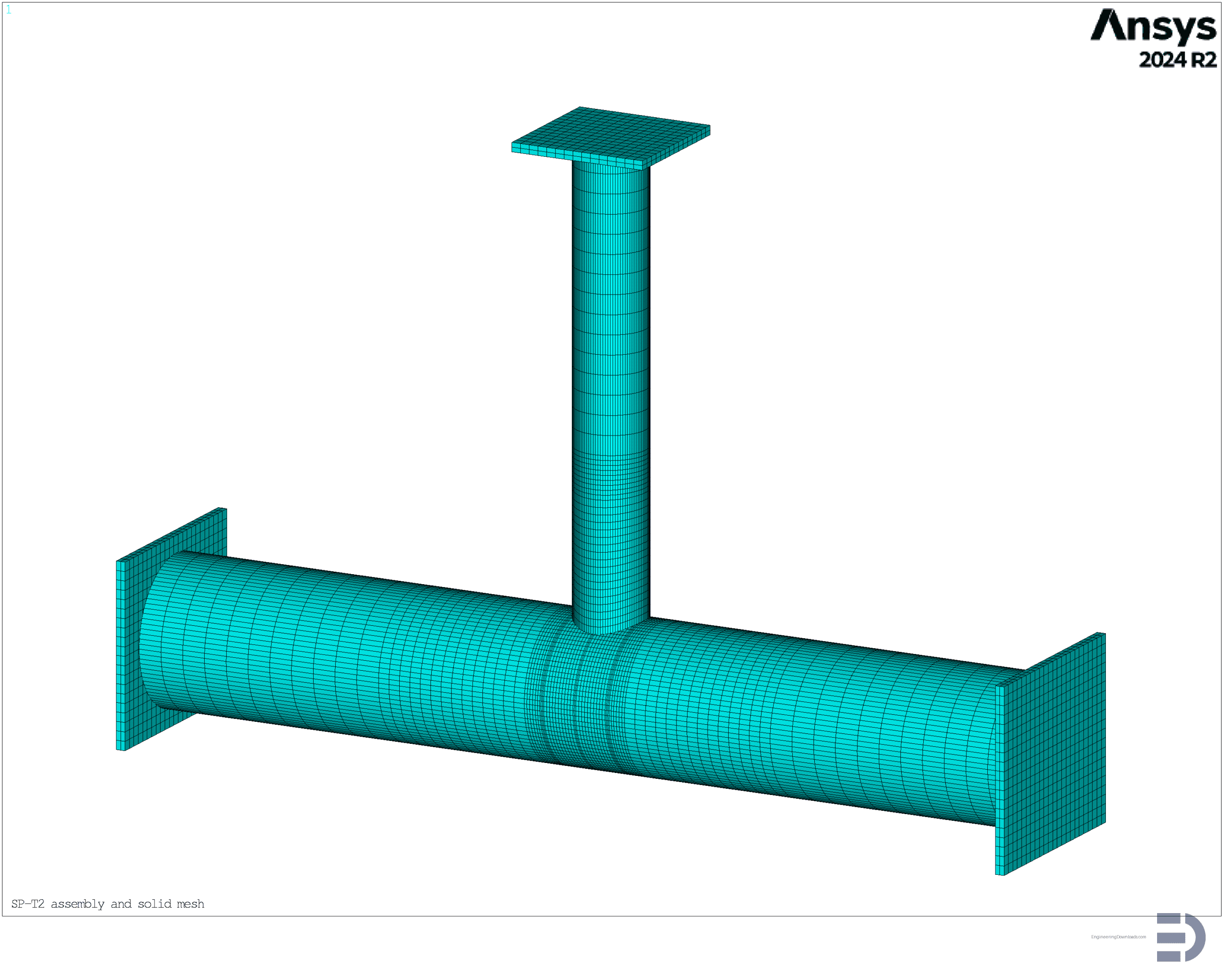
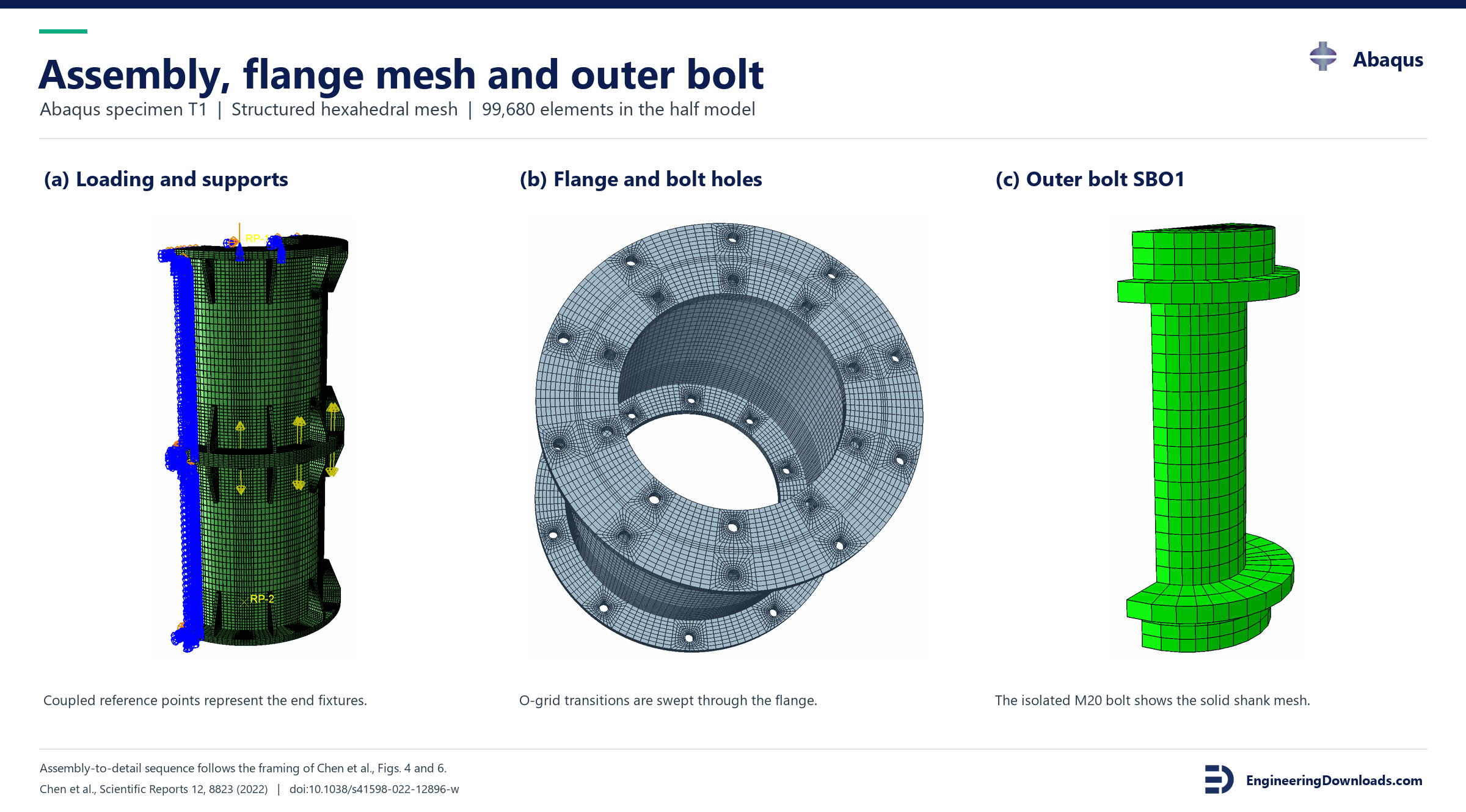
The joint has 20 M20 bolts and radial ribs. The structured hexahedral mesh uses bolt-hole O-grids and 36° flange sectors. The loading model first applies 10.053 kN pretension per full bolt, locks the achieved length, then imposes axial tension at a 29.5 mm eccentricity. The end fixtures are represented by coupled reference points.
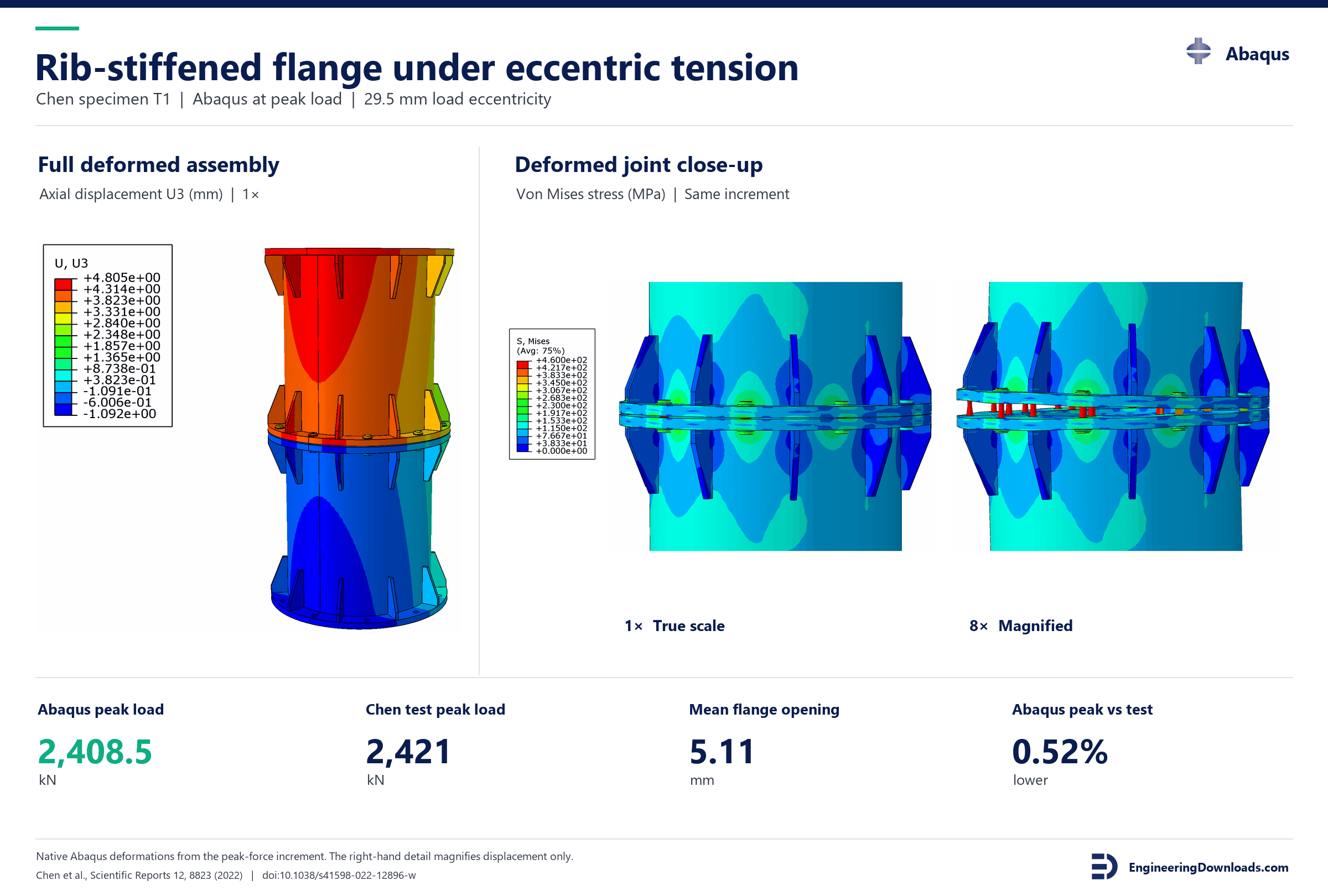
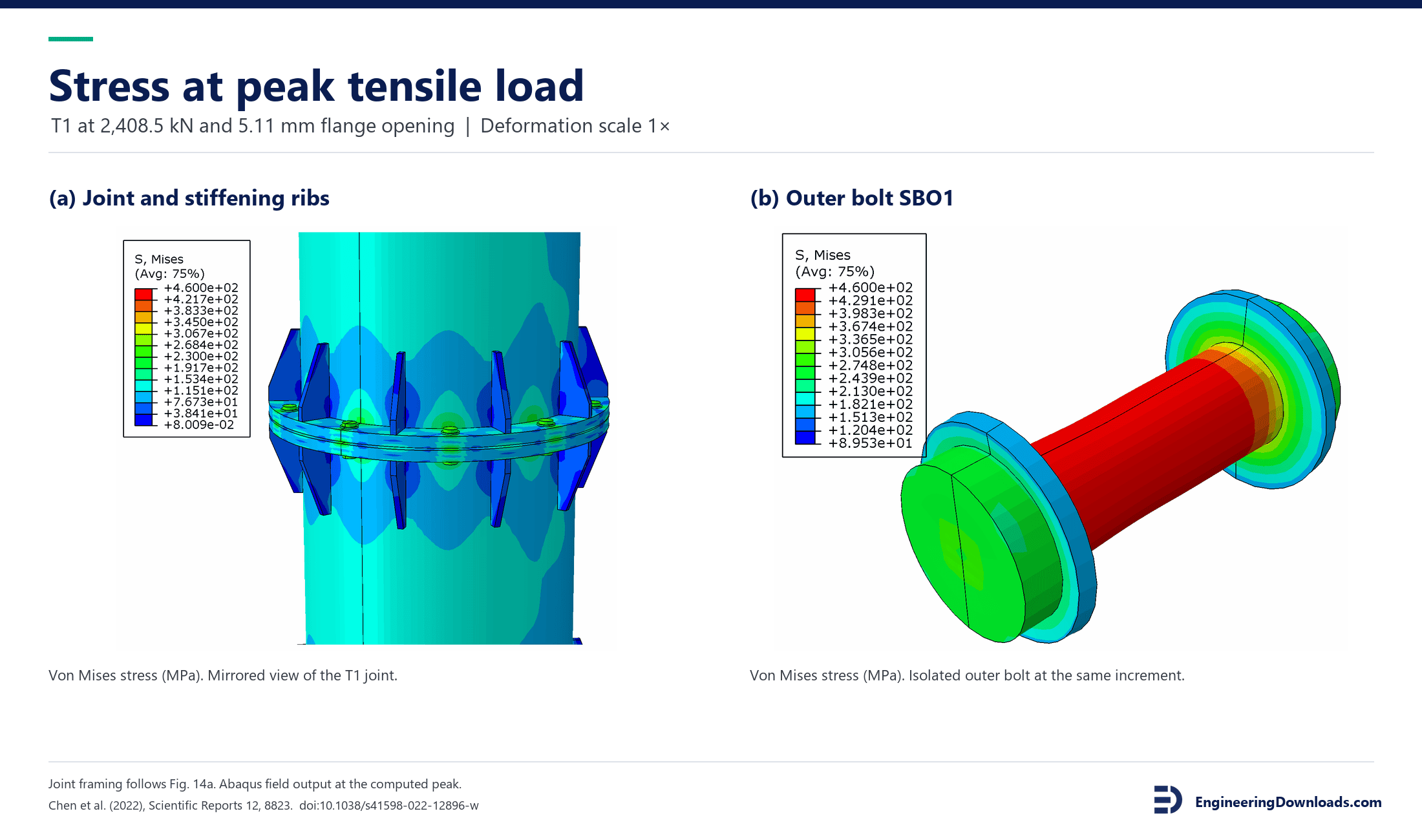
The computed peak was 2,408.5 kN, compared with 2,421 kN in Chen et al.’s experiment and 2,431 kN in their ANSYS model (Table 4). The Abaqus peak is 0.52% below the experiment. The workshop uses the peak-load comparison and examines the model’s flange opening and outer-bolt force histories.
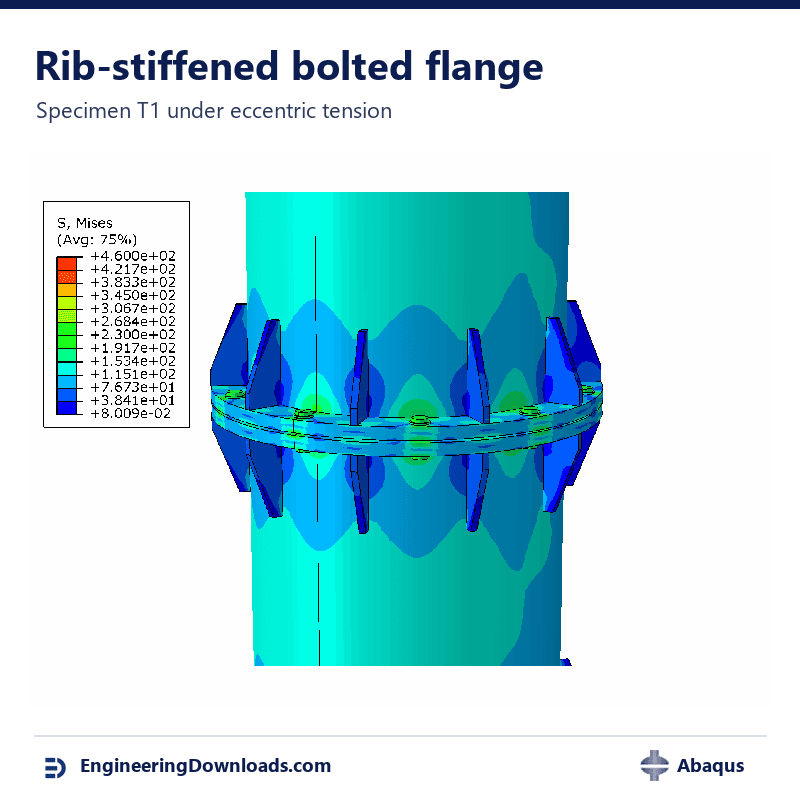
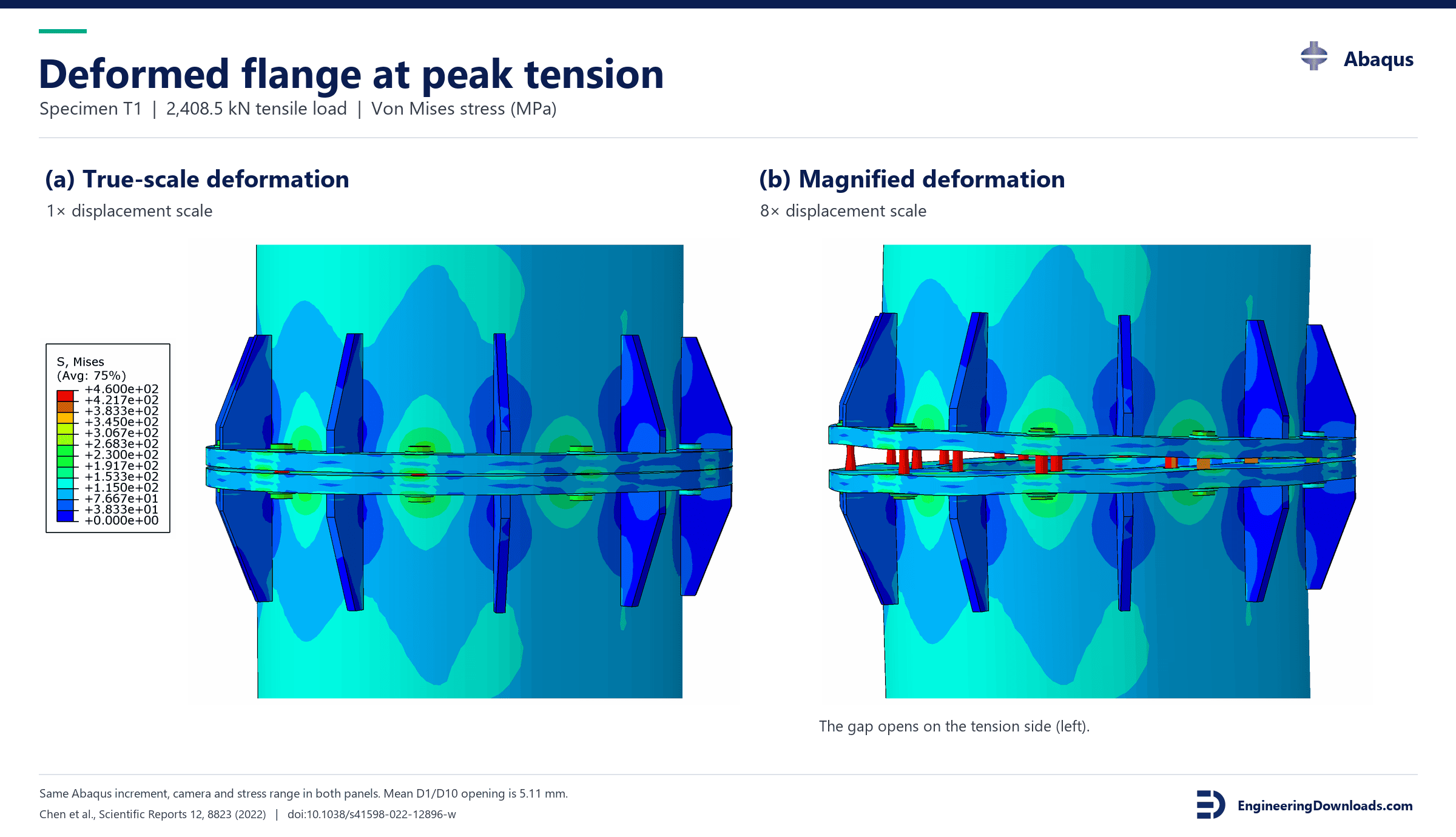
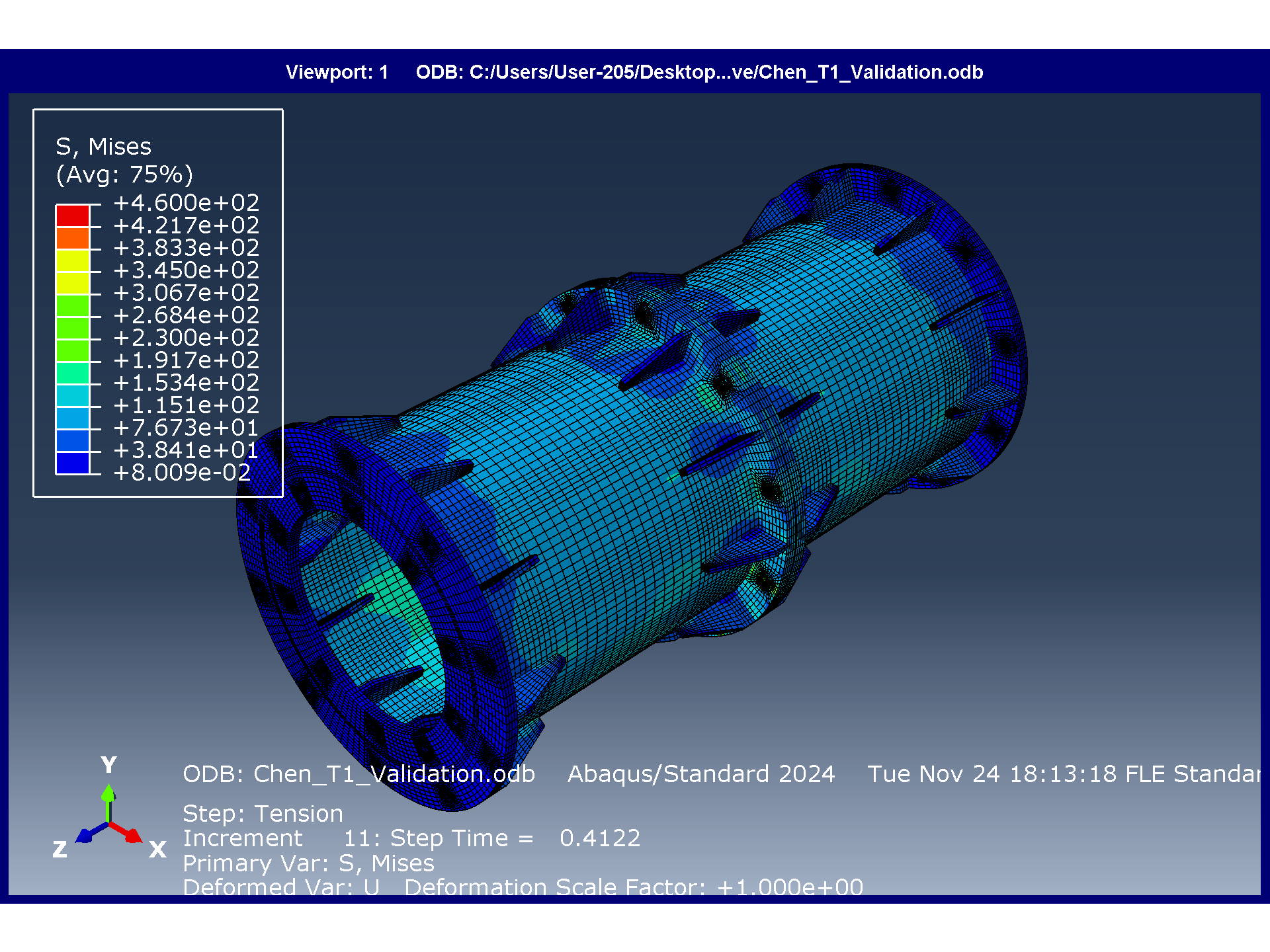
The full assembly shows axial displacement at true scale. The joint close-ups use the same increment, view and von Mises stress range. The 8× view magnifies displacement to make separation visible. The mean D1/D10 flange opening at this state is 5.11 mm.
Yong Chen, Wending Mou, Yong Guo, Jiyang Wang and Bin Xue, Experimental / numerical study of a circular rib-stiffened flange connection with inner and outer flange plates under combined bending and tensile loading, Scientific Reports 12, 8823 (2022).
The authors tested four nominally identical flanges at different load eccentricities and compared the tests with finite element and semi-analytical predictions. They tracked flange gaps and bolt forces, found that bolt strength governed capacity when plates, ribs and welds were sufficiently strong, and discussed how combined bending and tension affect yield and ultimate capacity. This workshop covers their T1 specimen.
See also our Abaqus bolt preloading workshop for an extended end-plate connection.
Need more than the files?
There are two ways we can help. Book a one hour online consultation if you want to talk a problem through with a CAE engineer, using the checkbox in the order box. Order a project if you need a full simulation built for you, delivered to an agreed scope, price and deadline under a written contract.
We work on FEA and CFD for engineers, researchers and companies. Order your project, or message us on WhatsApp for a quick reply.
Other packages engineers working on this topic also download.
 Dynamic analysis of the three-point bending test of a bolted steel splice connection
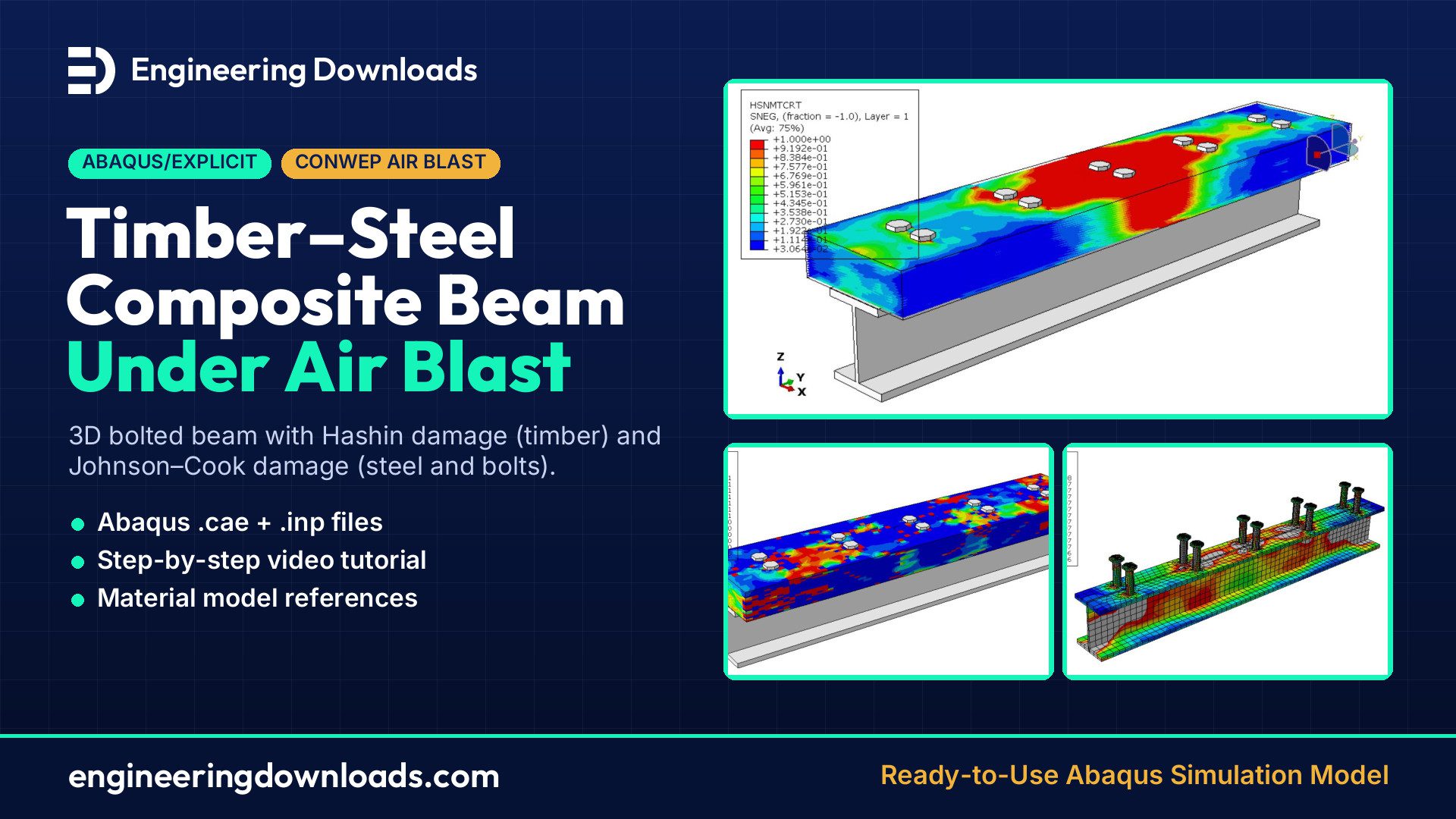 Timber–Steel Composite Beam Under Air Blast in Abaqus: CONWEP, Hashin & Johnson–Cook Damage
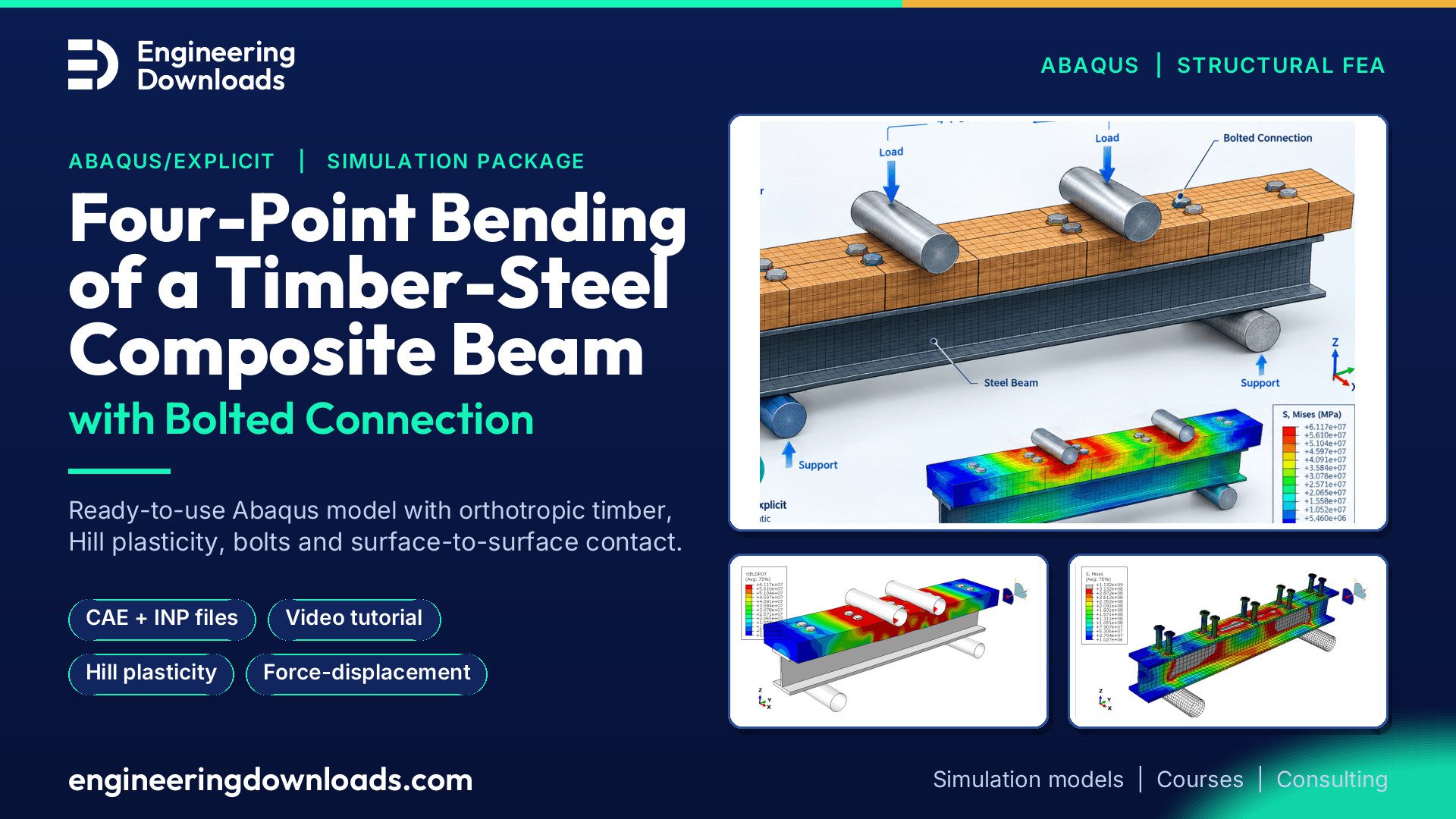 Four-Point Bending of a Bolted Timber–Steel Composite Beam in Abaqus: Hill Plasticity & Force–Displacement
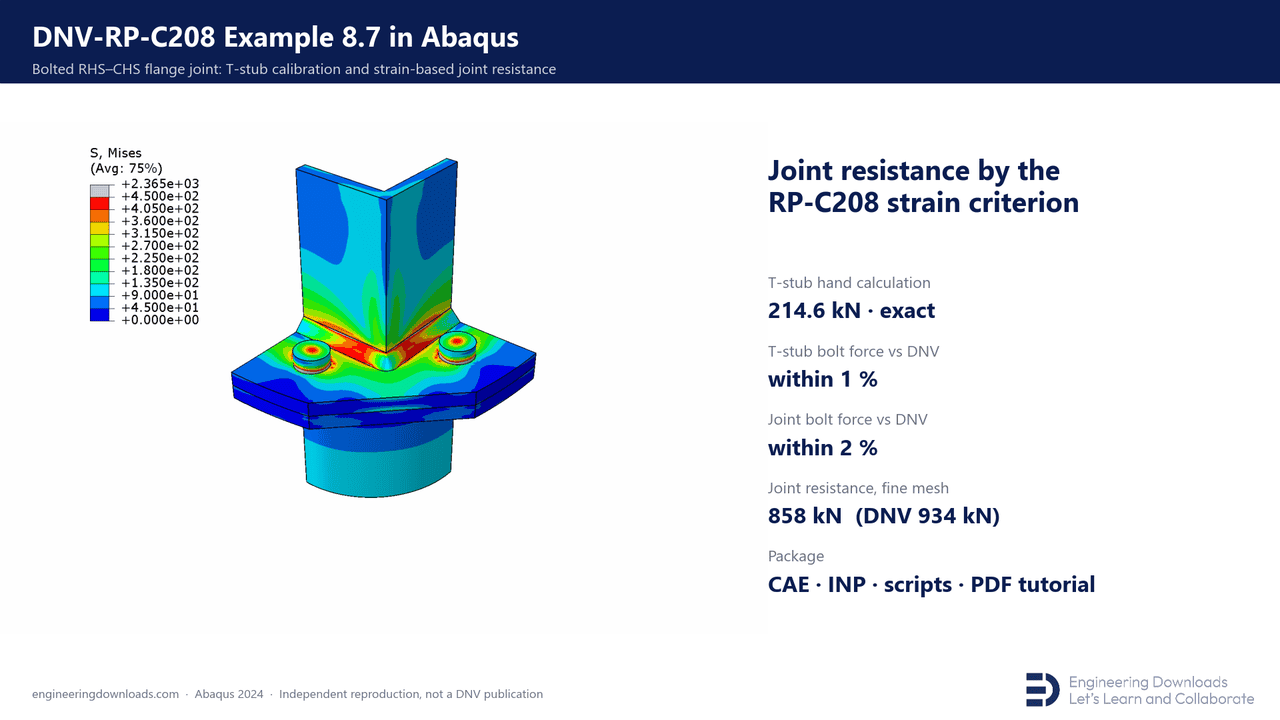 DNV-RP-C208 Example 8.7 in Abaqus: Bolted RHS-CHS Flange Joint Resistance with T-Stub Calibration
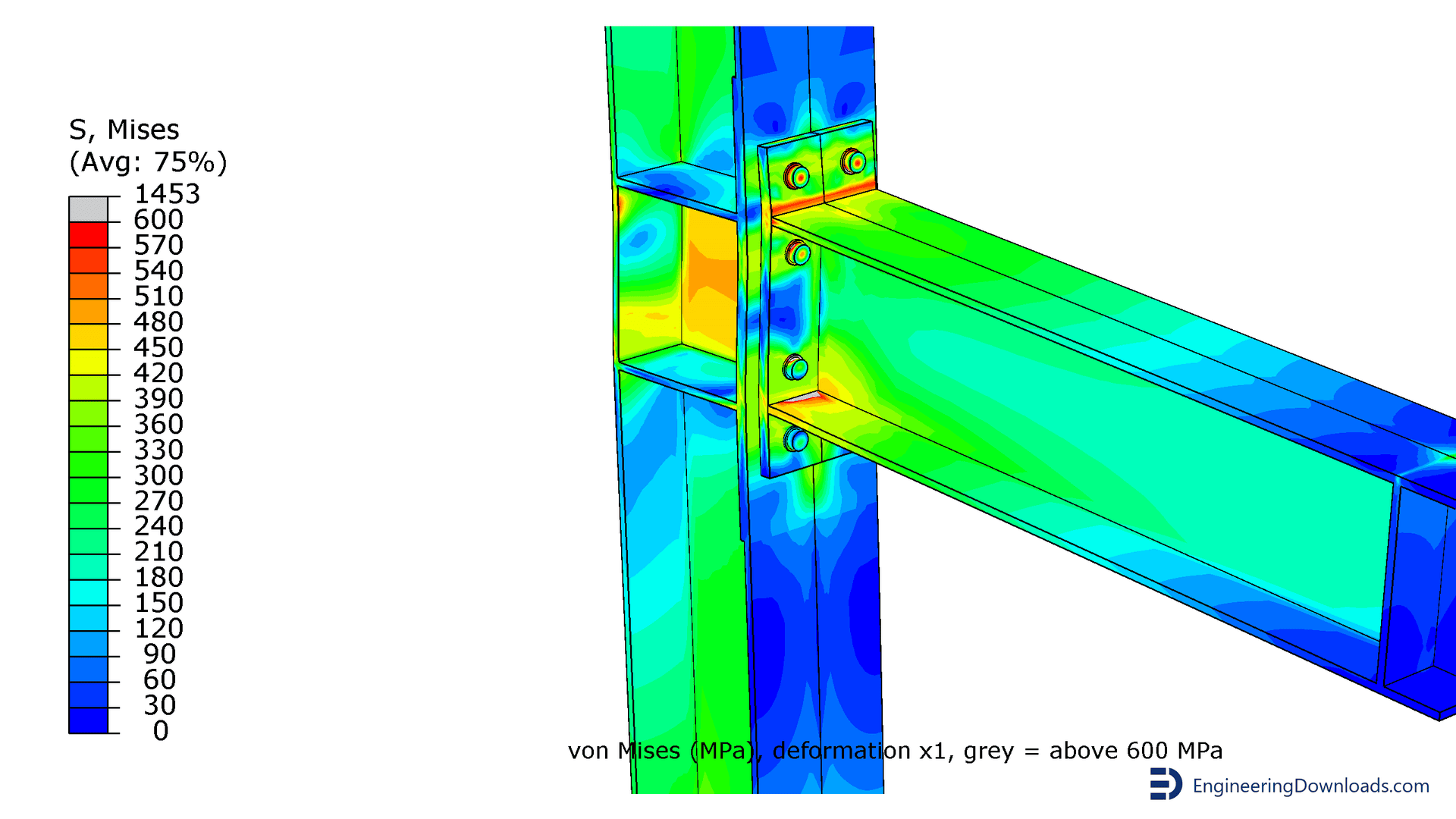 Bolt Preload Abaqus: SC3 End-Plate Connection with All-Hex Bolts (Native Bolt Load and Initial Stress, .inp and .cae)€89,00
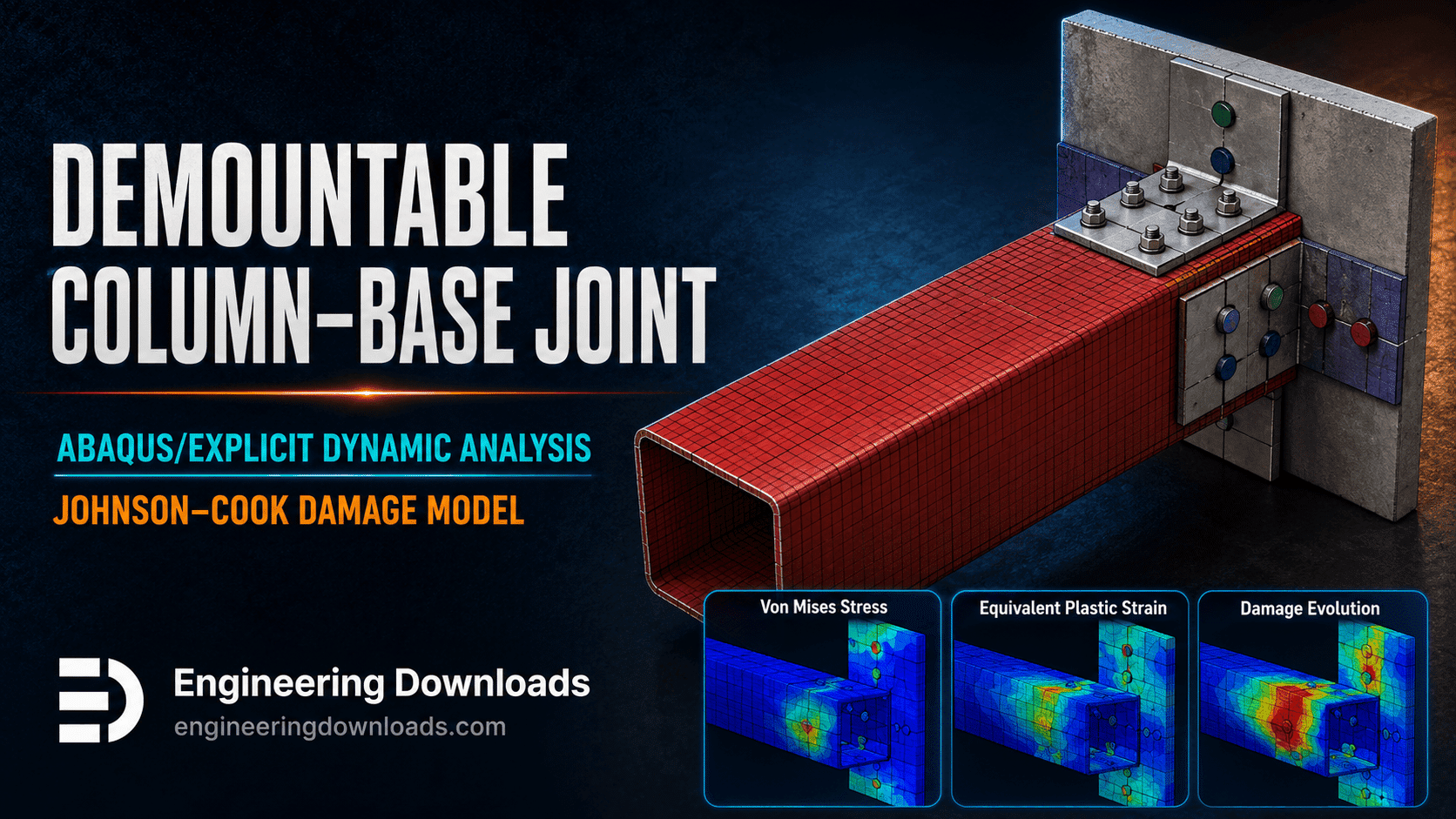 Behaviour analysis of demountable tubular column-to-base plate joints with studs
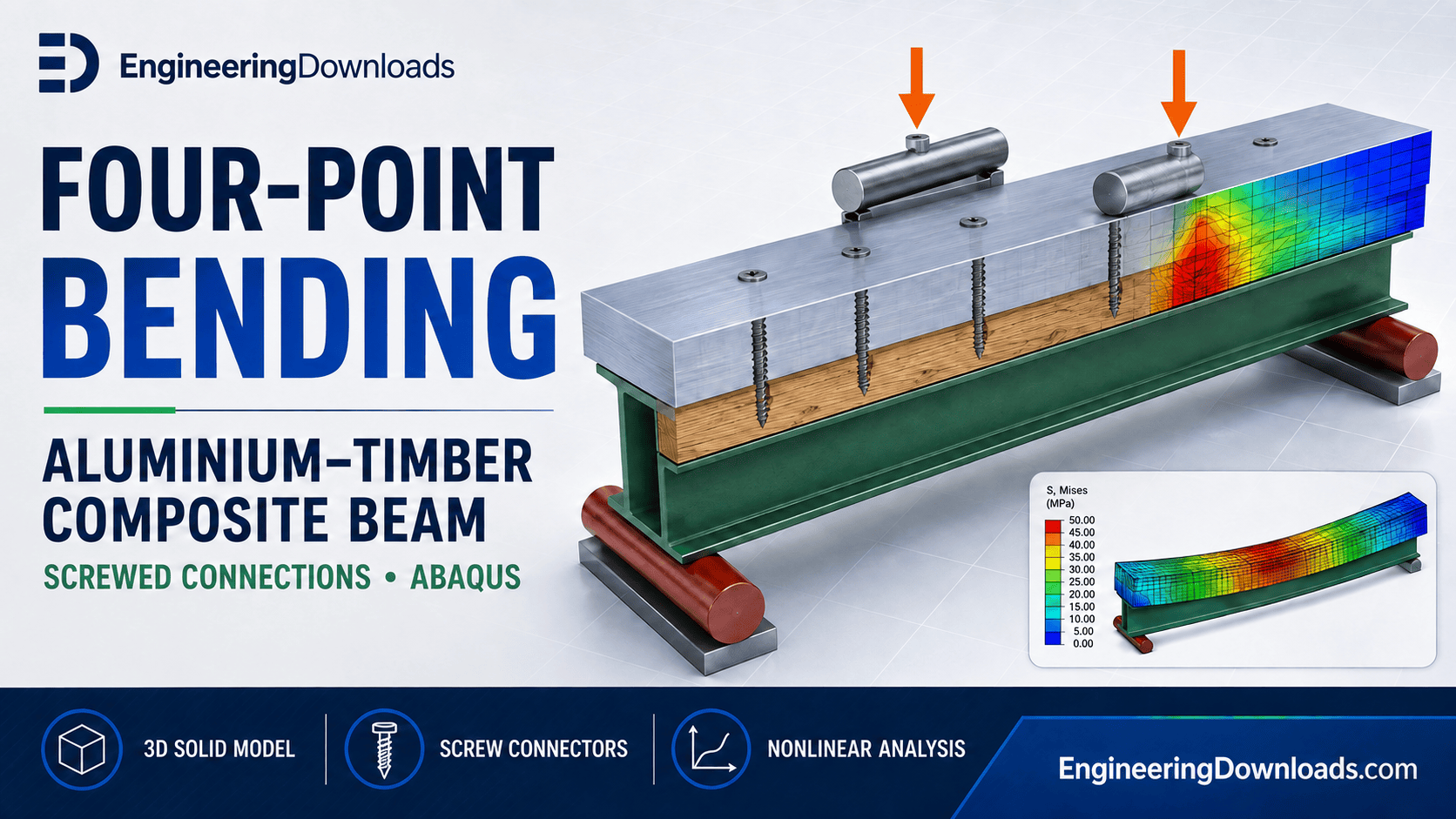 Analysis of aluminium-timber under four-point bending test
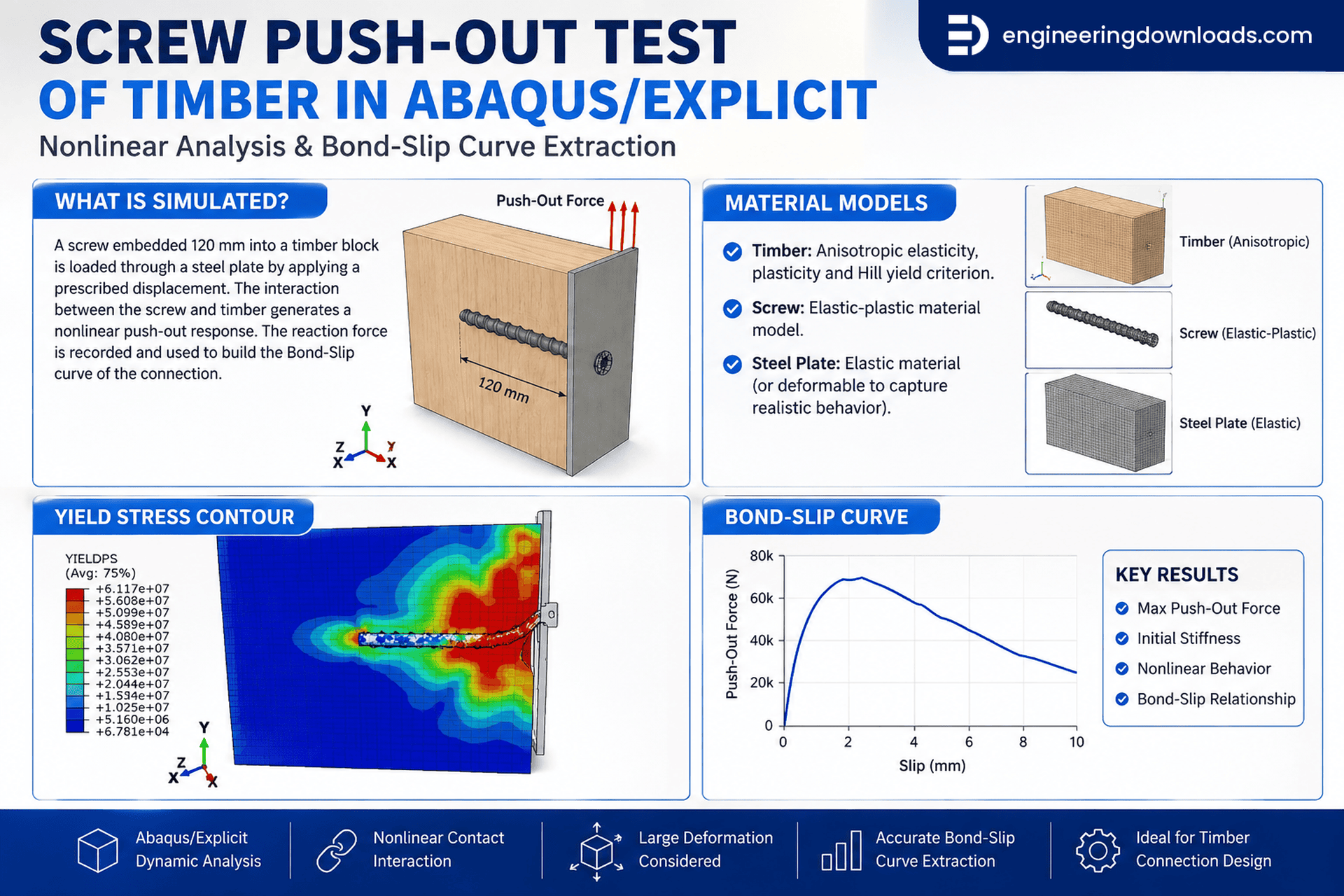 Screw Push-Out Test of Timber in Abaqus/Explicit: Bond-Slip Curve Simulation

Need a full custom project? See the options below.
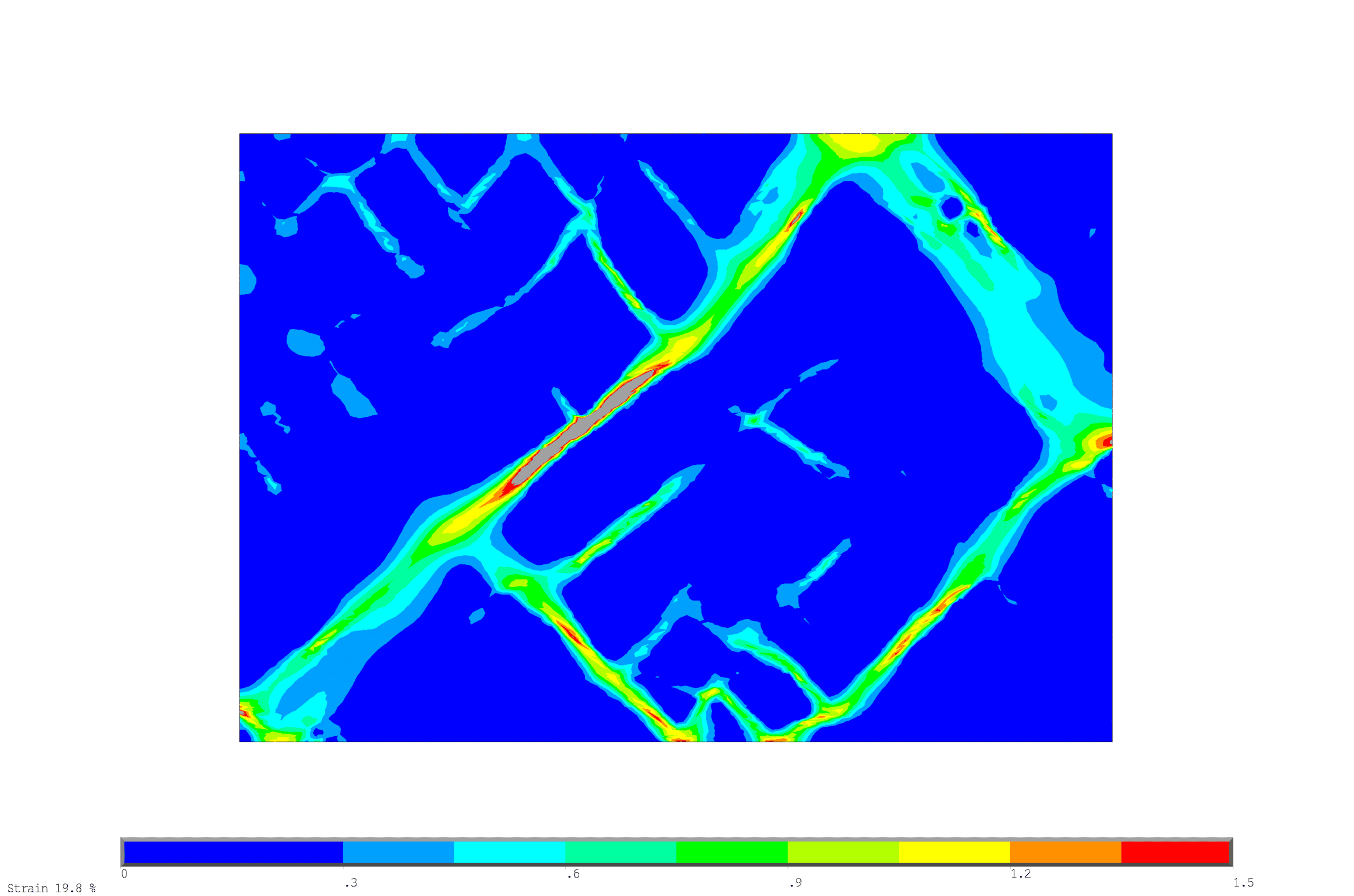
€129,00
€179,00
€149,00
€119,00
€129,00
€149,00
See more
Want to receive push notifications for all major on-site activities?