Need a full custom project? See the options below.
Need a full custom project? See the options below.
A complete, automated bond-based peridynamic model of dynamic crack propagation and cascading crack branching in a glass plate, solved in Abaqus with a Fortran user element. A single notch grows into a branching crack network from irreversible bond failure alone. You get the native CAE model, the input file, the Fortran source, a one-click Python run script and a PDF tutorial.
Dynamic fracture in brittle materials is hard for classical finite elements: cracks speed up, split into branches and interact with stress waves, and the path is not known in advance. Peridynamics describes the body as particles joined by bonds that break when stretched too far, so cracks nucleate, grow and branch without any crack path being prescribed. This product brings that approach into Abaqus: every bond is a two-node user element (VUEL) whose force and irreversible failure are coded in Fortran, and the whole workflow is automated.
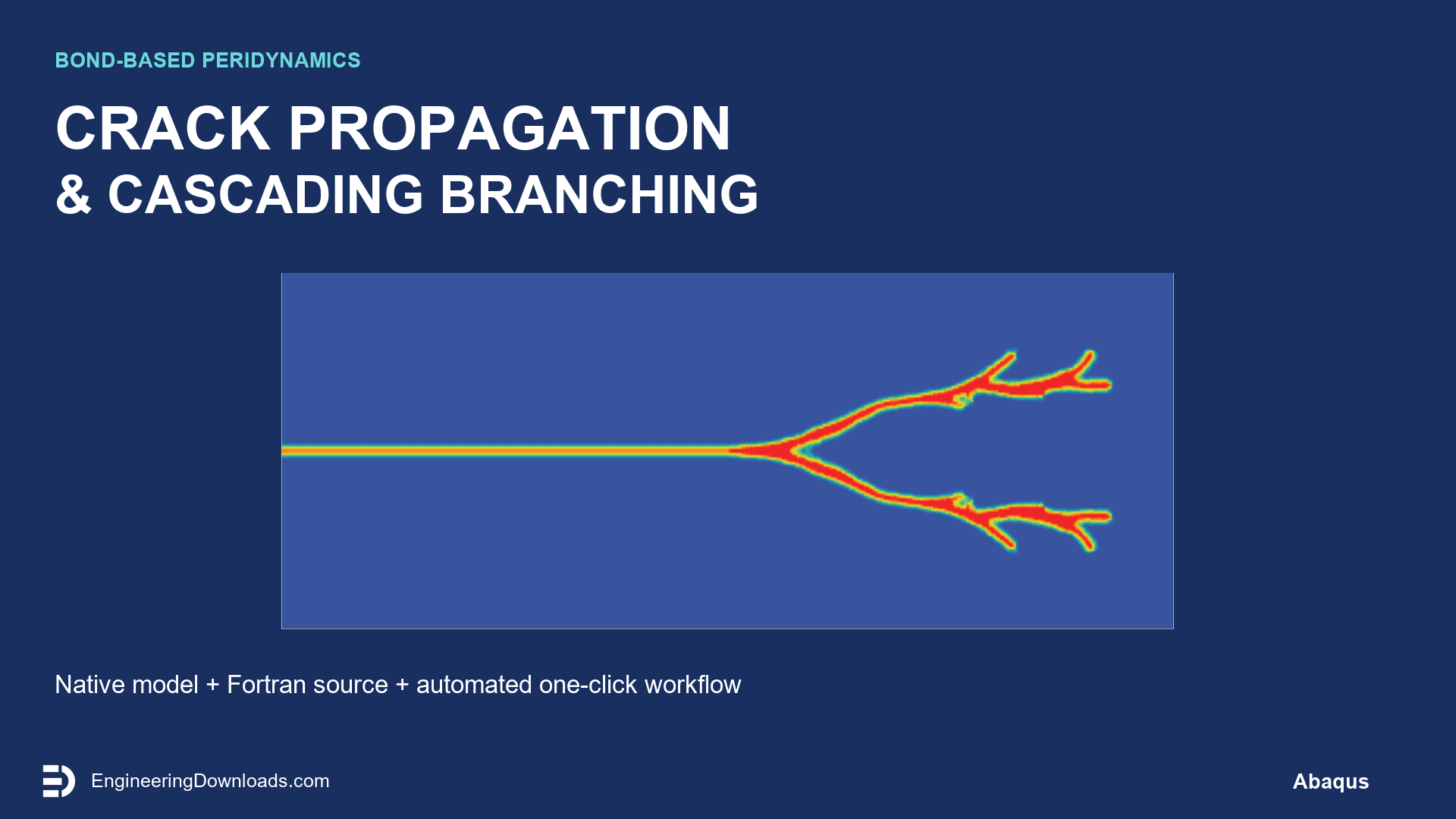
The model reproduces the soda-lime glass plate with a sudden 24 MPa tensile traction from the published study. The initial notch runs straight, then splits into two branches that branch again, giving the cascading pattern you see below.
The model follows Ha and Bobaru, “Studies of dynamic crack propagation and crack branching with peridynamics”, International Journal of Fracture 162, 229-244 (2010). The authors use bond-based peridynamics to simulate a pre-notched glass plate under sudden tensile loading. They show that the method captures crack speed, branching angles and the formation of secondary branches without any fracture criterion or path imposed from outside. They study how the horizon size, the shape of the micromodulus function and the material (soda-lime and Duran 50 glass) change the crack path, and discuss how elastic waves reflected from the crack surfaces concentrate energy near the tip and trigger branching.
Citation: Ha, Y. D. and Bobaru, F. (2010), Int. J. Fracture 162, 229-244, DOI 10.1007/s10704-010-9442-4. This product is an independent Abaqus implementation; every image on this page comes from our own Abaqus solution, and the reference panels are labelled as paper figures.
Model files and source code are included, so everything runs in your own Abaqus installation.
| Feature | Abaqus implementation |
|---|---|
| Geometry | 2D plate 100 x 40 mm, unit thickness, with a 50 mm edge notch at mid-height |
| Material (soda-lime glass) | E = 72 GPa, density 2440 kg/m3, fracture energy G0 = 135 J/m2, Poisson ratio 1/3 (bond-based plane stress) |
| Peridynamic model | Bond-based, constant micromodulus c = 9E/(pi delta^3), critical stretch s0 = 0.001618, irreversible bond failure, horizon 1 mm |
| Discretisation | 0.25 mm cell-centred grid: 64,000 particles and 1,513,654 bonds, each bond a two-node user element (VUEL) |
| Loading | Sudden equal and opposite 24 MPa tractions on the top and bottom edges, maintained |
| Time integration | Abaqus/Explicit, fixed 25 ns increment, 28 microseconds, no artificial damping or mass scaling |
| Extra scenarios | 14 MPa crack speed, 10 MPa constant and conical micromodulus, Duran 50 glass at 24 MPa (one script option each) |
Each unordered pair of particles inside the horizon is one bond. The CAE file holds the bond mesh as an inspectable part, with assembly sets for the loaded top and bottom particle rows and for output. The notch is created by severing every bond that crosses the 50 mm crack line, and the loaded particle rows are protected from failure.
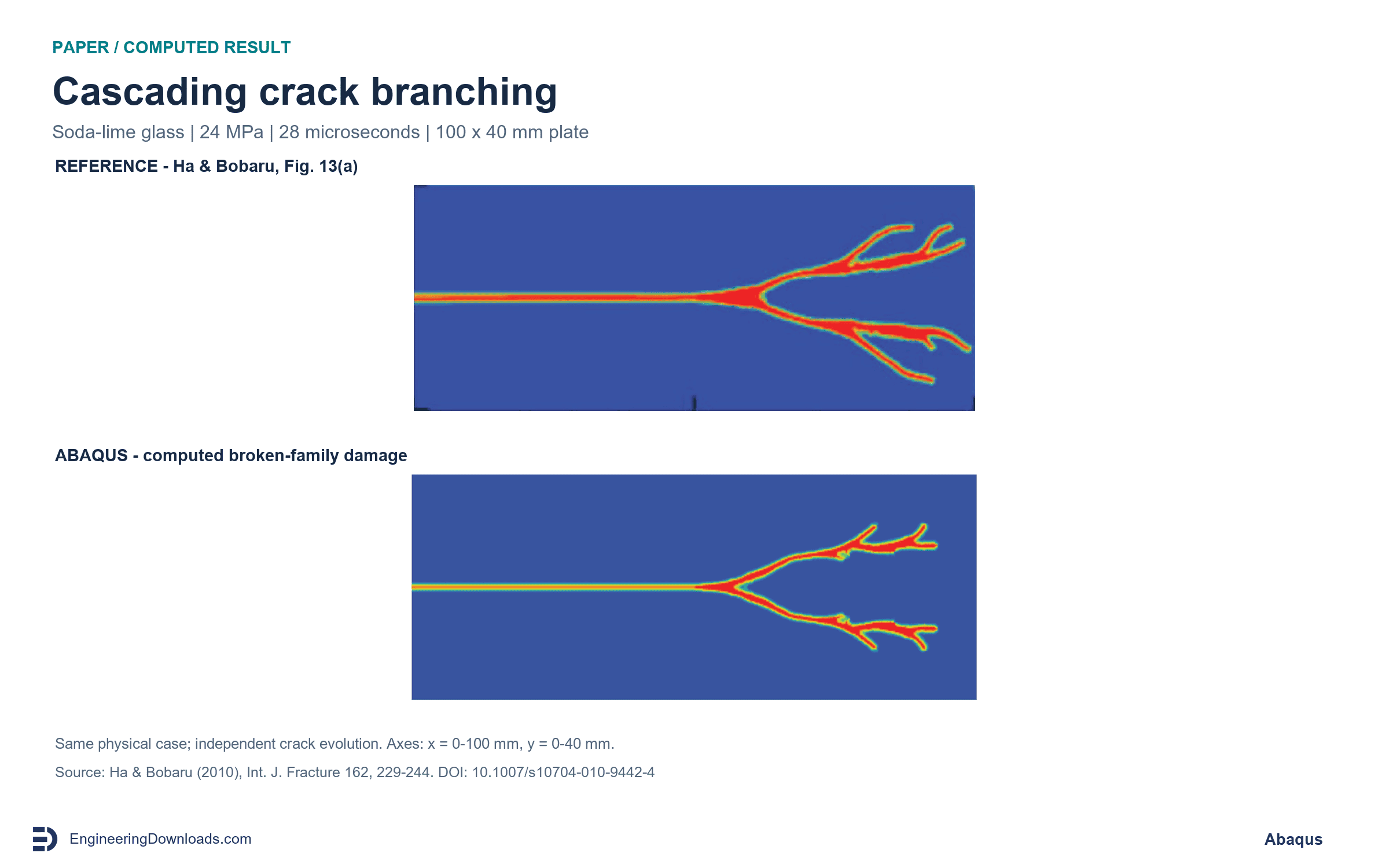
The notch propagates straight to about x = 58 mm, splits into a primary pair of branches, and each branch forms further secondary branches before 28 microseconds. The picture below places the published result above the Abaqus damage contour for the same case.
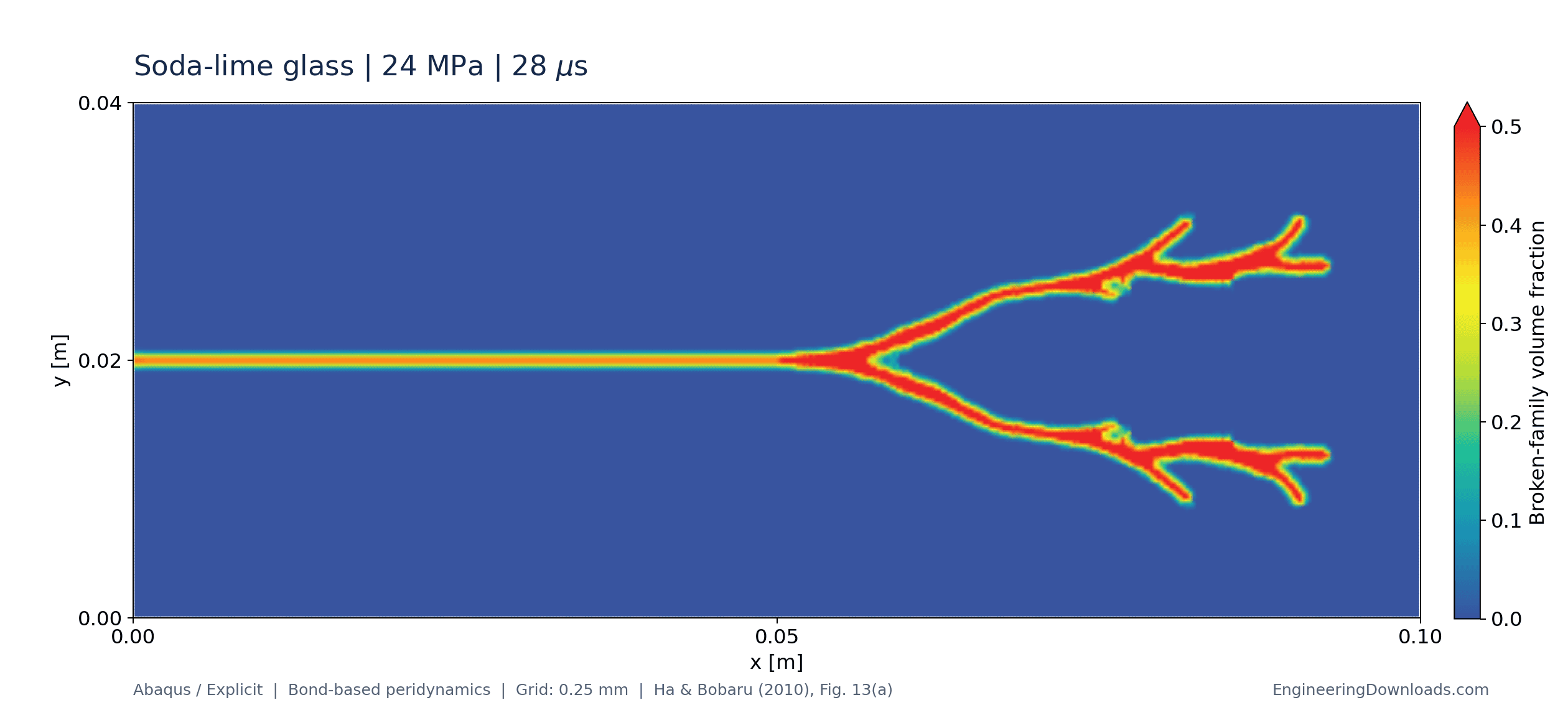
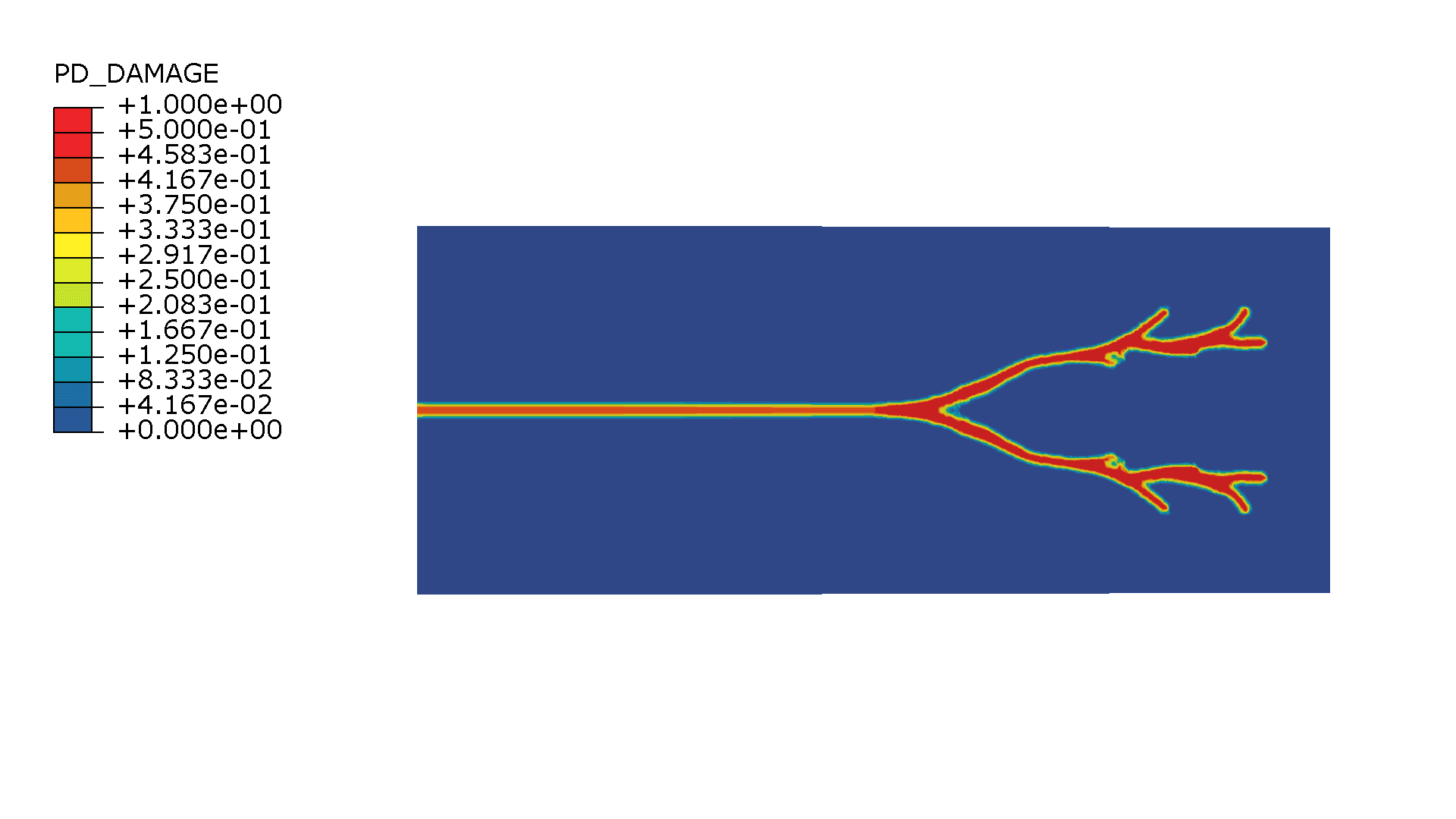
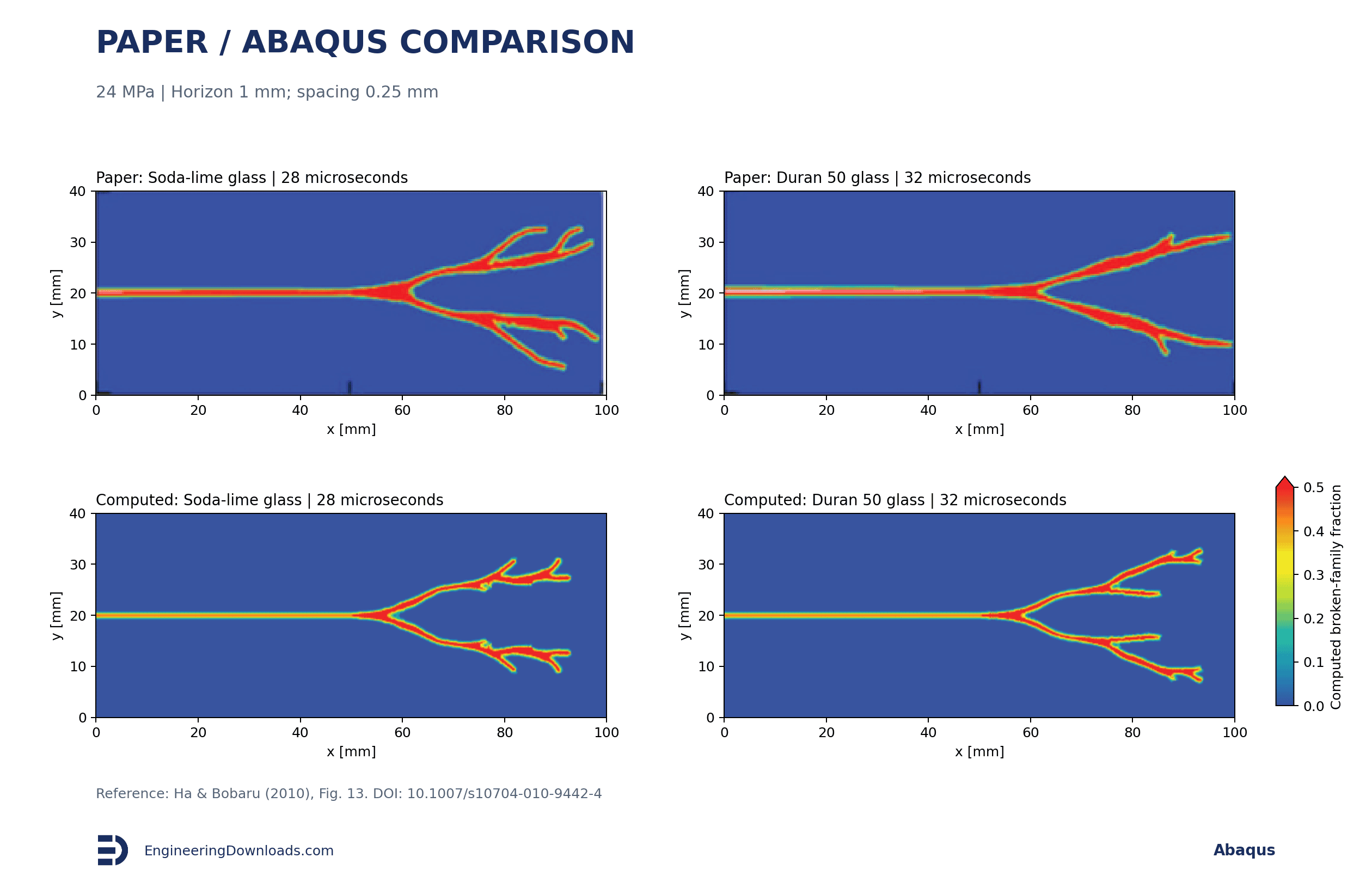
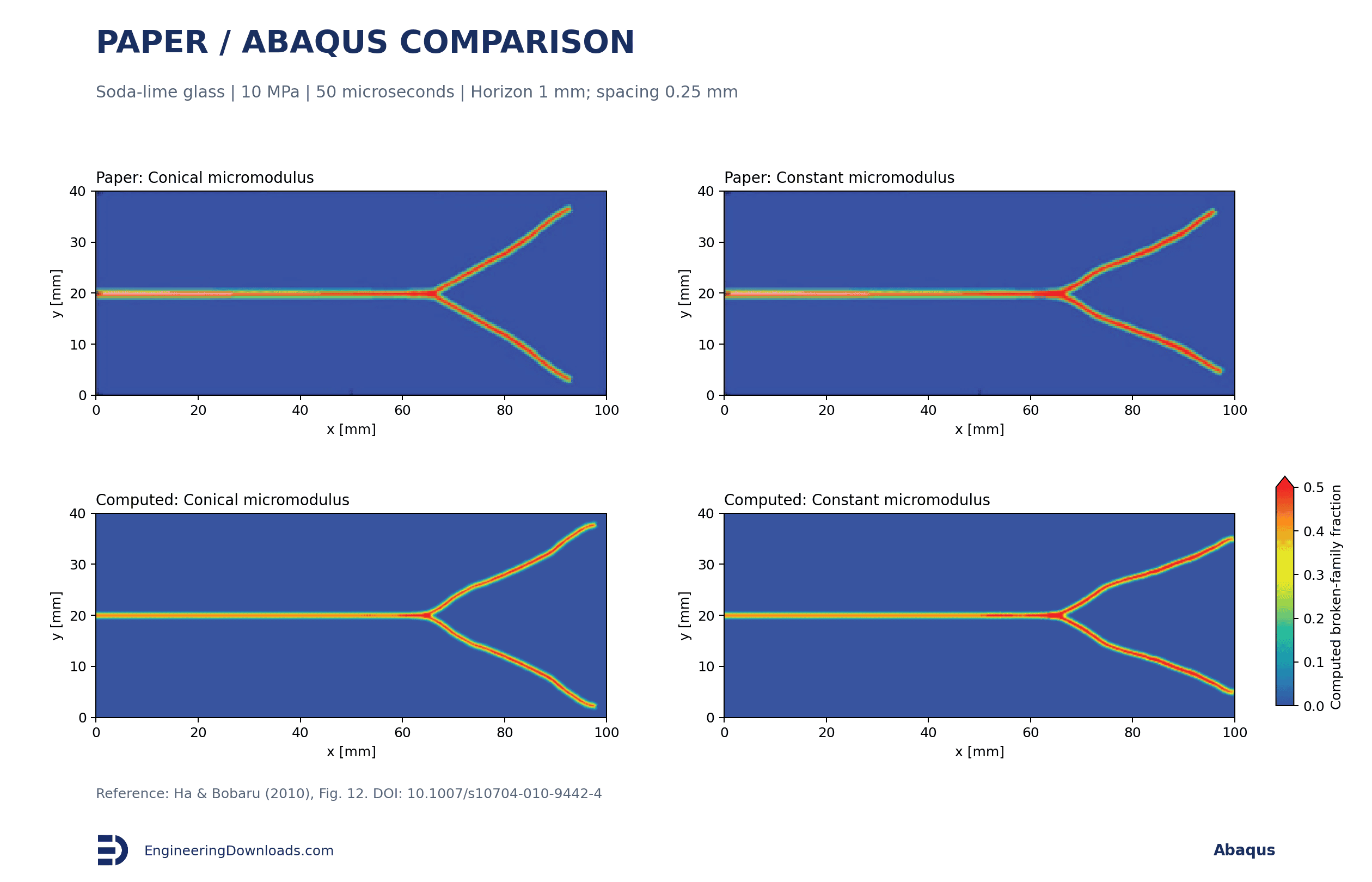
The same script runs the 10 MPa constant and conical micromodulus cases, where a single bifurcation forms, and Duran 50 glass at 24 MPa. The panels below set the paper figures beside the Abaqus results.
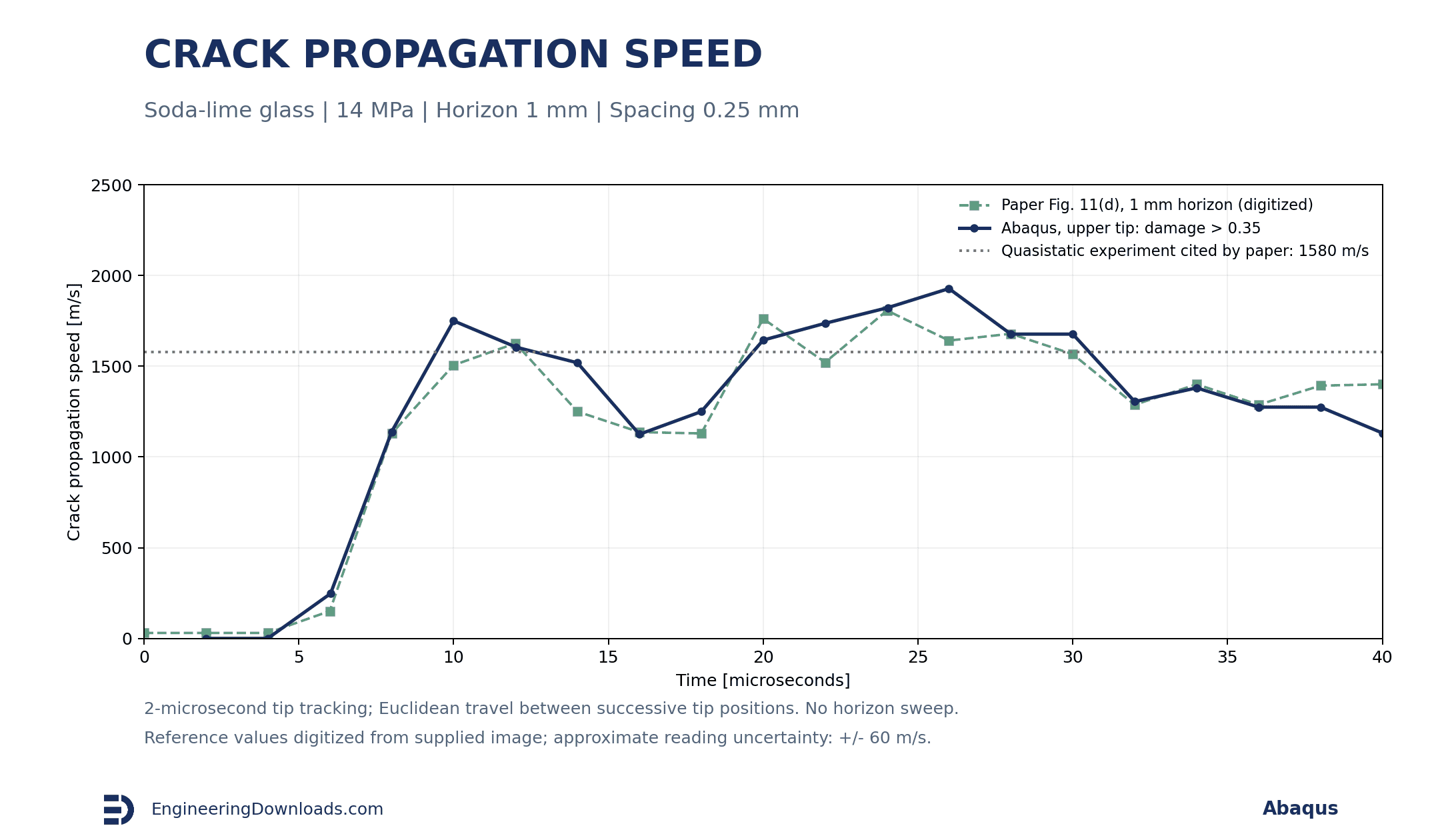
At 14 MPa the Abaqus crack tip accelerates to about 1900 m/s and then settles near 1100 to 1400 m/s, following the shape of the paper curve. The speed is measured from the tip position at 2 microsecond intervals.
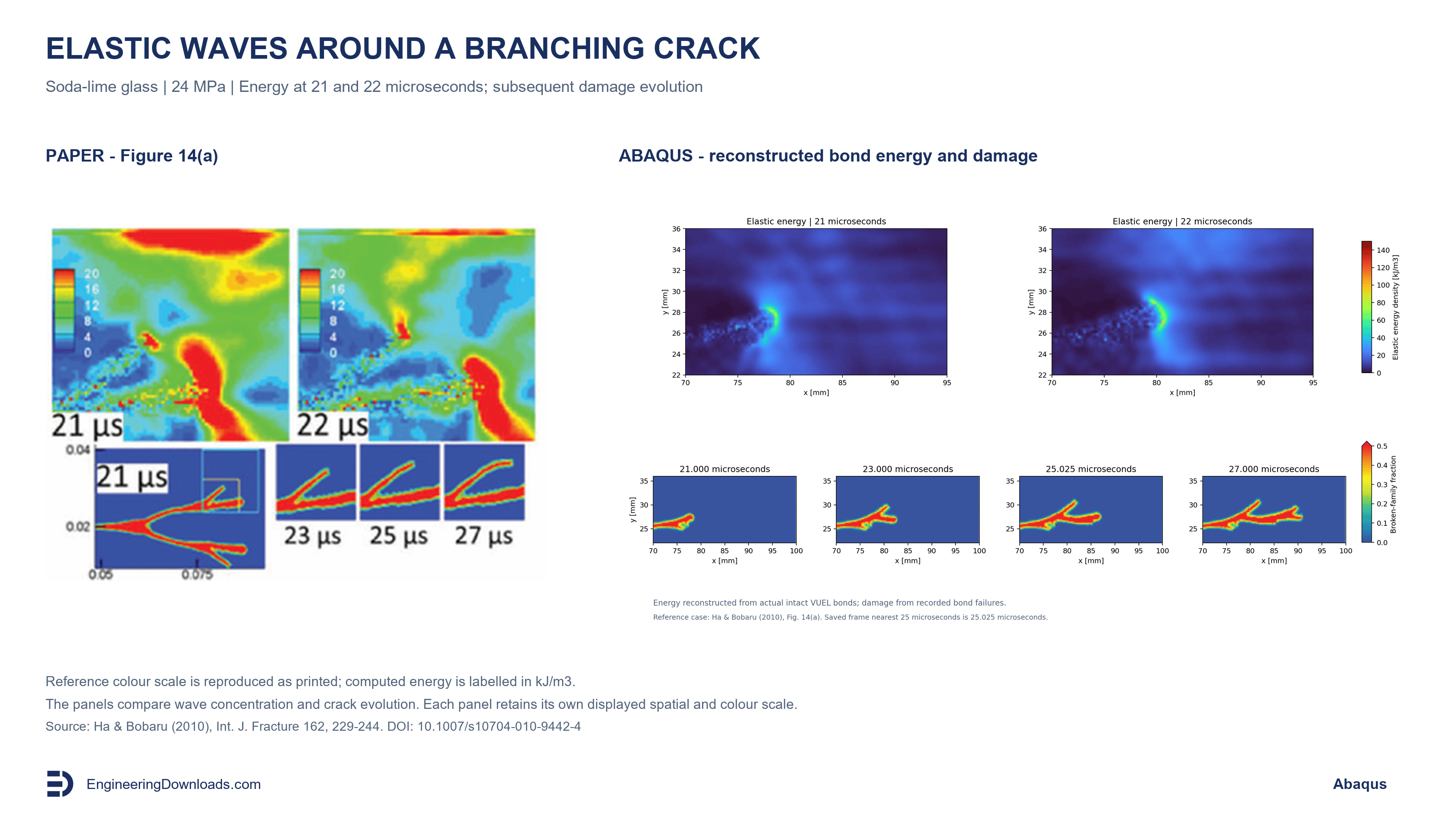
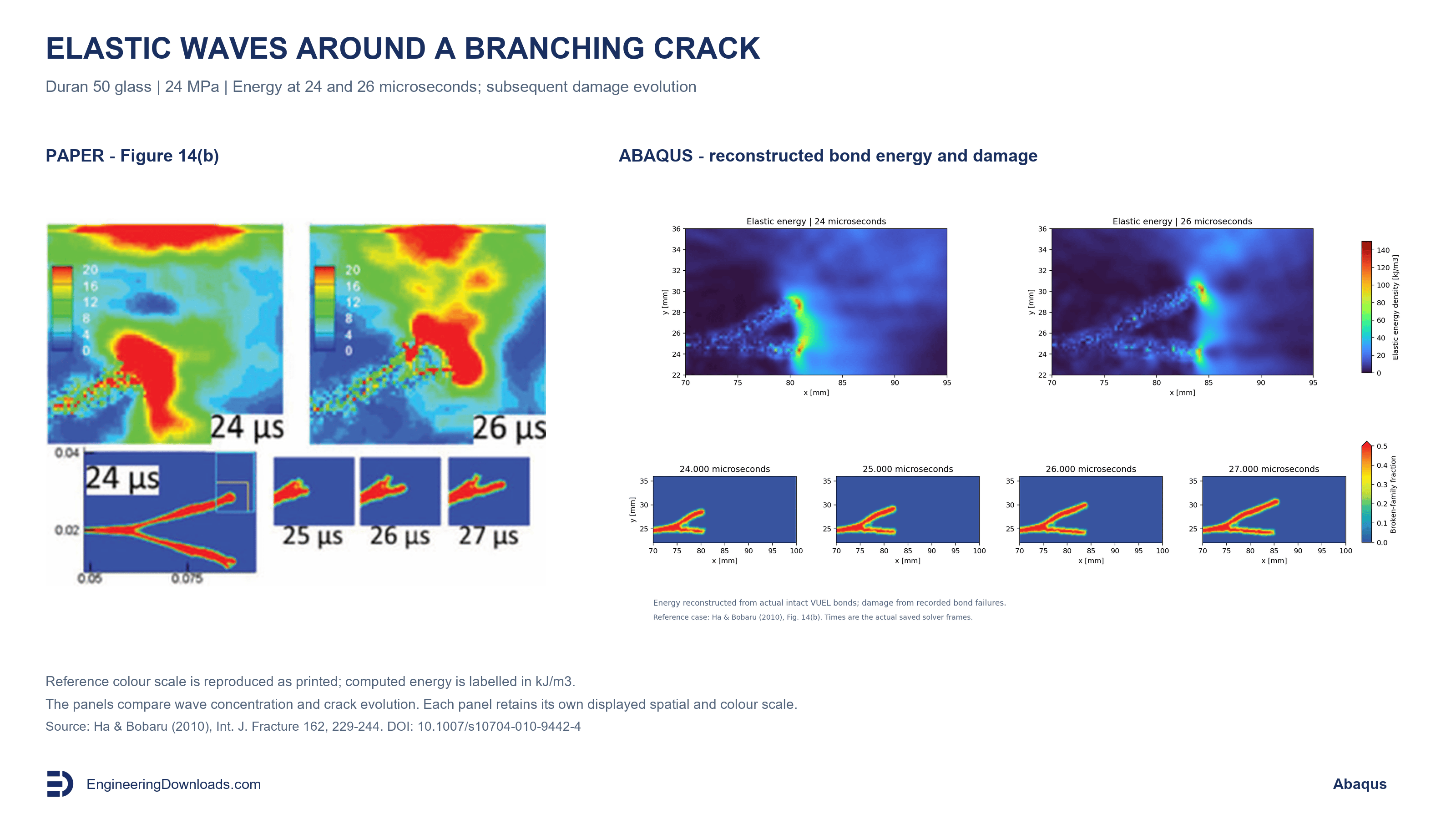
Elastic energy is rebuilt from the intact bonds at each saved frame. It shows the wave concentration ahead of the crack tip at 21 and 22 microseconds, next to the damage evolution that follows.
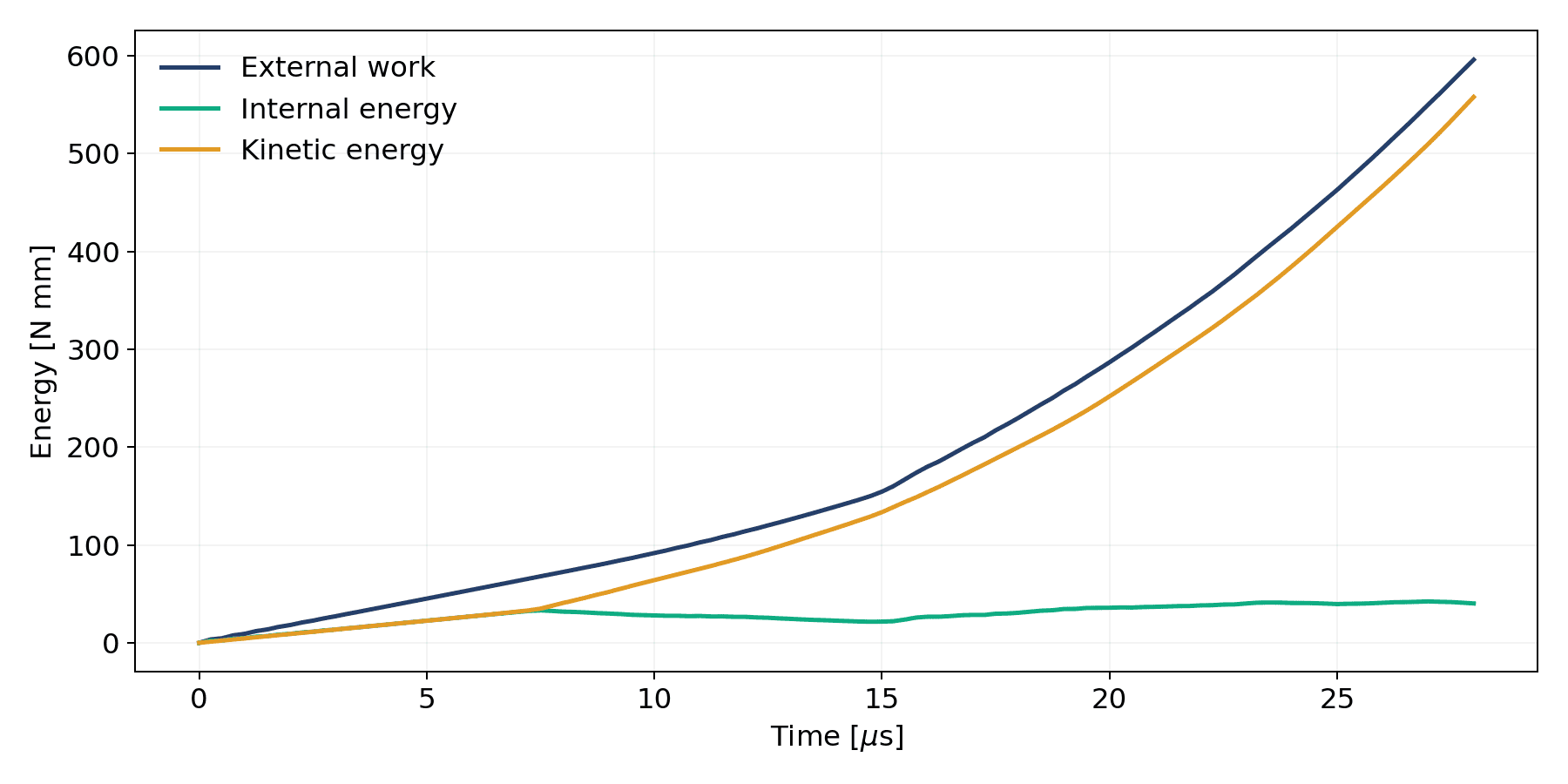
External work equals the sum of kinetic and internal energy (damage dissipation is already inside internal energy). For the four extra cases the final energy residual stays below 0.6 %, and no artificial damping or mass scaling is used.
Researchers and engineers in fracture mechanics and computational mechanics, MSc and PhD students learning peridynamics, and anyone who needs a working example of a VUEL-based nonlocal model with irreversible failure in Abaqus.
python run_model.py; add --scenario speed14, constant10, conical10 or duran24 for the other cases.Which software do I need? Abaqus with a Fortran compiler. The CAE database, input file, Fortran source and run script are included, so the model runs in your own installation.
How do I run it? Put the files in one folder and run python run_model.py. The script compiles the user element, builds the model, solves it and exports the damage contour. python run_model.py --check-only checks the script and finds the Abaqus launcher first.
Is the crack path prescribed? No. Only the initial notch is defined. Branching comes from bond failure.
Can I change the material or loading? Yes. The settings are embedded in the run script and the Fortran source is included.
Is it 2D or 3D? A 2D plate with unit thickness, bond-based plane stress.
Is there a tutorial? Yes, a 10-page PDF tutorial.
Need more than the files?
There are two ways we can help. Book a one hour online consultation if you want to talk a problem through with a CAE engineer, using the checkbox in the order box. Order a project if you need a full simulation built for you, delivered to an agreed scope, price and deadline under a written contract.
We work on FEA and CFD for engineers, researchers and companies. Order your project, or message us on WhatsApp for a quick reply.
Other packages engineers working on this topic also download.
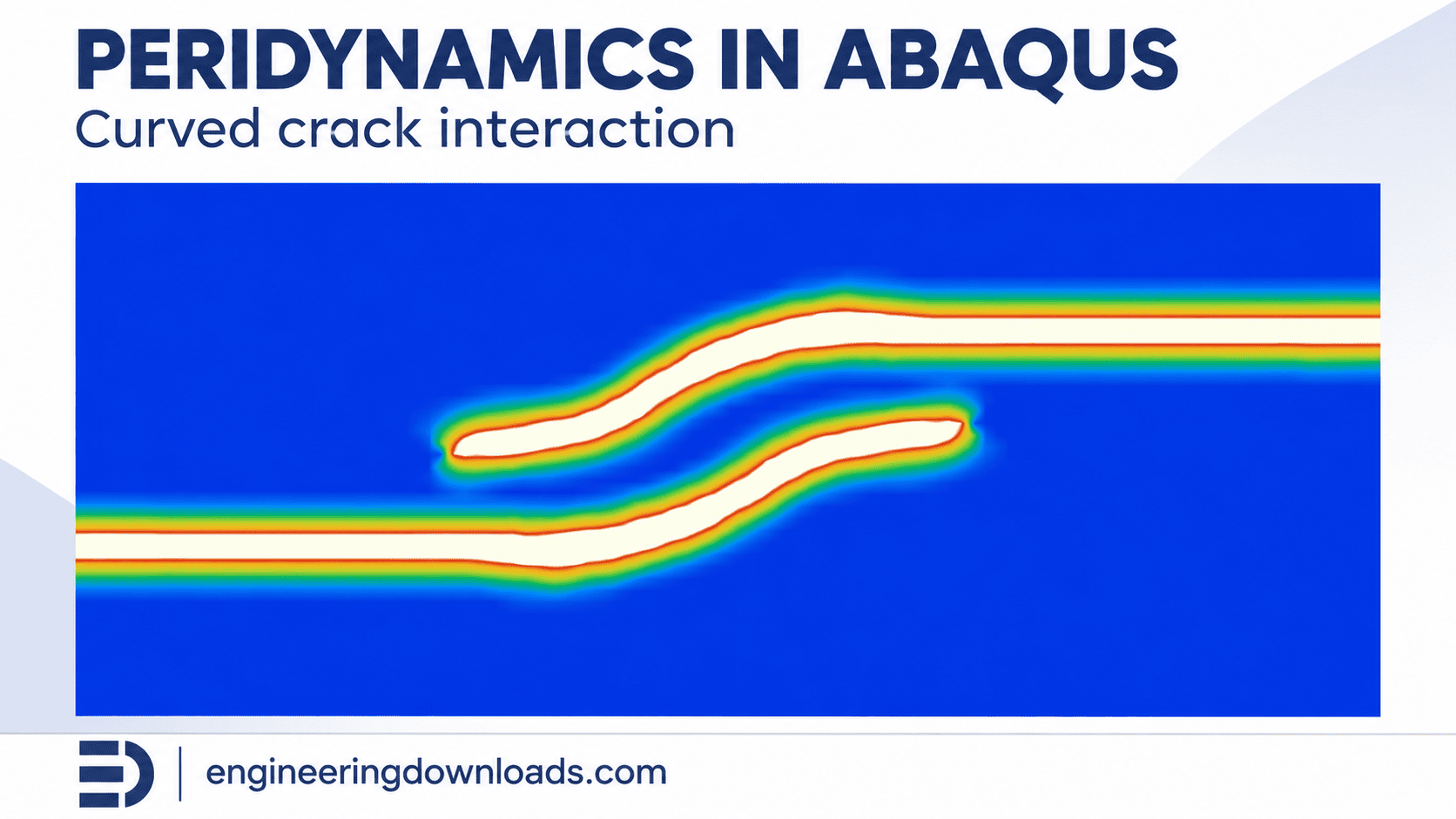 Peridynamics in Abaqus: Brittle Fracture with a VUMAT, after Han et al. (PeriFEM, CMES 2023)€149,00
 Glass analysis package in Abaqus
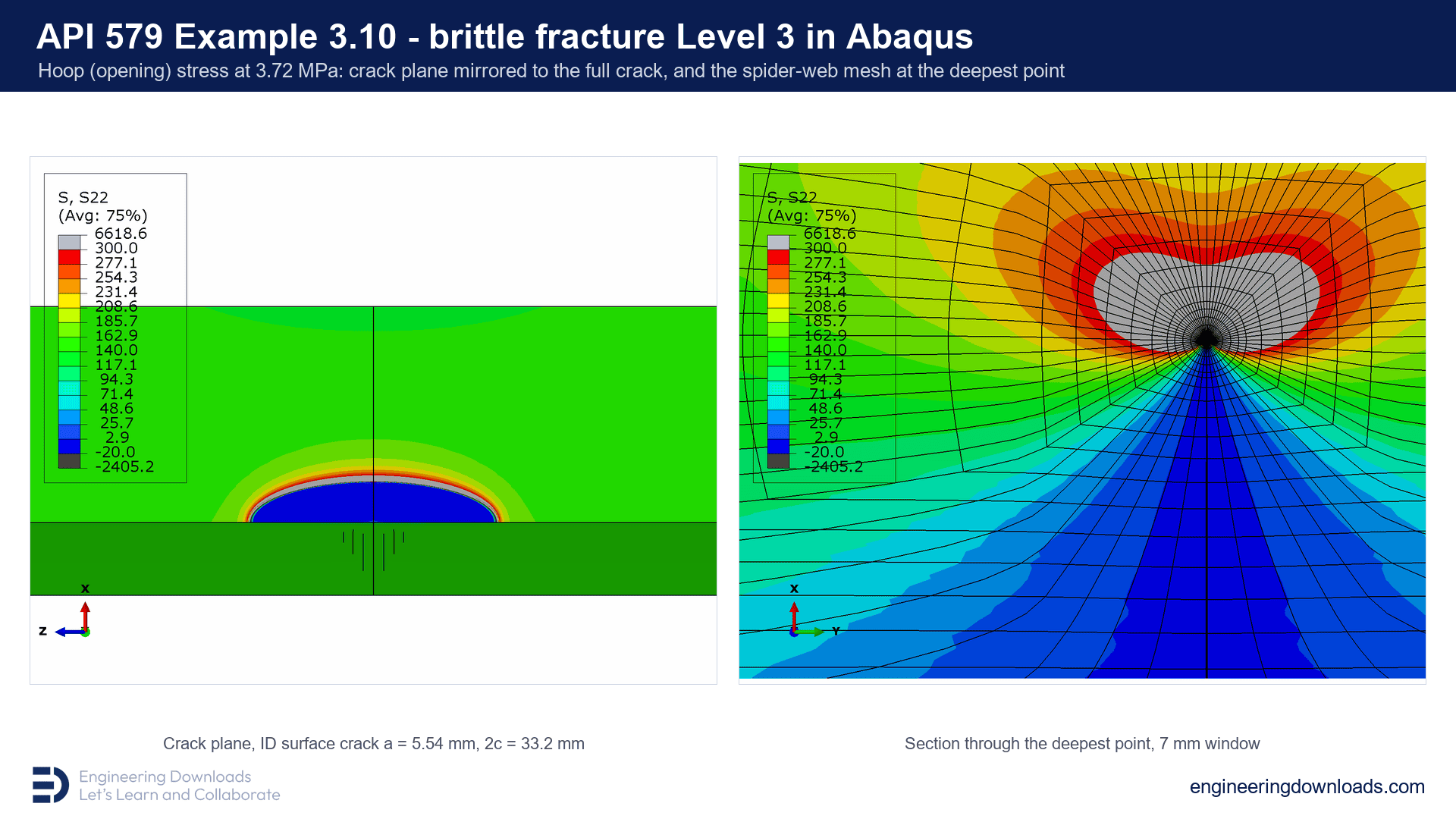 API 579 Example 3.10 in Abaqus: Brittle Fracture Level 3, Demethanizer Thermal Shock€139,00
 Johnson–Holmquist-II model of annealed glass in the dynamic compression test
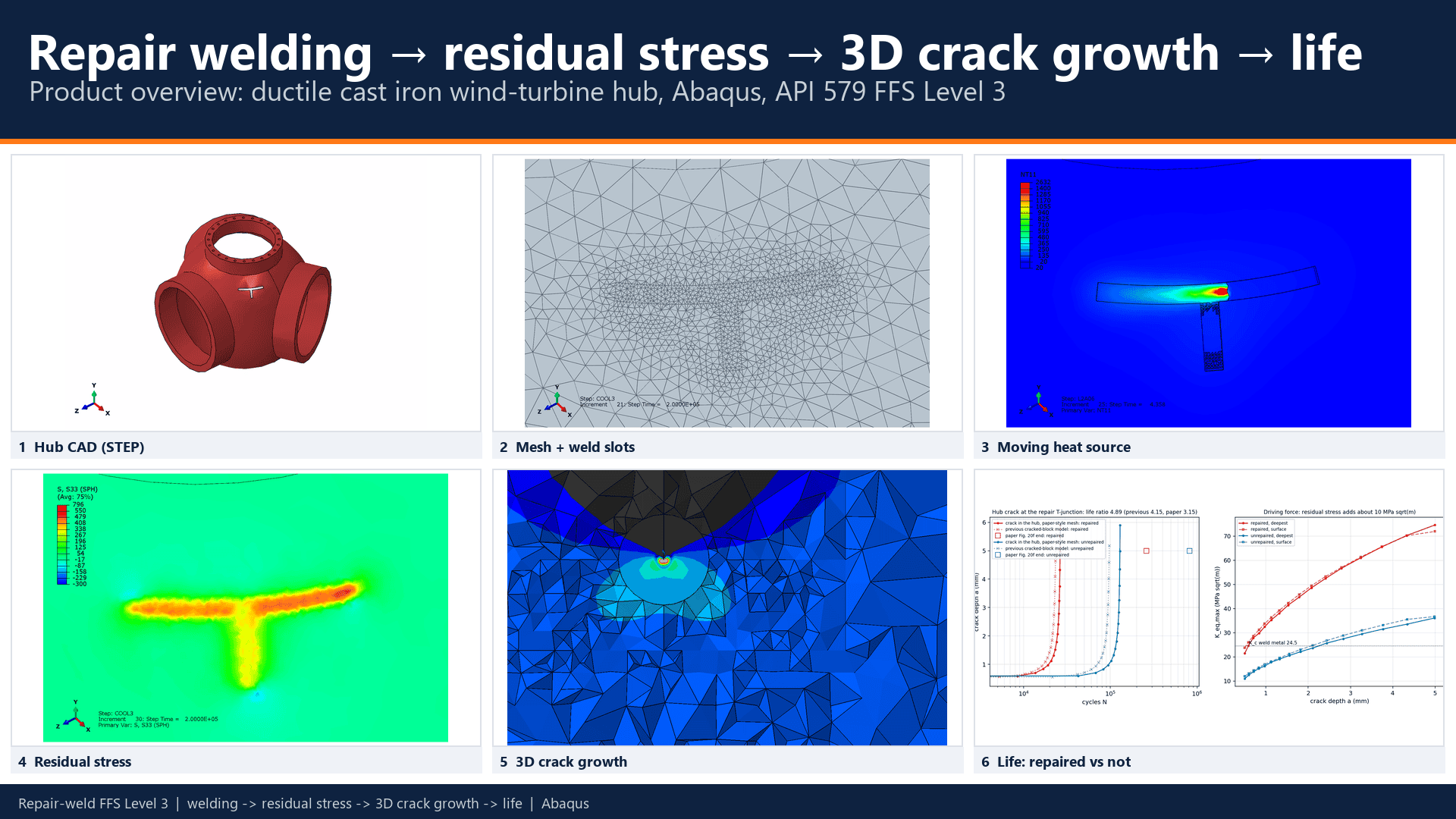 Repair Welding Residual Stress and 3D Fatigue Crack Growth in Abaqus: Ductile Cast Iron Wind-Turbine Hub (FFS Level 3)€299,00
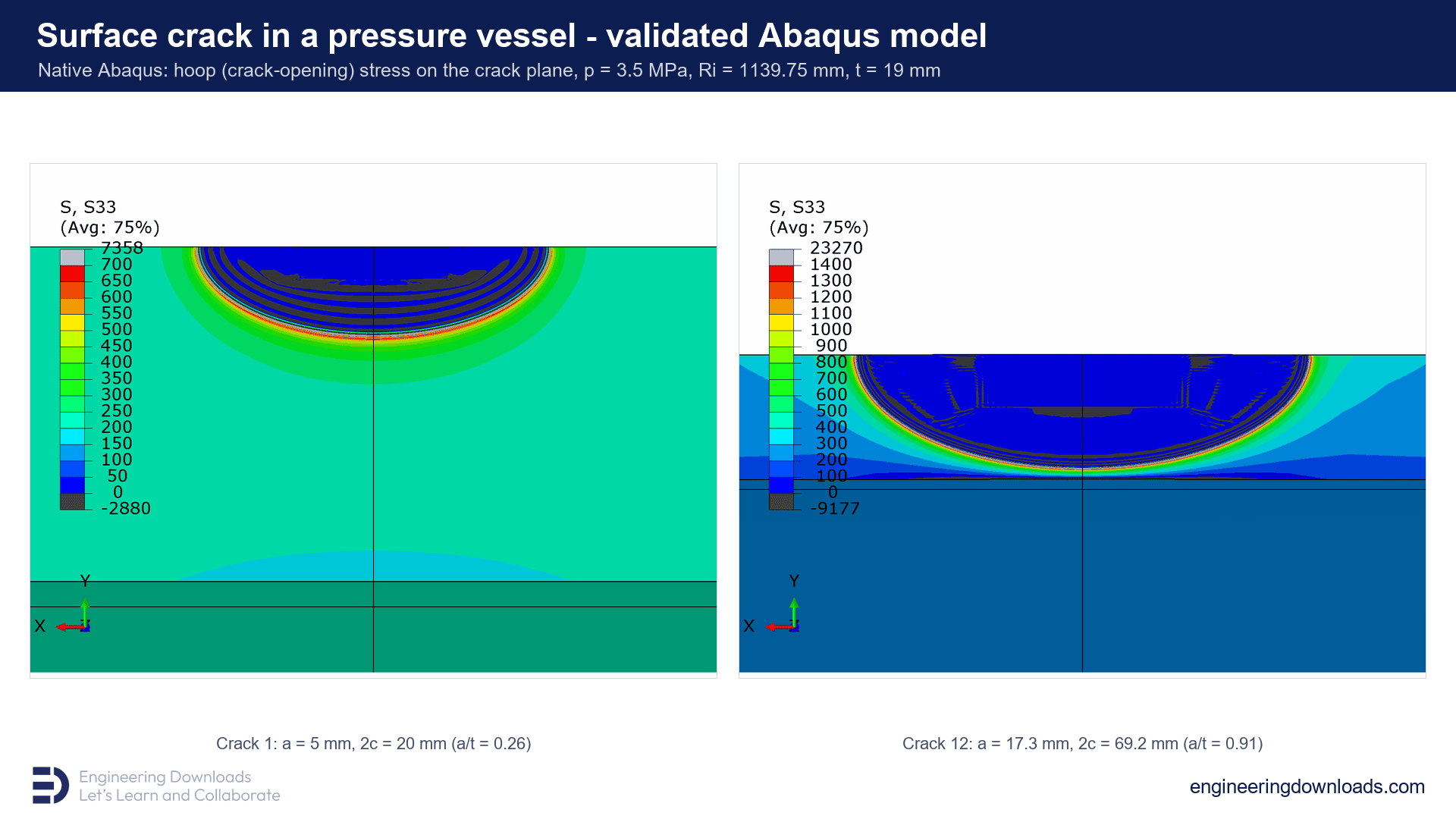 Surface Crack in a Pressure Vessel: Validated Abaqus Stress Intensity Factor Model (Spider-Web Mesh)€129,00
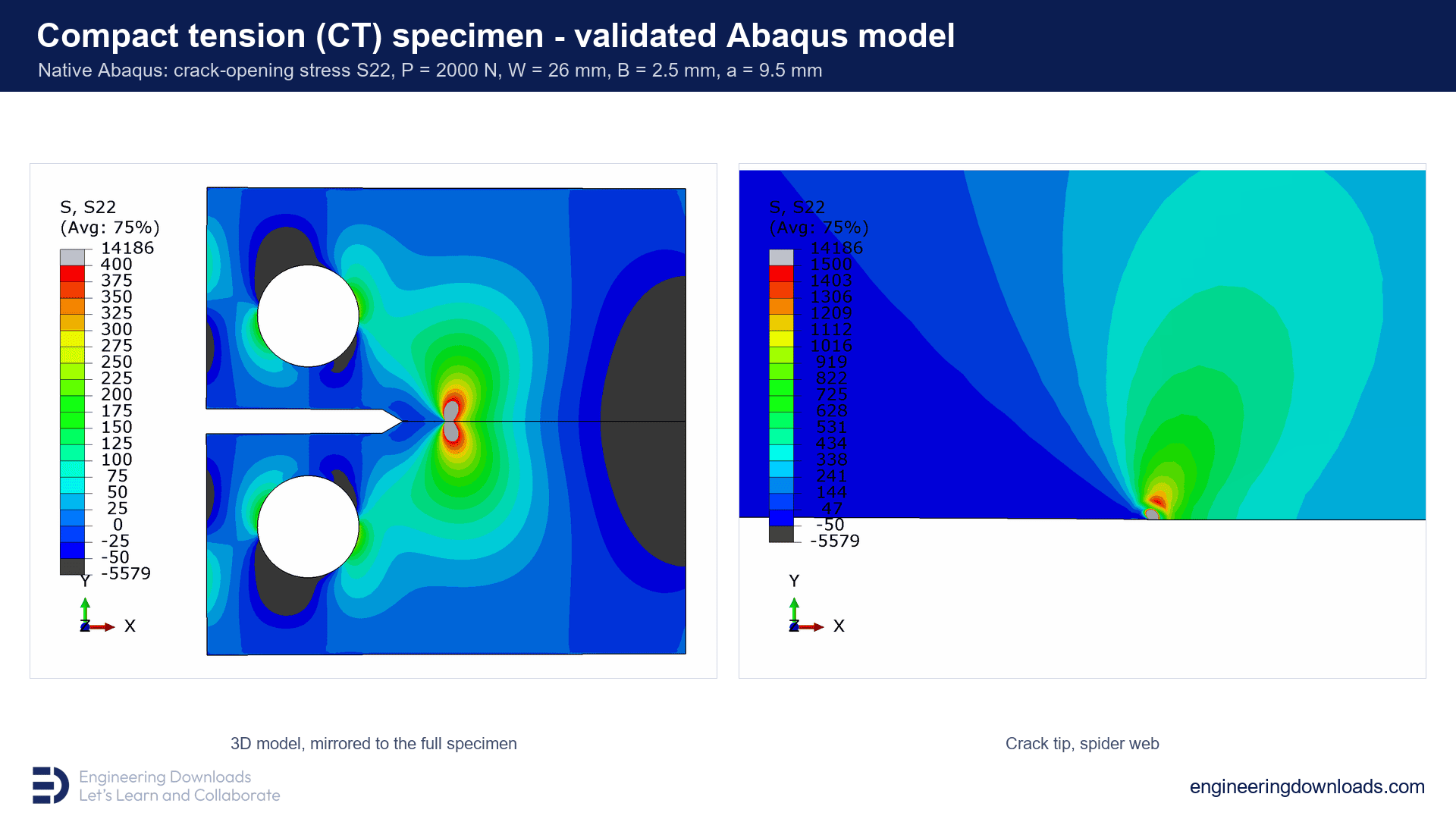 Compact Tension (CT) Specimen: Validated Abaqus Stress Intensity Factor Model vs ASTM E647 (2D + 3D)€99,00
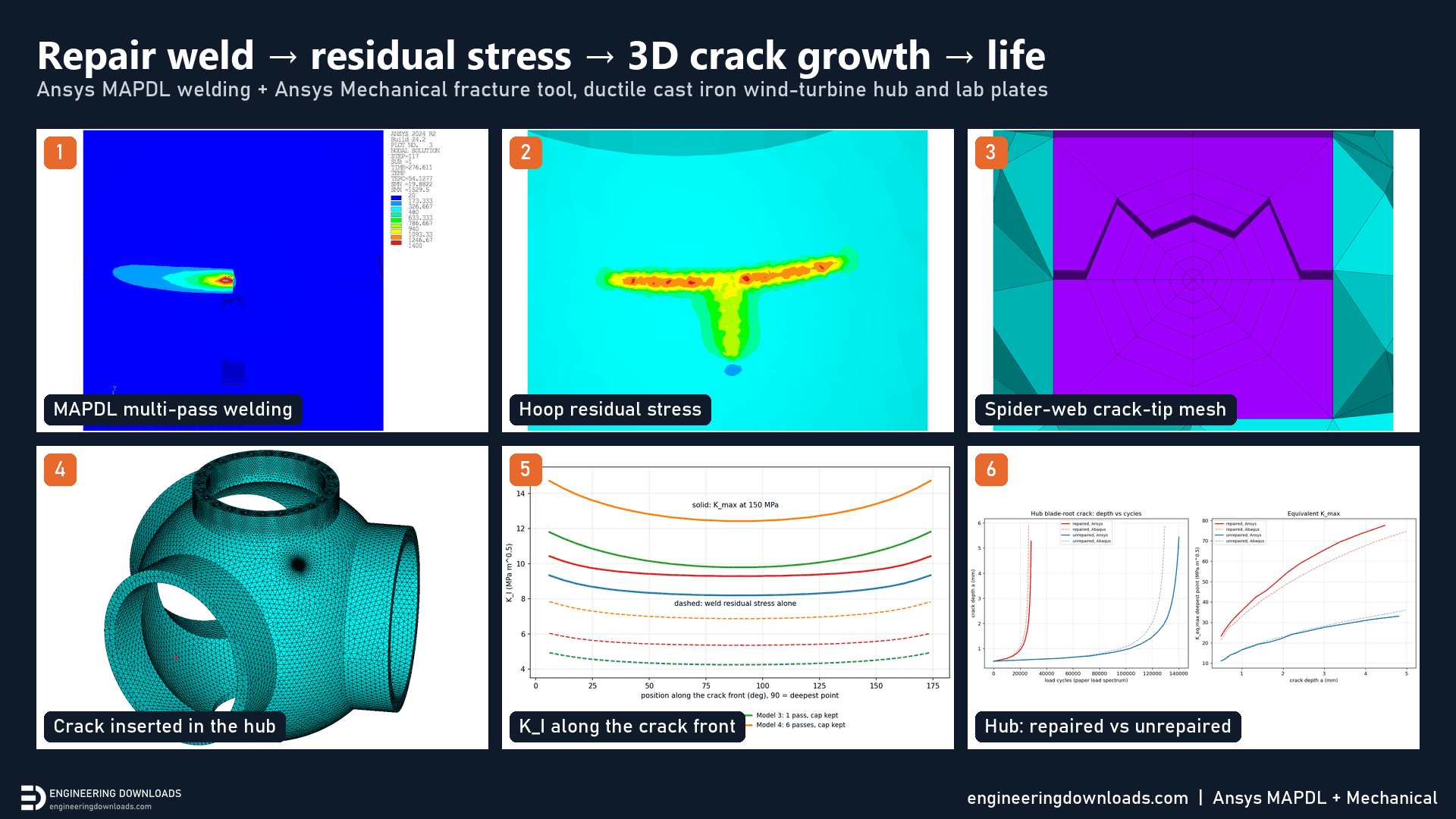 Repair Welding Residual Stress and 3D Fatigue Crack Growth in Ansys: Ductile Cast Iron Wind-Turbine Hub (FFS Level 3)€299,00

Need a full custom project? See the options below.
€129,00
€149,00
€89,00
€89,00
€299,00
€129,00
€129,00
€299,00
See more
Want to receive push notifications for all major on-site activities?

