Need a full custom project? See the options below.
Need a full custom project? See the options below.
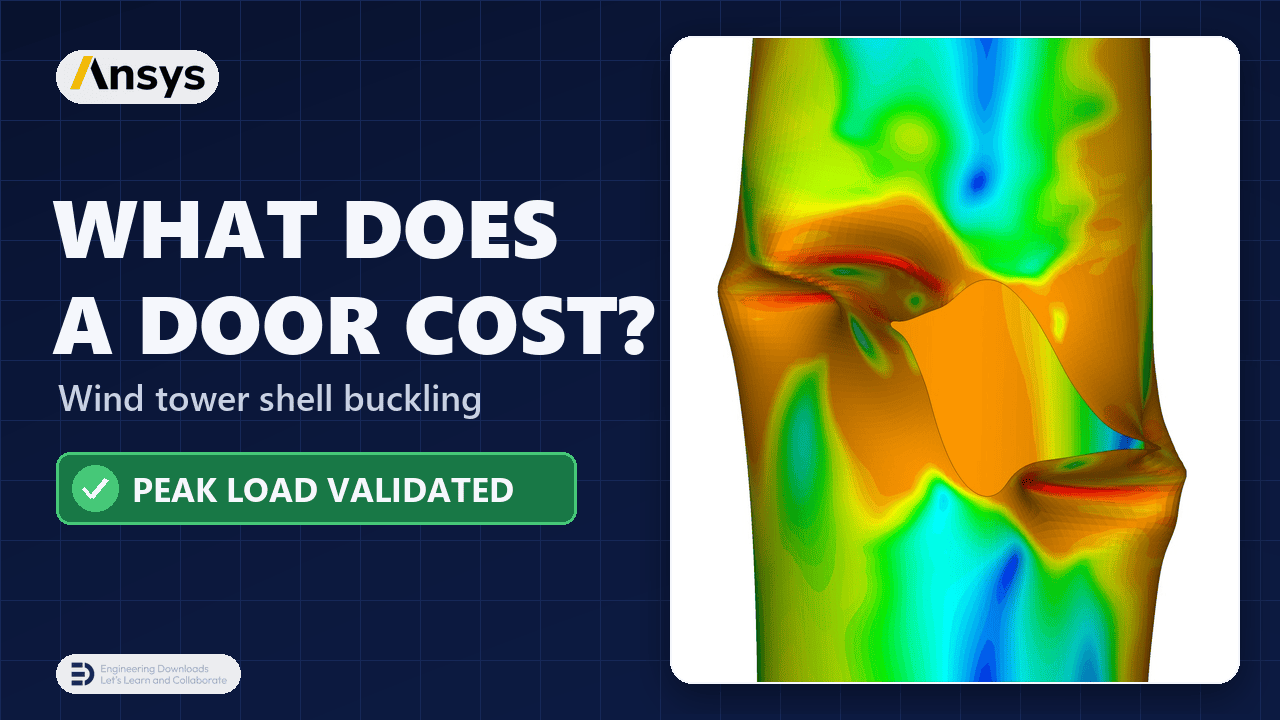
How much buckling strength does a man door take out of a tubular steel wind turbine tower, and how much does a door plate and frame give back? This Ansys package reproduces the journal paper Gantes, Vernardos, Koulatsou and Gül, “Nonlinear Finite Element Analysis of Tubular Steel Wind Turbine Towers near Man Door and Ventilation Openings to Optimize Design against Buckling”, Vibration 2024, 7, 212–228 (doi: 10.3390/vibration7010012) with a shell model of the lowest 11 m of the tower: linear buckling (LBA), buckling-mode imperfections and a GMNIA with arc-length control that follows each tower past its peak load. You get the Ansys Workbench project (.wbpz), the APDL input files for all four cases and a one-click Python run script that builds and solves every case automatically.
Gantes and co-authors look at the bottom section of a tubular steel wind turbine tower, where the man door and ventilation openings cut through the shell exactly where the bending moment is largest. With nonlinear finite element analysis that includes geometric and material nonlinearity and initial imperfections, they compare an intact shell with a bare door, doors reinforced with thicker plates and a stiffening frame, and ventilation openings with different wind directions, and use the equilibrium paths to rank the reinforcement options against buckling. (Summary in our own words; see the paper for the full abstract.)
| Item | This package |
|---|---|
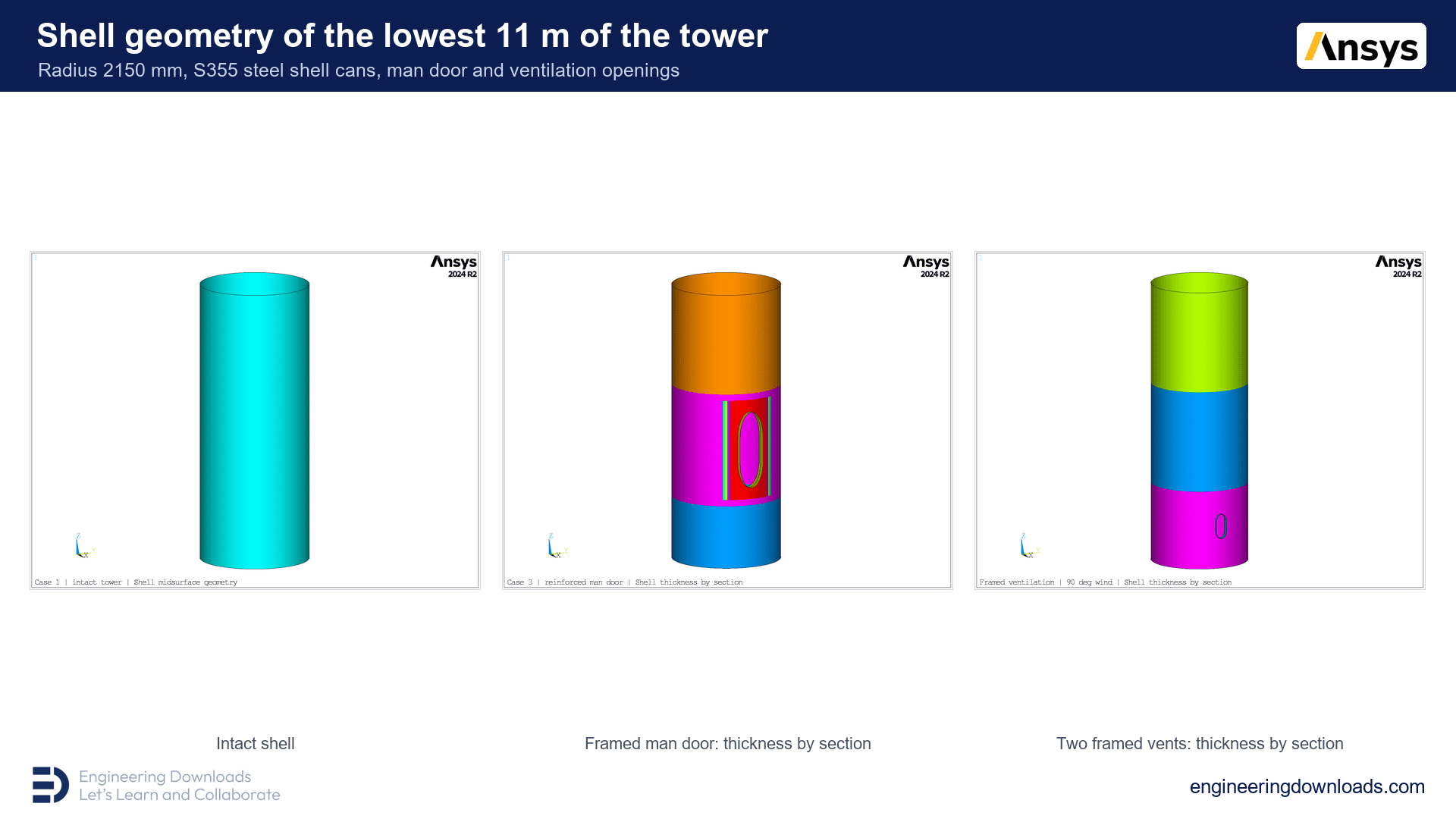
| Structure | Lowest 11 m of a tubular S355 steel tower, radius 2150 mm, shell cans of different thickness |
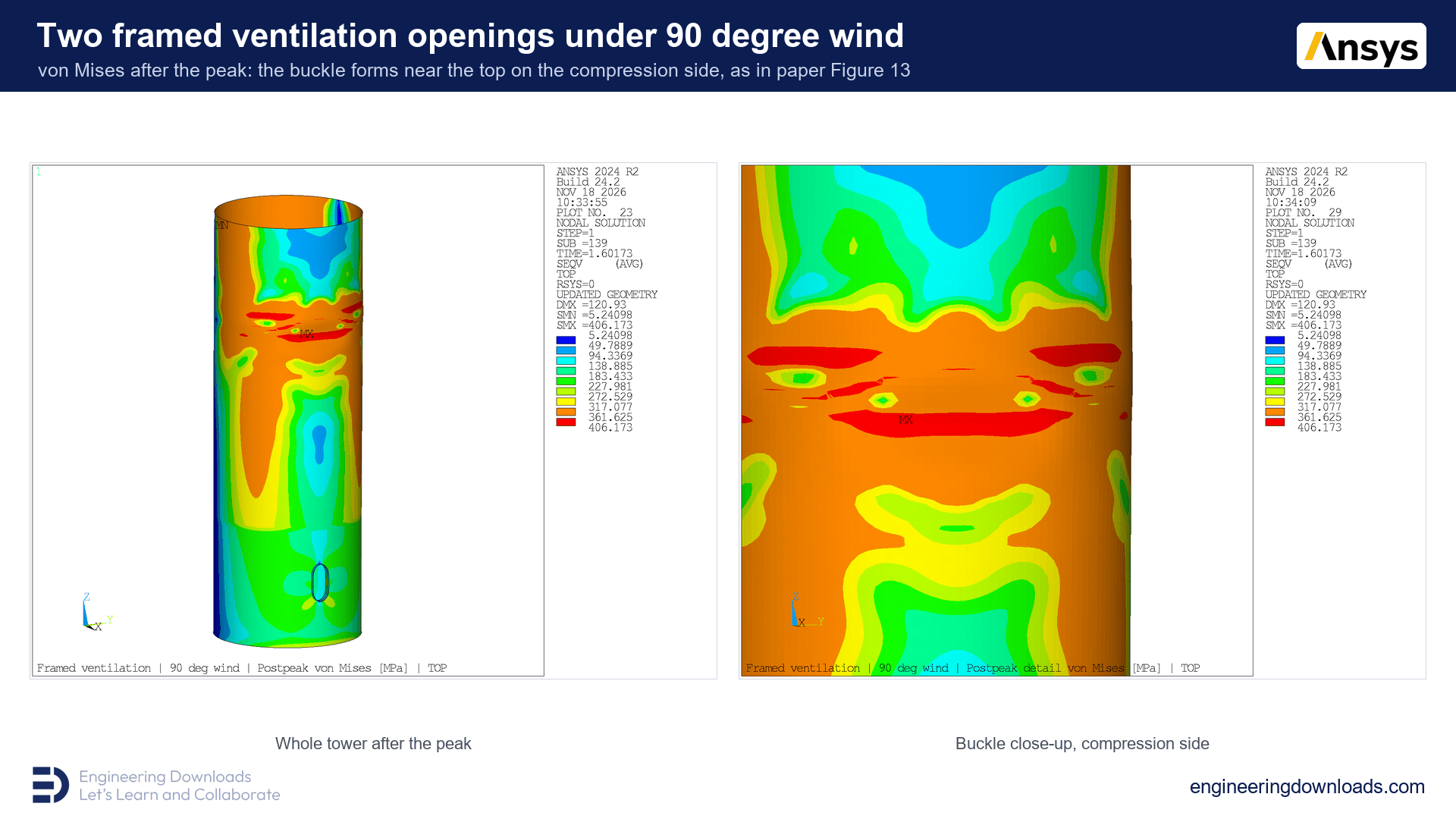
| Cases | T_MD1 intact shell; T_MD2 bare man door; T_MD3 man door with 65 mm door plate and frame; T_V90 two opposite framed ventilation openings, 90° wind |
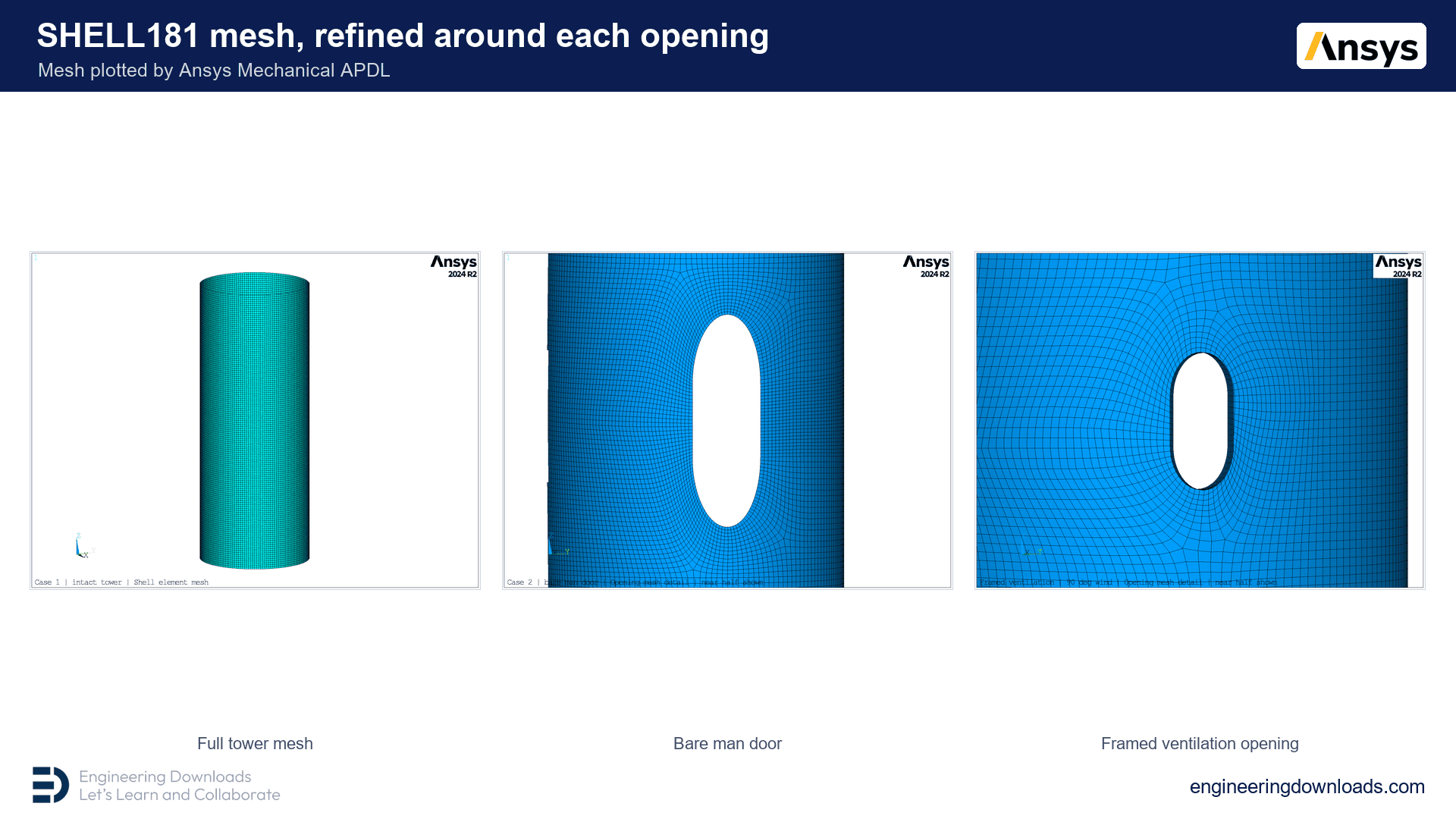
| Elements | SHELL181 shells with a mesh refined around each opening; MPC184 rigid beams to a top reference node |
| Material | Bilinear isotropic steel, E 210 GPa, ν 0.3, yield 355 MPa, 470 MPa at 0.15 plastic strain |
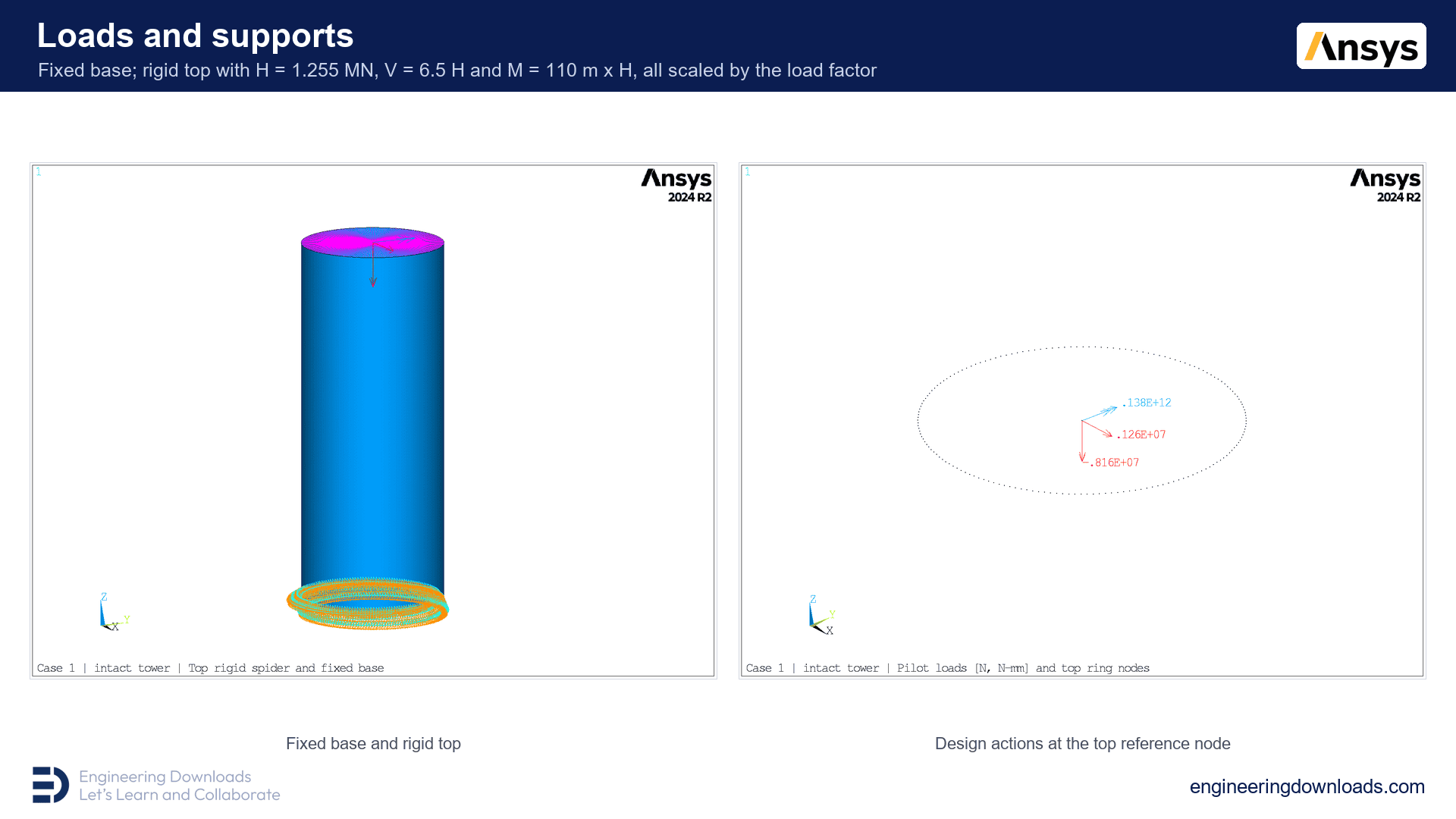
| Loads | At the top node: H = 1.255 MN, V = 6.5 H = 8.158 MN, M = 110 m × H = 138.05 MN·m (paper Figure 6), all scaled by one load factor λ |
| Supports | Fixed base |
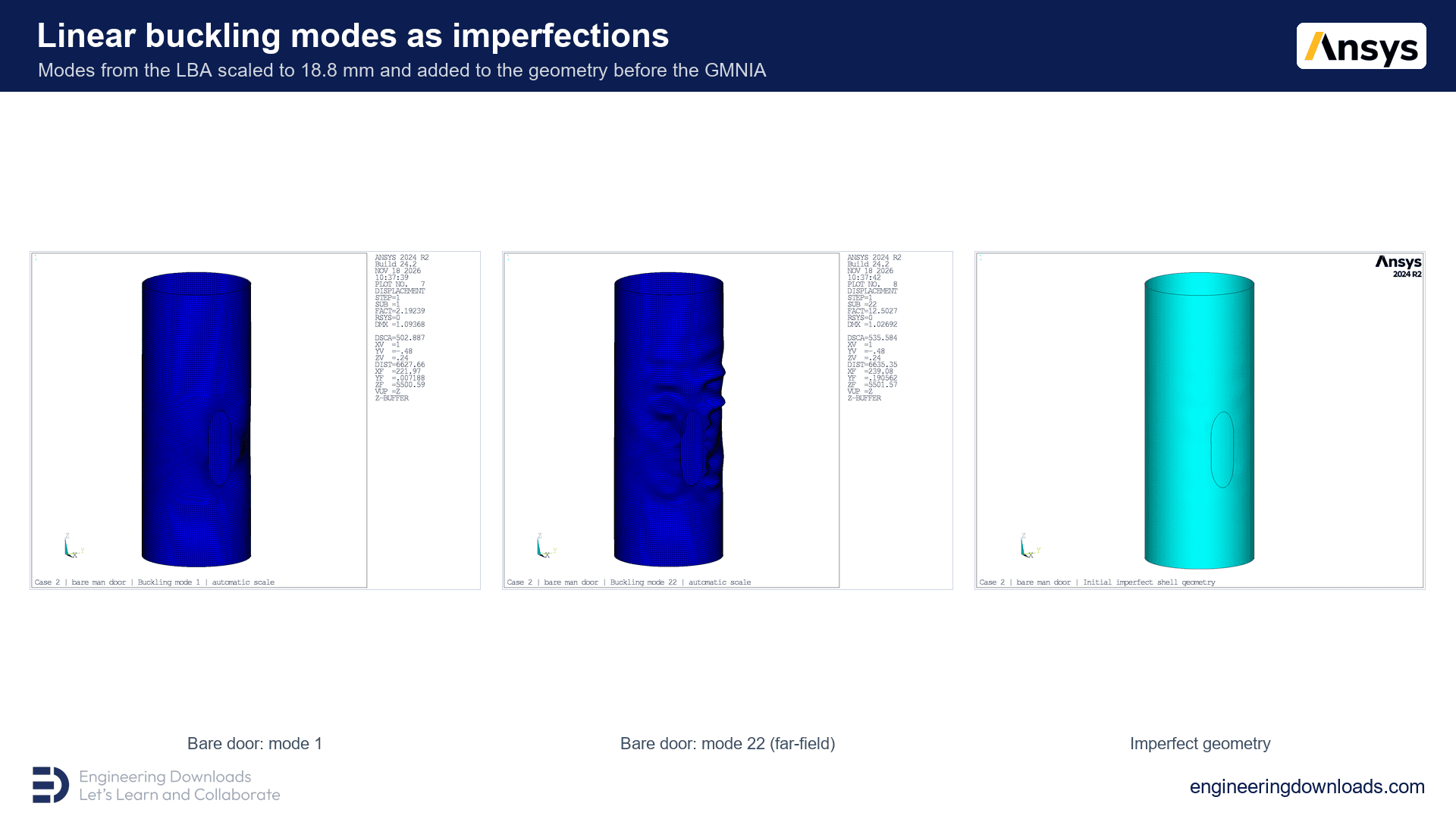
| Analysis | Linear buckling → modes scaled to 18.8 mm as imperfections → GMNIA with arc-length to beyond the peak |
| Software | Ansys Workbench and Ansys Mechanical APDL; model files and run script included, so it runs in your own Ansys |
| Case | Peak λ, paper | Peak λ, Ansys | Difference |
|---|---|---|---|
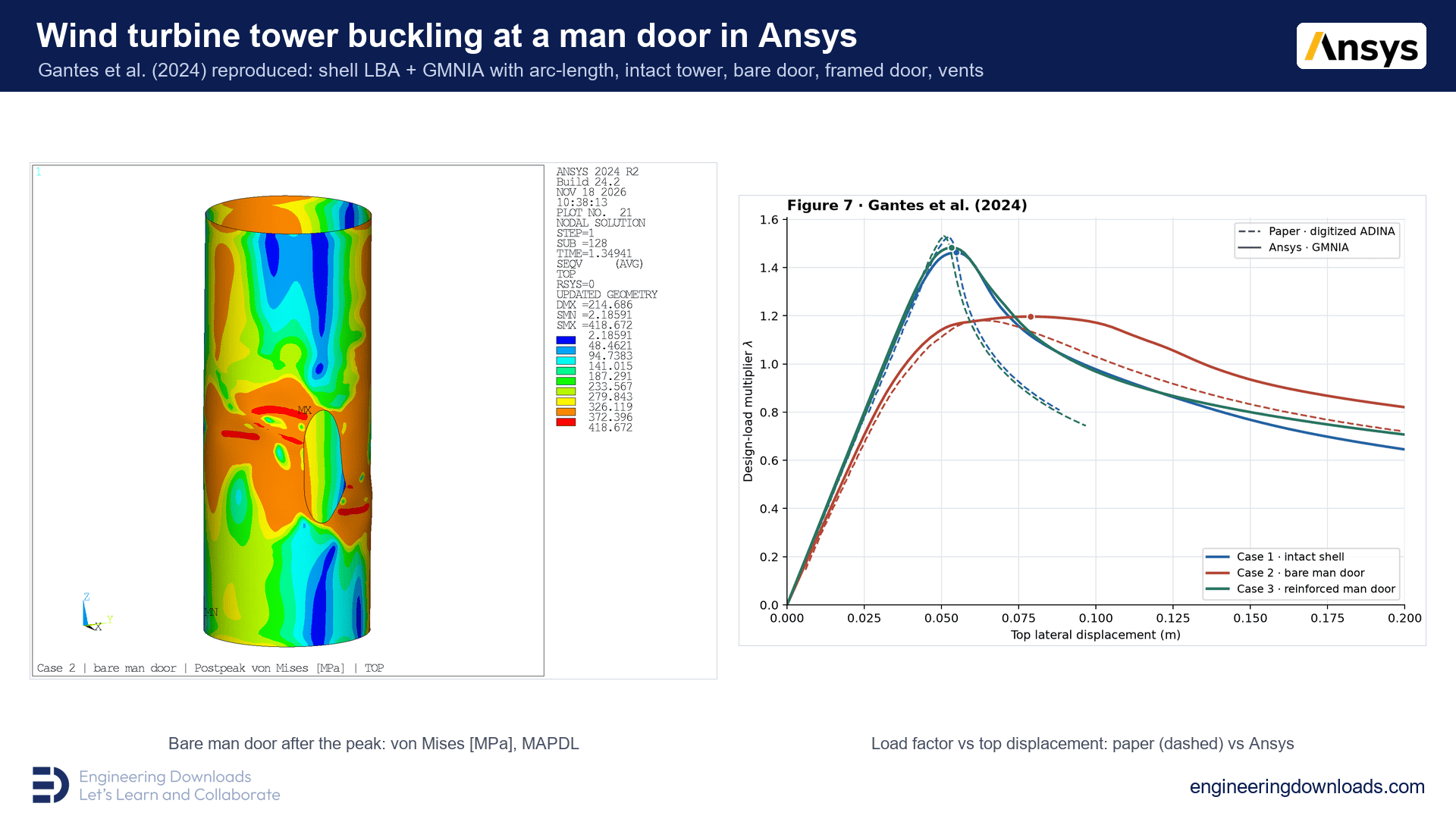
| Intact shell (T_MD1) | 1.530 | 1.463 | −4.4 % |
| Bare man door (T_MD2) | 1.182 | 1.197 | +1.3 % |
| 65 mm door plate + frame (T_MD3) | 1.532 | 1.483 | −3.2 % |
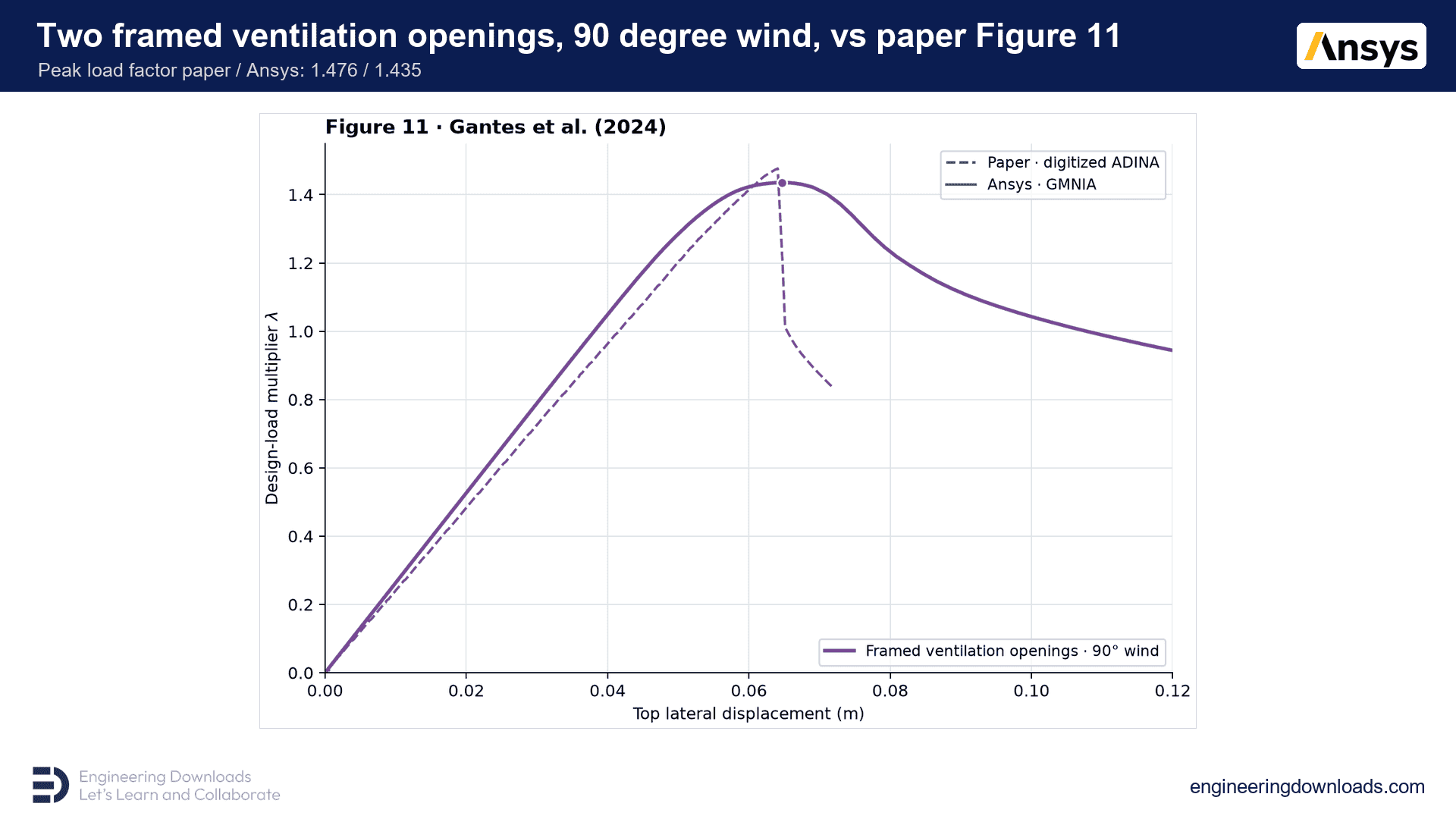
| Two framed vents, 90° wind (T_V90) | 1.476 | 1.435 | −2.8 % |
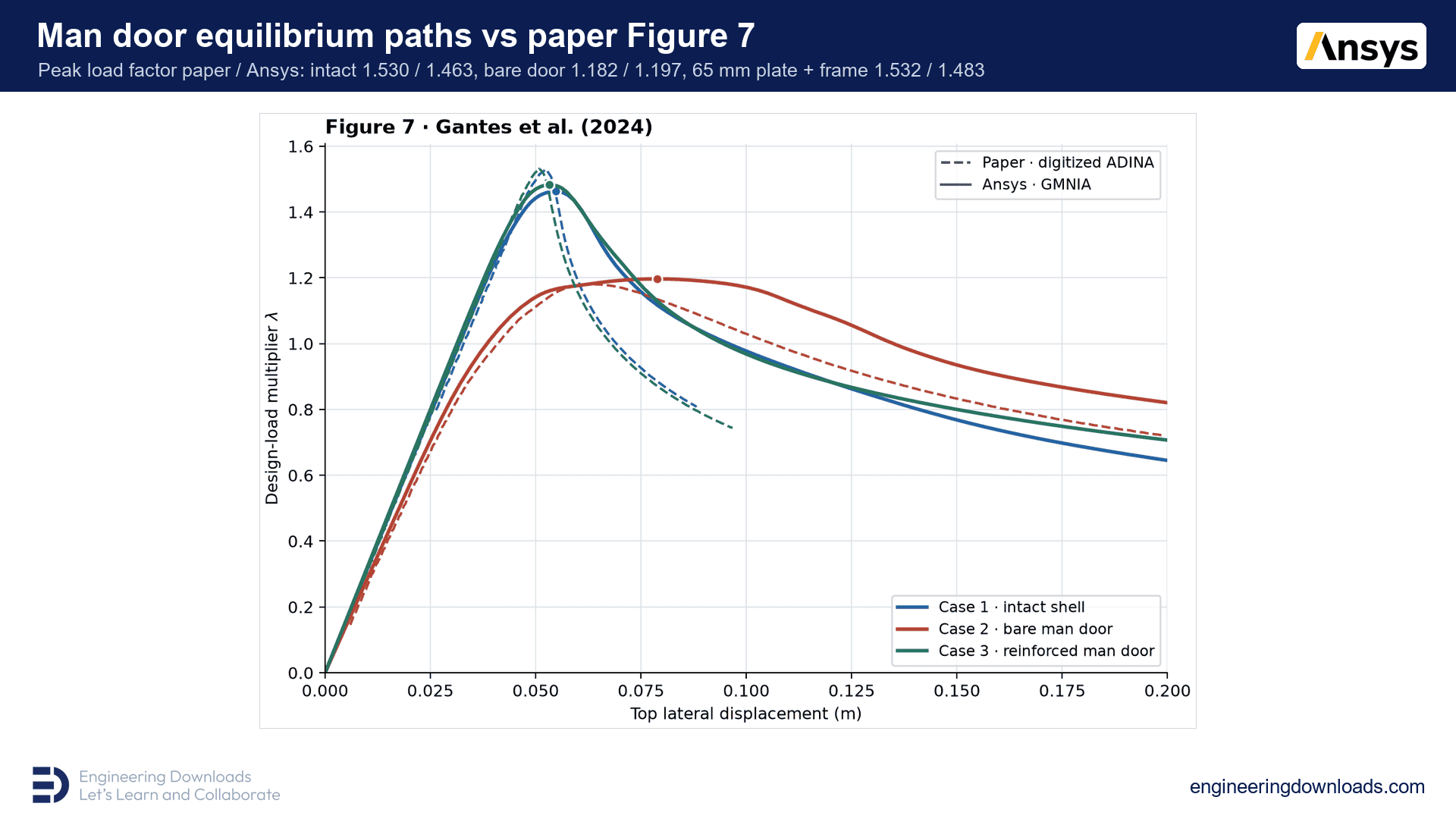
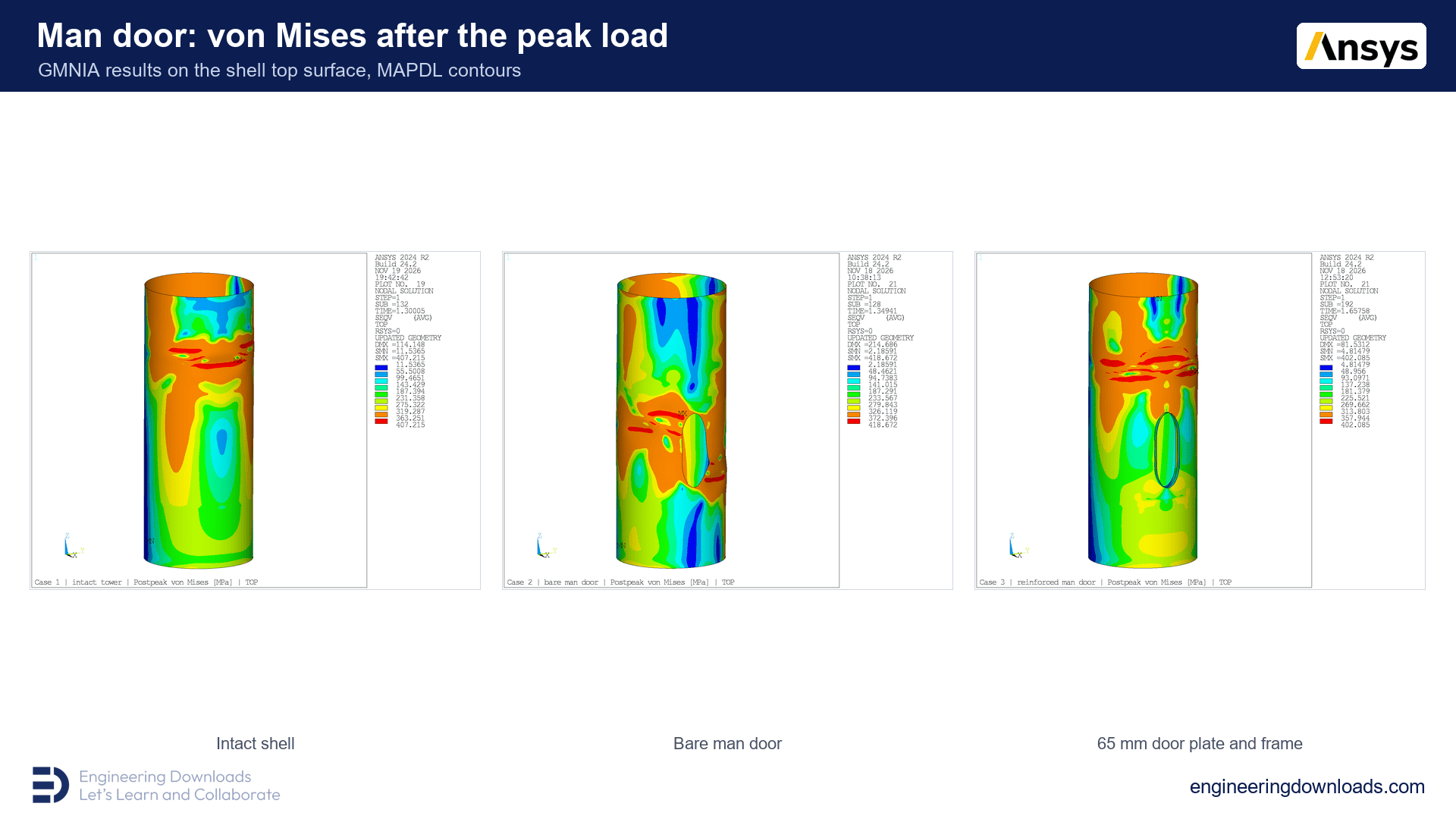
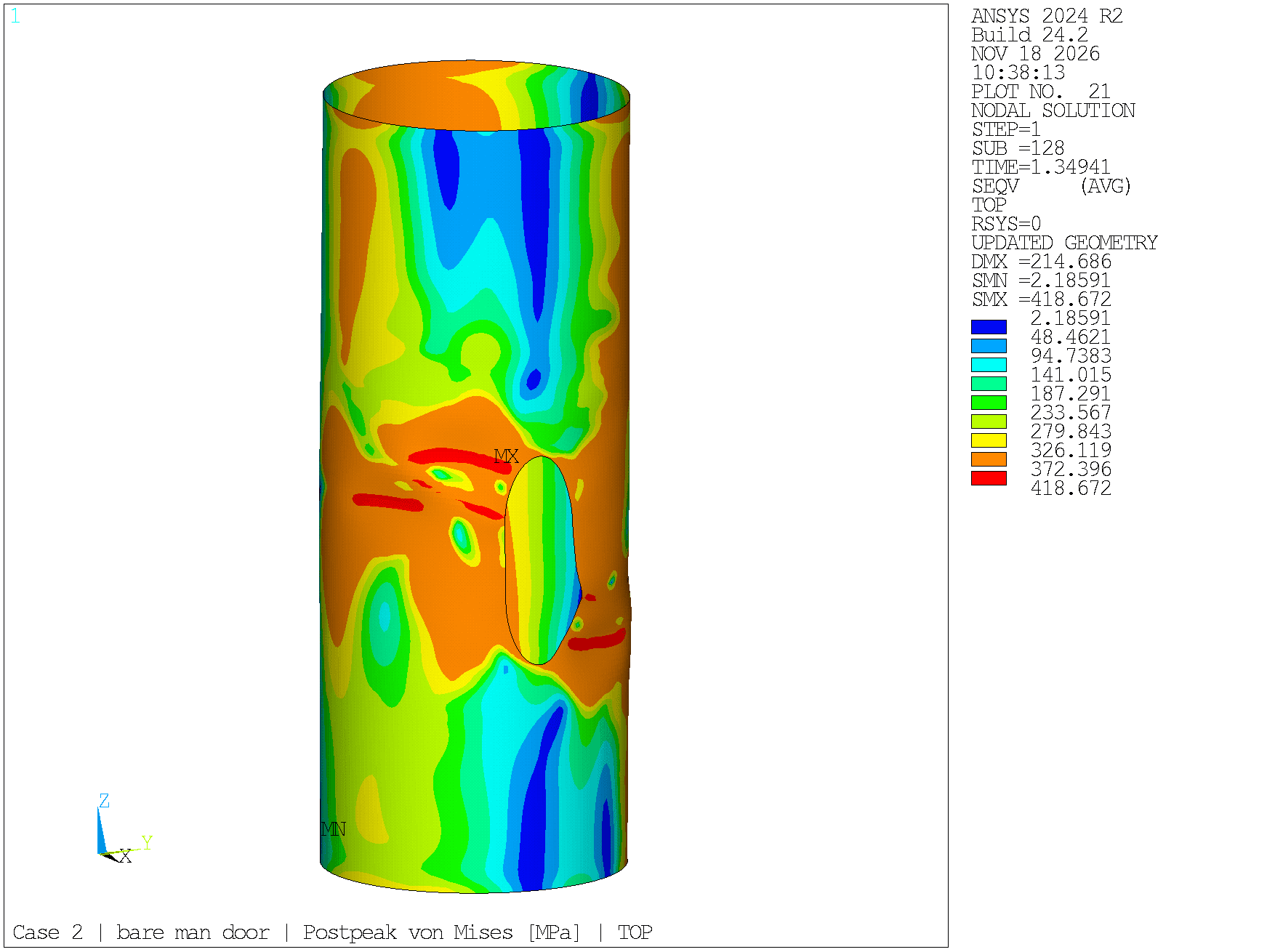
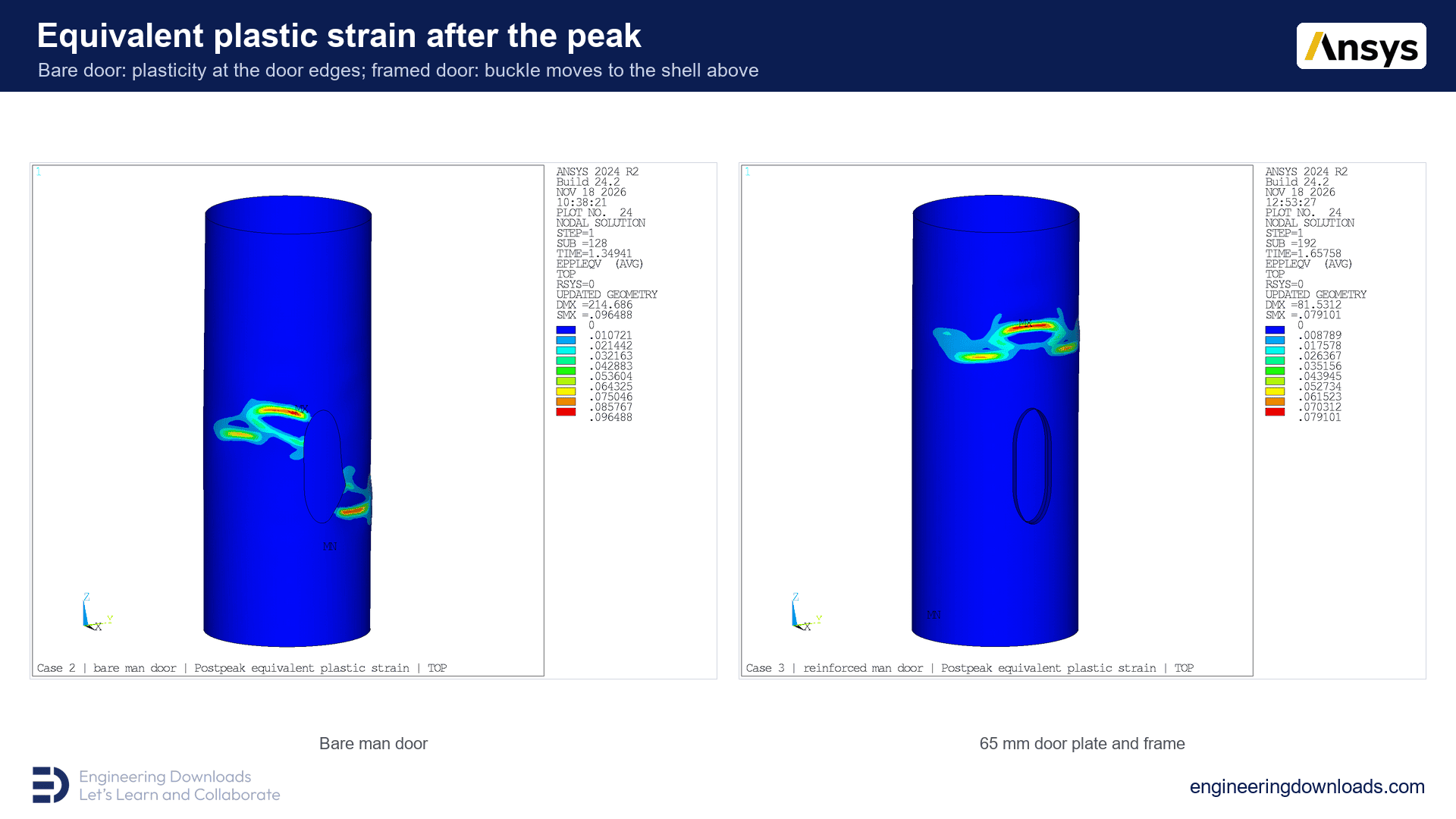
All four peak load factors are within 4.4 % of the paper. The bare man door lowers the peak by 18.2 % in Ansys (22.8 % in the paper), and the 65 mm door plate with its frame brings the tower back to the strength of the intact shell in both. The buckle forms at the door elevation for the bare opening and moves into the shell above the door once the opening is reinforced, the same pattern as in the paper.
The results report (PDF) included with the package covers:
Wind-energy and tower engineers who design door and vent reinforcement, FEA engineers who want a working LBA + GMNIA shell buckling workflow in Ansys with mode imperfections and arc-length control, and students who want to see a published tower buckling study rebuilt and checked against the paper.
Also available in Abaqus: wind turbine tower door opening buckling in Abaqus.
Which paper does this package reproduce? Gantes, Vernardos, Koulatsou and Gul, Nonlinear Finite Element Analysis of Tubular Steel Wind Turbine Towers near Man Door and Ventilation Openings to Optimize Design against Buckling, Vibration 2024, 7, 212-228, doi 10.3390/vibration7010012 (open access). The paper is cited, not bundled.
How close are the results to the paper? Peak load factor, paper / Ansys: intact shell 1.530 / 1.463, bare man door 1.182 / 1.197, 65 mm door plate and frame 1.532 / 1.483, two framed vents under 90 degree wind 1.476 / 1.435. All four are within 4.4 %.
Which analyses are included? A linear buckling analysis gives the buckling modes, which are scaled to 18.8 mm and added to the geometry. A geometrically and materially nonlinear analysis with imperfections (GMNIA) with arc-length control then follows each tower past its peak load.
What are the loads? The design actions of the paper (Figure 6) at a rigid top reference node: H = 1.255 MN, V = 6.5 H and M = 110 m x H, all multiplied by one load factor. The base is fixed.
Do I get a Workbench project? Yes. The package holds one archived Ansys Workbench project (.wbpz) with all four cases, the APDL input files for each case and a Python script that runs every case in one click.
What if the package is not what I expected? Write to us. Engineering Downloads refunds clients who are not satisfied with a delivered product.
Need more than the files?
There are two ways we can help. Book a one hour online consultation if you want to talk a problem through with a CAE engineer, using the checkbox in the order box. Order a project if you need a full simulation built for you, delivered to an agreed scope, price and deadline under a written contract.
We work on FEA and CFD for engineers, researchers and companies. Order your project, or message us on WhatsApp for a quick reply.
Other packages engineers working on this topic also download.
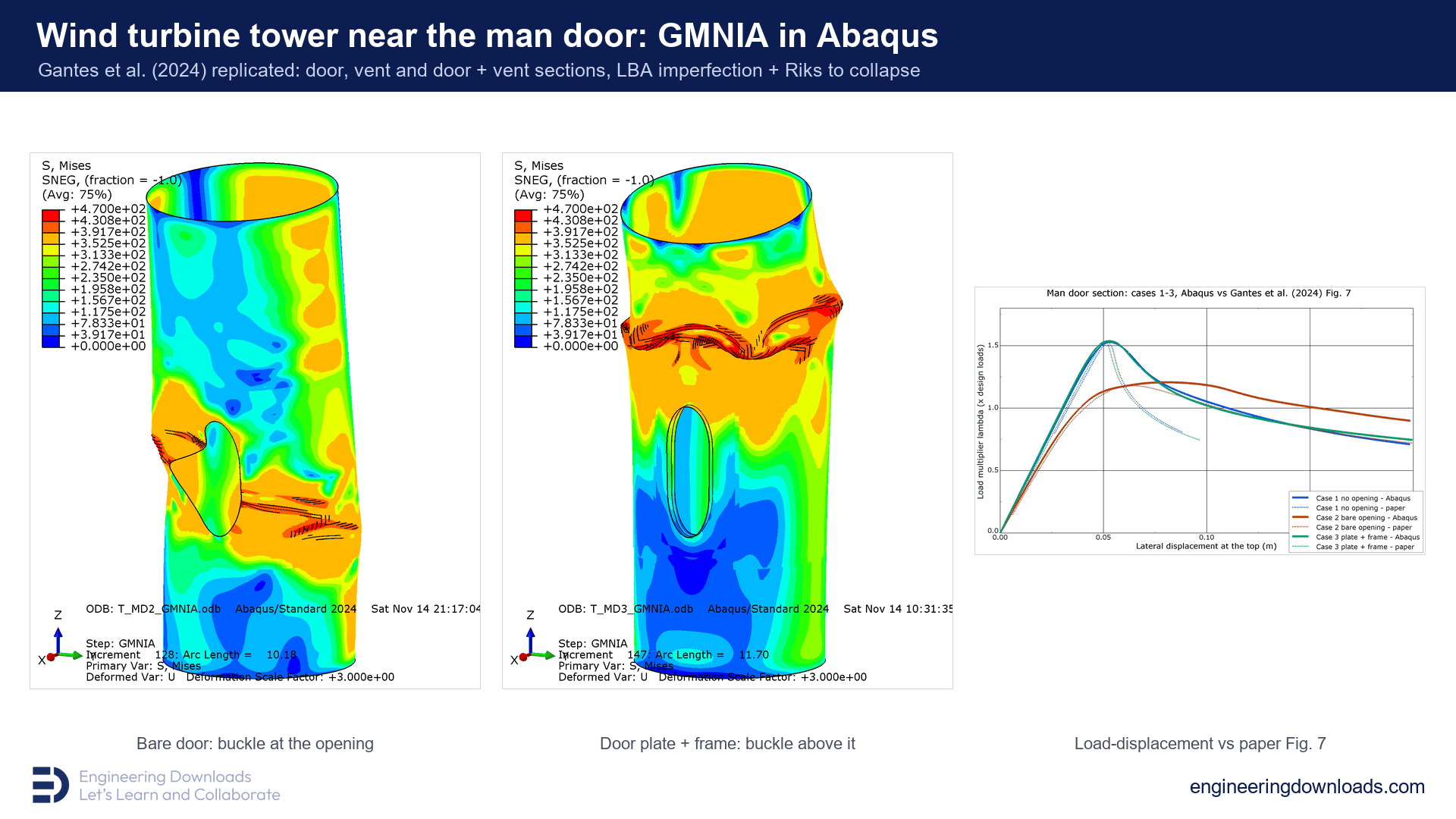 Wind Turbine Tower Buckling at Man Door and Vent Openings in Abaqus: GMNIA, after Gantes et al. (2024)€149,00
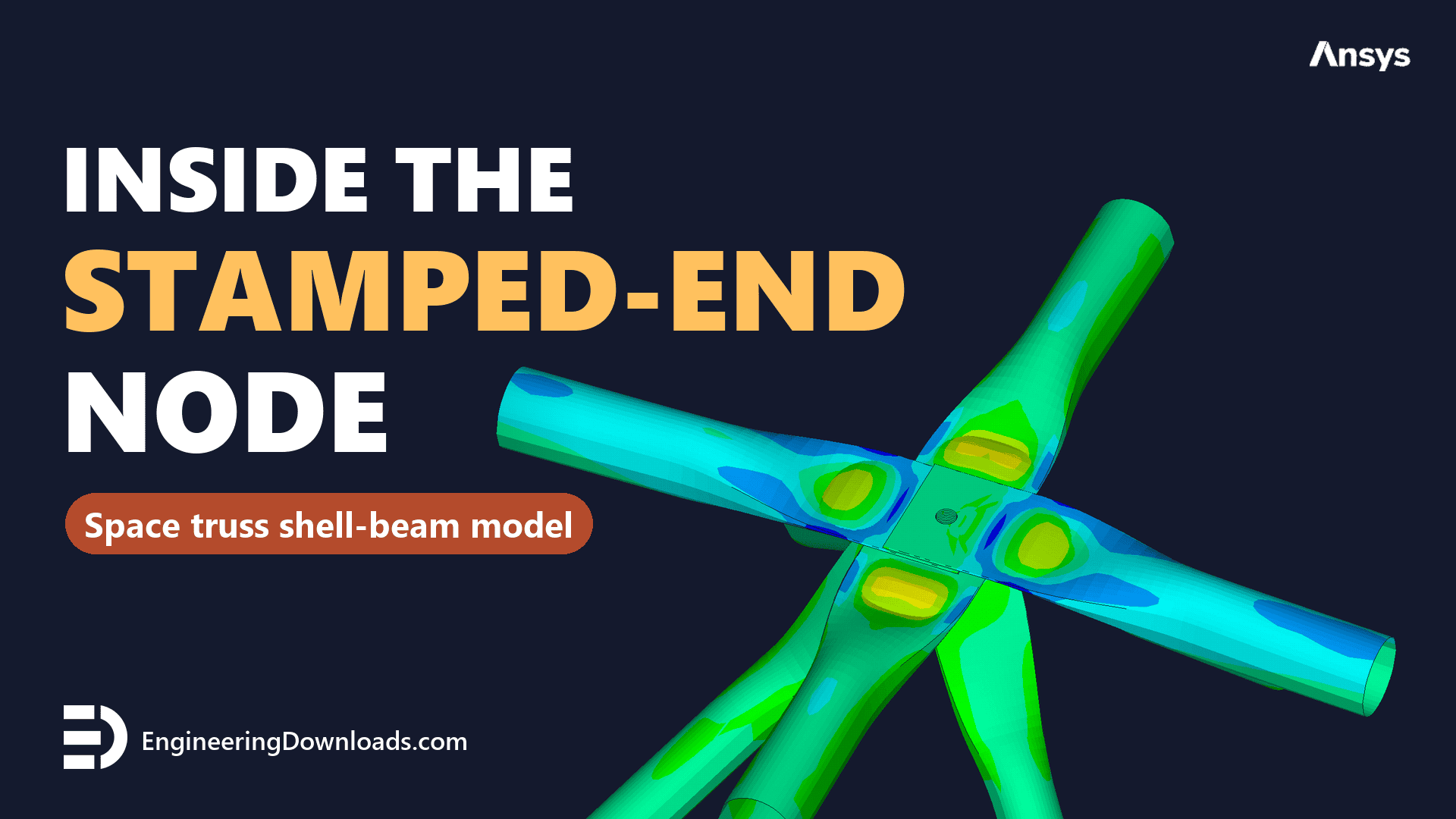 Stamped-End Tube Space Truss Node in Ansys: Shell-Beam Model of the Central Joint (Double-Layer Grid)€129,00
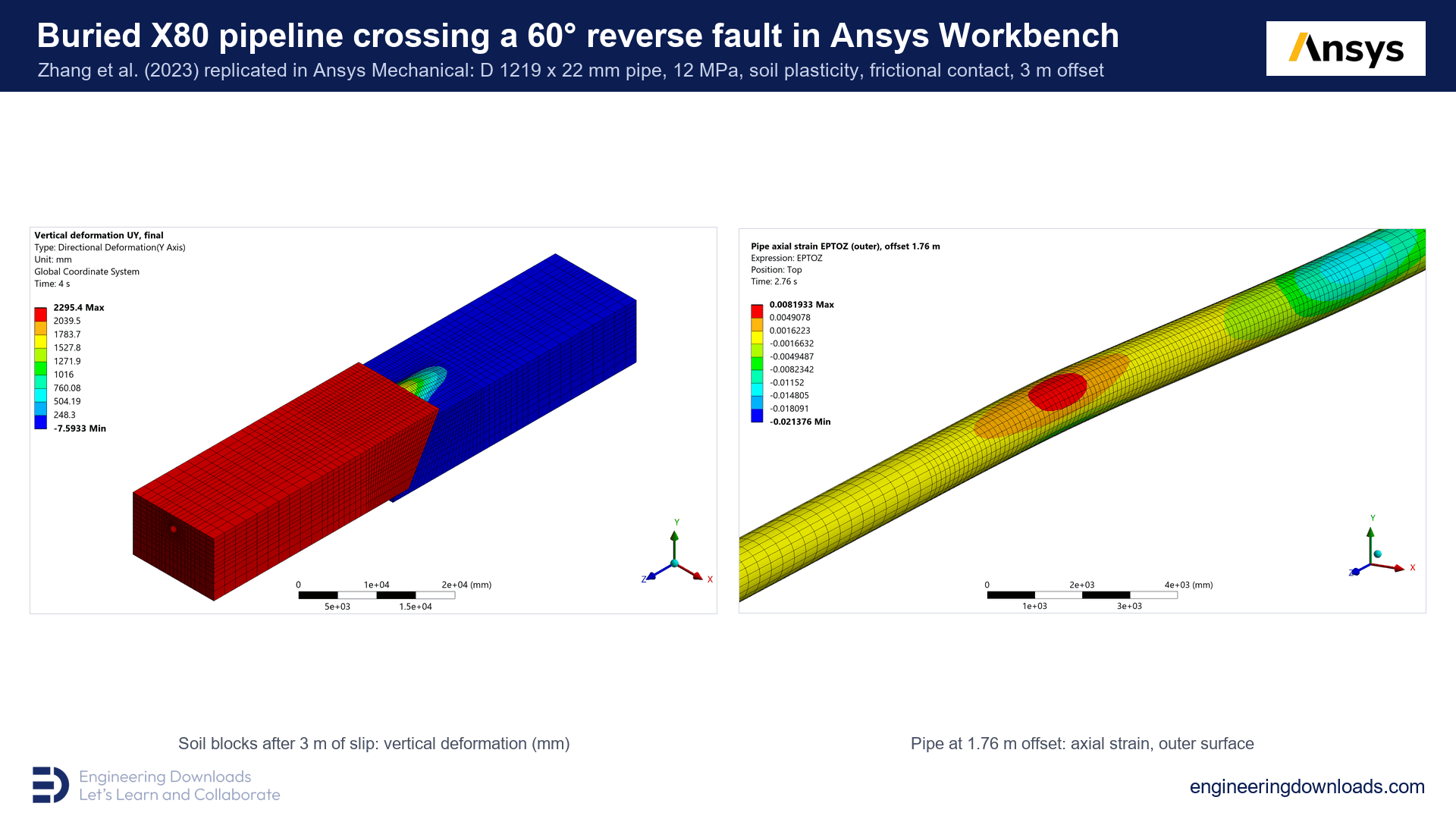 Buried Pipeline Crossing a Reverse Fault in Ansys Workbench, after Zhang et al. (2023)€129,00
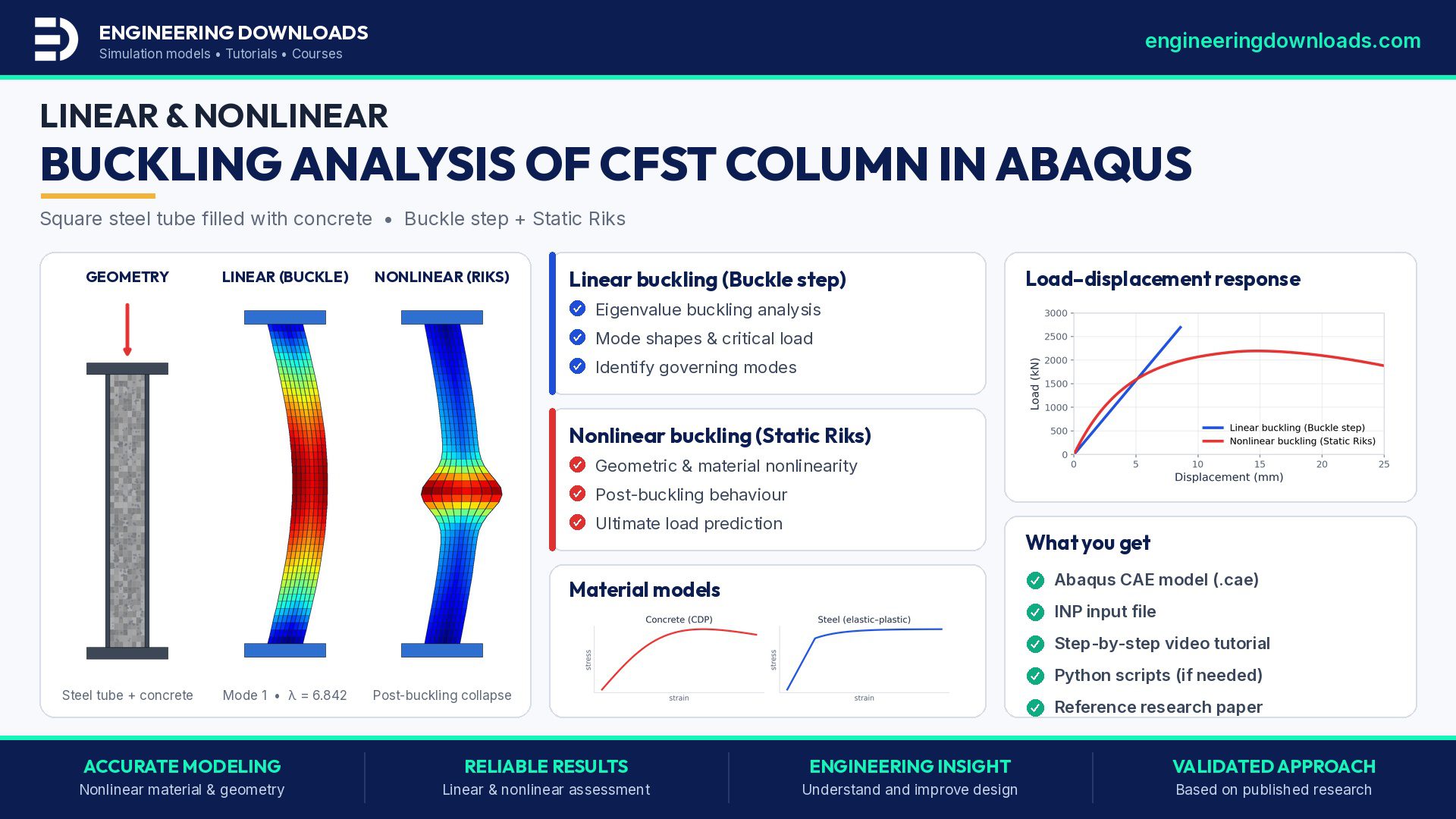 Buckling Analysis of a Concrete-Filled Steel Tube (CFST) Column Using Abaqus
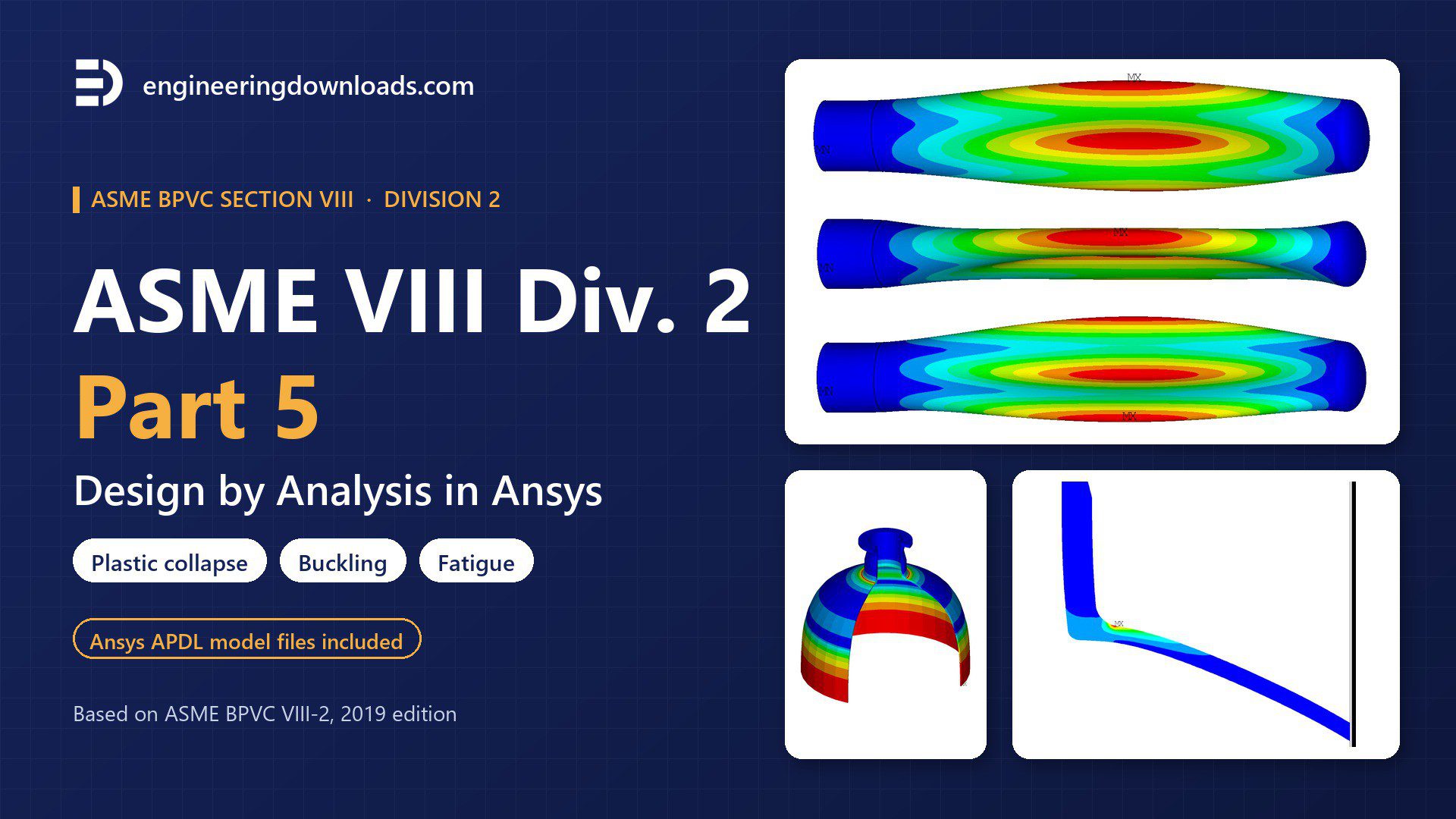 ASME VIII Div.2 Part 5 Design by Analysis with Ansys: Collapse, Buckling and Fatigue
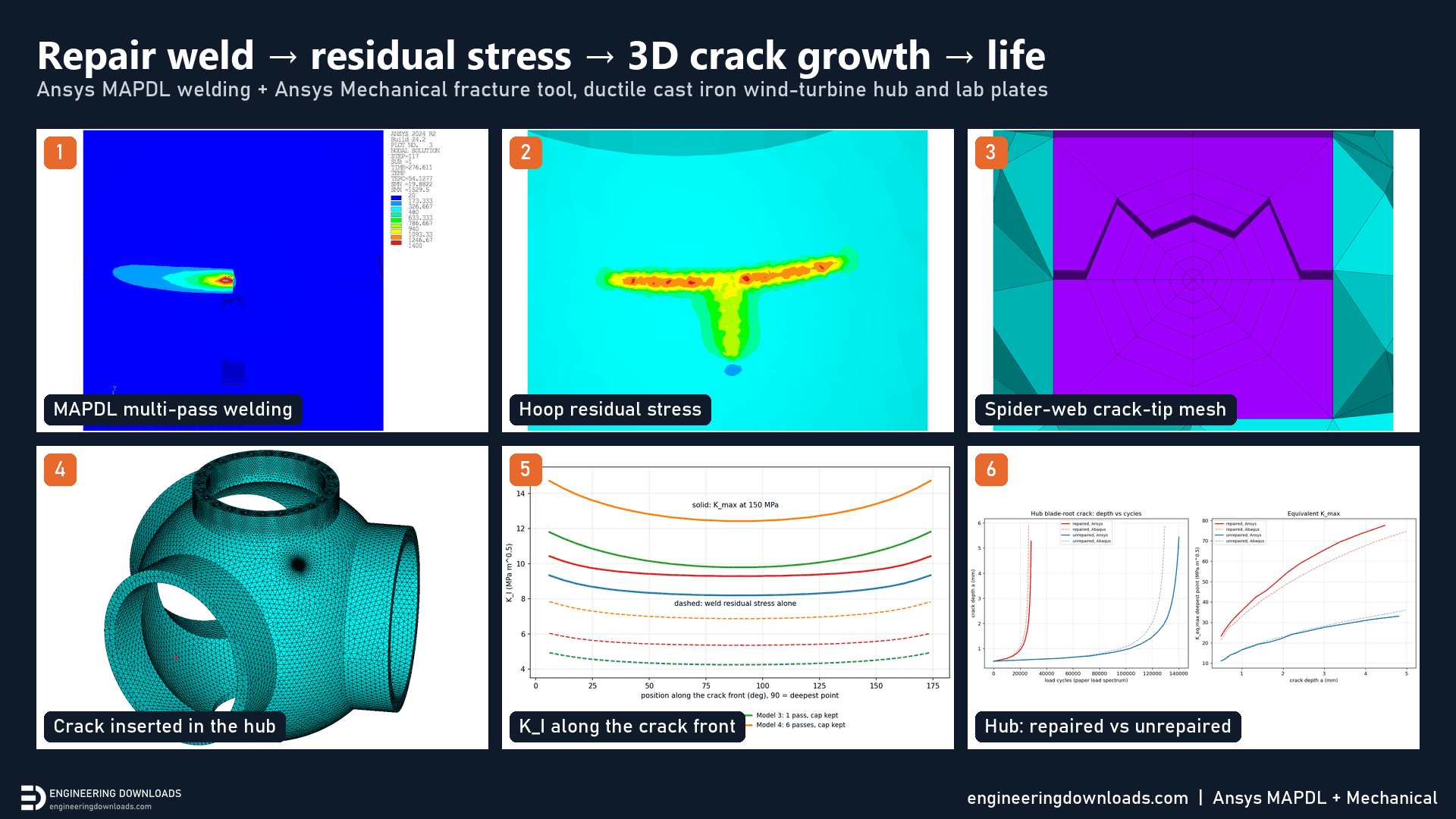 Repair Welding Residual Stress and 3D Fatigue Crack Growth in Ansys: Ductile Cast Iron Wind-Turbine Hub (FFS Level 3)€299,00
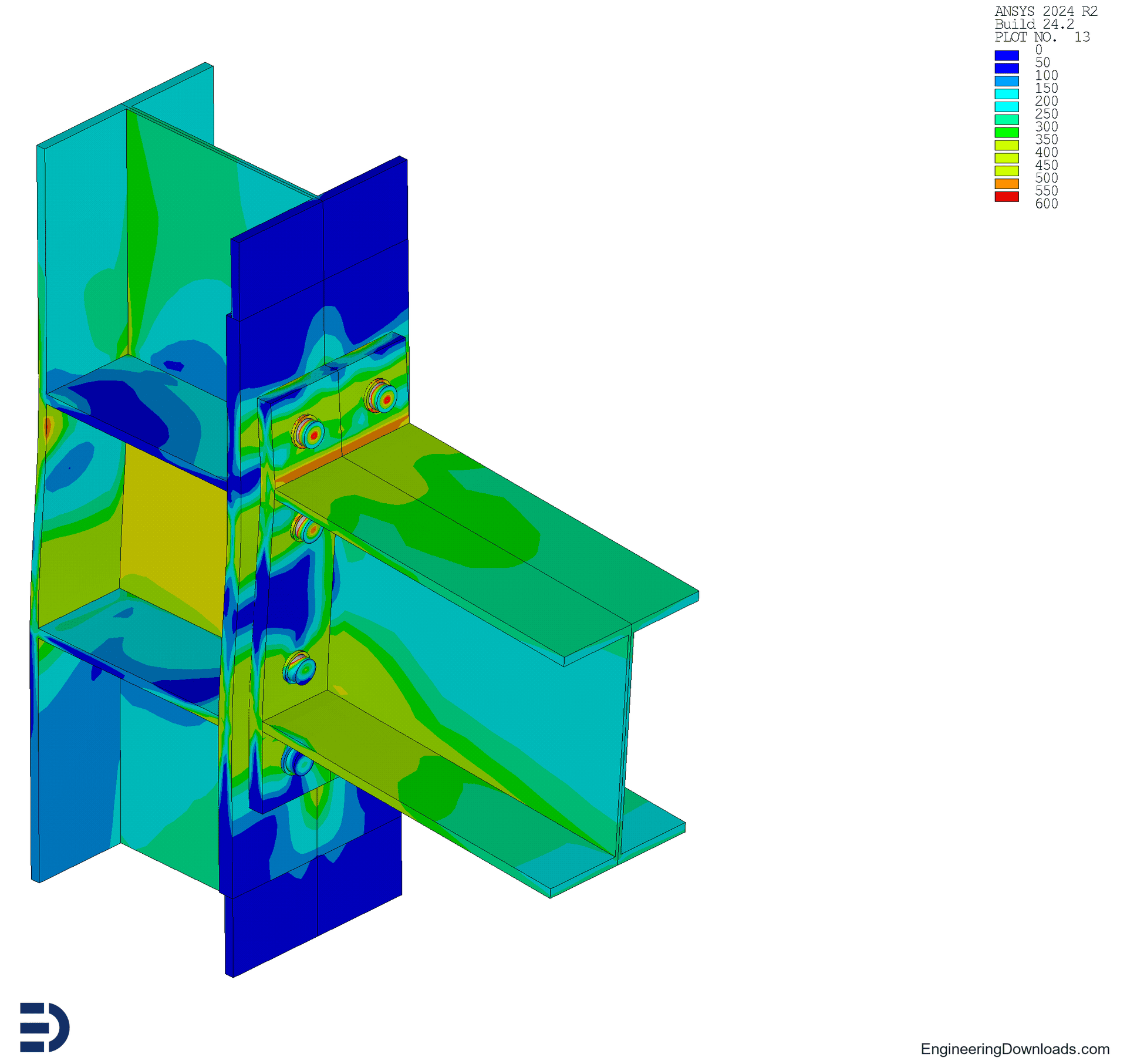 Bolt Pretension in Ansys Workbench: SC3 End-Plate Connection with All-Hex Bolts (Pretension Section with Lock, Initial Shank Stress, .wbpz)€89,00
 FEA of Connecting Rod using ANSYS

Need a full custom project? See the options below.
€129,00

€149,00
€89,00
€89,00
€299,00
€129,00
€129,00

€299,00
See more
Want to receive push notifications for all major on-site activities?

