Need a full custom project? See the options below.
Need a full custom project? See the options below.
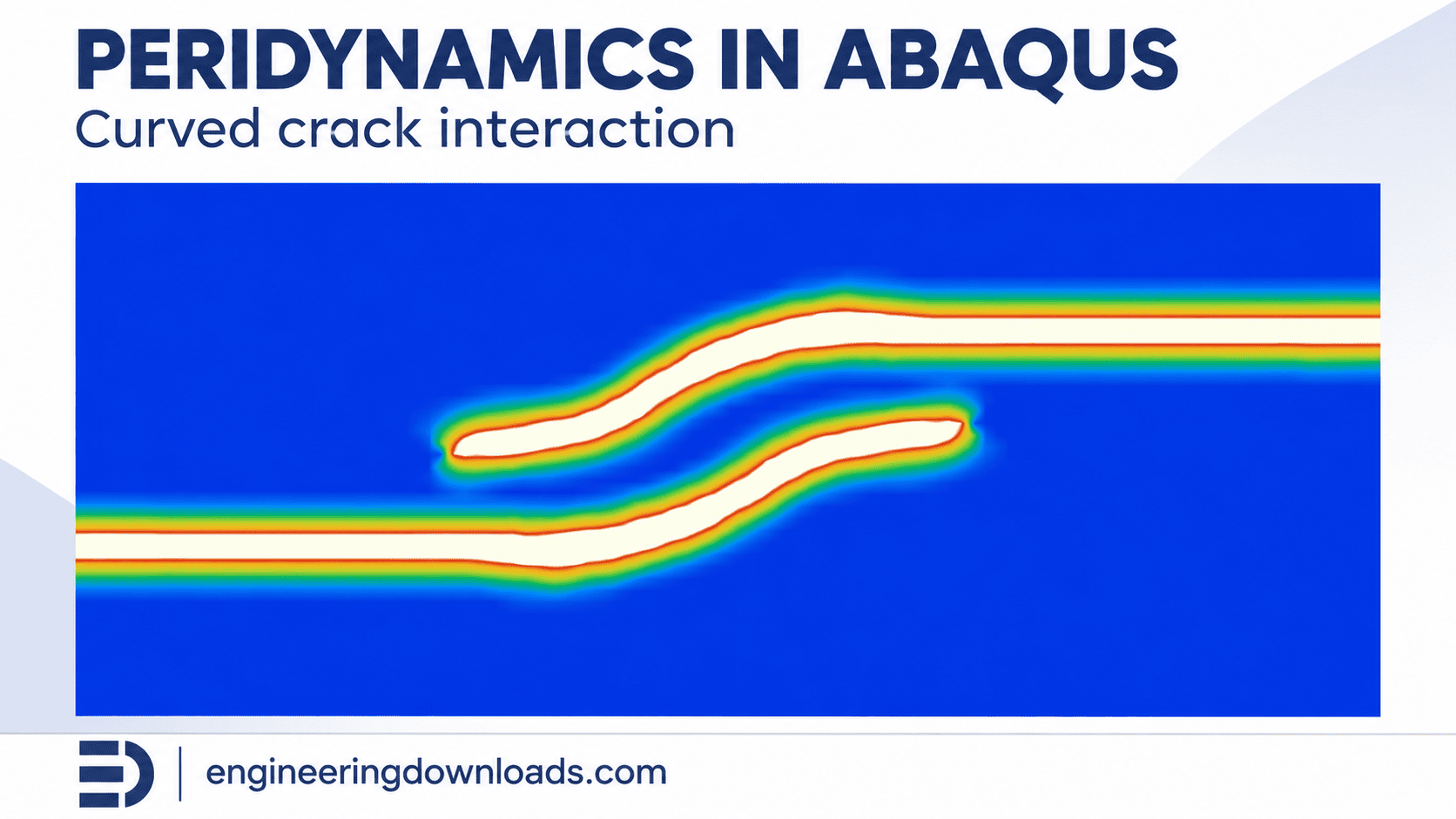
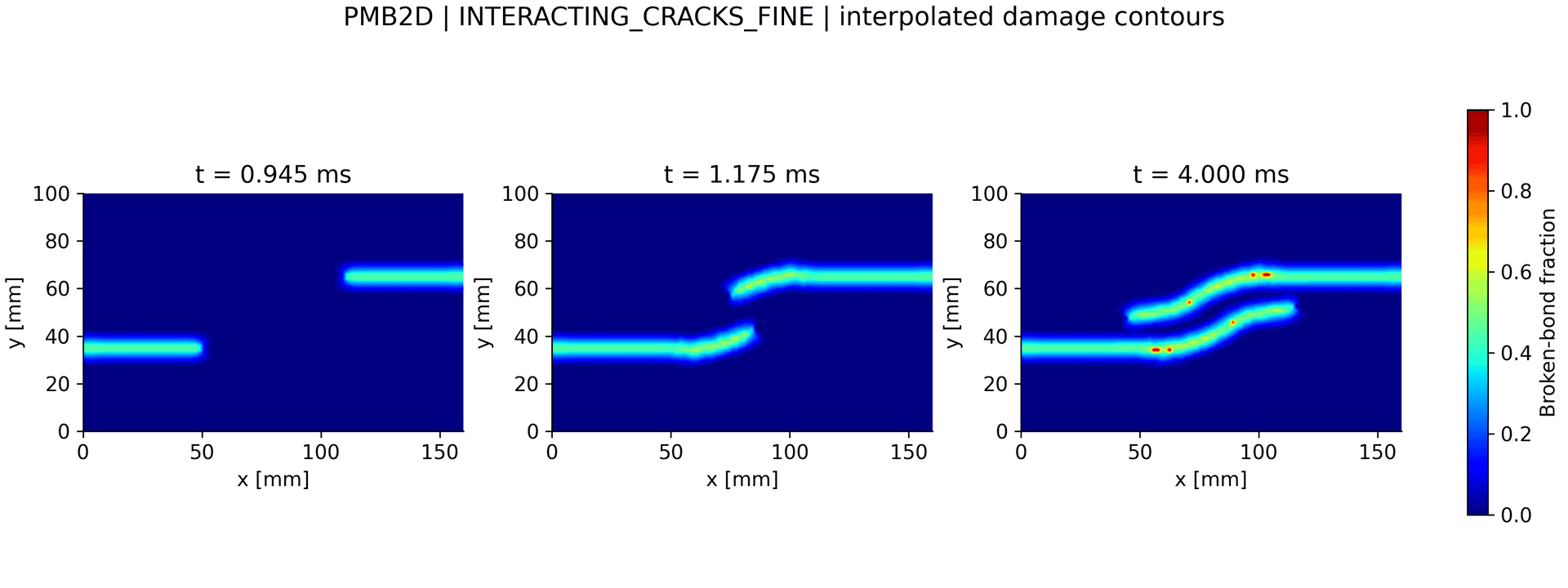
Peridynamics replaces the crack-tip singularity of classical fracture mechanics with a nonlocal bond model in which cracks are simply broken bonds, so they can start, curve and meet each other without a crack-path rule. This package puts that idea into Abaqus/Explicit using only native truss elements and one compiled VUMAT, and delivers a complete, solved showcase: two offset starter cracks in a 160 × 100 mm plate that grow, curve and interact. You get the CAE database, the self-contained 5,760-particle input deck, the VUMAT source and a 6-page PDF tutorial that explains how to run it and plot smooth damage contours.
Source paper: Fei Han, Zhibin Li, Jianyu Zhang, Zhiying Liu, Chen Yao and Wenping Han, “ABAQUS and ANSYS Implementations of the Peridynamics-Based Finite Element Method (PeriFEM) for Brittle Fractures”, Computer Modeling in Engineering & Sciences (CMES), 2023, vol. 136, no. 3, pp. 2715-2740, DOI 10.32604/cmes.2023.026922. Published open access under a Creative Commons Attribution 4.0 licence. Abstract as published:
In this study, we propose the first unified implementation strategy for peridynamics in commercial finite element method (FEM) software packages based on their application programming interface using the peridynamics-based finite element method (PeriFEM). Using ANSYS and ABAQUS as examples, we present the numerical results and implementation details of PeriFEM in commercial FEM software. PeriFEM is a reformulation of the traditional FEM for solving peridynamic equations numerically. It is considered that the non-local features of peridynamics yet possesses the same computational framework as the traditional FEM. Therefore, this implementation benefits from the consistent computational frameworks of both PeriFEM and the traditional FEM. An implicit algorithm is used for both ANSYS and ABAQUS; however, different convergence criteria are adopted owing to their unique features. In ANSYS, APDL enables users to conveniently obtain broken-bond information from UPFs; thus, the convergence criterion is chosen as no new broken bond. In ABAQUS, obtaining broken-bond information is not convenient for users; thus, the default convergence criterion is used in ABAQUS. The codes integrated into ANSYS and ABAQUS are both verified through benchmark examples, and the computational convergence and costs are compared. The results show that, for some specific examples, ABAQUS is more efficient, whereas the convergence criterion adopted in ANSYS is more robust. Finally, 3D examples are presented to demonstrate the ability of the proposed approach to deal with complex engineering problems.
What this package is, and is not. It follows the same goal as the paper, brittle peridynamic fracture inside a commercial FE code, but it is an original bond-based particle/truss implementation for Abaqus 2023 based on the formulation in Heo (2019, University of Strathclyde), not the paper's element-pair PeriFEM. It uses Abaqus/Explicit, not the implicit algorithm of the paper, and it contains no ANSYS files and no 3D examples. The paper's single-edge-notch benchmark was run during development as a qualitative path check and is not part of the delivered files.
| Item | Delivered fine benchmark |
|---|---|
| Plate | 160 × 100 × 1 mm, plane-stress bond model (ν = 1/3) |
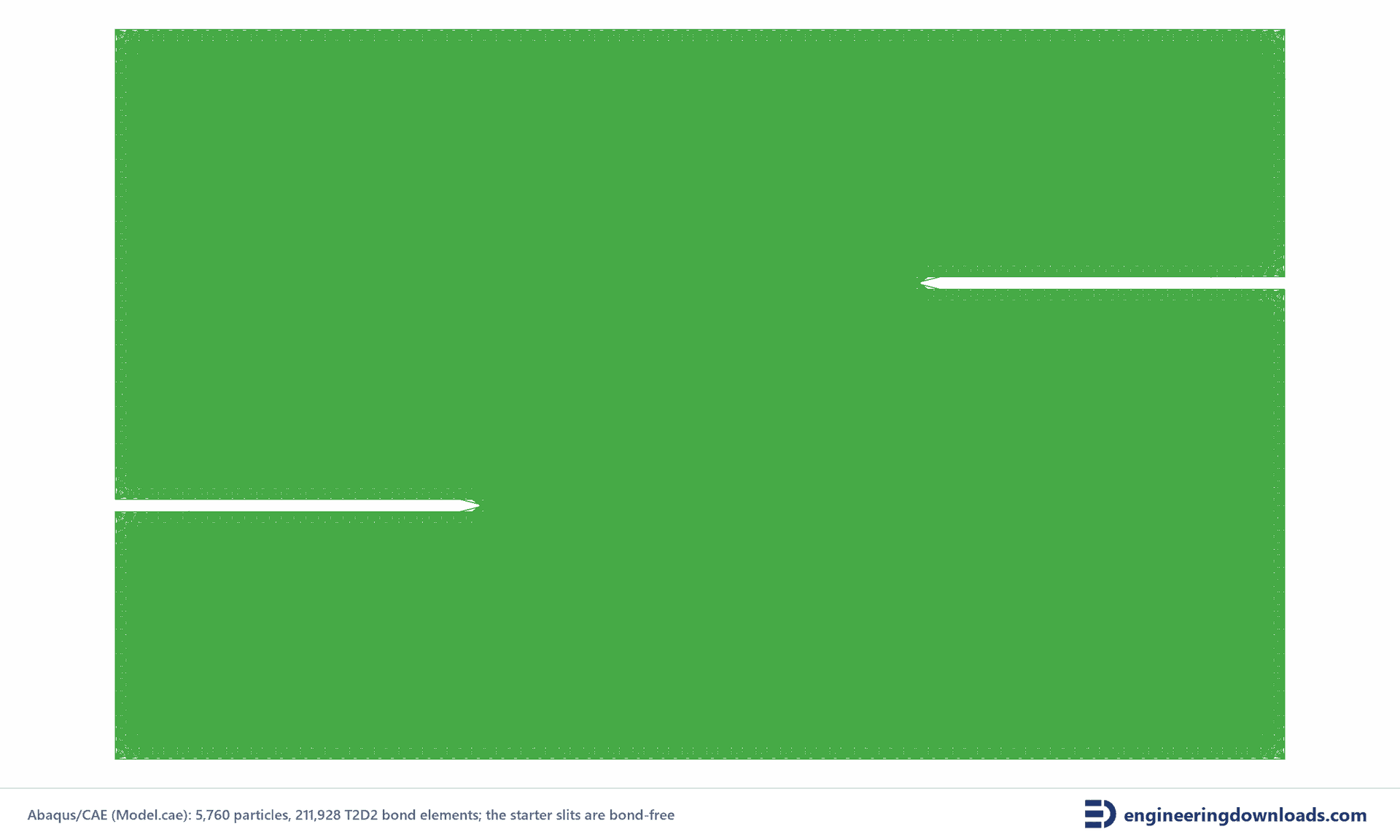
| Discretization | 5,760 particles, spacing 1.667 mm, 211,928 active bonds (T2D2 trusses plus point masses) |
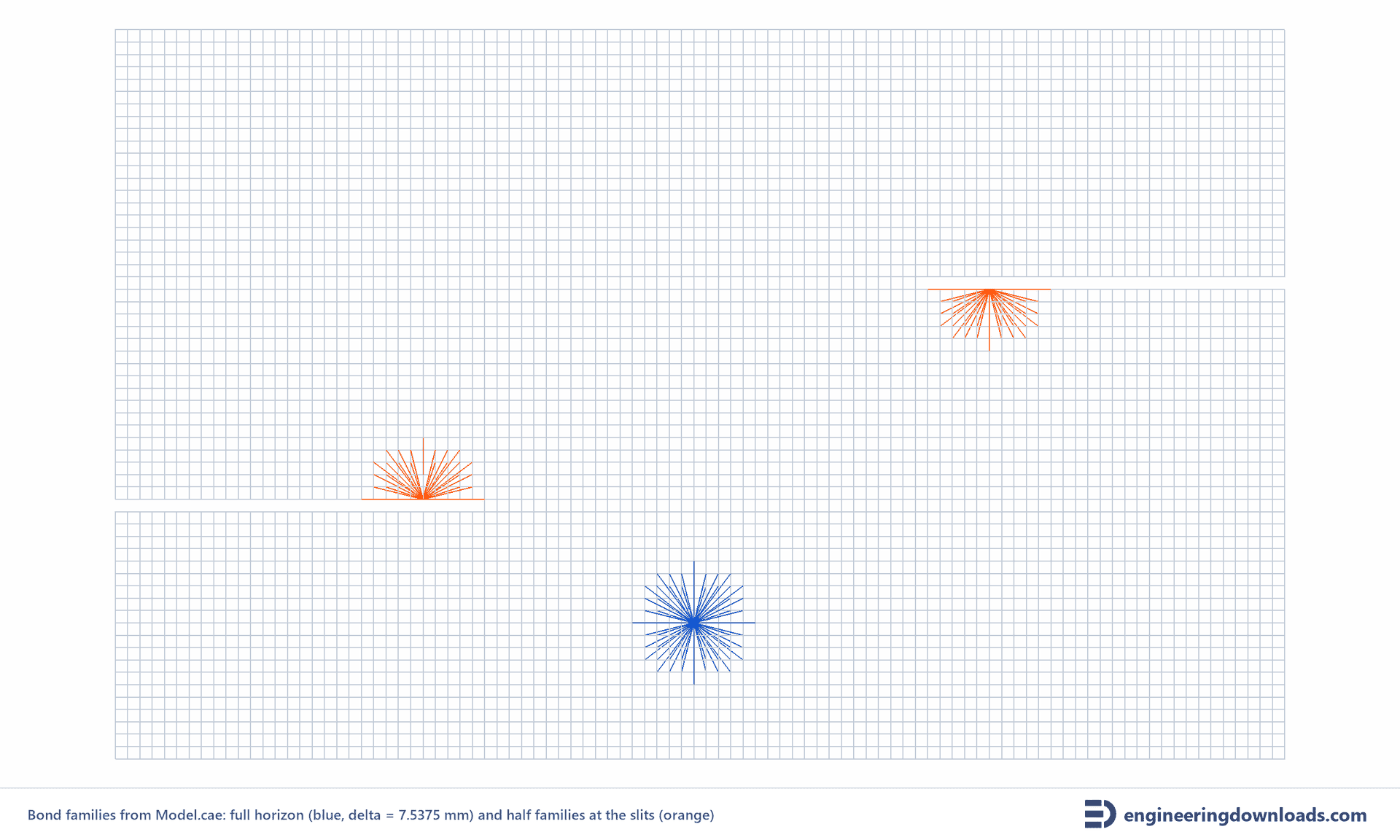
| Horizon | 7.5375 mm with a half-cell partial-volume shell |
| Material | E = 32,000 MPa, density 2.4e-9 tonne/mm³, Gc = 0.1 N/mm, critical stretch 7.645e-4 |
| Starter cracks | Two straight slits at (0,35)-(50,35) and (110,65)-(160,65) mm, offset and opposing |
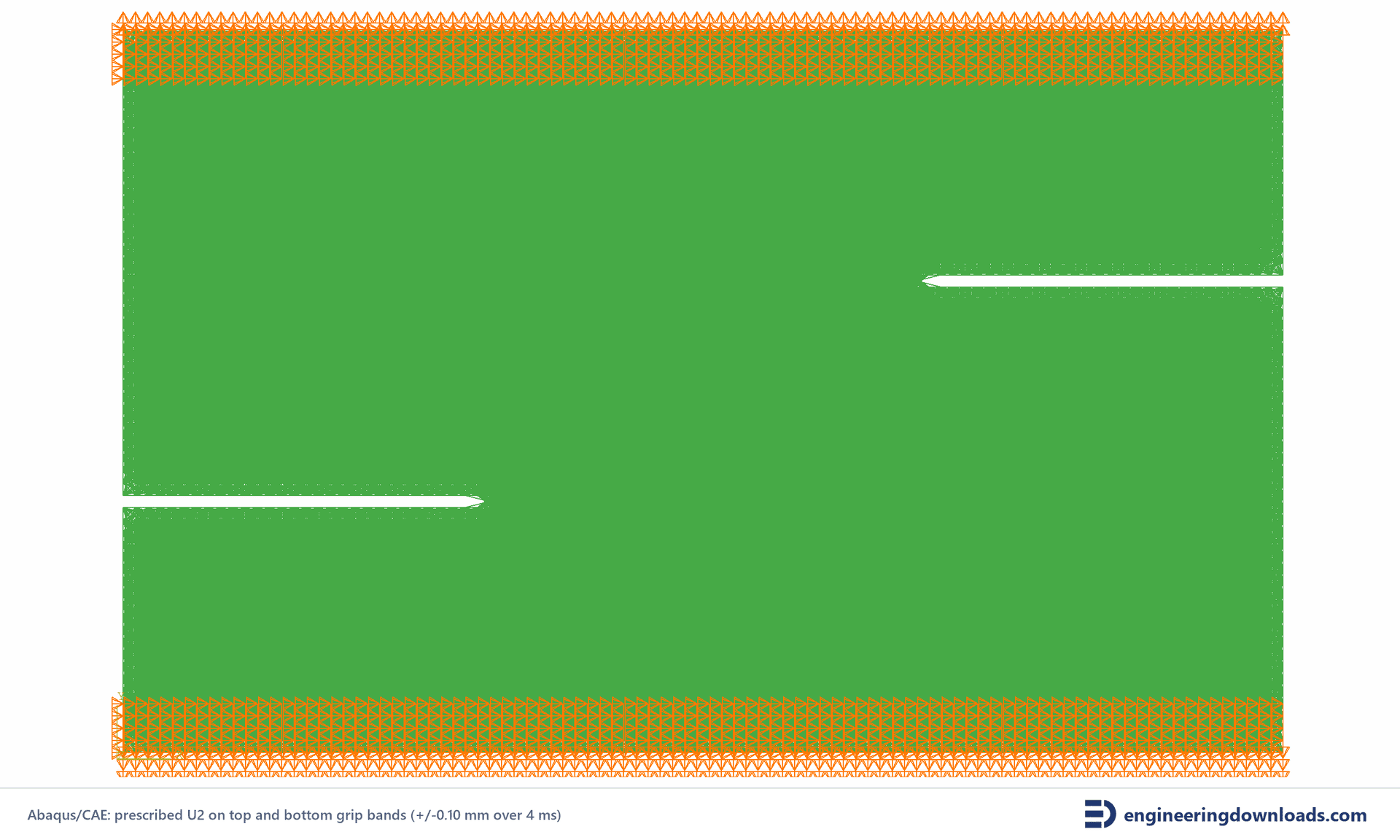
| Loading | Top and bottom grip bands, vertical motion ±0.10 mm, smooth ramp over 4 ms |
| Solver | Abaqus/Explicit, double precision, 4 CPU cores, 0.2 stable-increment scale factor, no mass scaling; about 410 s on the test machine |
| Subroutine | VUMAT with irreversible bond failure; log stretch, activity, maximum stretch, dissipated energy density and current stretch as state variables |
| Software tested | Abaqus 2023 on Windows with Intel Fortran Classic 2021.6 |
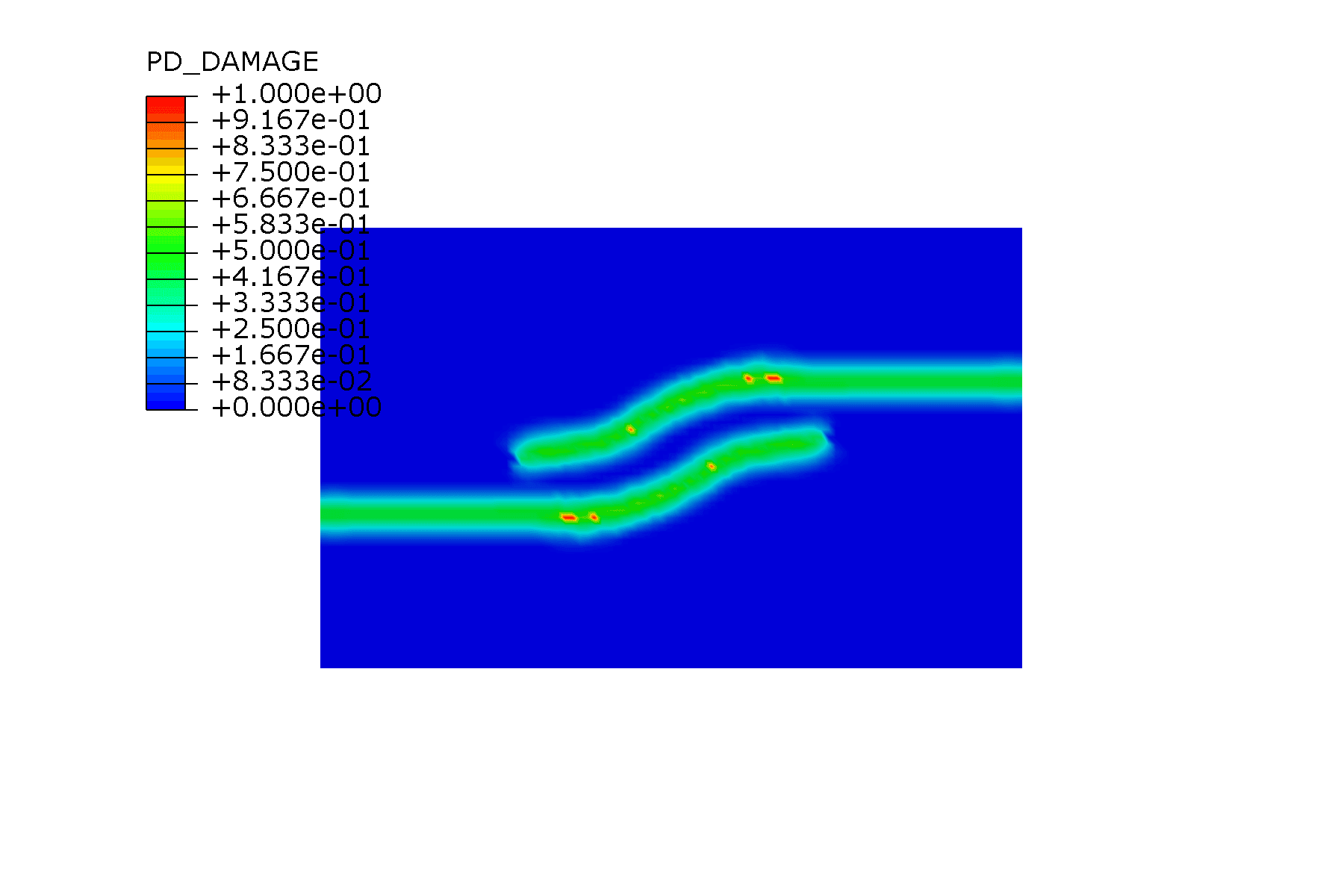
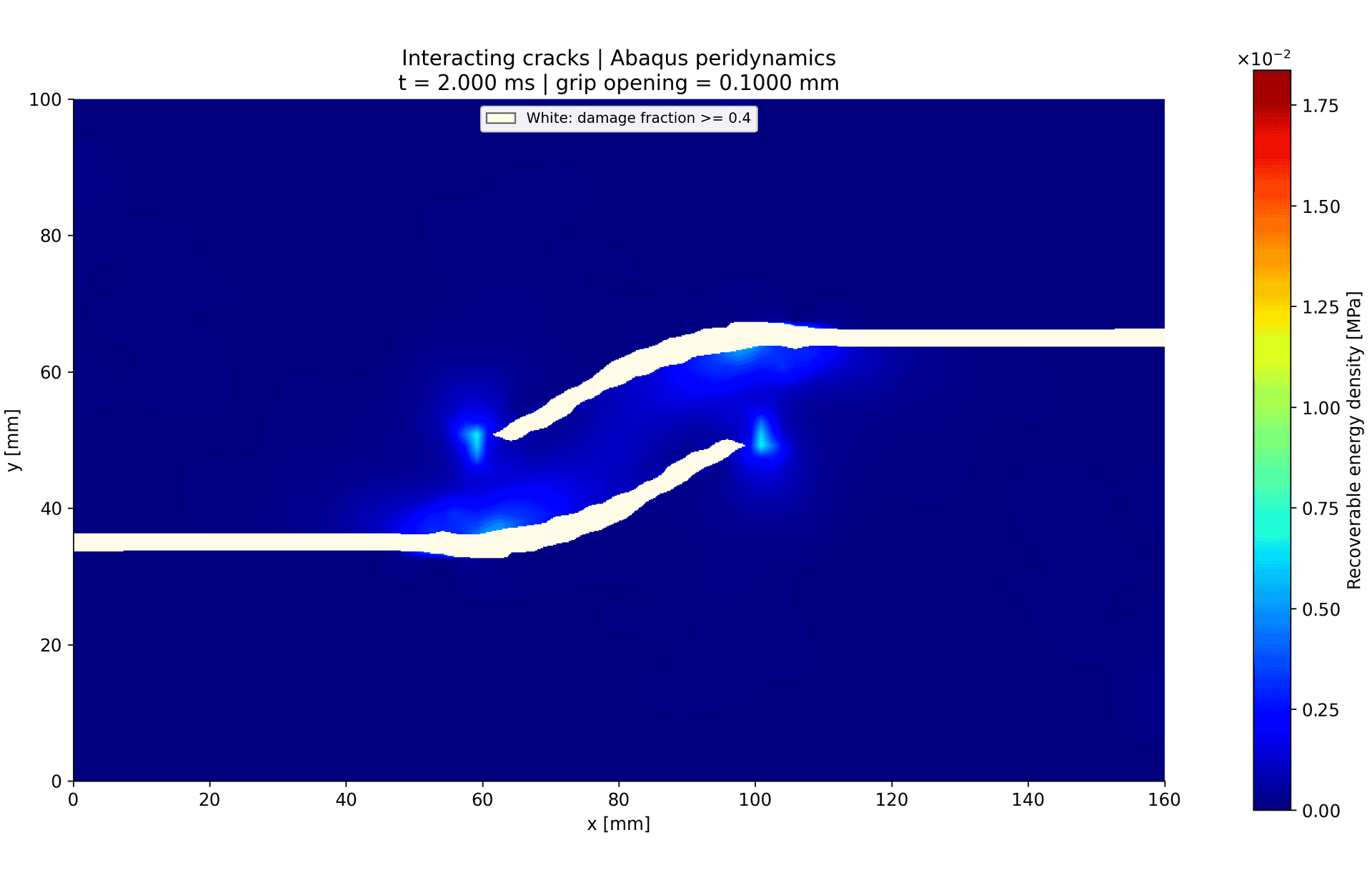
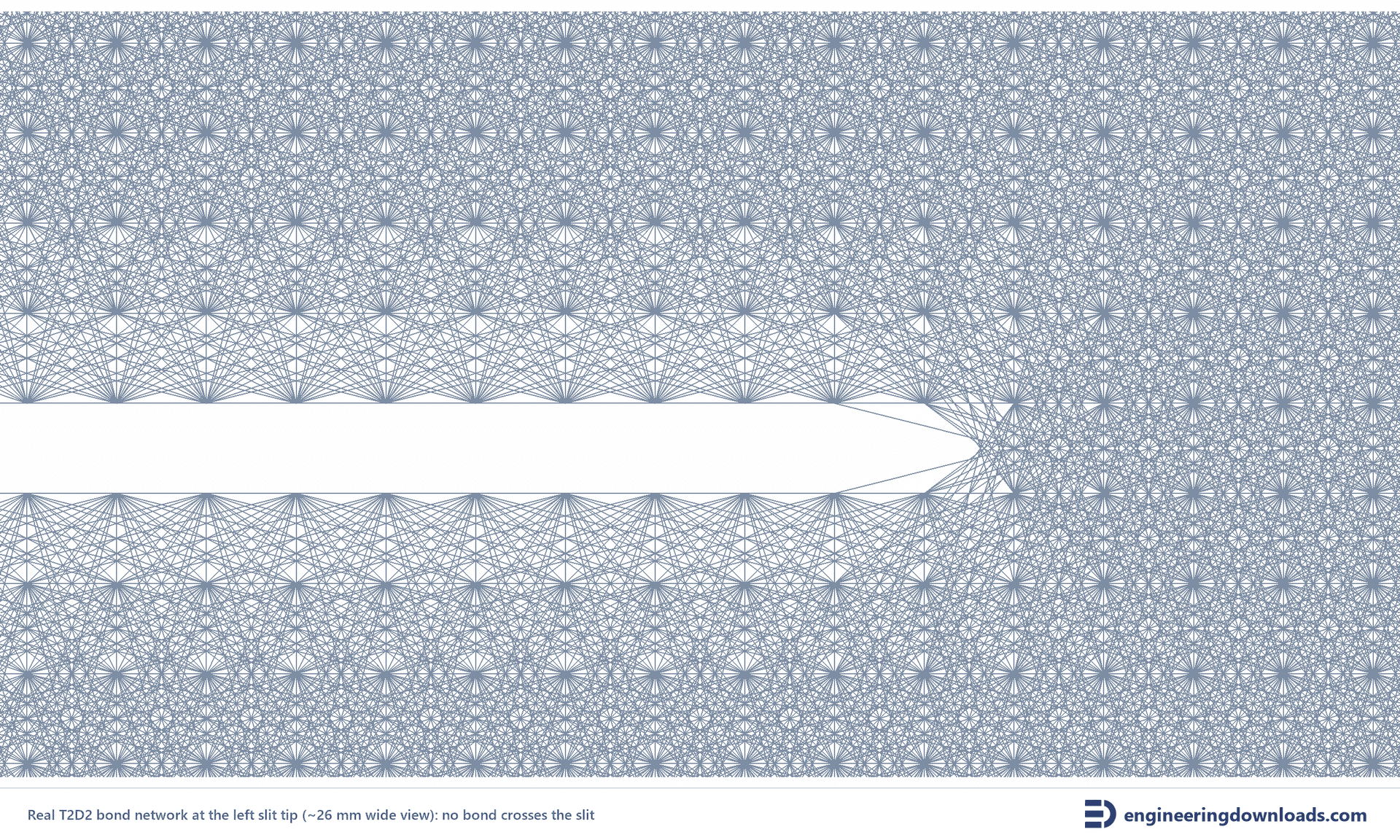
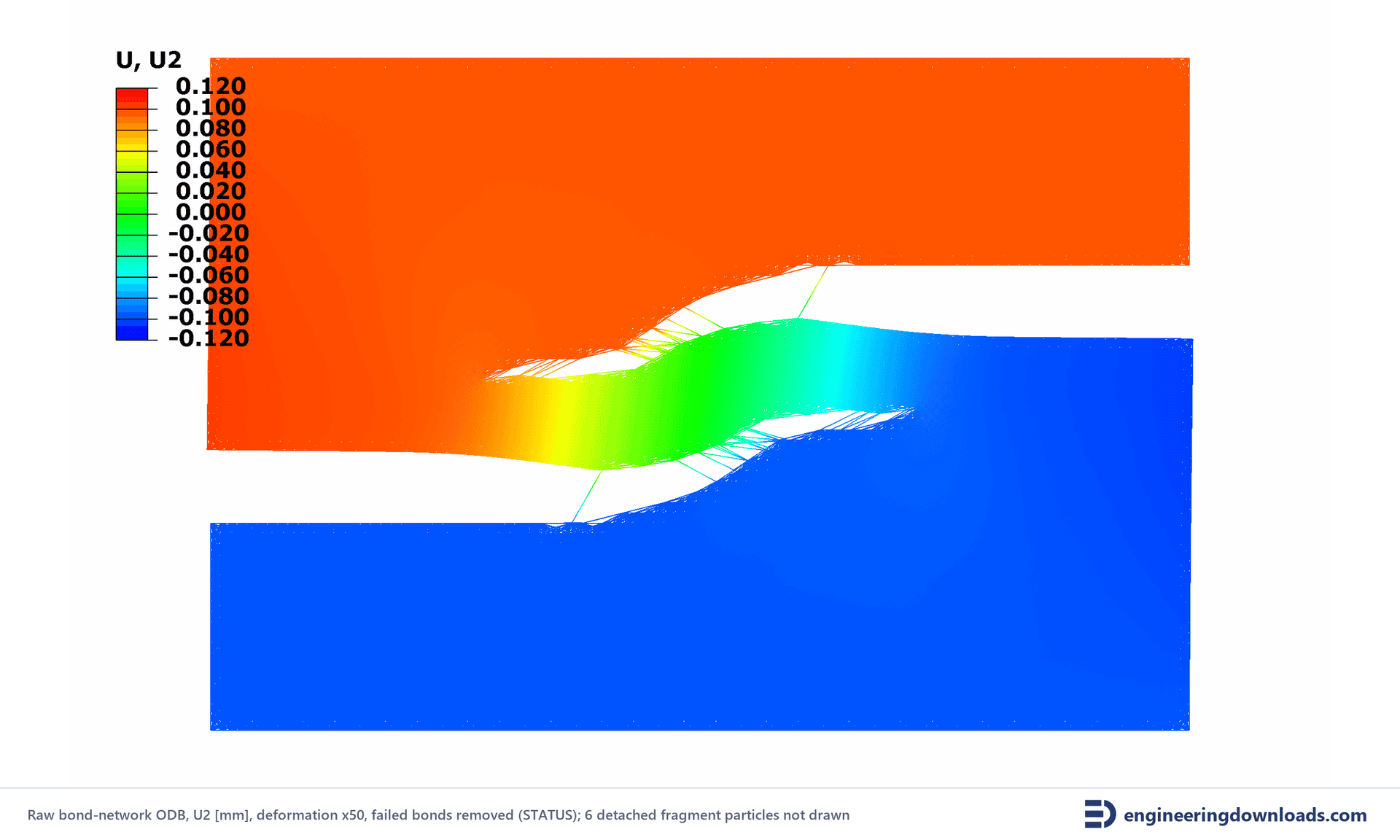
These images are renders of the delivered Model.cae, not drawings. The plate is a particle network: every bond is a native T2D2 truss element and the two starter slits are simply regions where no bonds exist.
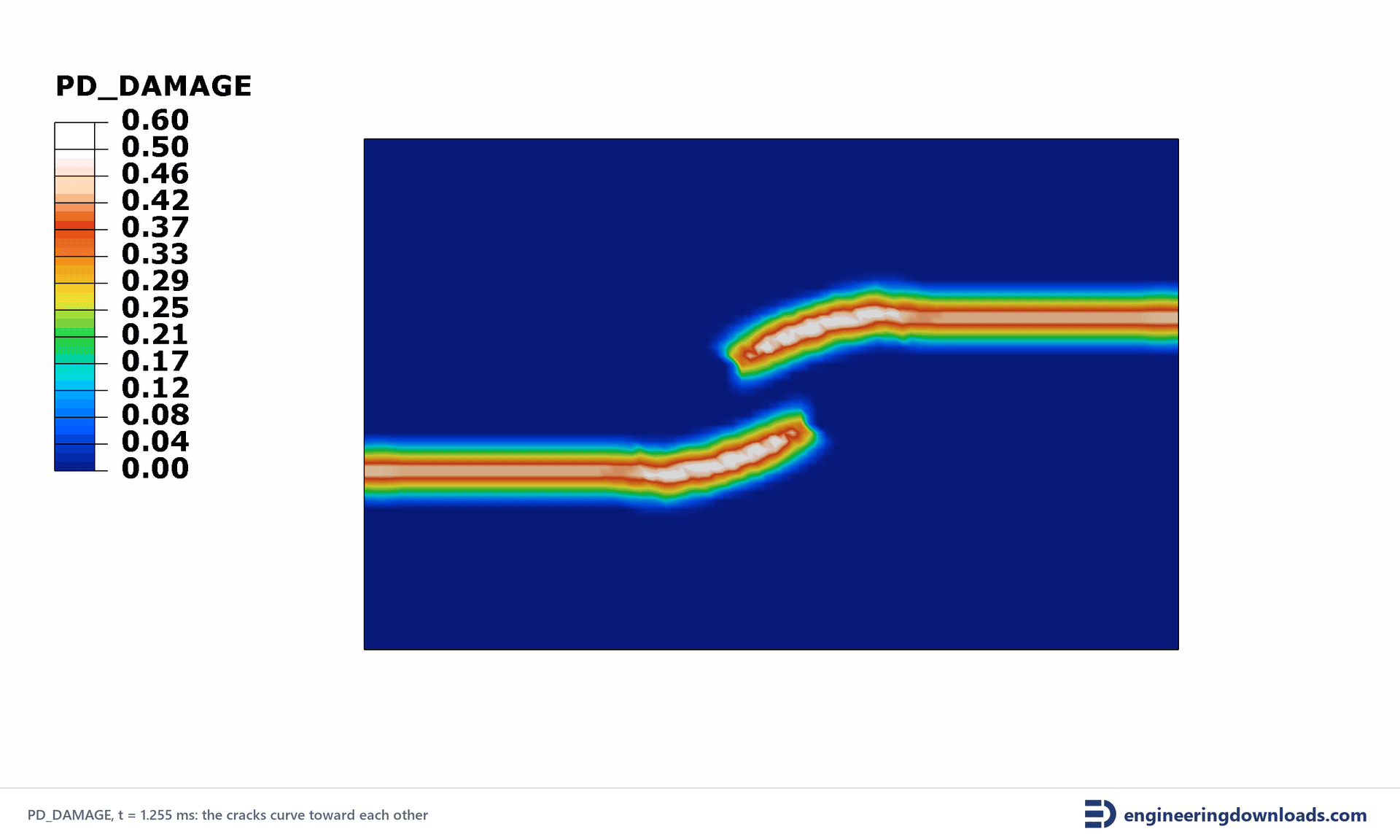
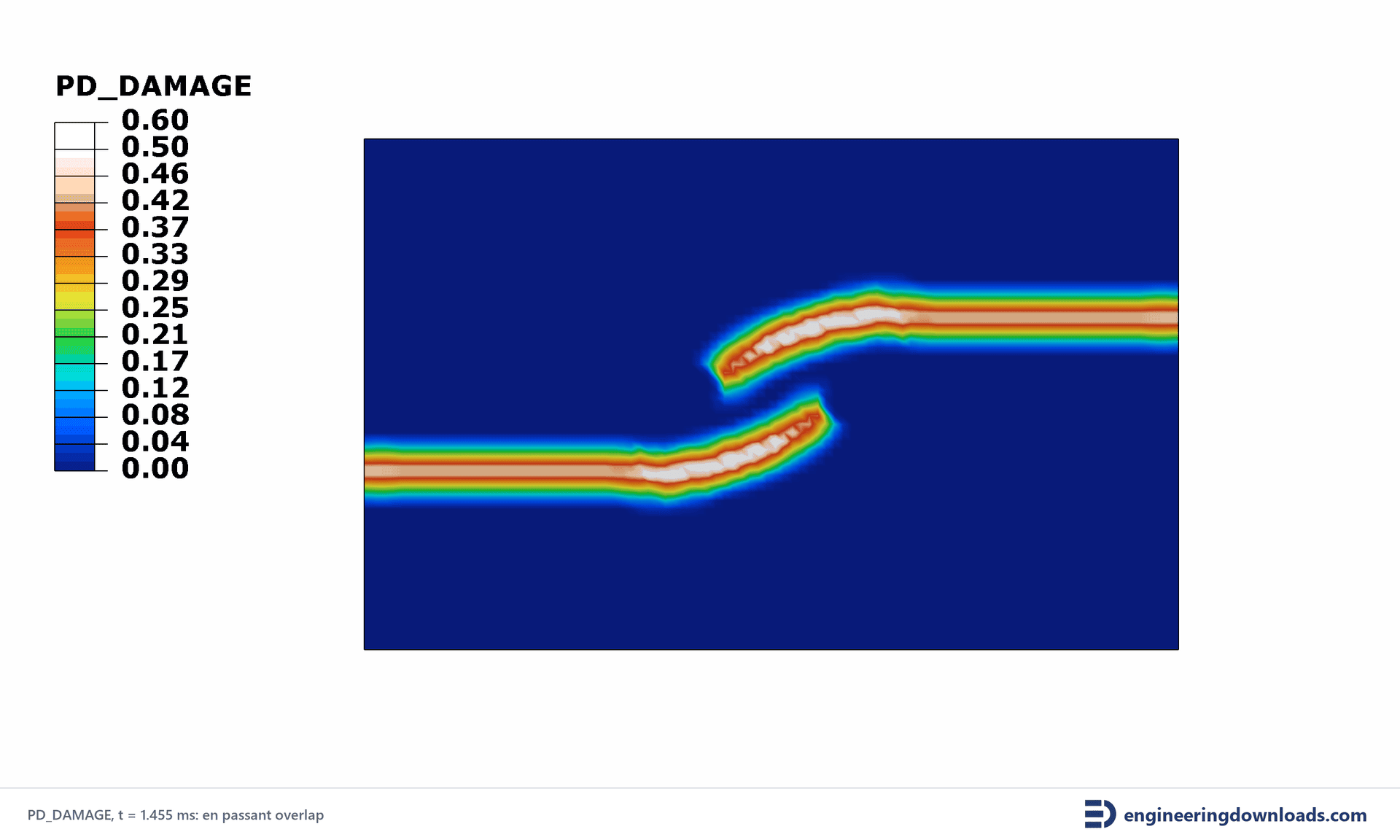
The tutorial lists the checks below. They verify the implementation and its energy balance; they do not validate the model against an experiment.
| Check | Result |
|---|---|
| Single bond force law | Relative error 9e-8; no healing after unloading, failed bond stress stays zero |
| Single-bond fracture energy | 0.0500000007 N mm against the analytical 0.05 N mm (error 1.5e-8) |
| Elastic plate vs an independent static spring-network solution | Reaction force 76.4064 N against 76.4058 N (0.00077 %) |
| Mass retained after bond deletion | 5.00000088e-7 against 5e-7 tonne |
| Both crack tips grow, no bonds cross the starter slits | Confirmed from the solved bond status |
| Native ODB audit | Displacement, reaction and bond-status arrays of the extracted results match the ODB exactly |
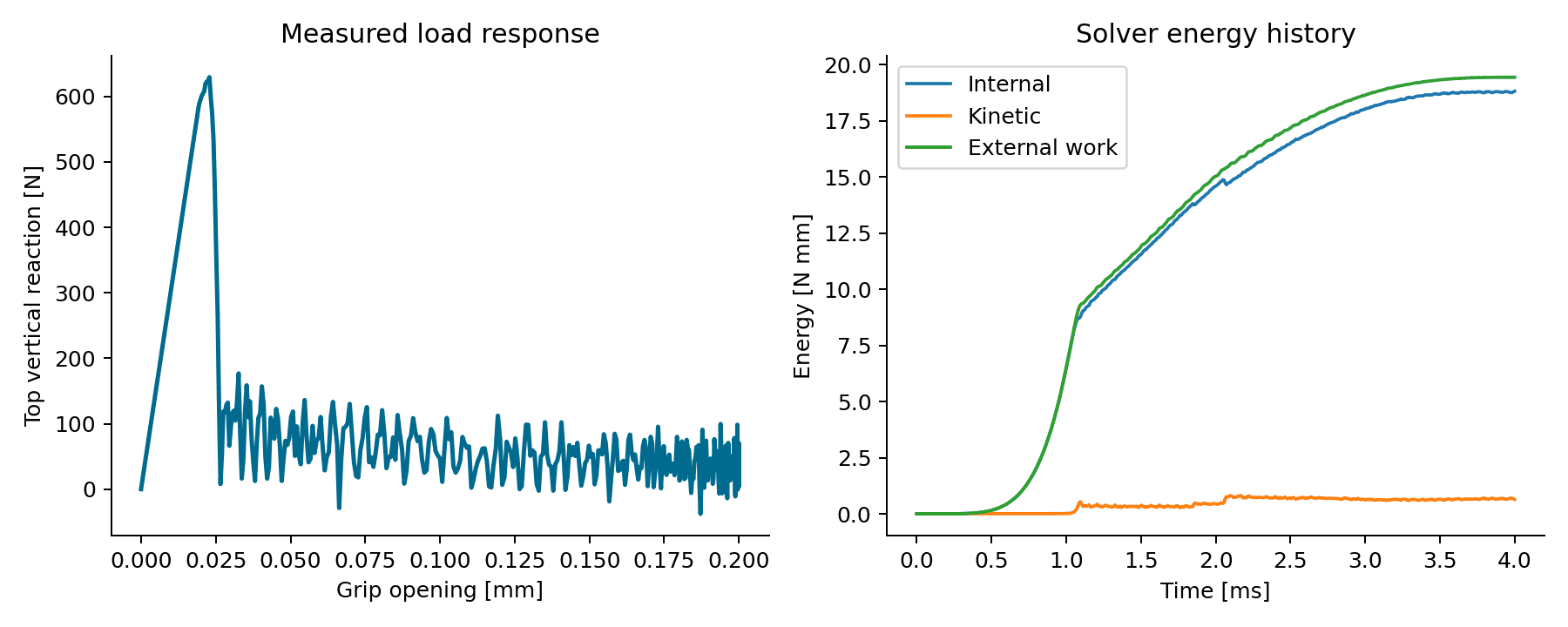
| Energy residual / work | 0.074 % (fine grid), 0.119 % (coarse grid) |
| Grid sensitivity, same physical case | Peak grip force 668.4 N (2,560 particles) vs 629.4 N (5,760 particles): 5.84 % change, inside the declared 10 % screen |
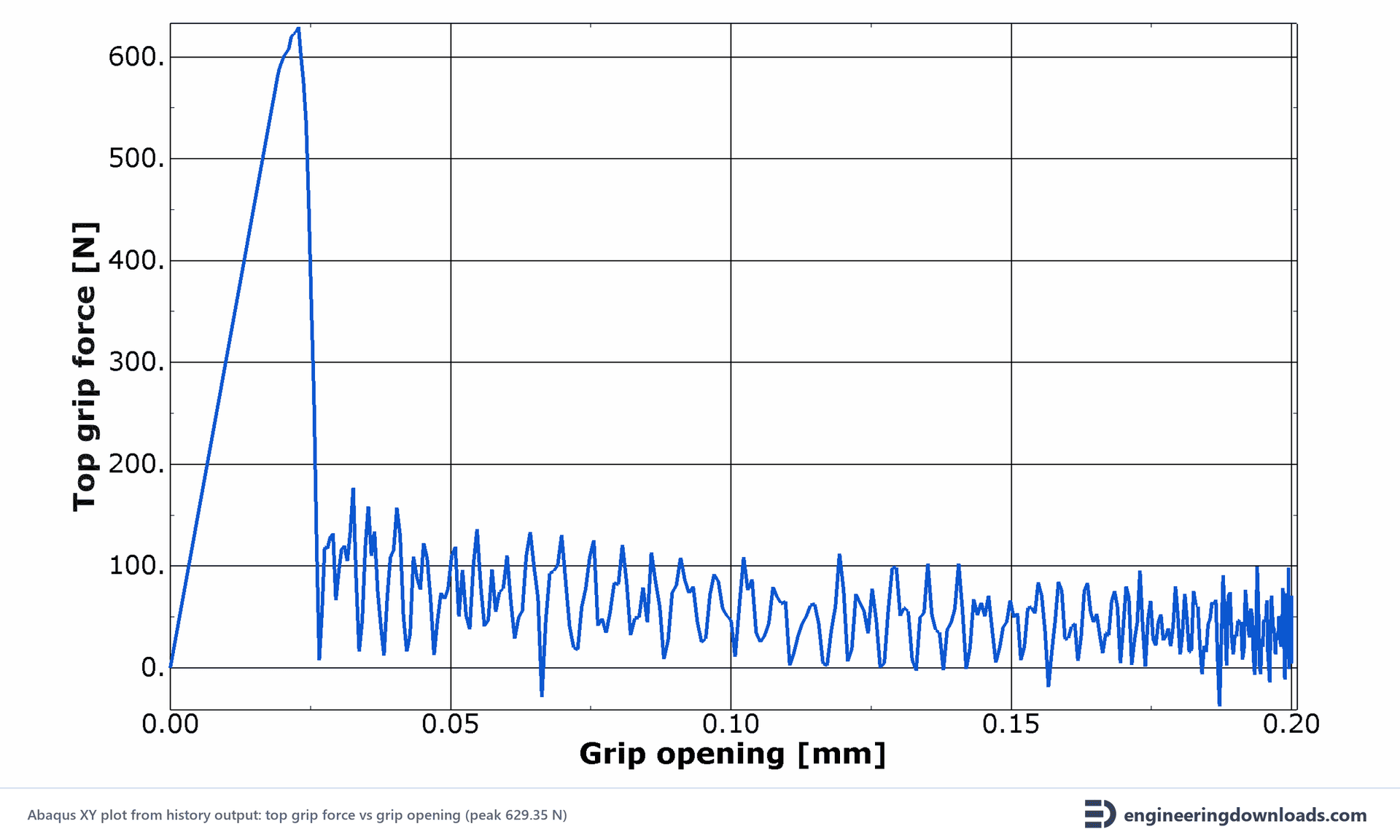
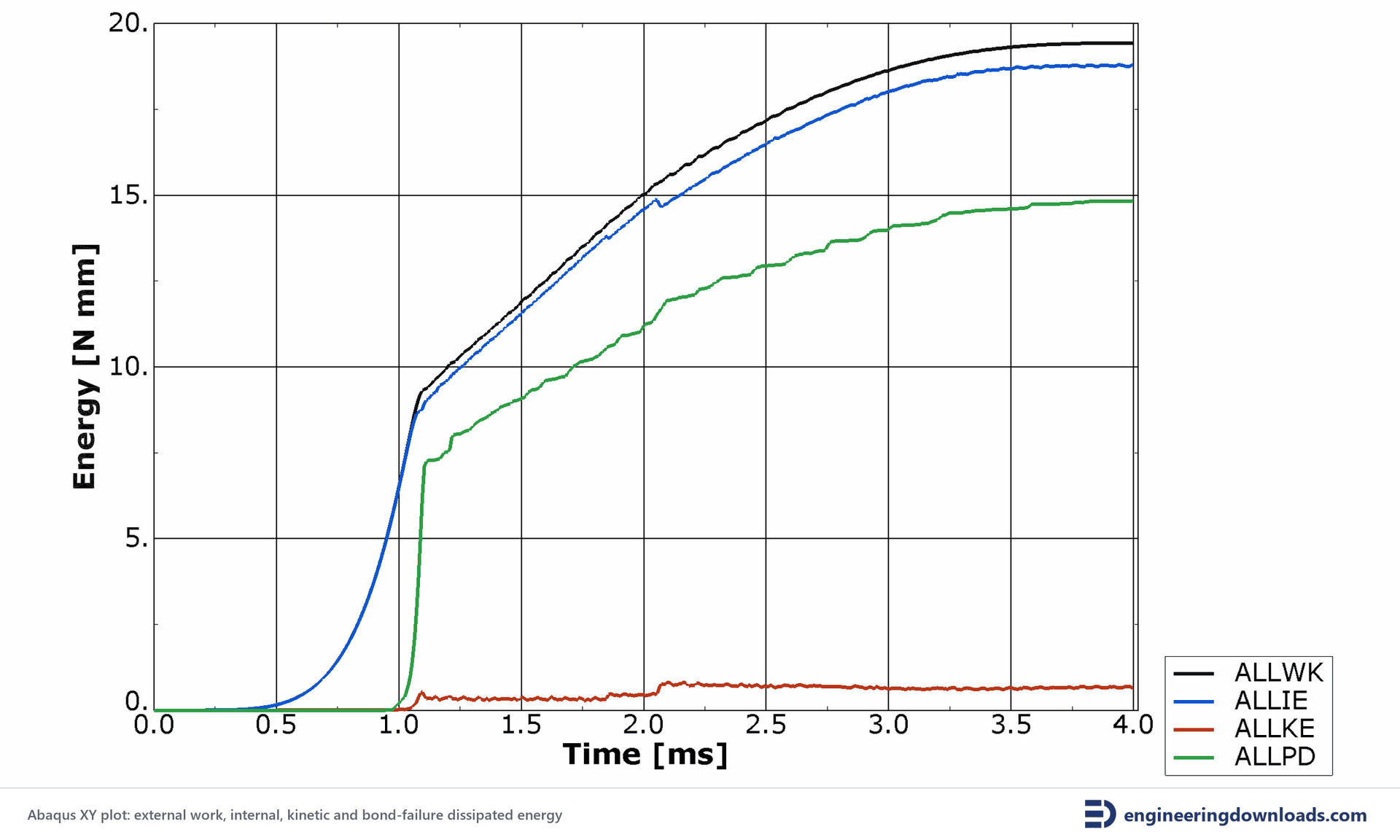
The solver writes a bond-network ODB. The CAE file stores a plotting command that rebuilds each particle's weighted broken-bond fraction into a connected display mesh, so you can contour PD_DAMAGE from 0 to 1 in the Abaqus Visualization module and export a clean figure. The display mesh is for plotting only and adds no stiffness.
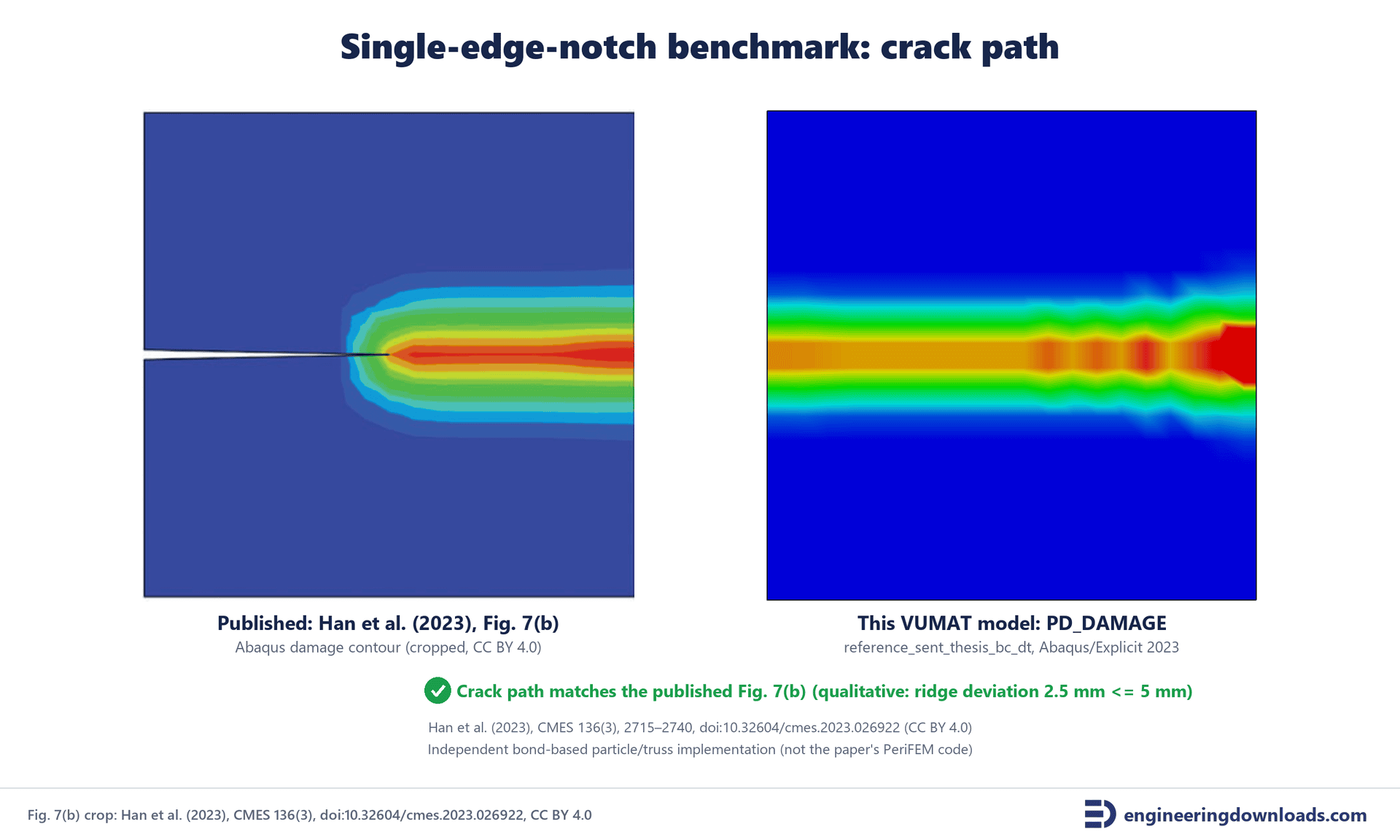
The paper's single-edge-notch example (100 × 100 mm plate, 50 mm notch) was run with the same bond model as a qualitative path check. The solved damage band stays on the notch line: ridge deviation 2.5 mm against a 5 mm limit, extension 97.5 mm, and 100 % of the extension damage within one horizon of the notch line. The paper gives no tabulated force or runtime for this example, so only the path is compared. This is an independent bond-based implementation, not the paper's PeriFEM code, and the case is not part of the delivered files.
Result databases are not included: the job solves in about seven minutes on four cores. A working Abaqus/Explicit licence and a supported Fortran compiler are required because the VUMAT is compiled when you submit.
FEA engineers and researchers who want a working peridynamic fracture example inside Abaqus, students learning how nonlocal bond models map onto truss elements and a VUMAT, and anyone who needs a clean, solved crack-interaction case to study or present. Changing the particle spacing, geometry or horizon means regenerating bond areas, masses, grips and calibration, so treat the deck as a fixed benchmark rather than a general mesh tool.
What does this package contain? An Abaqus/Explicit peridynamic brittle fracture model of two interacting cracks: Model.cae, the 5,760-particle Model.inp, the VUMAT source and a 6-page PDF tutorial.
Is this the PeriFEM code from the Han et al. paper? No. It follows the same goal, peridynamic brittle fracture inside Abaqus, but it is an original bond-based particle/truss implementation after Heo (2019) running in Abaqus/Explicit. It does not use the paper's element-pair PeriFEM formulation, includes no ANSYS files and no 3D examples.
Is the model validated against experiments? No. It is verified numerically (force law, fracture energy, an independent static solution, energy balance and a two-grid check) and it reproduces the qualitative curving of two interacting cracks. Quantitative load-displacement and crack-path agreement with experiments has not been established.
Which Abaqus version do I need? Abaqus/CAE and Abaqus/Explicit 2023 with a working Fortran compiler for the VUMAT, tested on Windows with Intel Fortran Classic 2021.6. A job uses about 0.75 GiB of RAM on four cores.
Can I change the geometry or the cracks? The delivered deck is a fixed benchmark. Changing spacing, geometry, slit positions, horizon, E or Gc requires regenerating the bond areas, masses, grips and critical-stretch calibration, and a CAE remesh cannot rebuild the nonlocal connectivity. The plane-stress bond model also requires ν = 1/3.
What if the package is not what I expected? Write to us. Engineering Downloads refunds clients who are not satisfied with a delivered product.
Independent engineering package for training and research. It is not affiliated with the authors of the cited paper or with Dassault Systèmes. The paper abstract is reproduced under its CC BY 4.0 licence; one cropped panel of the paper's Fig. 7(b) is shown with attribution under CC BY 4.0, and no other figures are reproduced. Not a certified assessment tool.
Need more than the files?
There are two ways we can help. Book a one hour online consultation if you want to talk a problem through with a CAE engineer, using the checkbox in the order box. Order a project if you need a full simulation built for you, delivered to an agreed scope, price and deadline under a written contract.
We work on FEA and CFD for engineers, researchers and companies. Order your project, or message us on WhatsApp for a quick reply.
Other packages engineers working on this topic also download.
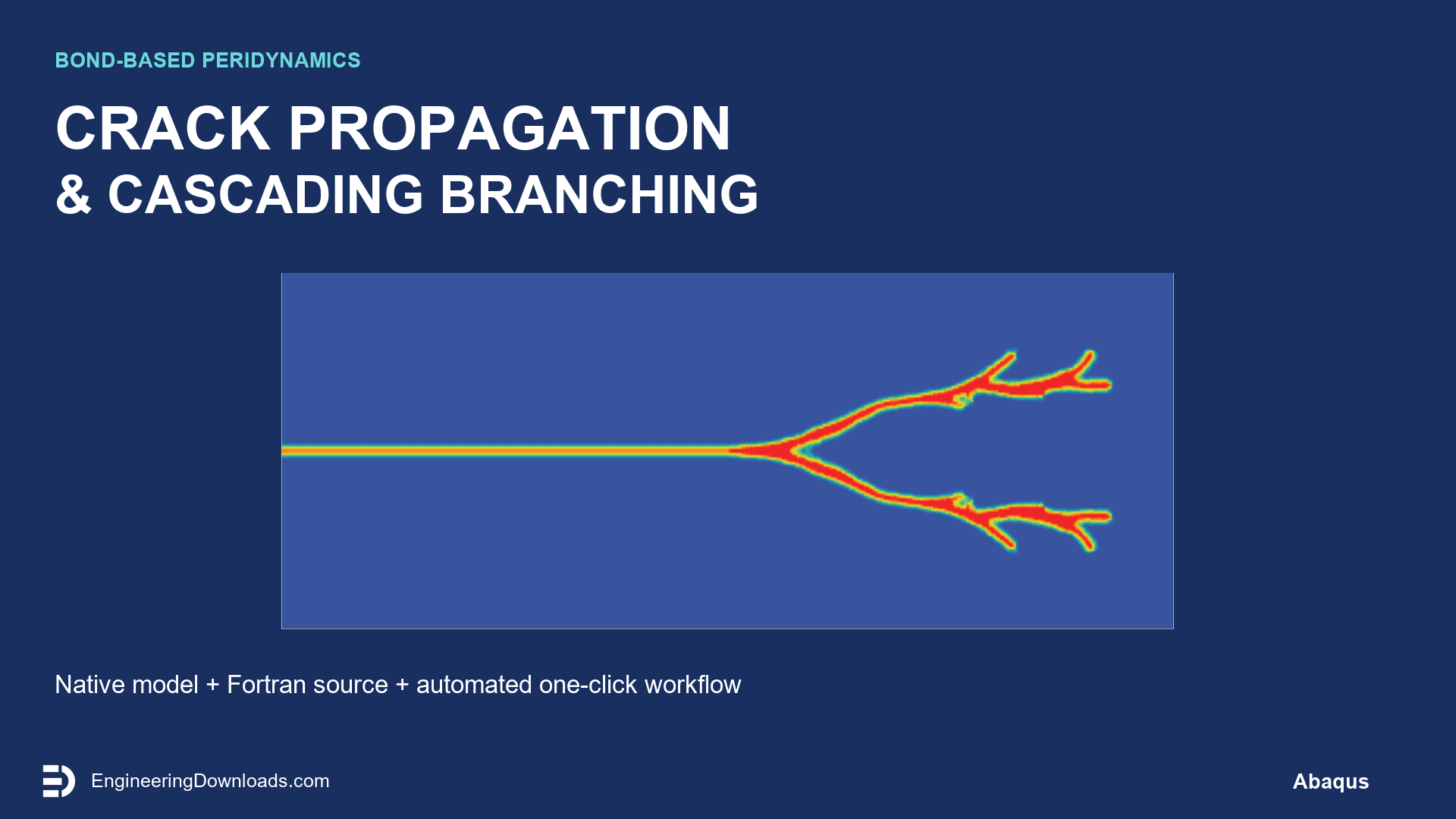 Crack Propagation and Crack Branching with Peridynamics in Abaqus: Dynamic Glass Plate after Ha and Bobaru (2010)€149,00
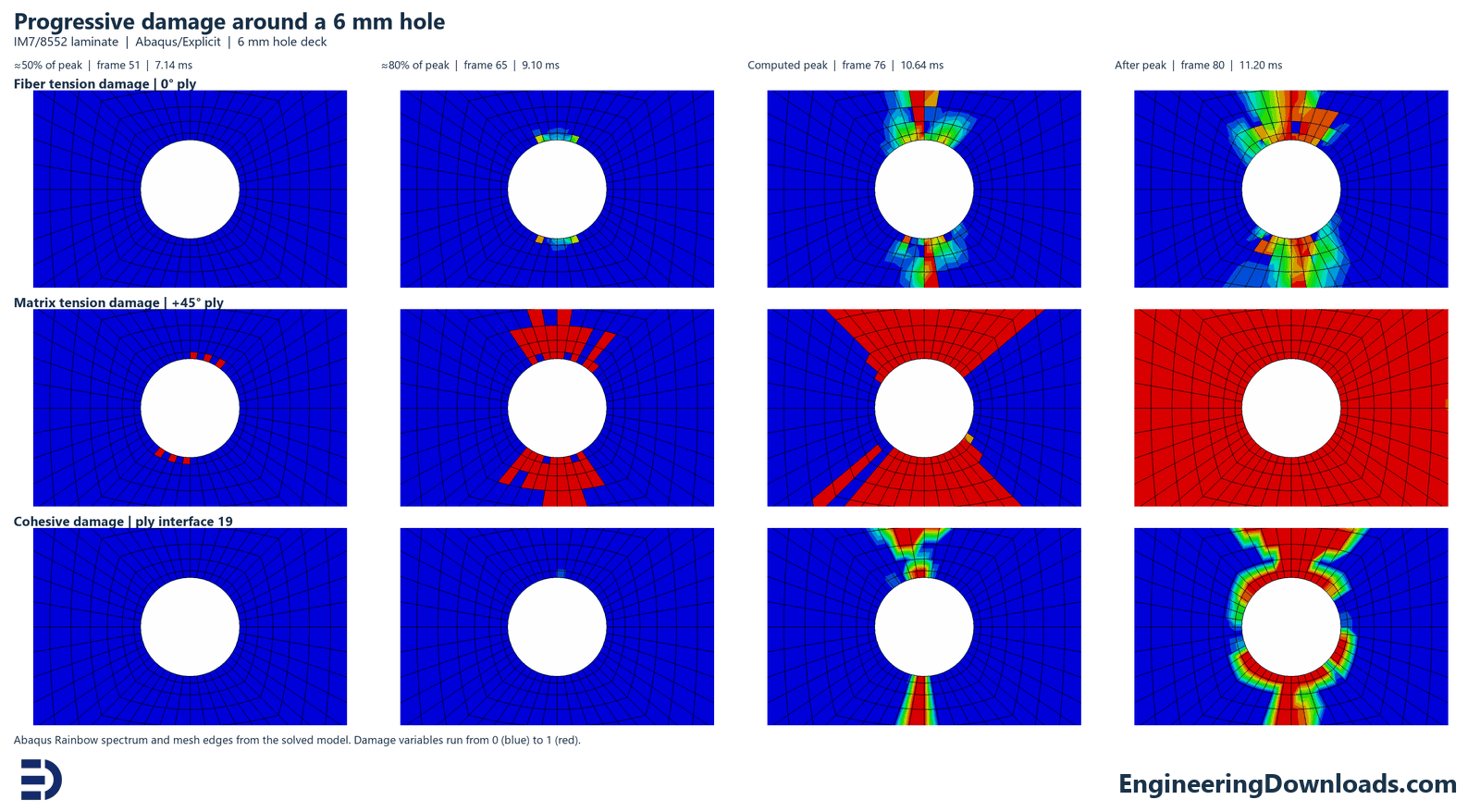 3D Hashin Progressive Damage VUMAT for Abaqus: Open-Hole Laminate with Cohesive Delamination€159,00
 API 579 Example 3.10 in Abaqus: Brittle Fracture Level 3, Demethanizer Thermal Shock€139,00
 RC Slab Impact Analysis in Abaqus Using the Brittle Cracking Model (Hammer Impact)
 2D Spall Fracture in long rod Simulation Package for ABAQUS — Petrov-Morozov VUMAT for PMMA
 Deformation behavior of single and multi-layered materials under impact loading
 Crack propagation by XFEM
 Crack propagation by cohesive zone method (CZM) in Abaqus

Need a full custom project? See the options below.
€129,00
€179,00
€149,00
€119,00
€129,00
See more
Want to receive push notifications for all major on-site activities?