Need a full custom project? See the options below.
Need a full custom project? See the options below.
A surface crack on the inside of a pressure vessel, right next to the longitudinal seam. The published API 579-2 Example 9.5 screens it at Level 1, where it fails, and then accepts it at Level 2 with a failure assessment diagram (FAD) that includes a weld residual stress. This Abaqus package rebuilds the whole example: a 3D crack model with collapsed crack-tip elements (CAE + INP), an open Python Part 9 engine that reproduces all 27 numbers of the example, and a PDF tutorial that compares every result with the book.
Source: API 579-2/ASME PTB-14 Example 9.5, assessed to API 579-1/ASME FFS-1 (2021) Part 9. SA-516 Grade 70 vessel, 120 in inside diameter, 1.0 in wall, 275 psig at 50 °F. Inside-surface longitudinal crack a = 0.20 in deep and 2c = 3.20 in long next to the seam weld, with a uniform residual stress of 29.52 ksi.
| Item | This package |
|---|---|
| Geometry | Quarter of the shell around the crack: 400 mm of hoop arc × 500 mm axial, far end kept plane |
| Crack | Semi-elliptical inside-surface crack, a = 5.08 mm, c = 40.64 mm (a/c = 1/8) |
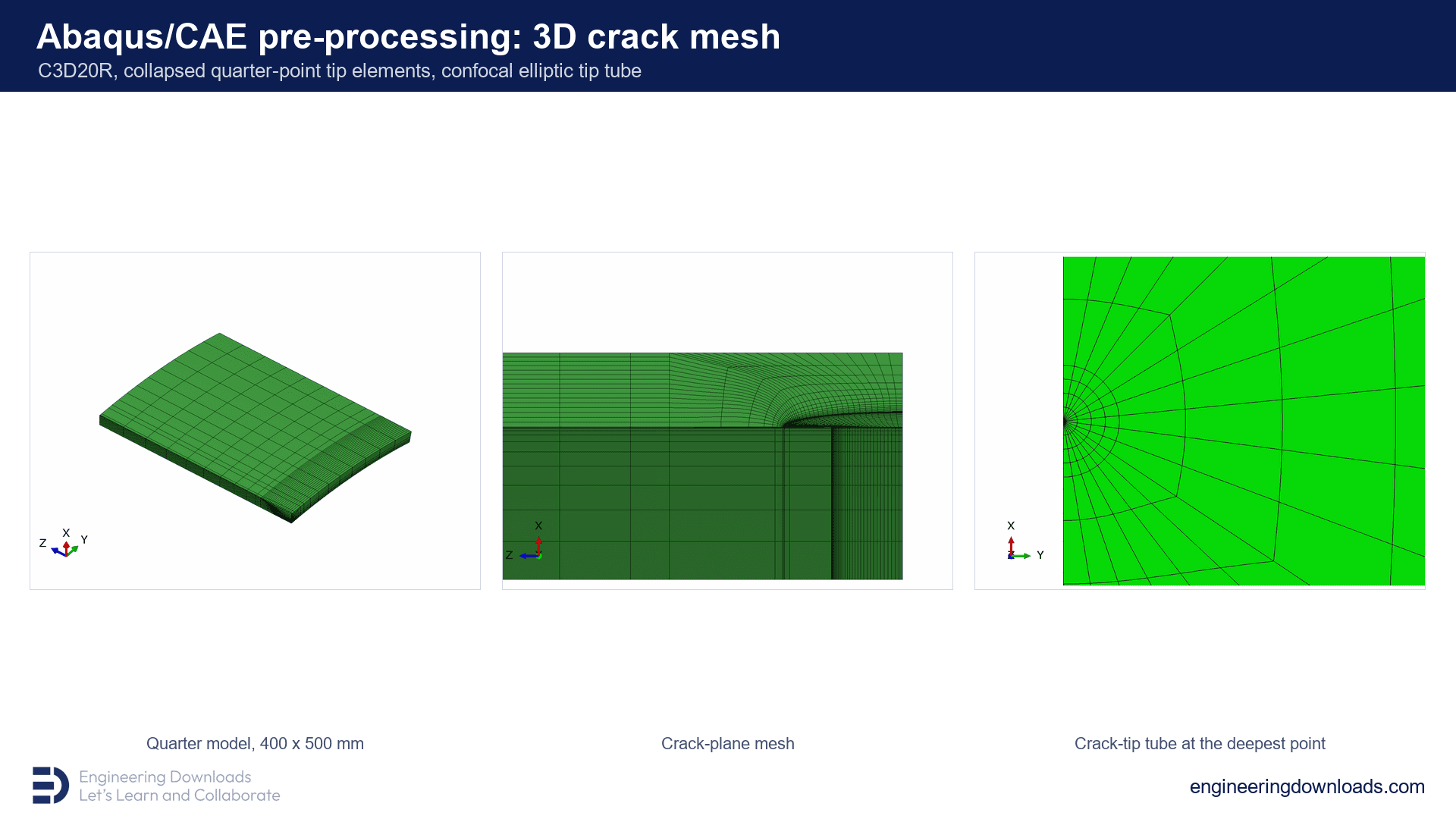
| Mesh | 14,768 C3D20R/C3D15 elements, 36 along the front, collapsed quarter-point tip elements in a confocal elliptic tube |
| Load cases | PCF: 275 psig on bore and crack faces + closed-end force. U: 29.52 ksi crack-face pressure (residual stress) |
| Fracture output | *CONTOUR INTEGRAL, K factors, 10 contours at every front node |
| Assessment | Level 1 screening and Level 2 FAD: Table 9B.12 G0, Annex 9C reference stress, Table 9.3 plasticity factor, Eq. 9.22 |
| Software | Abaqus/CAE and Abaqus/Standard 2024; Python 3 (numpy, scipy, matplotlib) |
| Quantity | Example | This package |
|---|---|---|
| Level 1 screening | Not satisfied | Not satisfied |
| LrP | 0.4455 | 0.4455 |
| KP deepest / surface (ksi√in) | 15.613 / 5.426 | 15.613 / 5.426 (hand), 15.904 / 5.441 (Abaqus) |
| KSR deepest / surface (ksi√in) | 27.250 / 9.470 | 27.250 / 9.470 (hand), 27.449 / 9.205 (Abaqus) |
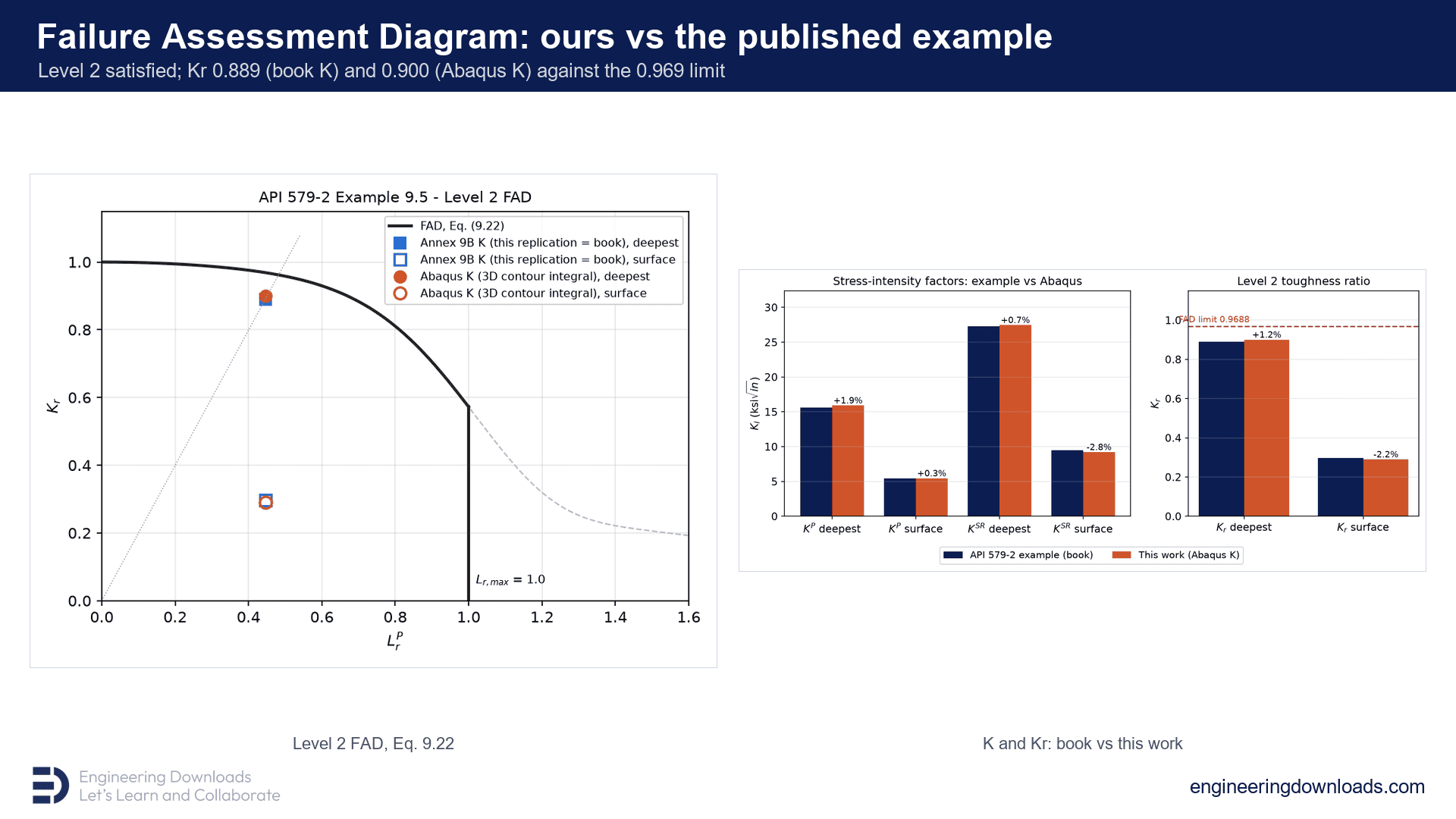
| Kr deepest | 0.8894 | 0.8894 (hand), 0.9001 (Abaqus K) |
| FAD limit at LrP | 0.9688 | 0.9688 |
| Level 2 verdict | Acceptable | Acceptable with either set of K |
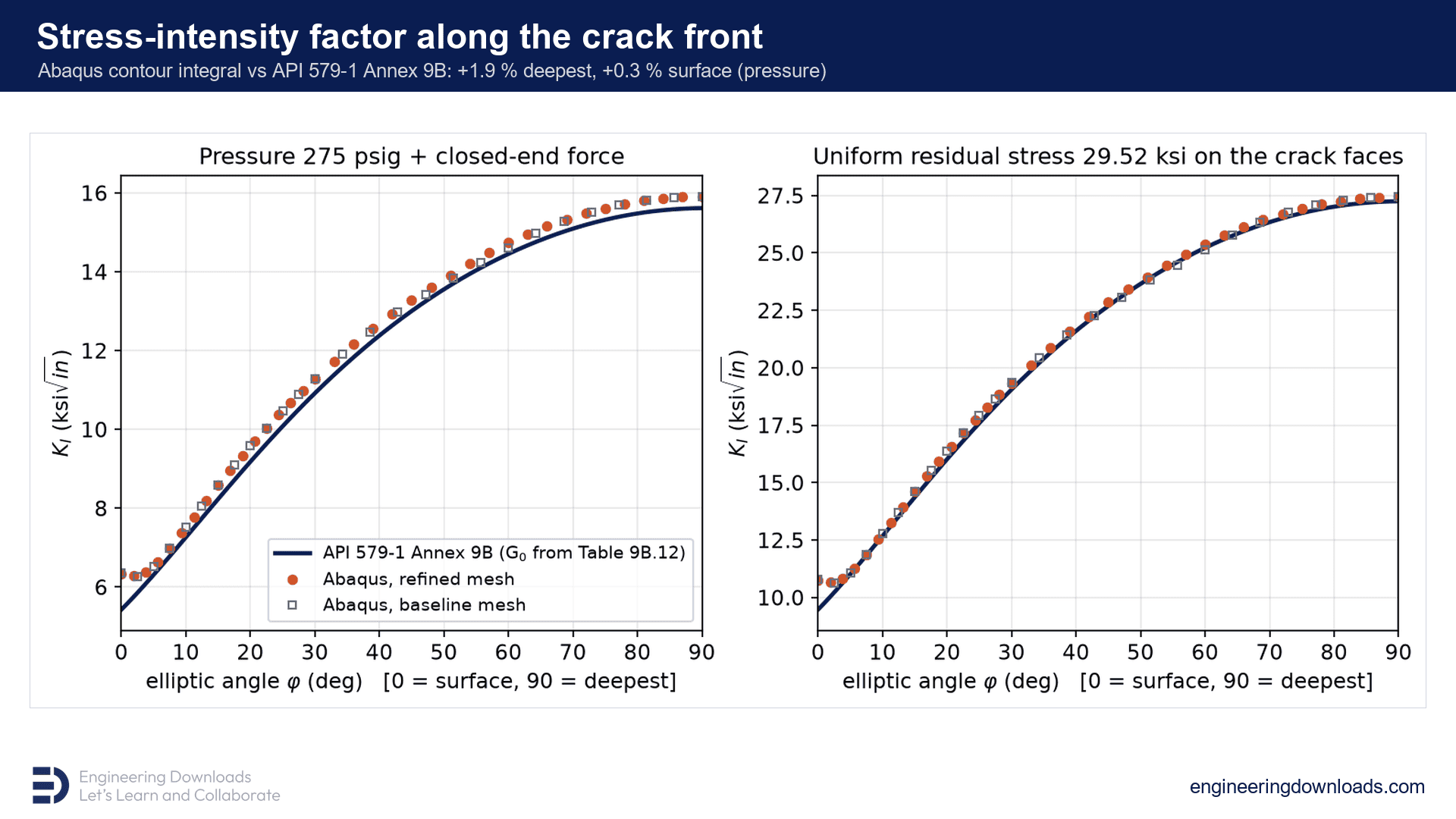
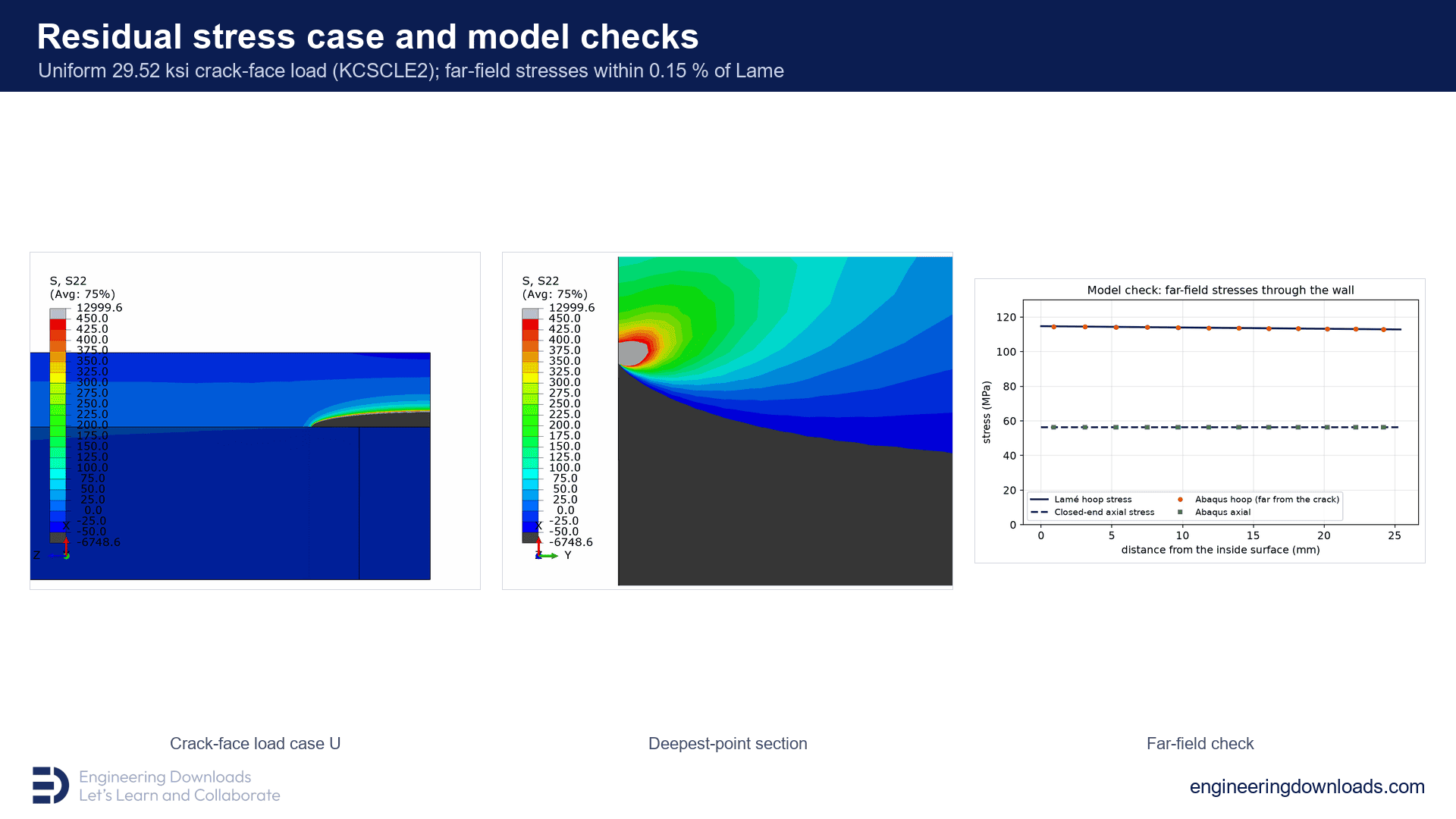
The Python engine reproduces all 27 compared quantities of the example within 0.02 %. The 3D Abaqus model gives K within +1.9 % of the Annex 9B solution at the deepest point and within 0.3 % to −2.8 % at the surface, a mesh-converged result (refinement changes the deepest-point K by under 0.07 %). Far-field stresses match Lamé within 0.15 %. With Abaqus K the deepest-point Kr rises from 0.889 to 0.900, still below 0.969, so the decision does not change.
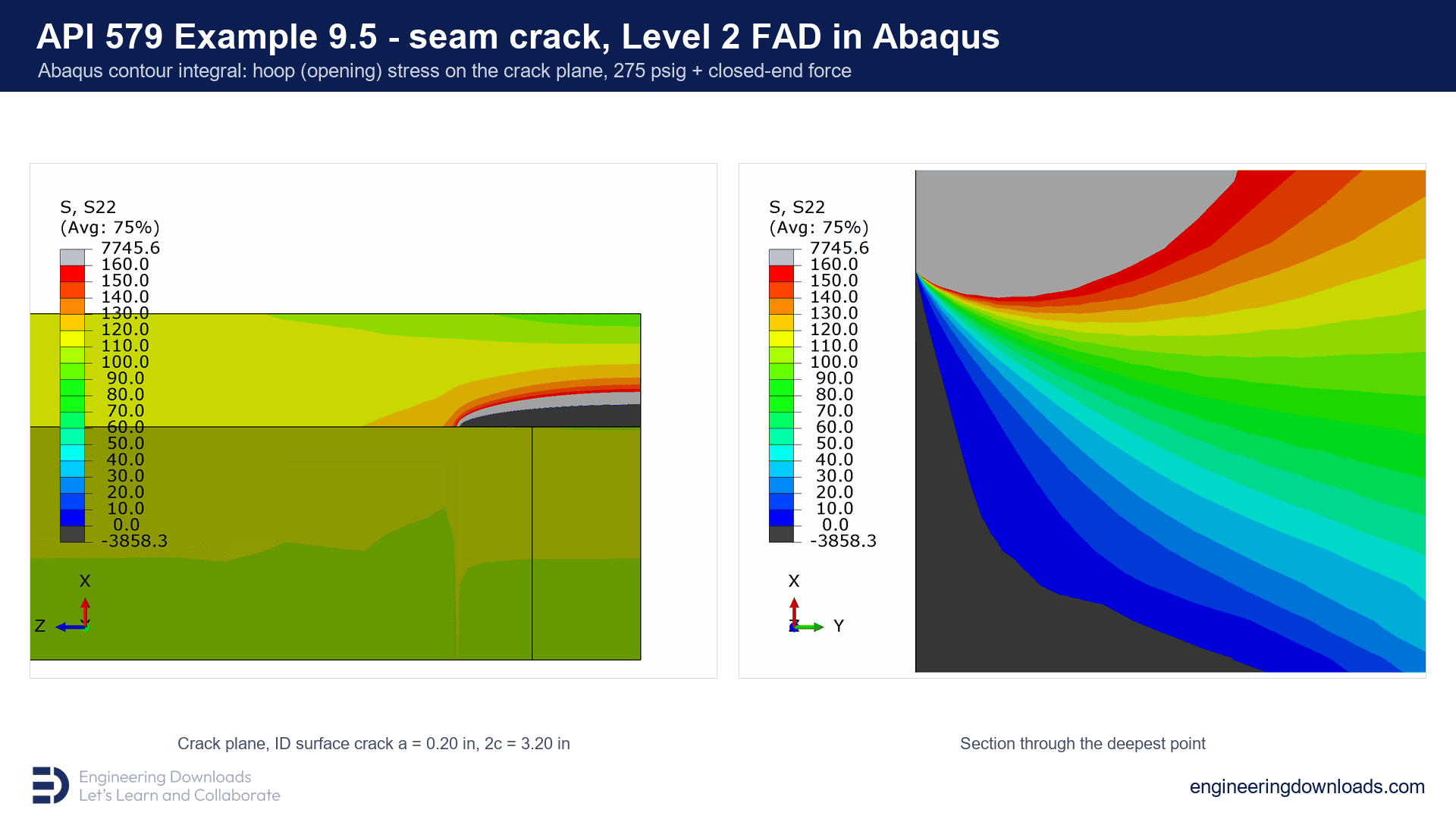
Mesh, crack-tip tube, loads and boundary conditions come straight from Abaqus/CAE; stress and displacement contours come from the ODBs. The scripts that export them are included.
Integrity engineers who assess crack-like flaws to API 579 Part 9, FEA engineers who want a checked 3D contour-integral crack model in Abaqus, and students learning how the FAD, the reference stress and the plasticity factor fit together. Change the crack size, shell or pressure and the generator writes new Abaqus decks for your own case.
What does this package calculate? The complete API 579-2 Example 9.5: Level 1 screening and the Level 2 FAD of an inside-surface seam crack under pressure and weld residual stress, plus a 3D Abaqus contour-integral check of the stress-intensity factors and the FAD repeated with the Abaqus K.
Does it reproduce the API 579 example? Yes. All 27 compared quantities match the book within 0.02 %, and both verdicts agree: Level 1 not satisfied, Level 2 satisfied. Abaqus gives K within +1.9 % at the deepest point and from +0.3 % to -2.8 % at the surface.
Can I use it for my own vessel? Yes. Shell radius, wall, crack size, pressure and residual stress are inputs of the Python engine and of the mesh generator, which writes new Abaqus decks for your case.
Are the images real Abaqus results? Yes. Every mesh, load and contour image is an unedited PNG written by Abaqus/CAE 2024 from the included models and their results; only a title bar, the logo and the web address are added around them. The image scripts are included so you can regenerate them. Charts are drawn by the included Python scripts, with the example's values as reference markers.
Are the API coefficient tables included? No. API 579-1 is copyrighted, so the package ships the parser scripts that read the influence-coefficient tables from your own licensed PDF of API 579-1 (2021) into JSON. Everything else runs as delivered.
Which Abaqus version do I need? Abaqus/CAE and Abaqus/Standard 2024 or newer for the CAE files and scripts; the INP files also run in older releases. ODB files are not included: each job runs in about a minute on 6 cores.
What if the package is not what I expected? Write to us. Engineering Downloads refunds clients who are not satisfied with a delivered product.
Is this an API publication or a certified assessment? No. It is an independent worked benchmark and training package. It does not reproduce API figures and does not replace a fitness-for-service assessment by a qualified engineer.
This is an independent worked benchmark for training. It is not an API publication, reproduces no API tables or figures and does not replace an assessment by a qualified engineer. You need your own copy of API 579-1/ASME FFS-1 and API 579-2.
Need more than the files?
There are two ways we can help. Book a one hour online consultation if you want to talk a problem through with a CAE engineer, using the checkbox in the order box. Order a project if you need a full simulation built for you, delivered to an agreed scope, price and deadline under a written contract.
We work on FEA and CFD for engineers, researchers and companies. Order your project, or message us on WhatsApp for a quick reply.
Other packages engineers working on this topic also download.
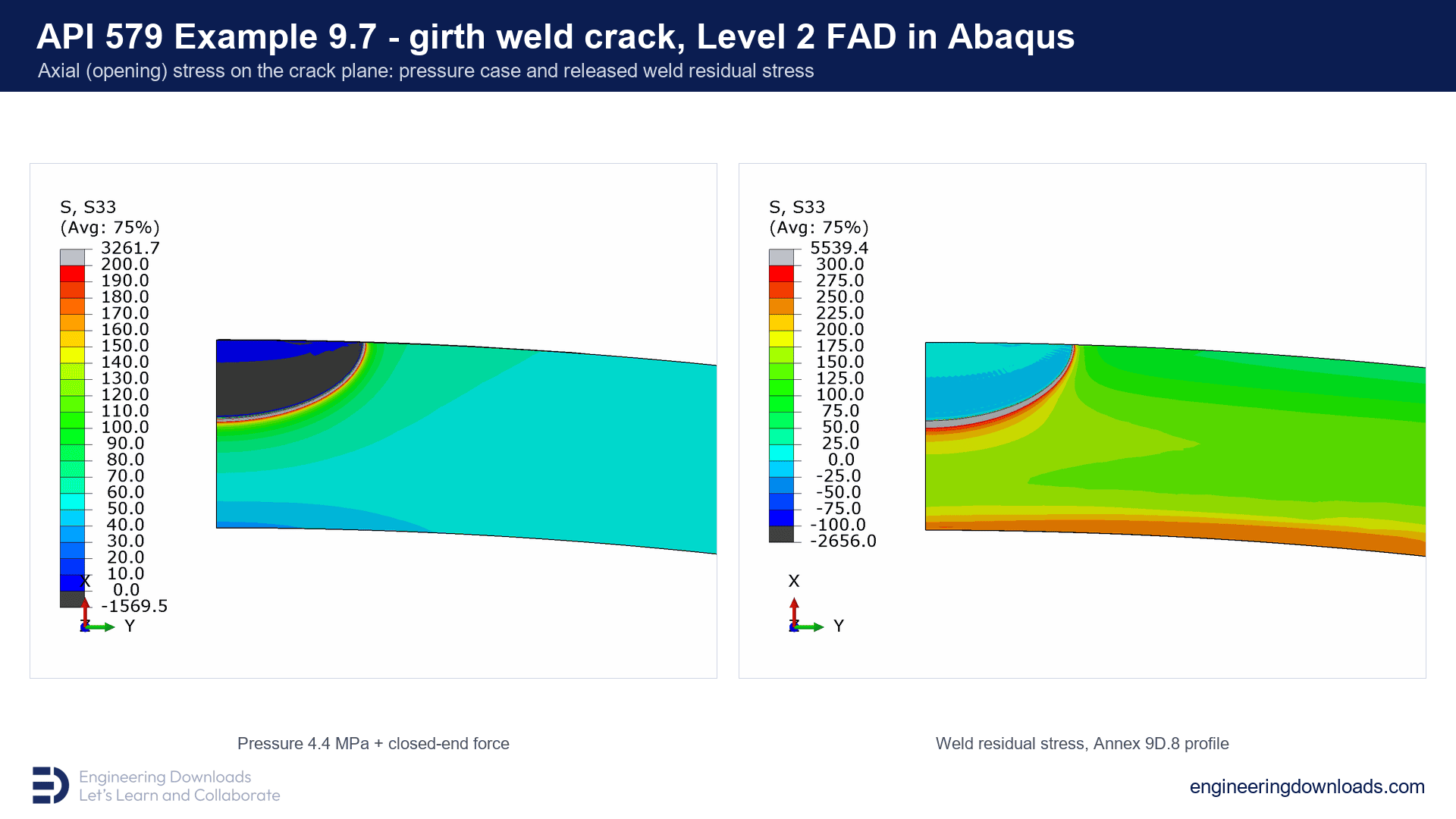 API 579 Example 9.7 in Abaqus: Girth Weld Crack with Weld Residual Stress, Level 2 FAD€129,00
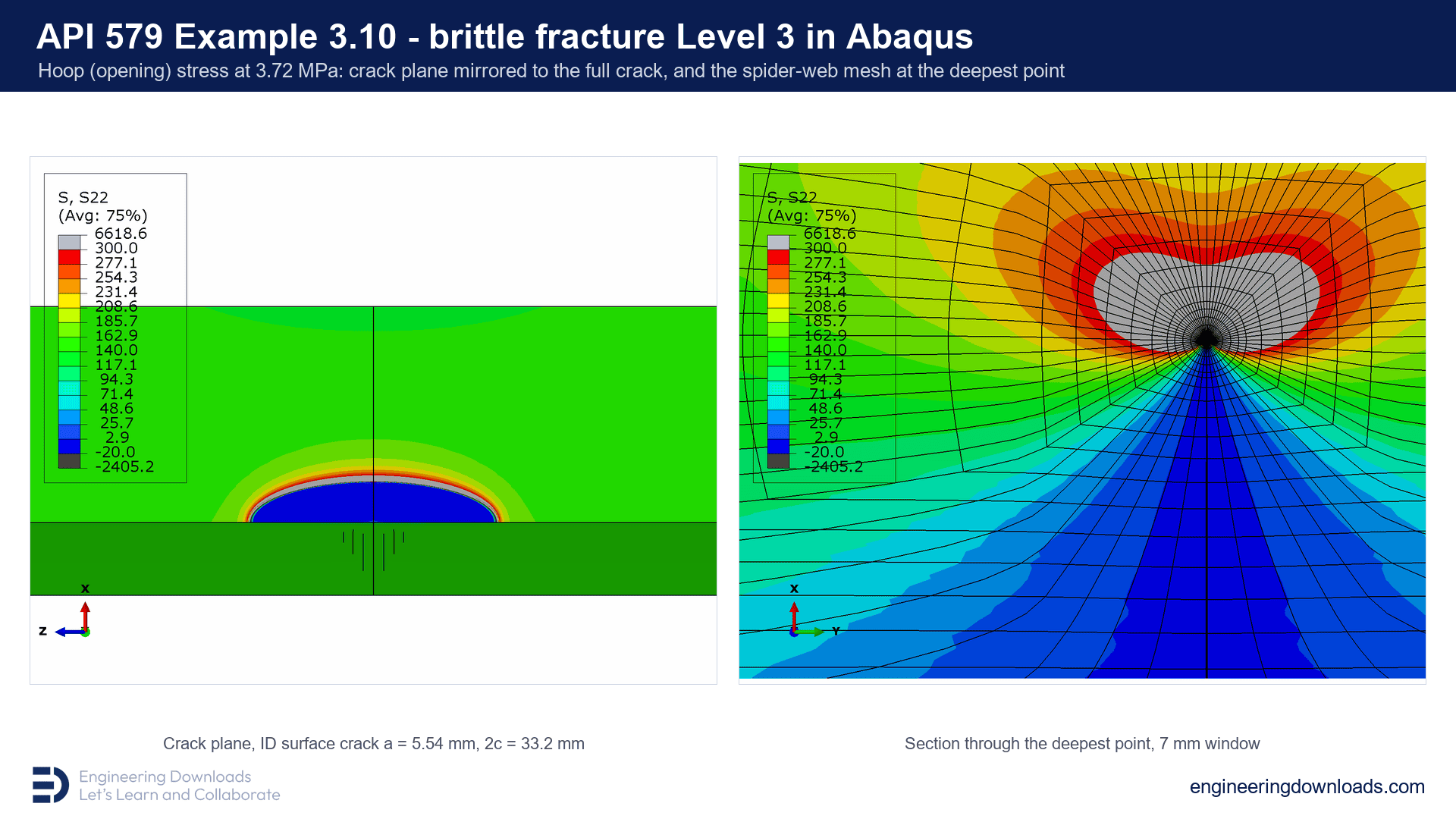 API 579 Example 3.10 in Abaqus: Brittle Fracture Level 3, Demethanizer Thermal Shock€139,00
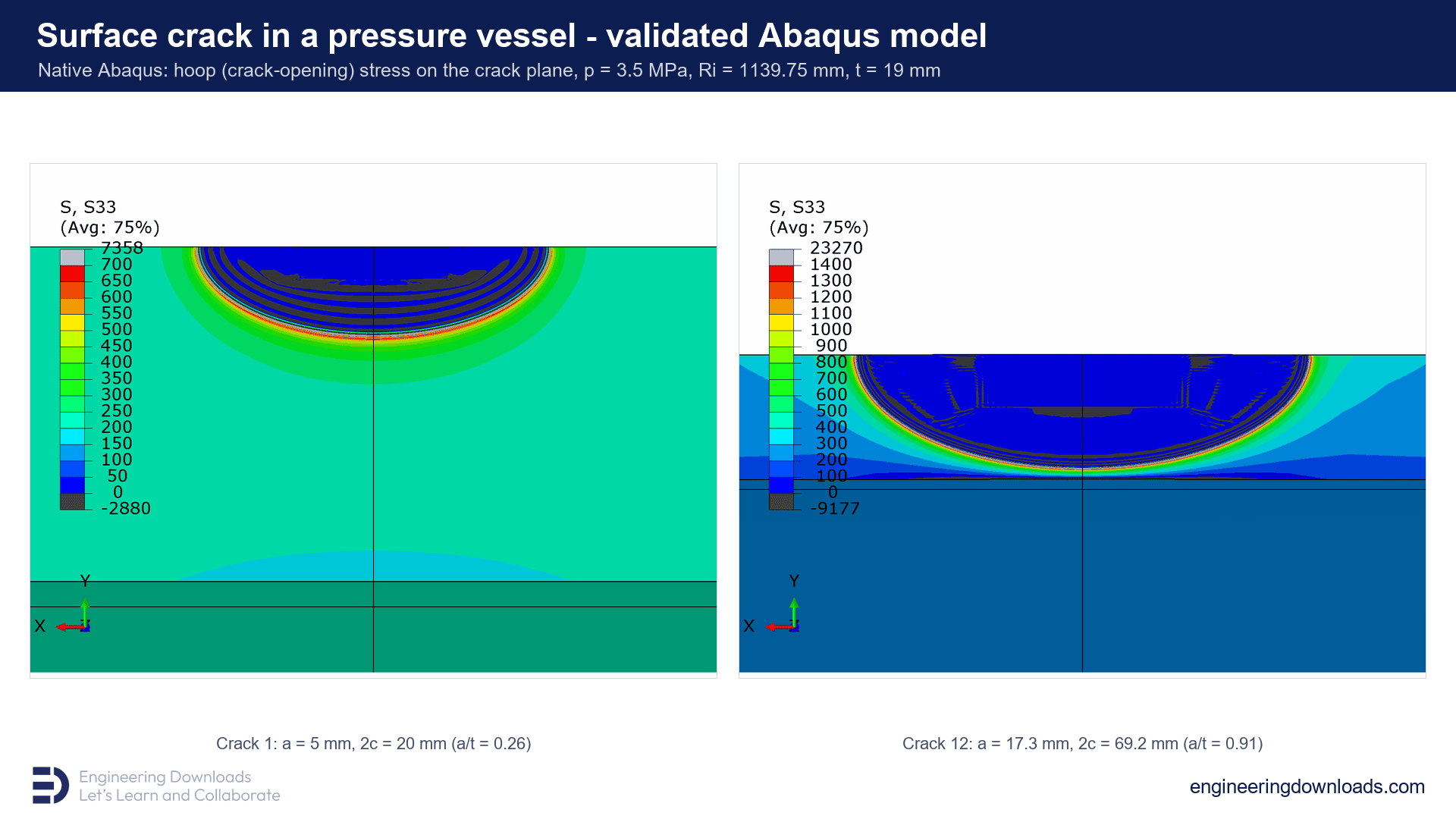 Surface Crack in a Pressure Vessel: Validated Abaqus Stress Intensity Factor Model (Spider-Web Mesh)€129,00
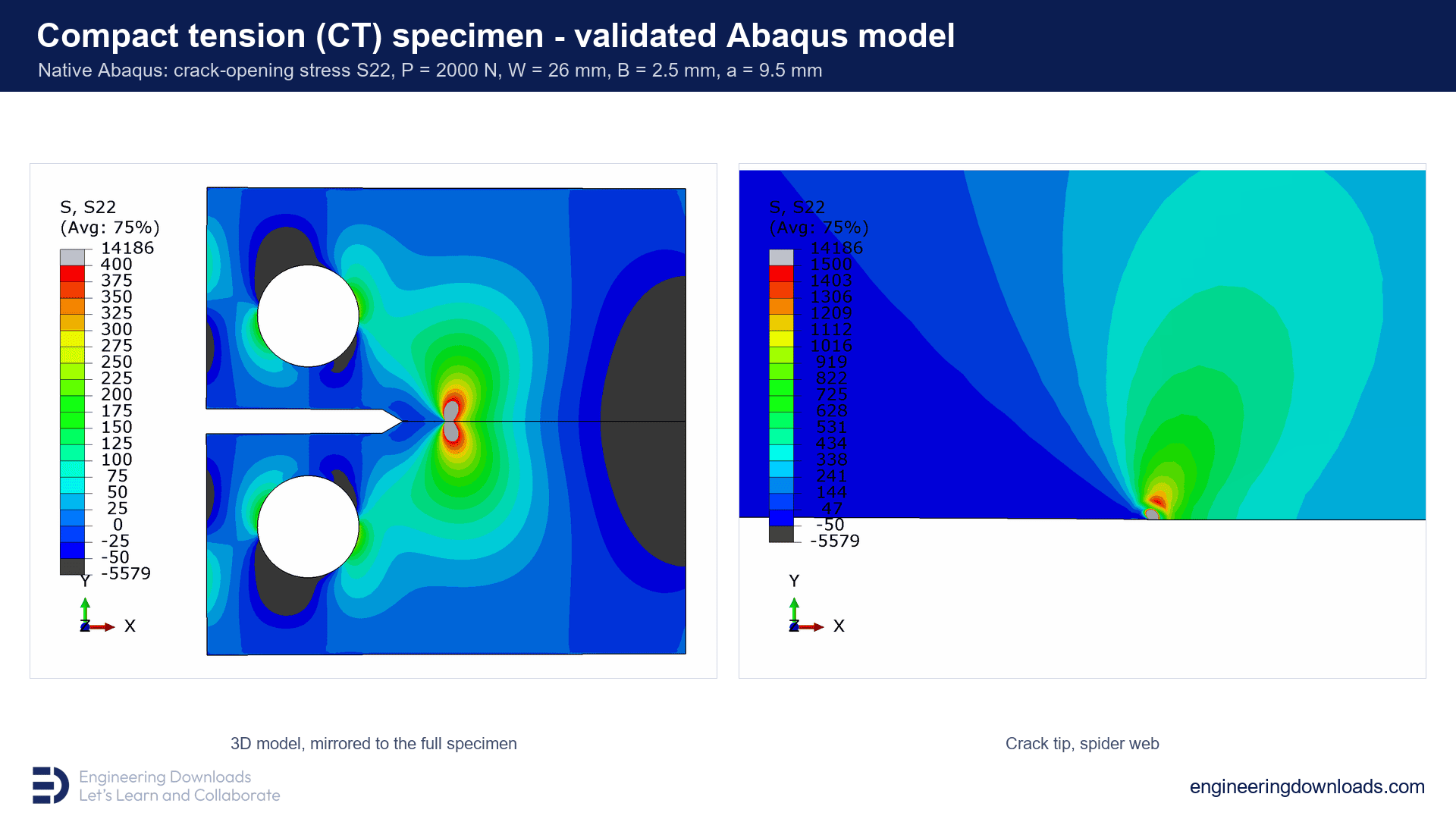 Compact Tension (CT) Specimen: Validated Abaqus Stress Intensity Factor Model vs ASTM E647 (2D + 3D)€99,00
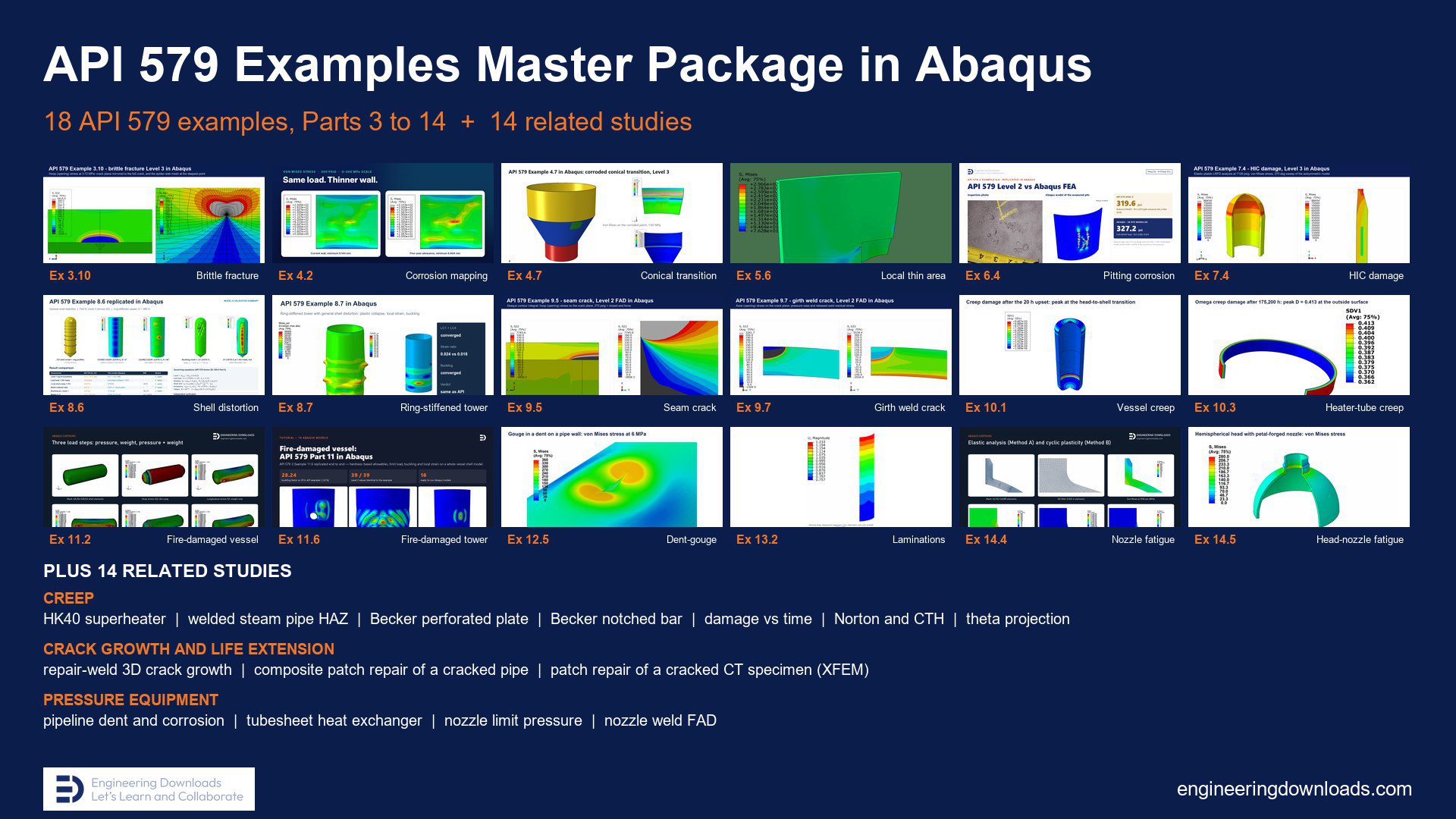 API 579 Examples Master Package in Abaqus: 18 Examples from Parts 3 to 14 plus 14 Creep, Crack Growth, Life Extension and Pressure-Equipment Studies
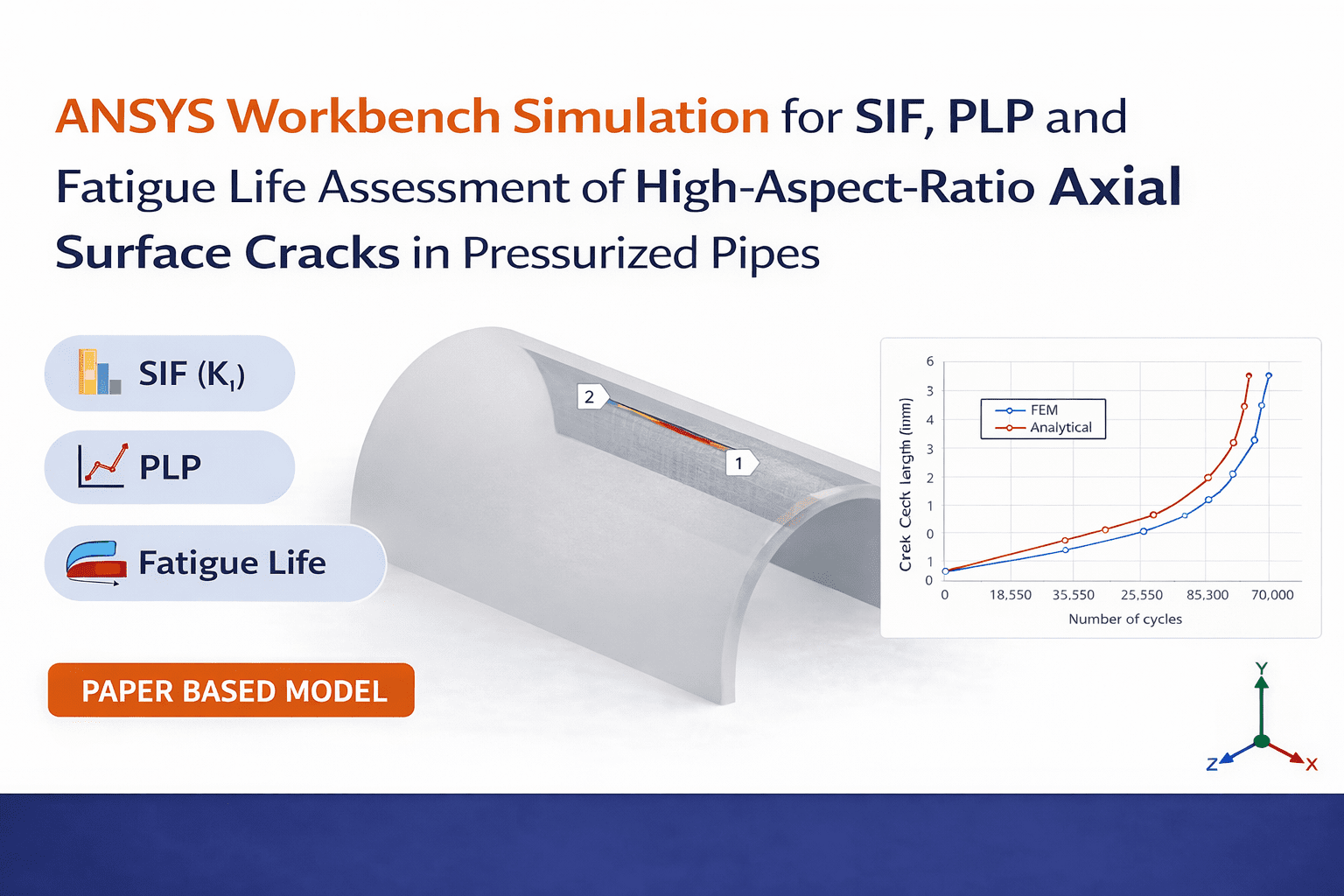 ANSYS Workbench Simulation for SIF, PLP and Fatigue Life Assessment of High-Aspect-Ratio Axial Surface Cracks in Pressurized Pipes€129,00
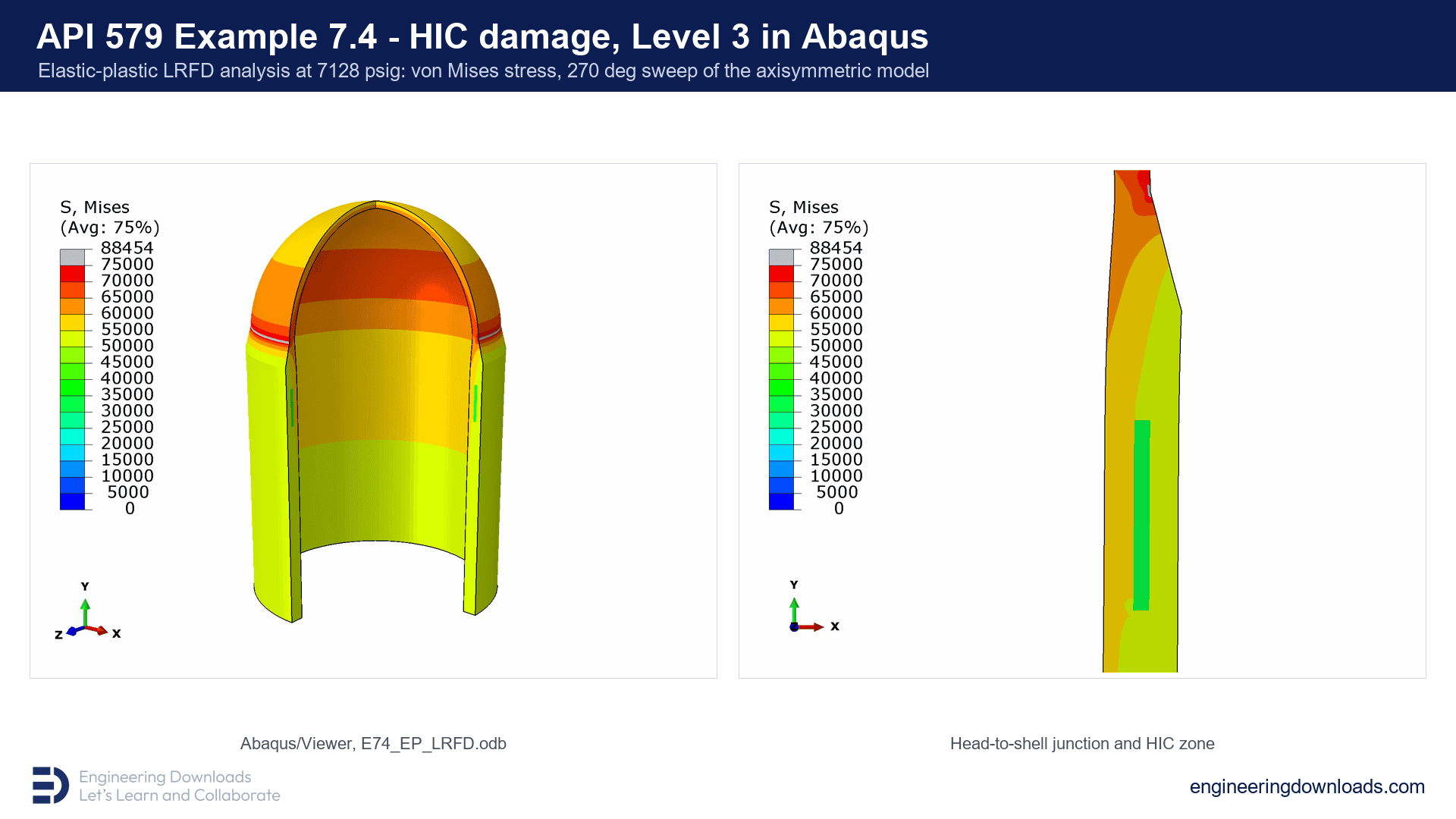 API 579 Example 7.4 in Abaqus: HIC Damage Level 3 Assessment with FAD and Plastic Collapse€139,00
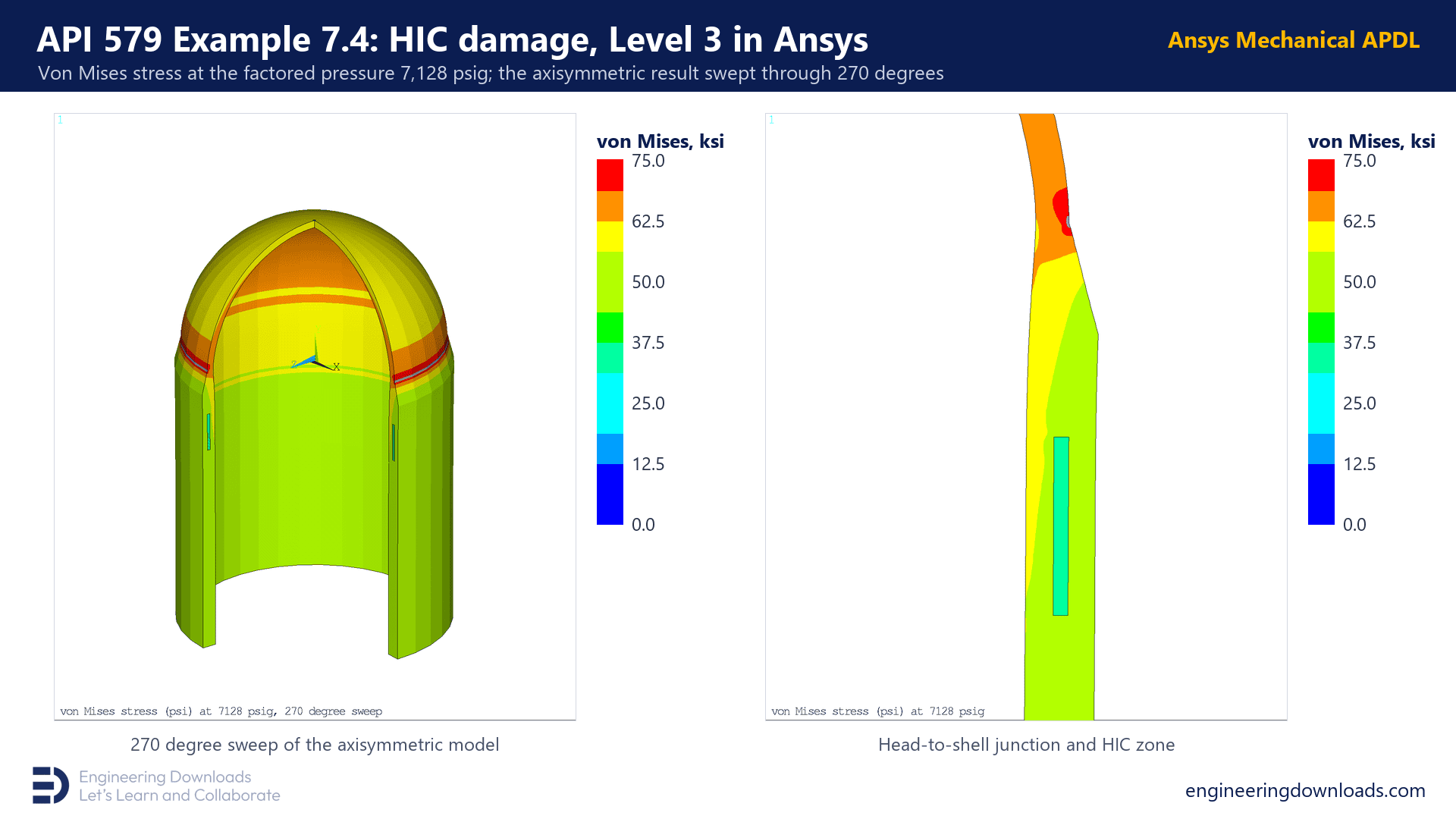 API 579 Example 7.4 in Ansys: HIC Damage Level 3 Assessment with FAD and Plastic Collapse€139,00

Need a full custom project? See the options below.
€129,00
€179,00
€149,00
€119,00
€129,00
€149,00
See more
Want to receive push notifications for all major on-site activities?