Need a full custom project? See the options below.
Need a full custom project? See the options below.
A dent with a gouge in its floor is one of the hardest pipe defects to judge. API 579-1/ASME FFS-1 Part 12 gives a Level 2 strength-factor check, and a nonlinear finite element model shows where the stress and plastic strain actually sit. This package rebuilds the published API 579-2 Example 12.5 (a gouge in a dent in a 508 mm pipe at 6 MPa) in two ways: a one-click Python script that reproduces every printed Level 2 value, and Abaqus solid models of the dented and gouged pipe on four meshes plus an intact pipe checked against thick-cylinder theory. You get INP and CAE files, the script, key images and an 8-page PDF tutorial.
Source: API 579-2/ASME PTB-14 Fitness-For-Service Example Problem Manual, Part 12, Example 12.5. The example gives the pipe dimensions, the dent and gouge depths, the material strengths, the Charpy energy and the operating pressure, and works out the strength factor and the reduced maximum allowable working pressure. It does not give a three-dimensional defect shape, so the Abaqus model uses a smooth assumed dent and a narrow assumed gouge matching the published depths.
| Item | API 579-2 Example 12.5 | This package |
|---|---|---|
| Component | Pipe, 508 mm OD, 12.7 mm wall, 0.5 mm future corrosion allowance | Half-circumference, half-length segment with symmetry planes |
| Defect | Gouge 1.27 mm deep inside a dent 25.4 mm deep | Smooth assumed dent and narrow assumed gouge with the published depths |
| Loading | Operating pressure 6 MPa | Bore pressure 6 MPa plus closed-end thrust, applied in one nonlinear step |
| Level 2 evaluation | Strength factor and reduced MAWP | run_part12_assessment.py: all 11 printed values in one click |
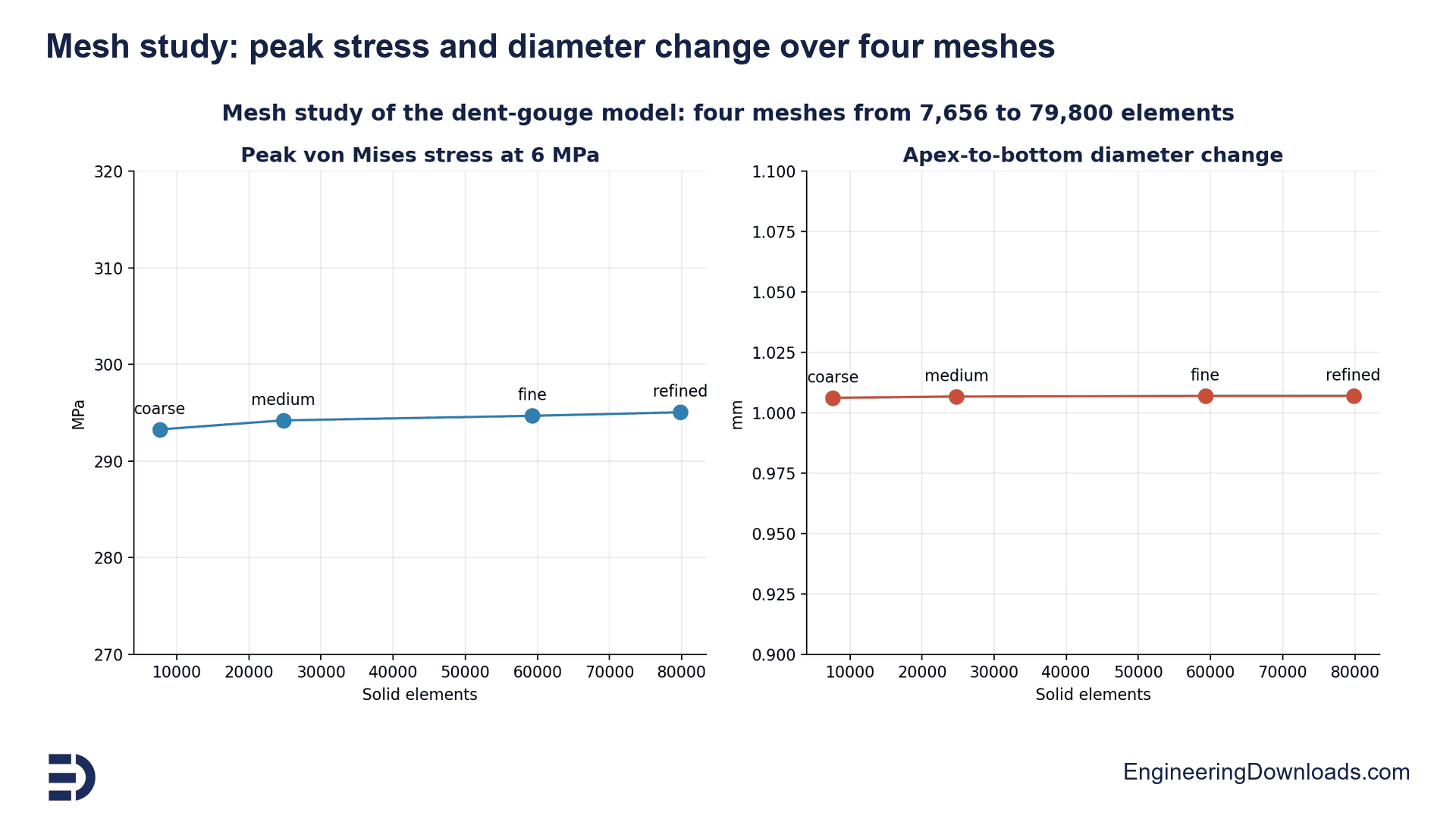
| Meshes | – | Intact pipe (11,520 elements) and dent-gouge meshes of 7,656, 24,768, 59,280 and 79,800 elements |
| Software | – | Abaqus and Python 3 |
| Quantity | Example 12.5 | This package | Difference |
|---|---|---|---|
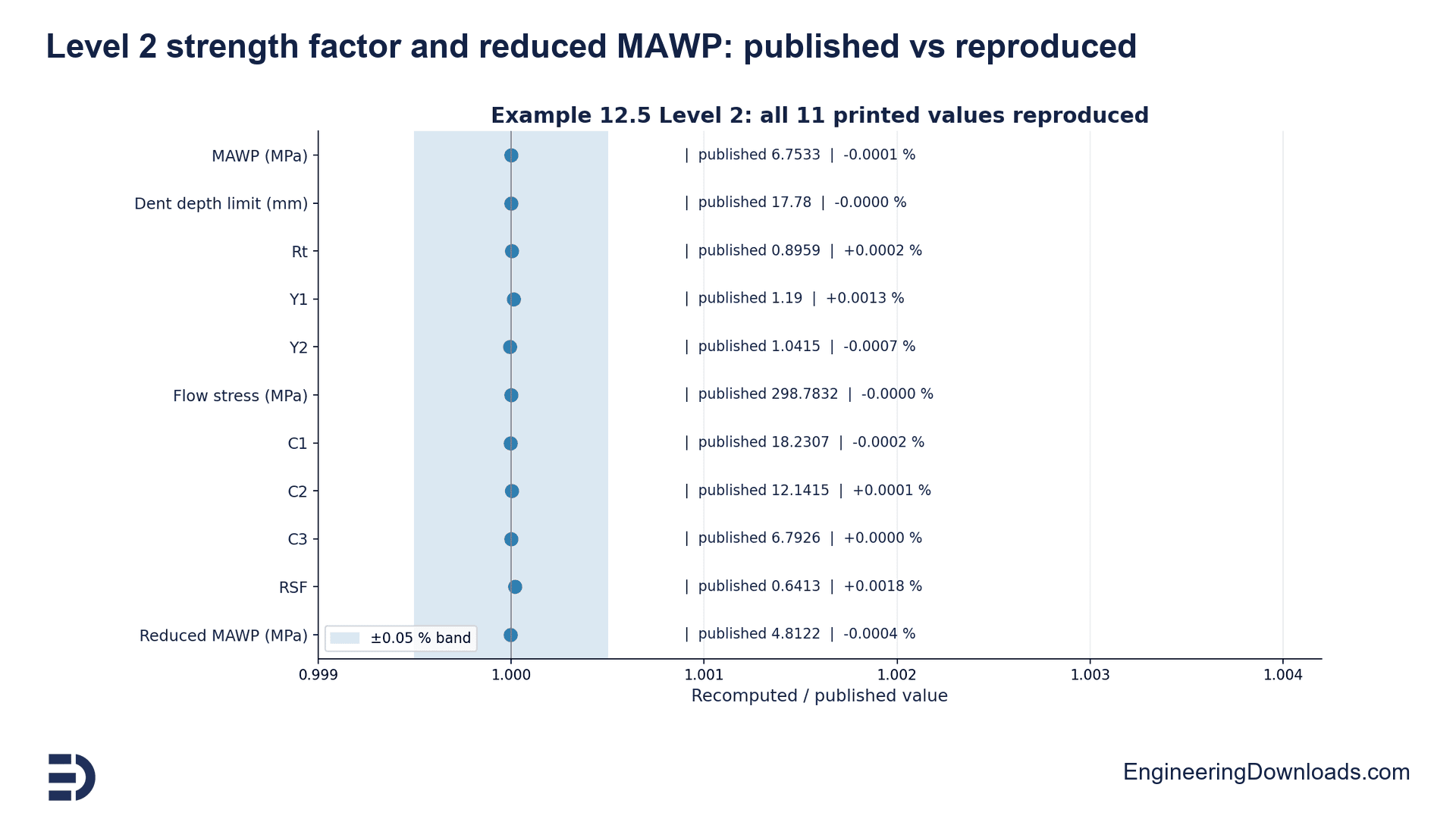
| Undamaged MAWP | 6.7533 MPa | 6.7533 MPa | −0.0001% |
| Remaining thickness ratio Rt | 0.8959 | 0.8959 | +0.0002% |
| Y1 / Y2 | 1.1900 / 1.0415 | 1.1900 / 1.0415 | +0.0013% / −0.0007% |
| Flow stress | 298.7832 MPa | 298.7832 MPa | 0.0000% |
| C1 / C2 / C3 | 18.2307 / 12.1415 / 6.7926 | 18.2307 / 12.1415 / 6.7926 | within 0.0003% |
| Remaining strength factor RSF | 0.6413 | 0.6413 | +0.0018% |
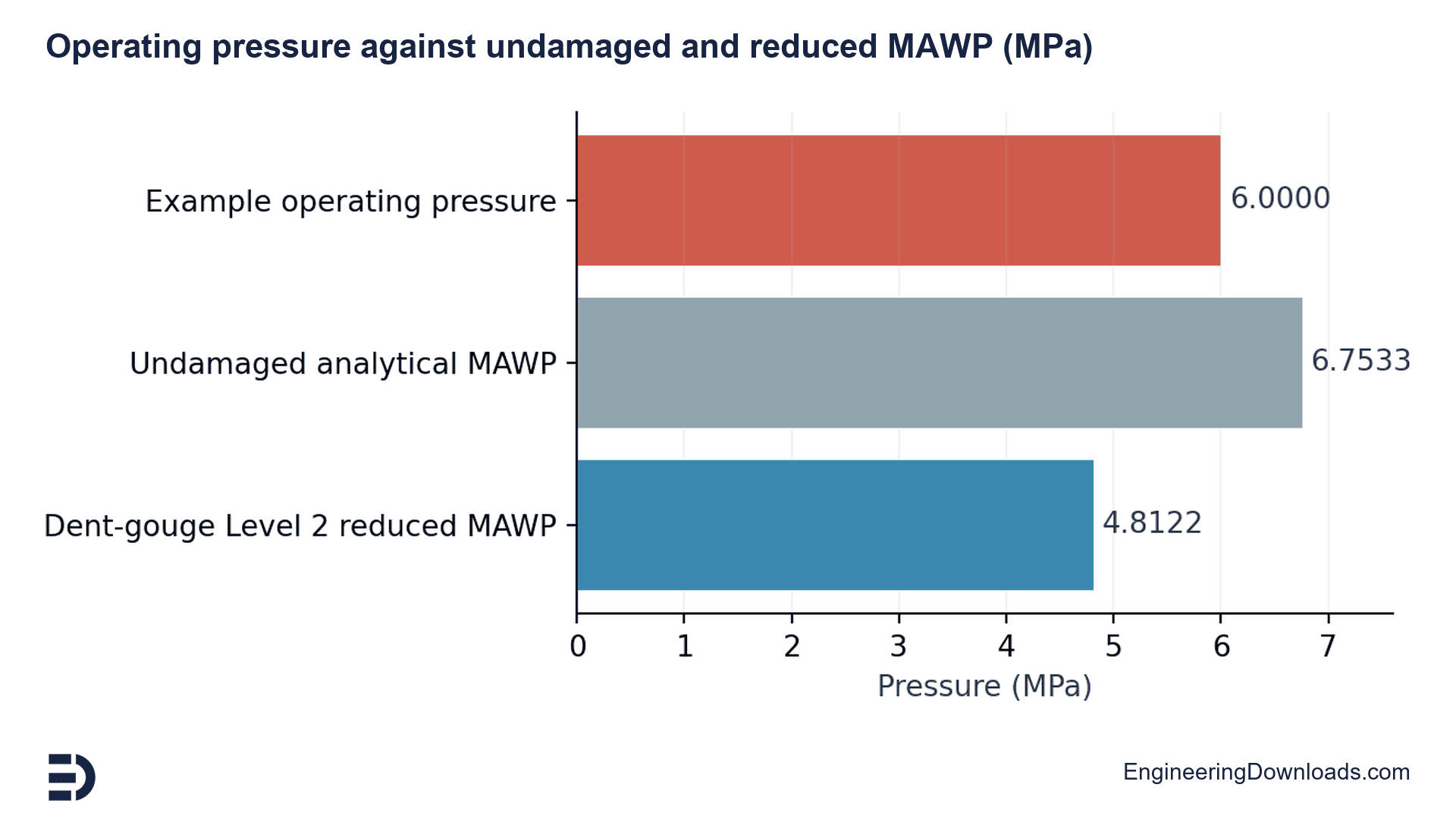
| Reduced MAWP | 4.8122 MPa | 4.8122 MPa | −0.0004% |
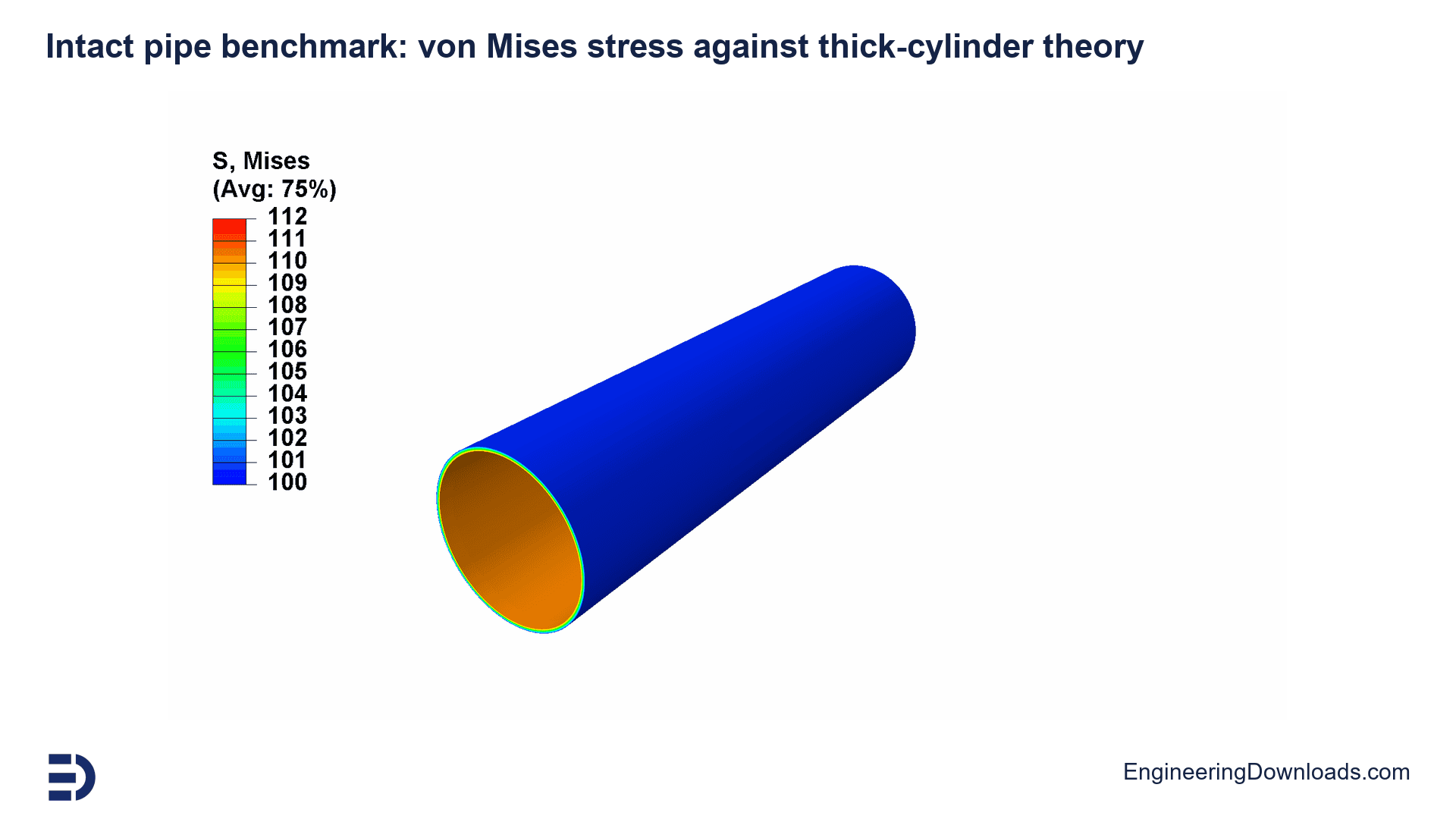
| Intact pipe FE hoop stress vs thick-cylinder theory | – | – | max 0.016% |
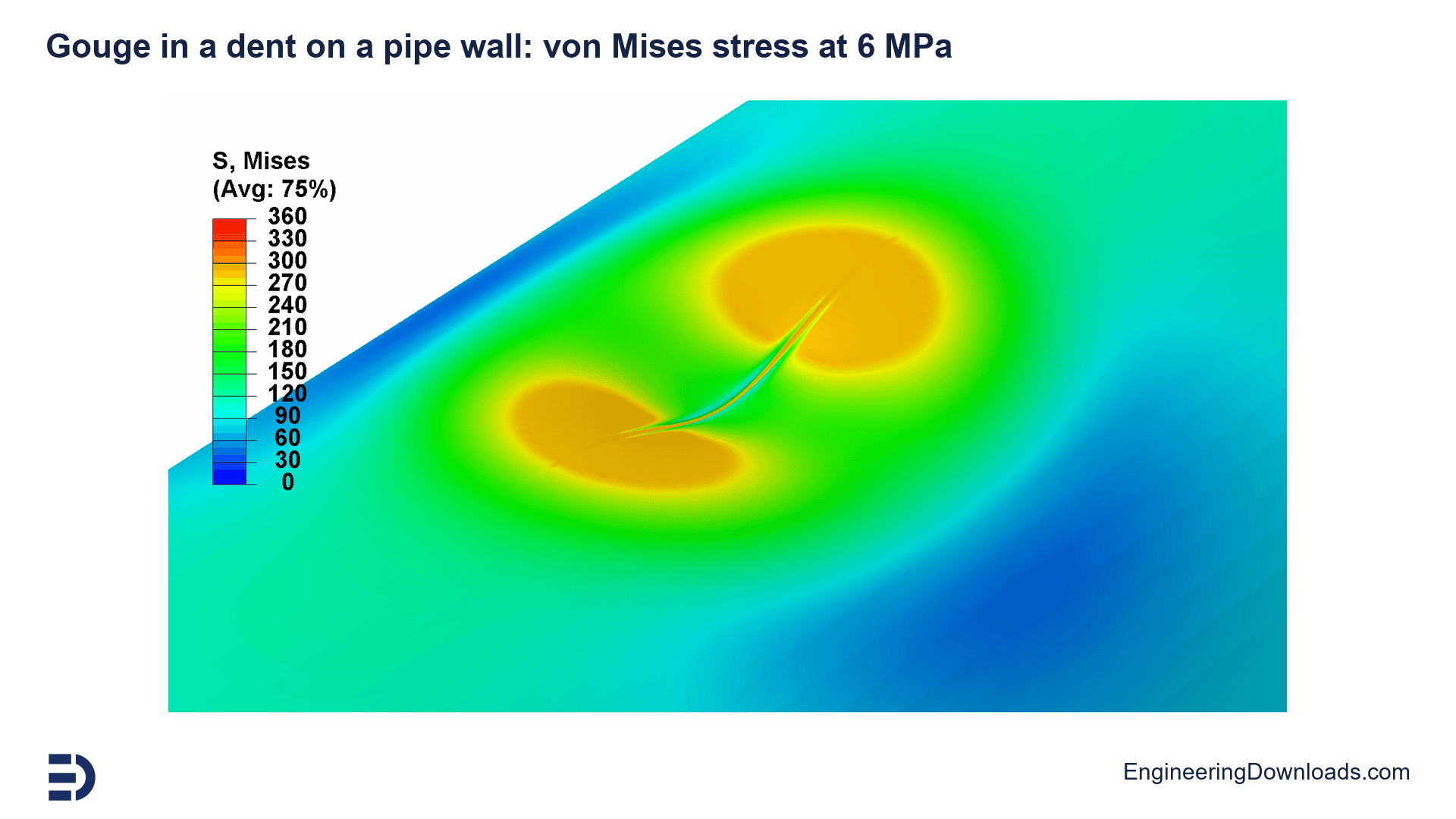
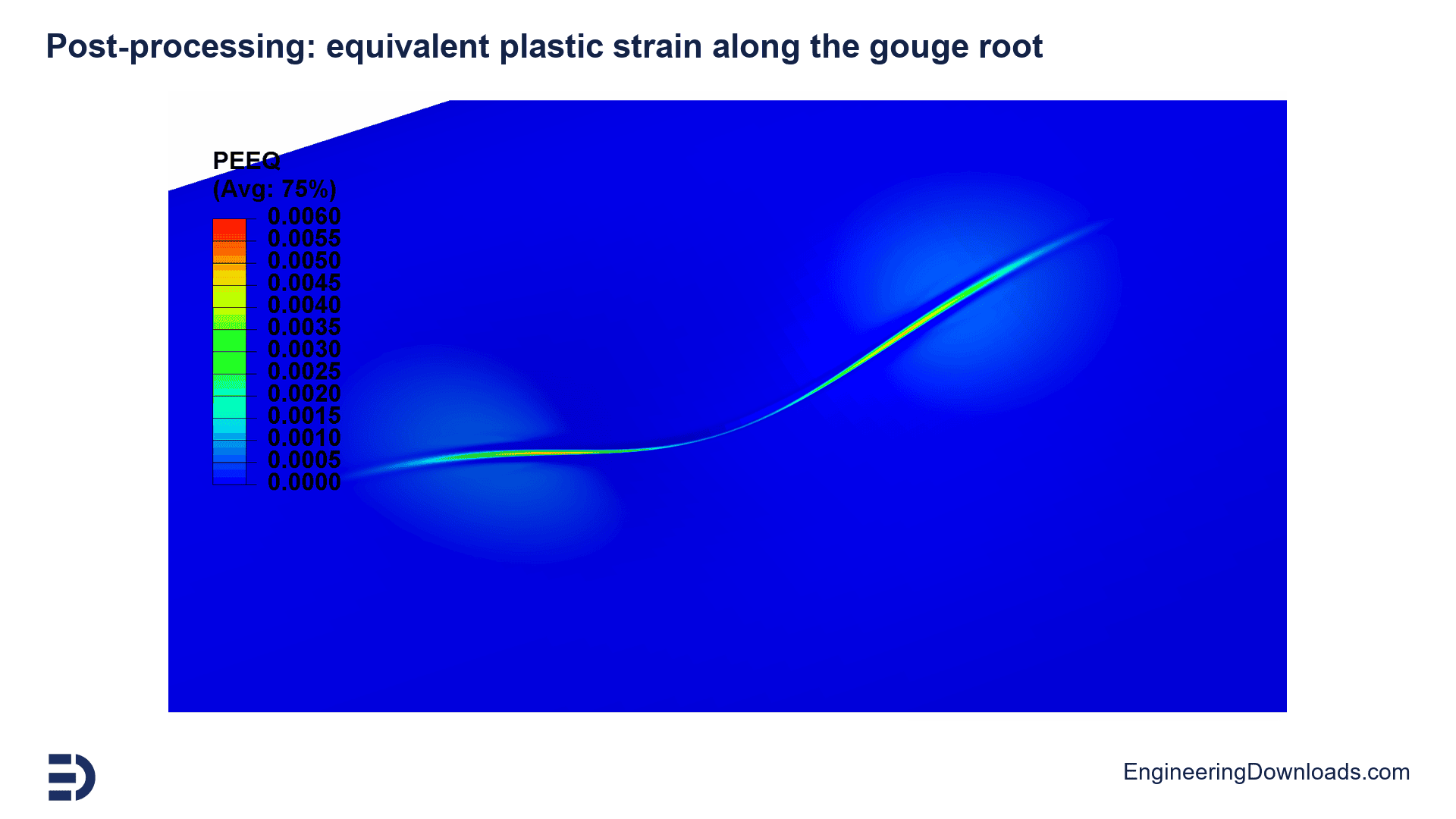
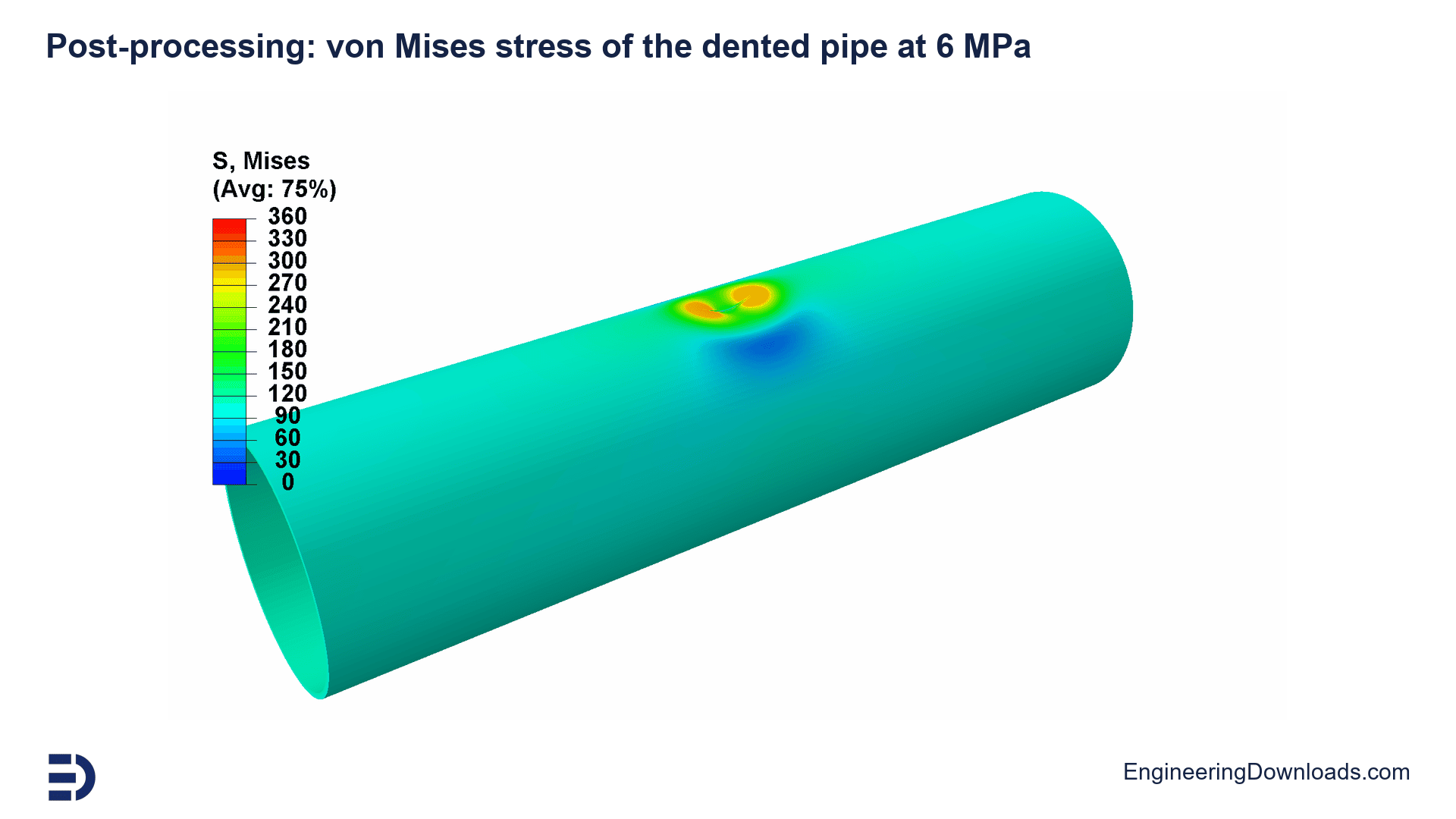
All 11 printed values of the example are reproduced within 0.002%. The reduced MAWP of 4.8122 MPa is below the 6 MPa operating pressure, which is why a detailed nonlinear model of the defect is the natural next step. In the finite element study the peak von Mises stress changes by 0.16% from the medium to the fine mesh and by 0.12% from the fine to the refined mesh, the apex diameter change varies by less than 0.03%, and the end-cap force balance is within 0.023% of theory. All 46 numerical checks of the five models pass.
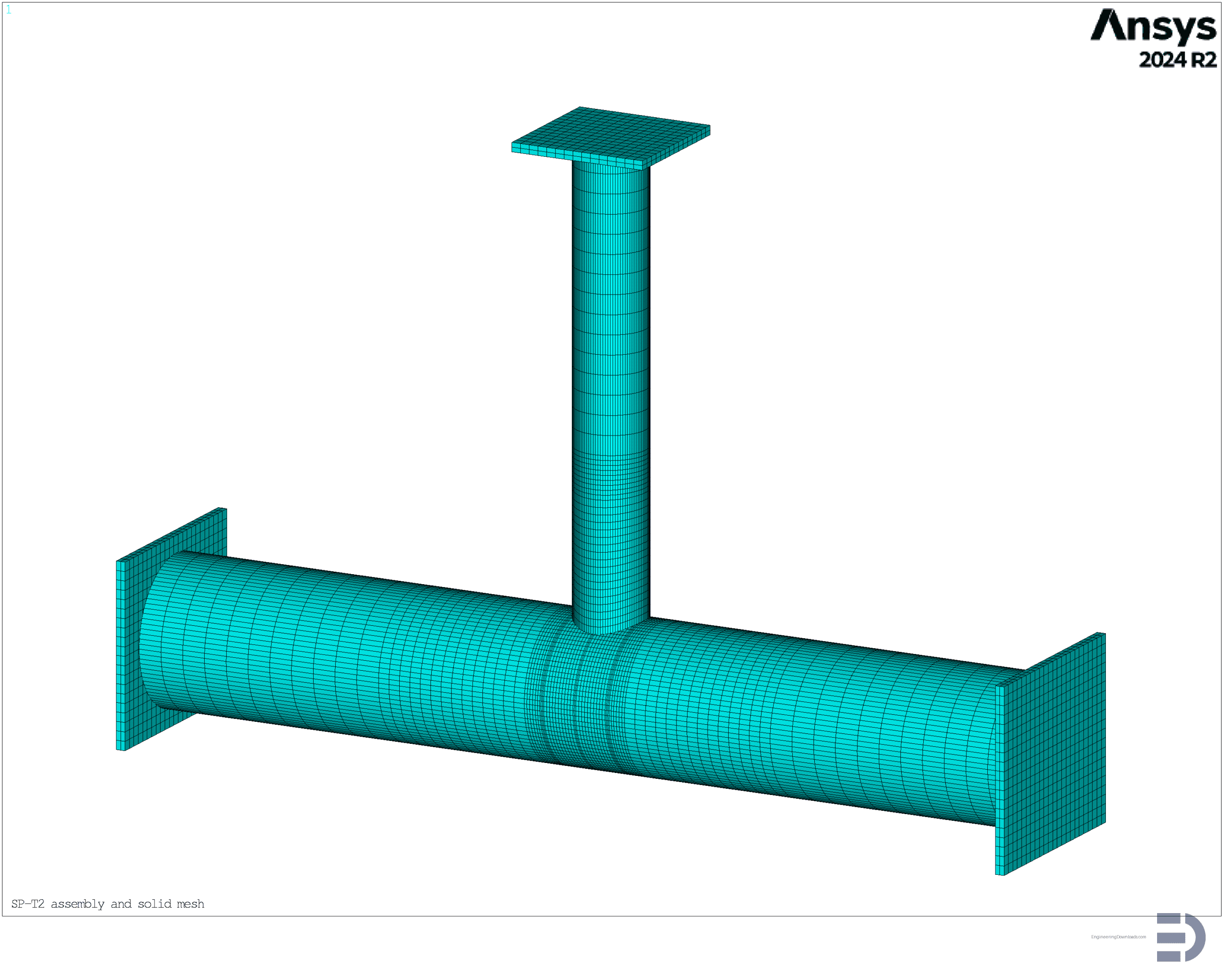
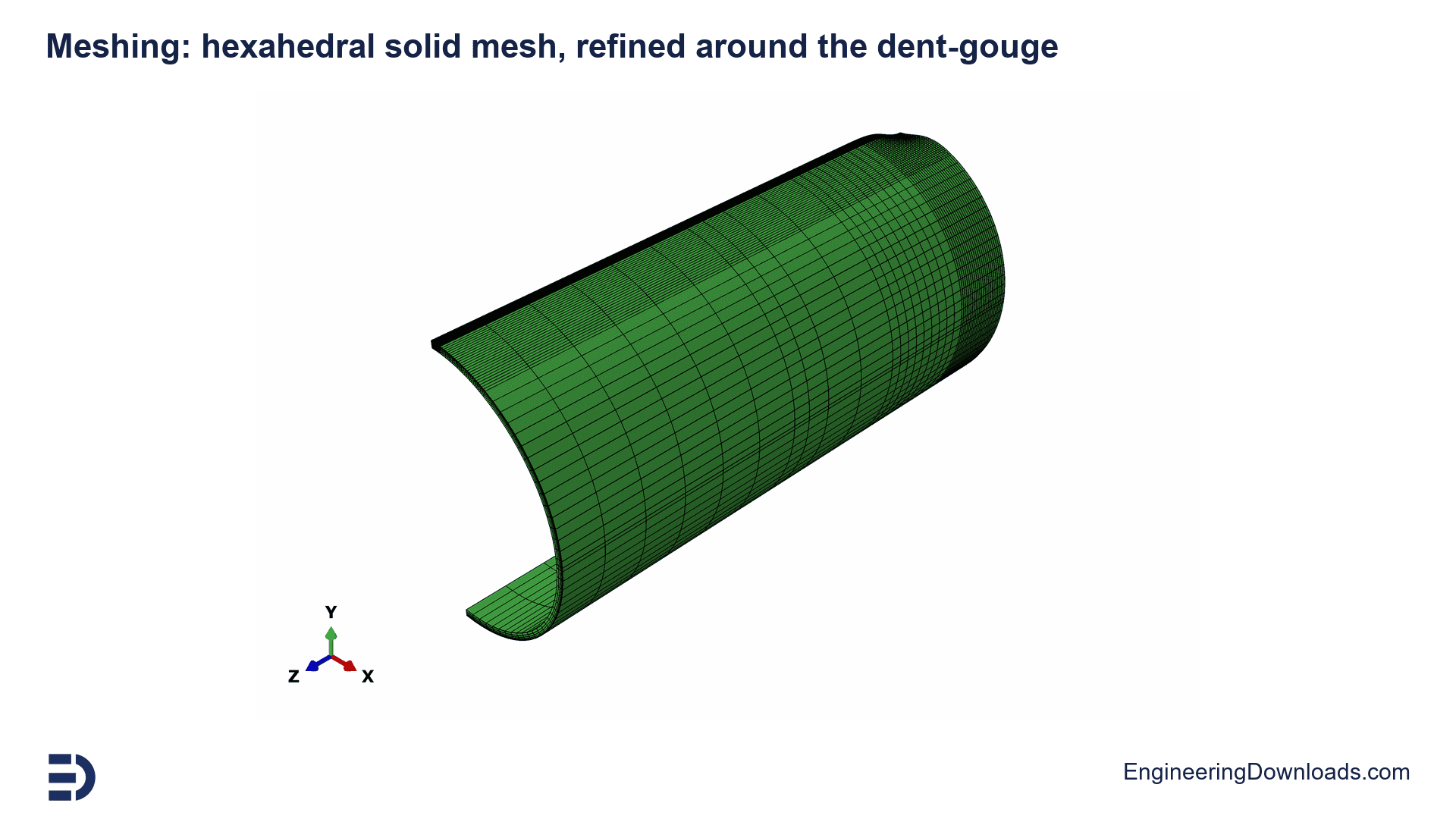
A half-circumference, half-length segment of the pipe is meshed with 3D solid elements, refined through the thickness and around the dent and gouge. Bore pressure acts on the inside surface and the closed-end thrust acts on the end cap. Symmetry planes fix the X and Z translations and one anchor point removes the rigid-body mode along Y. Geometric nonlinearity is on and the material is elastic-plastic with yield at 290 MPa and linear isotropic hardening of 1000 MPa.
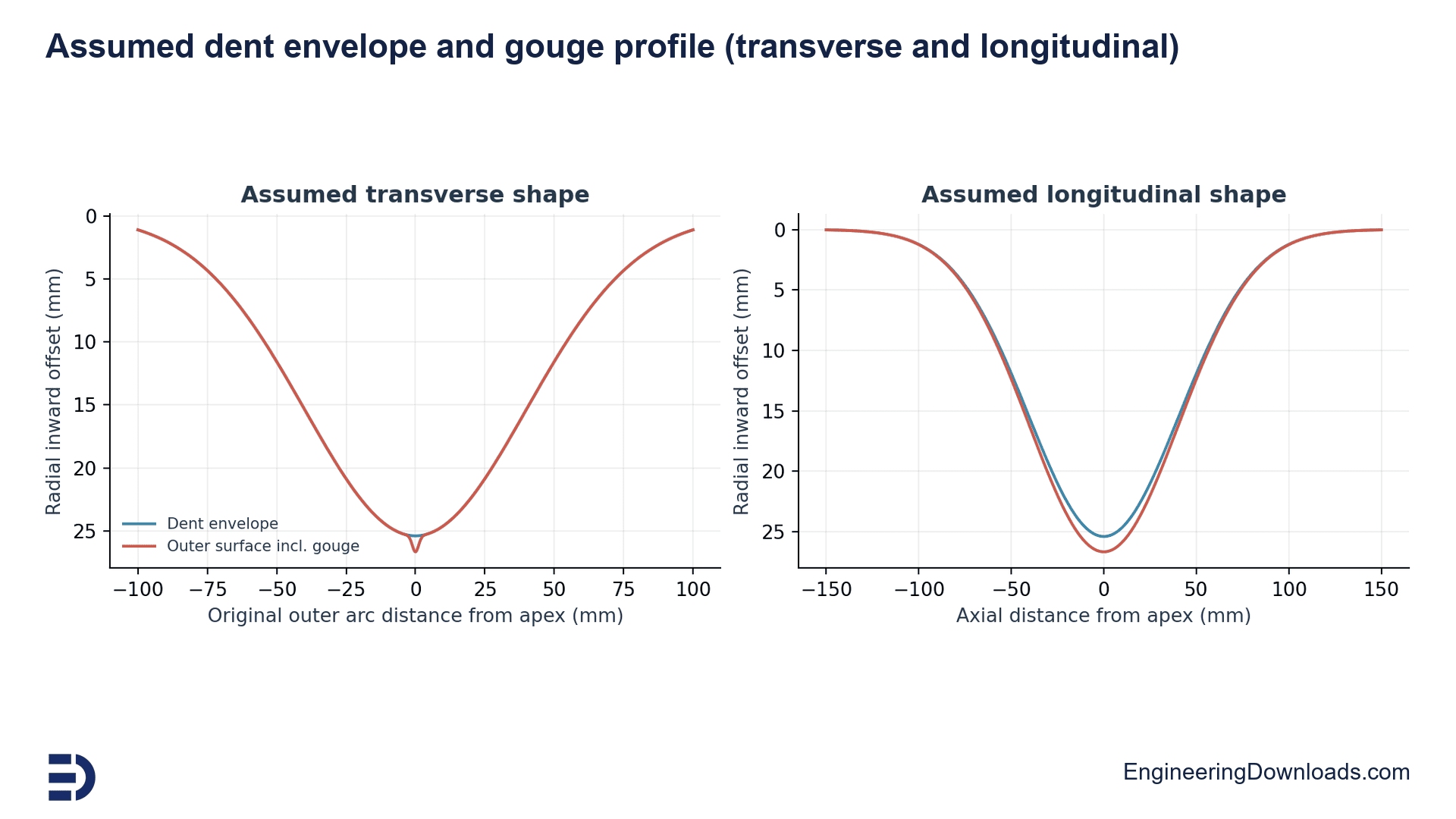
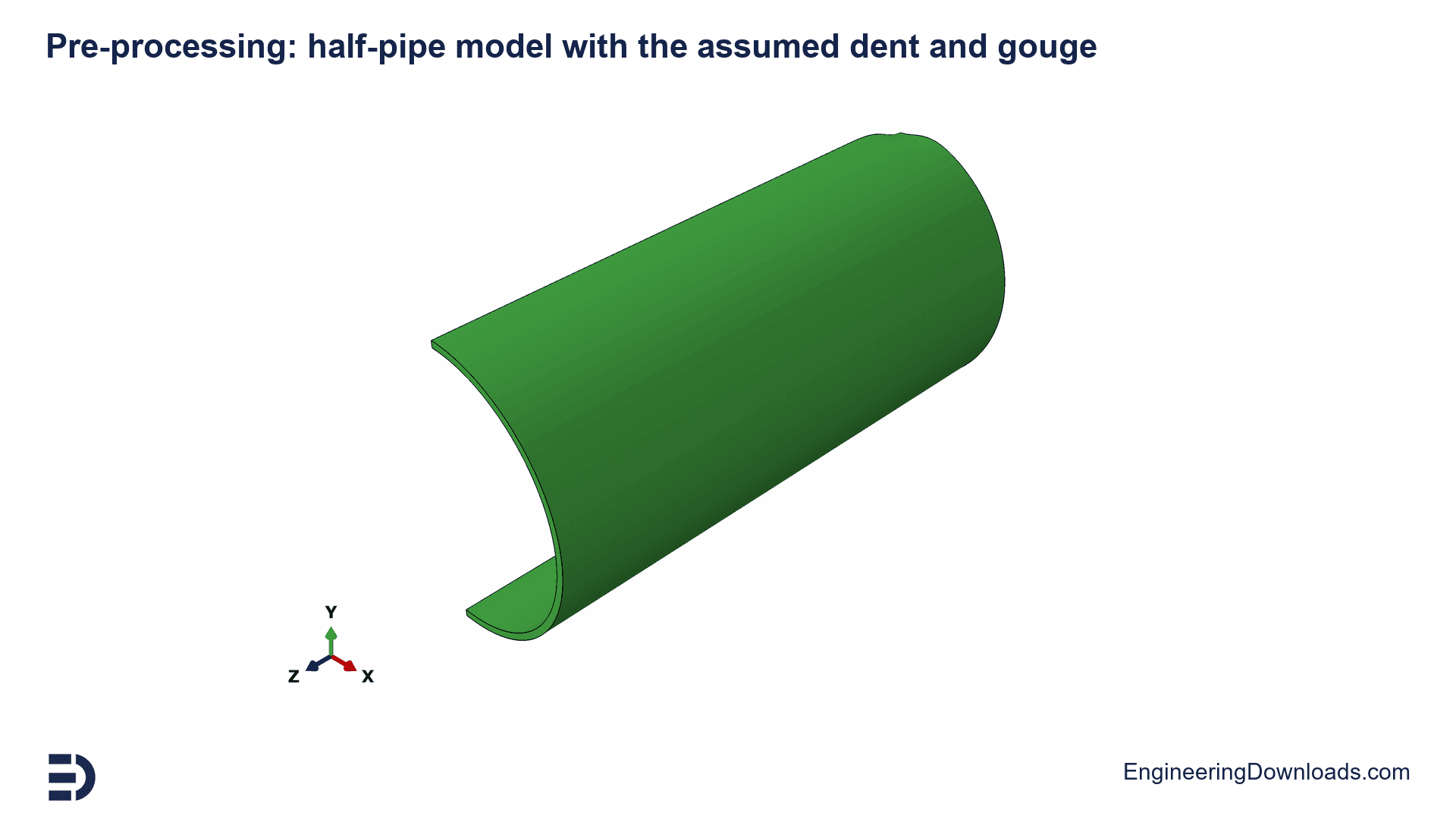
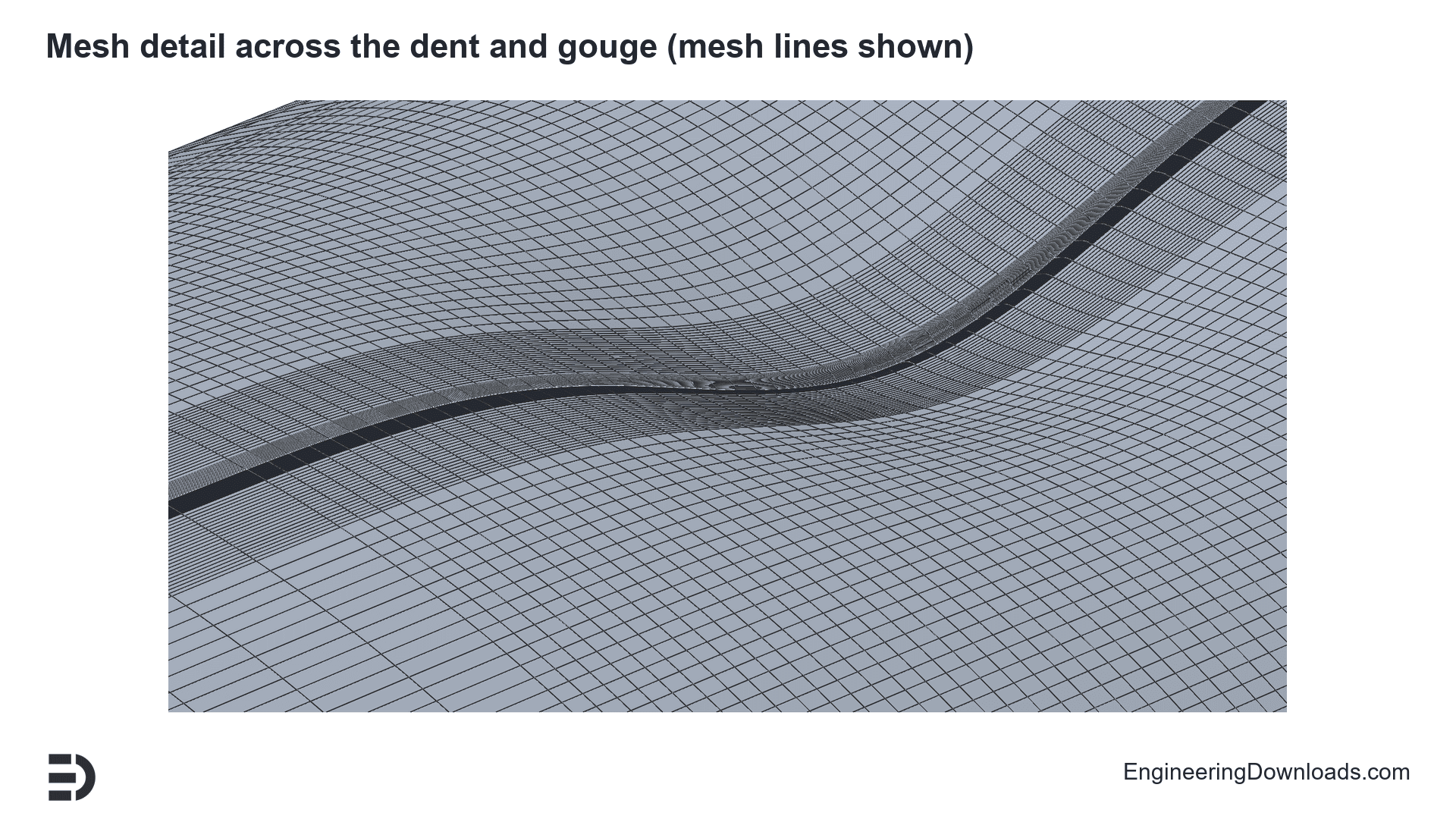
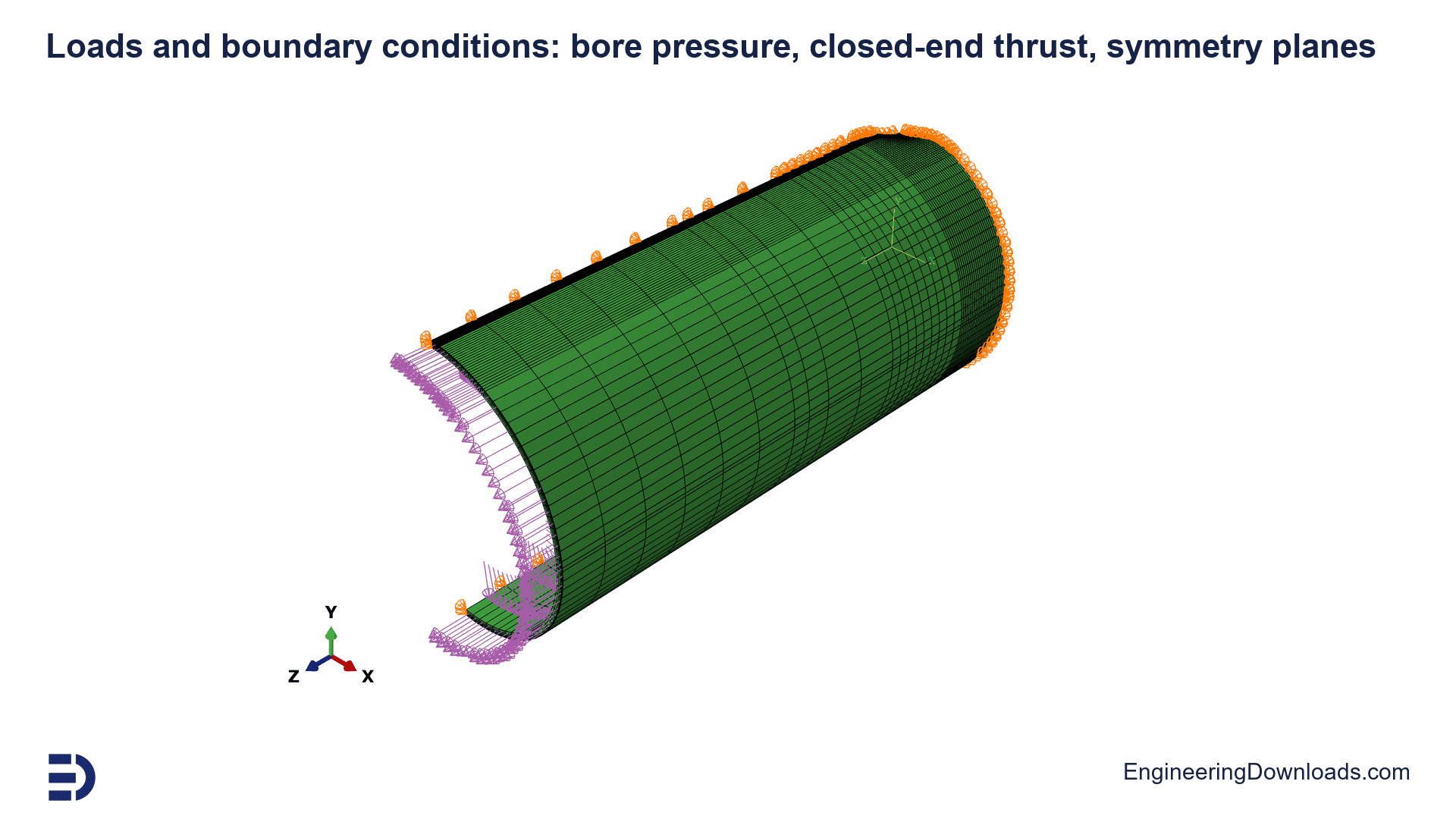
This is an educational benchmark: the Level 2 result is reproduced from the example, and the nonlinear dent-gouge model is a demonstration with an assumed defect shape and hardening curve. It is not a component-specific Level 3 assessment. The models and the script run in your own Abaqus and Python installation, and you need your own copy of the standard.
What does this package assess? A gouge inside a dent in a pressurized pipe, as in API 579-2 Example 12.5 (Part 12). It reproduces the Level 2 strength-factor calculation and the reduced MAWP, and adds a nonlinear Abaqus solid model of the dented and gouged pipe at the operating pressure.
What is the one-click script? run_part12_assessment.py is plain Python 3 with no extra packages. Run it and it prints the Level 2 values next to the 11 values printed in the example, the thick-cylinder stresses of the intact pipe and the check of the operating pressure against the reduced MAWP, and writes a CSV. No edits are needed.
How close is the result to the example? All 11 printed Level 2 values are reproduced within 0.002%, including a remaining strength factor of 0.6413 and a reduced MAWP of 4.8122 MPa. The intact-pipe finite element model matches the thick-cylinder hoop stress within 0.016%.
Which Abaqus files do I get? INP and CAE files of an intact pipe and of the dent-gouge model on four meshes (7,656, 24,768, 59,280 and 79,800 solid elements). You solve them in your own Abaqus installation.
Which inputs are assumed? The example gives depths and radii but no three-dimensional defect shape or plastic curve. The model therefore uses a smooth assumed dent, a narrow assumed gouge and linear isotropic hardening of 1000 MPa above a 290 MPa yield. The defect starts stress-free, so dent forming is not modelled. The tutorial lists every assumption.
Can I use it for my own pipe? Yes for the Level 2 part: change the diameter, thickness, depths, strengths, Charpy values and pressure in the input block of the script. For the finite element part, change the dent and gouge geometry in the model, re-mesh and re-solve.
Is this a Level 3 assessment? No. It is an educational benchmark and modelling demonstration. The nonlinear model shows how a dent-gouge is modelled, but it does not replace a component-specific assessment by a qualified engineer.
Do I need the standard? Yes. API 579-1/ASME FFS-1 and API 579-2/ASME PTB-14 are not included. Keep your own copy to follow the equations.
What if the package is not what I expected? Write to us. Engineering Downloads refunds clients who are not satisfied with a delivered product.
Need more than the files?
There are two ways we can help. Book a one hour online consultation if you want to talk a problem through with a CAE engineer, using the checkbox in the order box. Order a project if you need a full simulation built for you, delivered to an agreed scope, price and deadline under a written contract.
We work on FEA and CFD for engineers, researchers and companies. Order your project, or message us on WhatsApp for a quick reply.
Other packages engineers working on this topic also download.
 Pipeline Dent and Corrosion Analysis in Abaqus: Level 3 FFS Modelling
 A parametric study on the mechanical performance of buried X65 steel pipelines under subsurface detonation
 The application of CFRP to strengthen buried steel pipelines against subsurface explosion
 Pipe and Pipeline Simulation Package in Abaqus (21 Models)
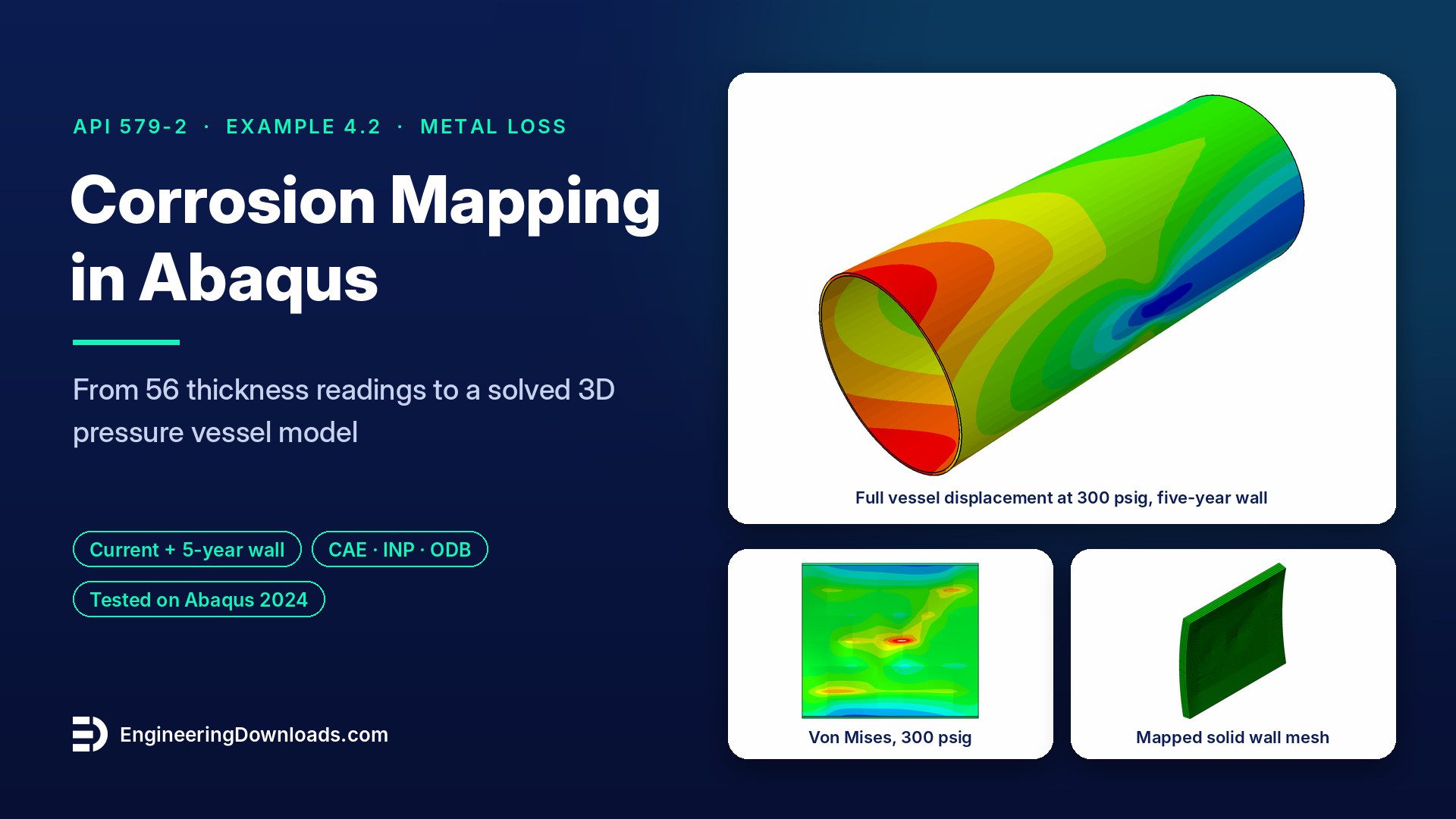 API 579 Example 4.2 in Abaqus: Corrosion Mapping of a Metal Loss Pressure Vessel
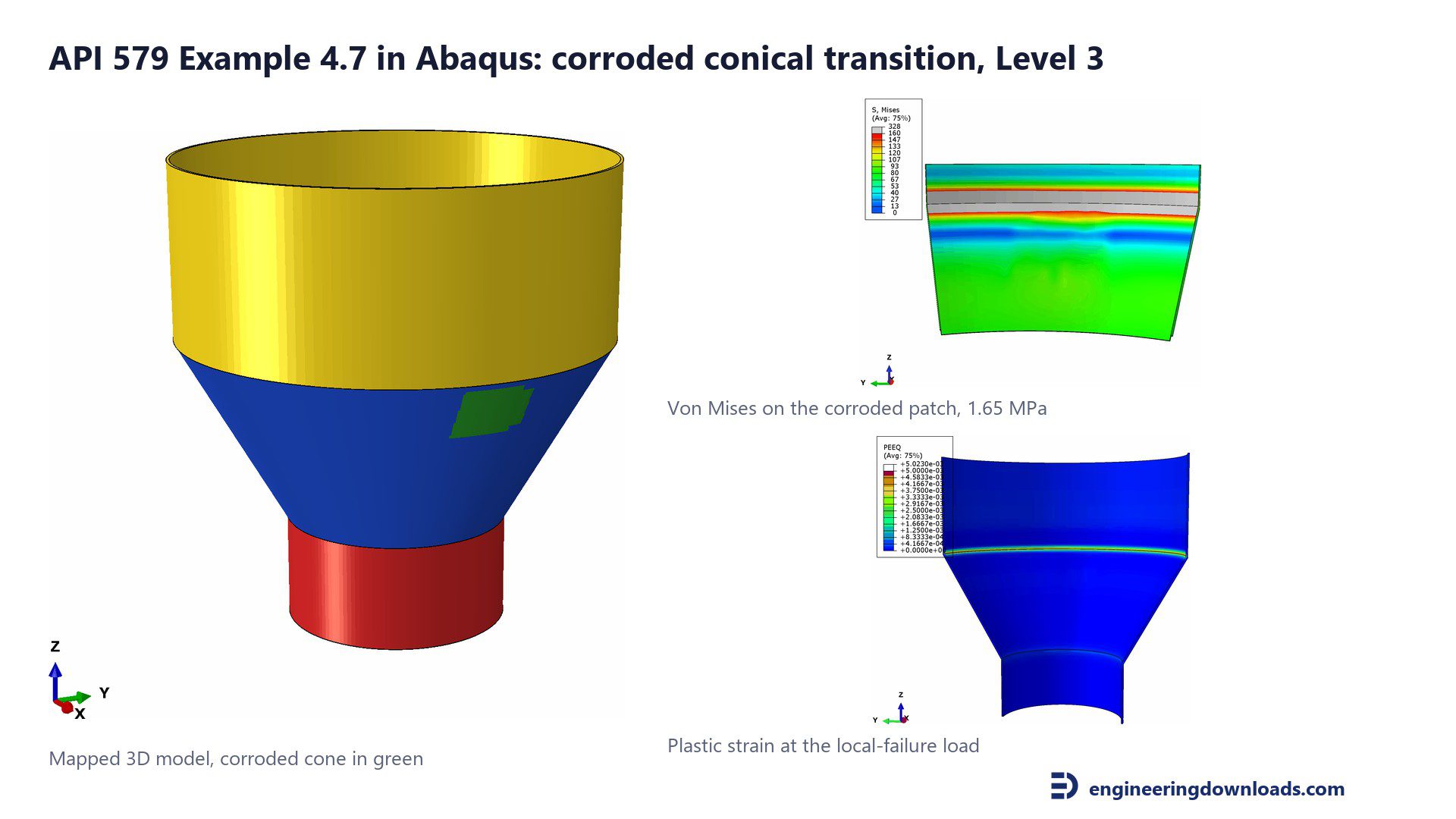 API 579 Example 4.7 in Abaqus: Corroded Conical Transition, Level 3 FFS
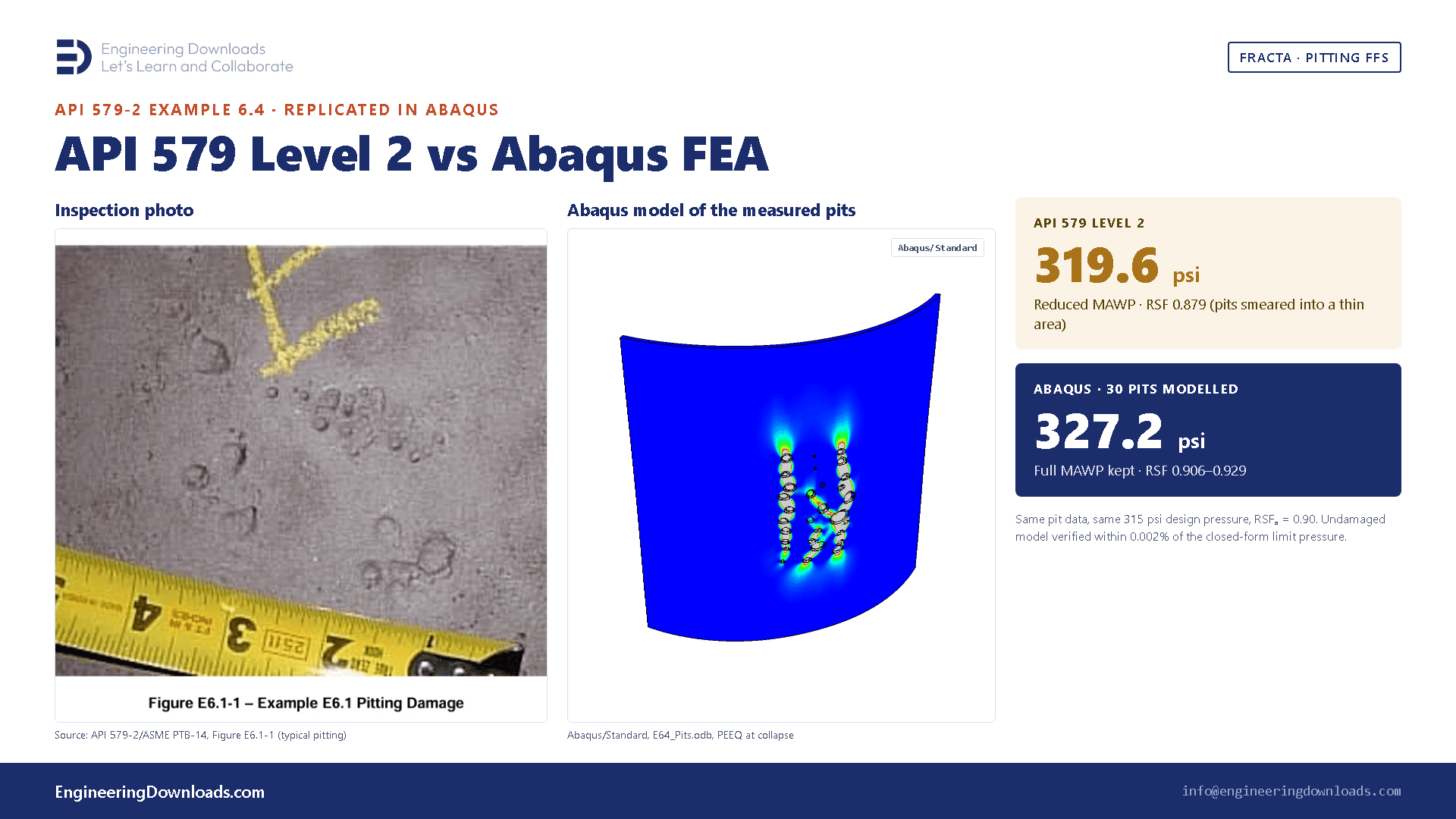 API 579 Example 6.4 in Abaqus: Localized Pitting Corrosion, Level 2 vs Level 3 FFS€129,00
 API 579 Example 8.6 in Abaqus: General Shell Distortion and Buckling, Level 3 FFS€129,00

Need a full custom project? See the options below.
€129,00
€179,00
€149,00
€119,00
€129,00
€149,00
See more
Want to receive push notifications for all major on-site activities?