Need a full custom project? See the options below.
Need a full custom project? See the options below.
An Abaqus model of phase-field cohesive zone fatigue crack propagation in a notched concrete beam under mixed-mode cyclic loading. The phase field is solved as the temperature degree of freedom of coupled temperature-displacement elements, with the material law in a UMAT and the phase-field equation in a HETVAL subroutine. You get the CAE database, the input file, the Fortran source, a one-click run script and a PDF tutorial.
The theory is explained in the PDF tutorial, and the subroutine coding is explained step by step next to the source.
Concrete, rock, ceramics and other quasi-brittle materials rarely fail in a single overload. Bridges, pavements, offshore structures and wind-turbine foundations carry millions of load cycles, and a crack advances a little with every cycle. A useful model has to start a crack, curve it under mixed-mode loading and let it grow cycle after cycle without remeshing. The phase-field cohesive zone approach does this by smearing the crack over a narrow band and letting a field equation decide where and how it grows.
This product is that model as a working Abaqus package: a notched concrete beam with an off-centre notch, loaded cyclically between 5 % and 85 % of a reference load. Source code and model files are included, so you can read, run and adapt it in your own Abaqus.
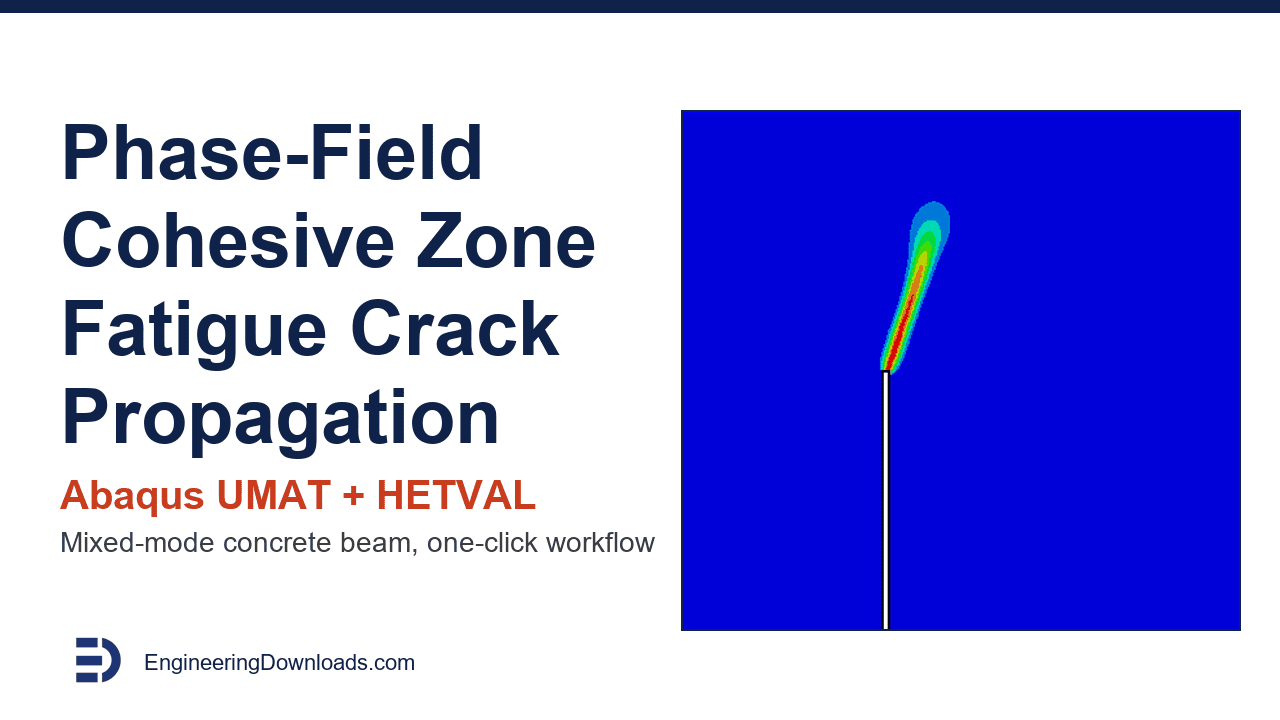
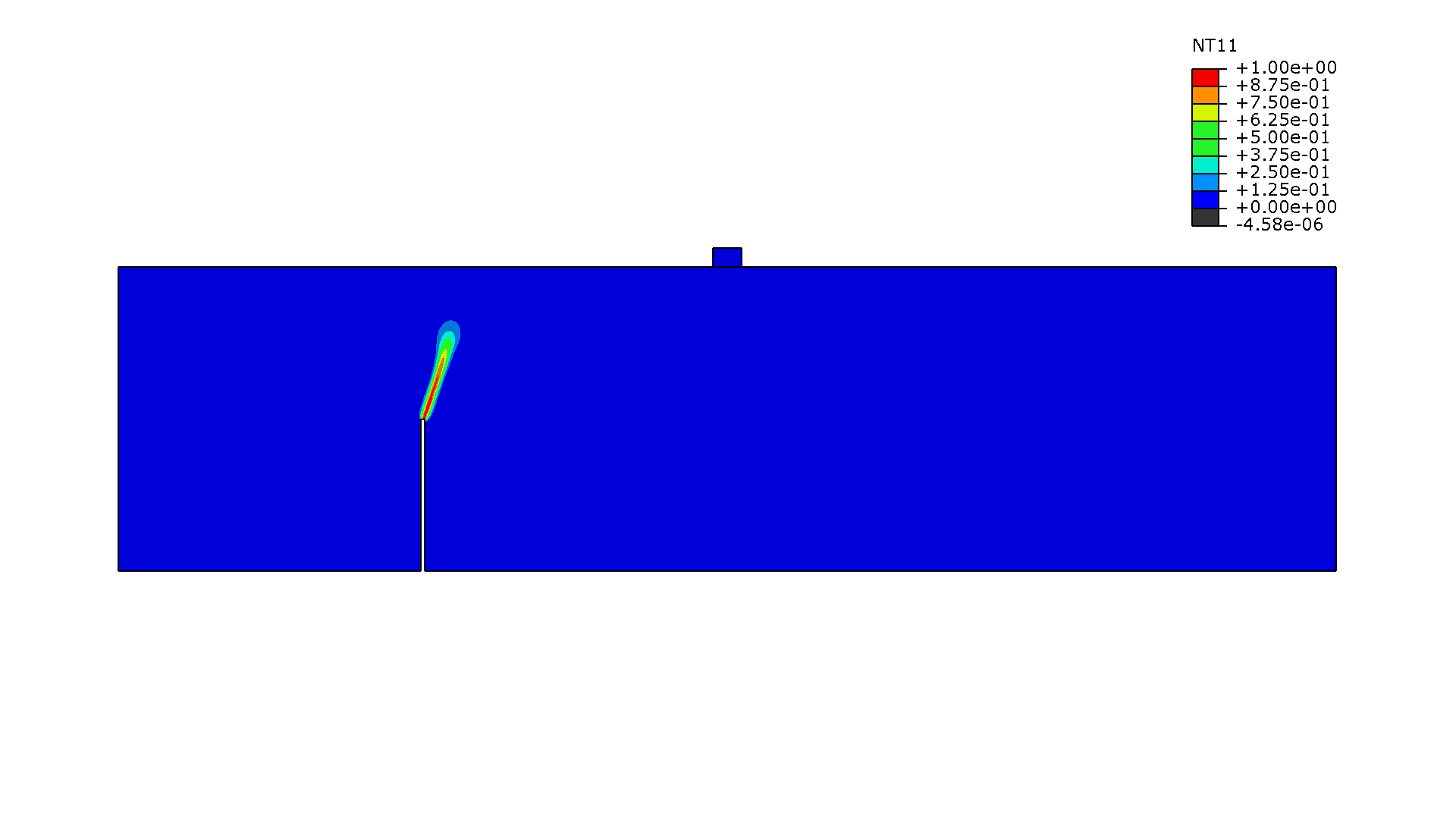
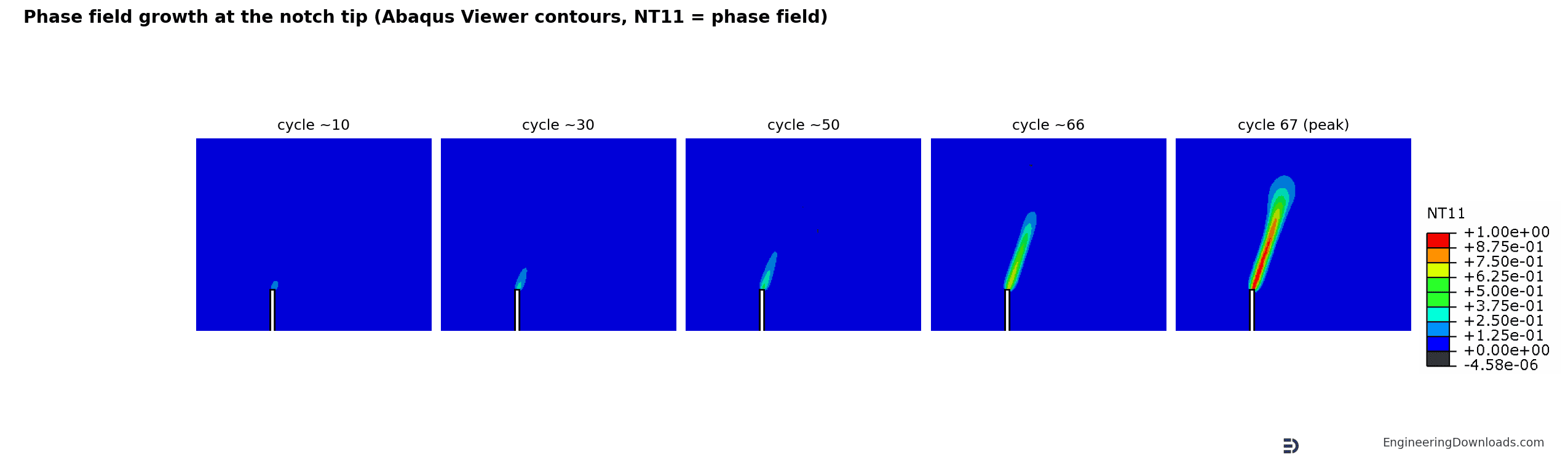
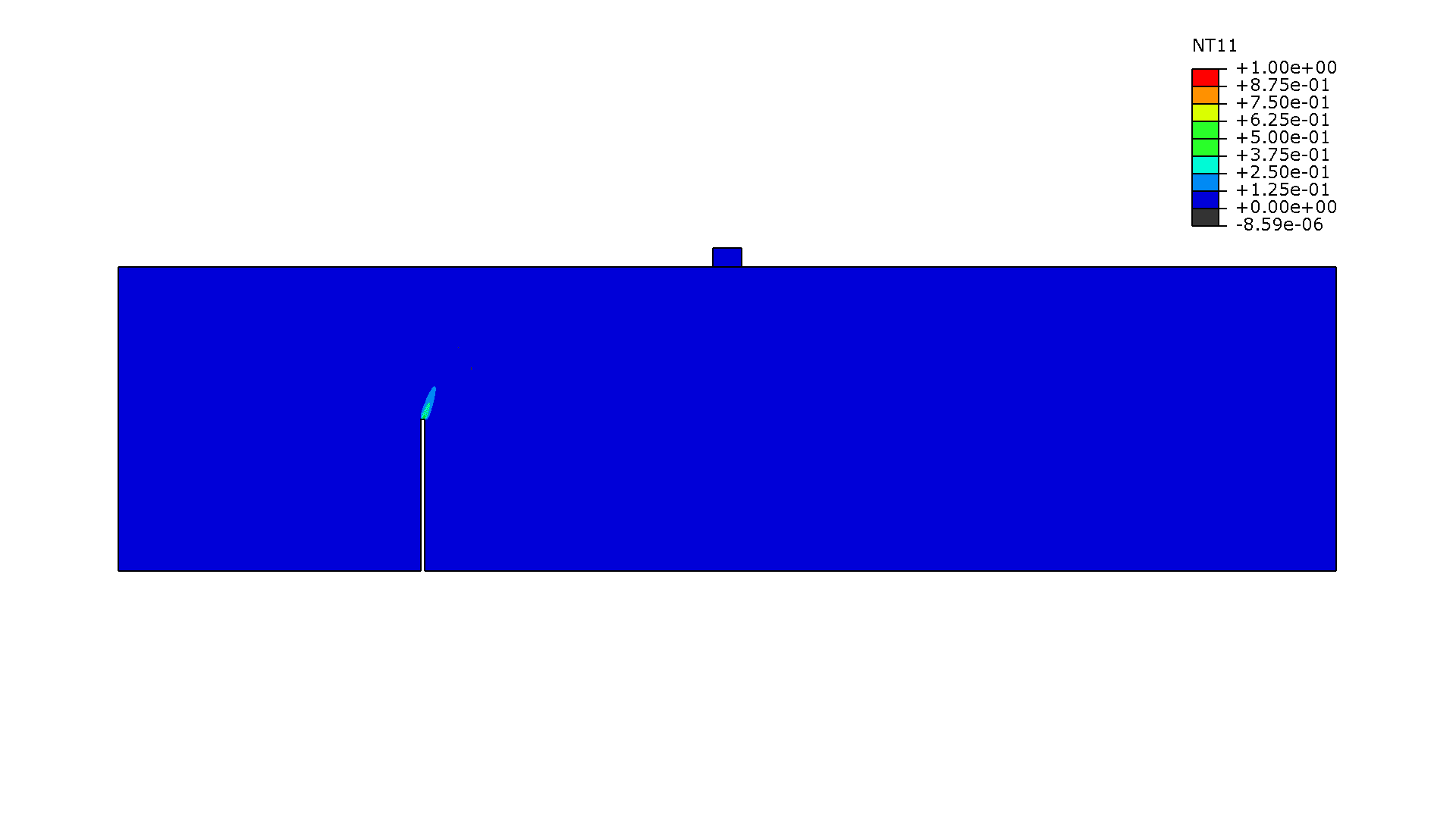
Unedited default Abaqus Viewer result: phase field (NT11) at the cycle-67 peak. The red-orange ridge is the cracked band; the blue-cyan zone around it is the diffuse crack width.
Source: Baktheer, A.; Martinez-Paneda, E.; Aldakheel, F., Phase field cohesive zone modeling for fatigue crack propagation in quasi-brittle materials, Computer Methods in Applied Mechanics and Engineering (2024), doi:10.1016/j.cma.2024.116834.
In short: The authors extend the phase-field cohesive zone model (PF-CZM) to cyclic loading. A degradation of the fracture energy, driven by an accumulated local energy variable, lets cracks initiate and grow under repeated loads, while the cohesive-type degradation function keeps the tensile strength and fracture energy as real material inputs. The formulation is implemented in Abaqus with a user material and a heat-generation subroutine, and it is demonstrated on fatigue benchmarks for quasi-brittle materials, including mixed-mode crack propagation. This page is a paraphrase; see the original article for the authors’ abstract.
| Feature | Abaqus implementation |
|---|---|
| Benchmark | Notched concrete beam, three-point bending with off-centre notch, mixed-mode I+II (loading scenario LS4) |
| Geometry | 640 x 160 mm, thickness 80 mm, notch 2 x 80 mm centred at x = 160 mm, 15 x 10 mm tied load insert |
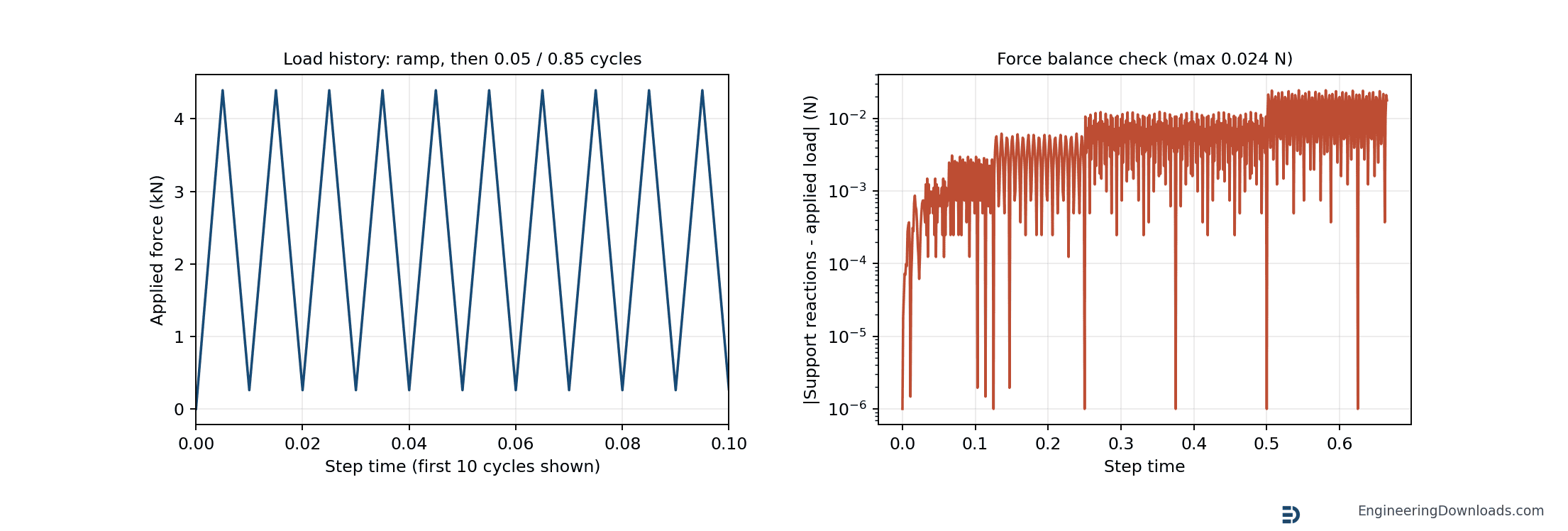
| Load | Reference load 5170 N, cycling between 258.5 N and 4394.5 N (5 % to 85 %), 10 increments per cycle |
| Elements | Coupled temperature-displacement CPE3T / CPE4T, 5104 elements, mesh refined along the crack path |
| Phase field | Solved as the temperature degree of freedom NT11 |
| Subroutines | UMAT (degraded stiffness, driving energy, fatigue variable) and HETVAL (phase-field residual), file PF_CZM_Fatigue.for |
| Material constants | E 30000 MPa, nu 0.2, length scale 2.5 mm, Gc 0.09 N/mm, ft 2.8 MPa, kf 0.01 |
| Solution | Single coupled step, separated solution technique, fixed increments, run to the peak of cycle 67 |
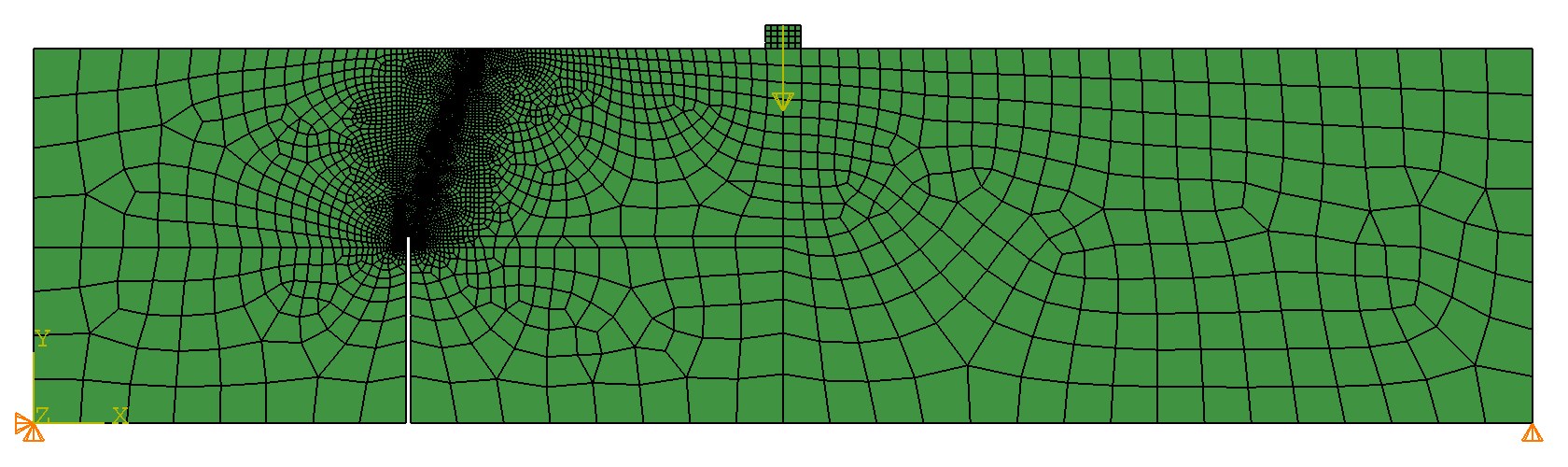
The Abaqus/CAE model shows the beam with the mesh refined along the expected crack path, the tied load insert with the load arrow, and the two supports.
The PDF tutorial walks through each of these step by step, with the code next to the equations.
Governing relations. The stress is σ = g(φ)σ0. HETVAL returns the source −[g′(φ)Hπ/(2ℓGcFdeg) + (1−φ)/ℓ2]. Here φ and Fdeg are dimensionless, H is in MPa, ℓ is in mm, and Gc is in N/mm.
The phase field grows from the notch tip, starts vertically and turns toward the load, with unstable crack growth during cycle 67, as in the author dataset.
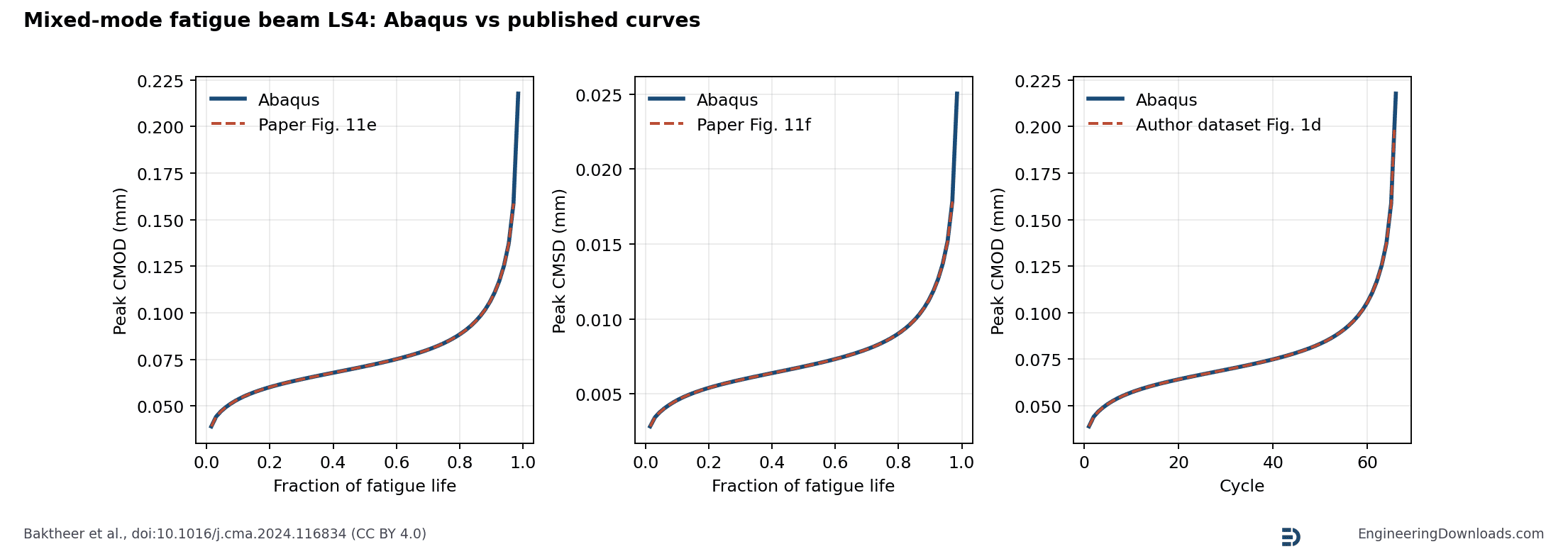
Comparison with the published numerical benchmark. The Abaqus peak notch-mouth opening (CMOD) and sliding (CMSD) overlay the curves digitised from Fig. 11e/f of the paper and the author dataset. The difference to the paper curves is 0.02 % RMSE for CMOD and 0.05 % RMSE for CMSD over 15-90 % of life. At cycle 65, CMOD / CMSD are 0.1587 / 0.0178 mm against 0.1585 / 0.0178 mm in the paper, and at the cycle-67 peak they are 0.950 / 0.110 mm. The crack ridge position differs from Fig. 11g by 0.43 mm RMS.
The crack ridge was sampled at seven elevations to compare its position with Fig. 11g.
Force balance. The sum of the two vertical support reactions equals the applied load at every peak, with a maximum residual of 0.024 N, which is the first check on any run.
Model files (.inp/.cae) and source code are included, so the model runs in your own Abaqus.
abaqus python run_model.py.The model and subroutines are adapted from the author dataset of A. Baktheer, doi:10.17632/6dhjjhhtbs.1, licensed under CC BY 4.0. Changes: the input ends at the peak of cycle 67 and writes a reduced set of outputs, and the constant kf is declared double precision in the Fortran. If you use the model, please cite Baktheer, Martinez-Paneda and Aldakheel (2024), doi:10.1016/j.cma.2024.116834.
Need more than the files?
There are two ways we can help. Book a one hour online consultation if you want to talk a problem through with a CAE engineer, using the checkbox in the order box. Order a project if you need a full simulation built for you, delivered to an agreed scope, price and deadline under a written contract.
We work on FEA and CFD for engineers, researchers and companies. Order your project, or message us on WhatsApp for a quick reply.
Other packages engineers working on this topic also download.
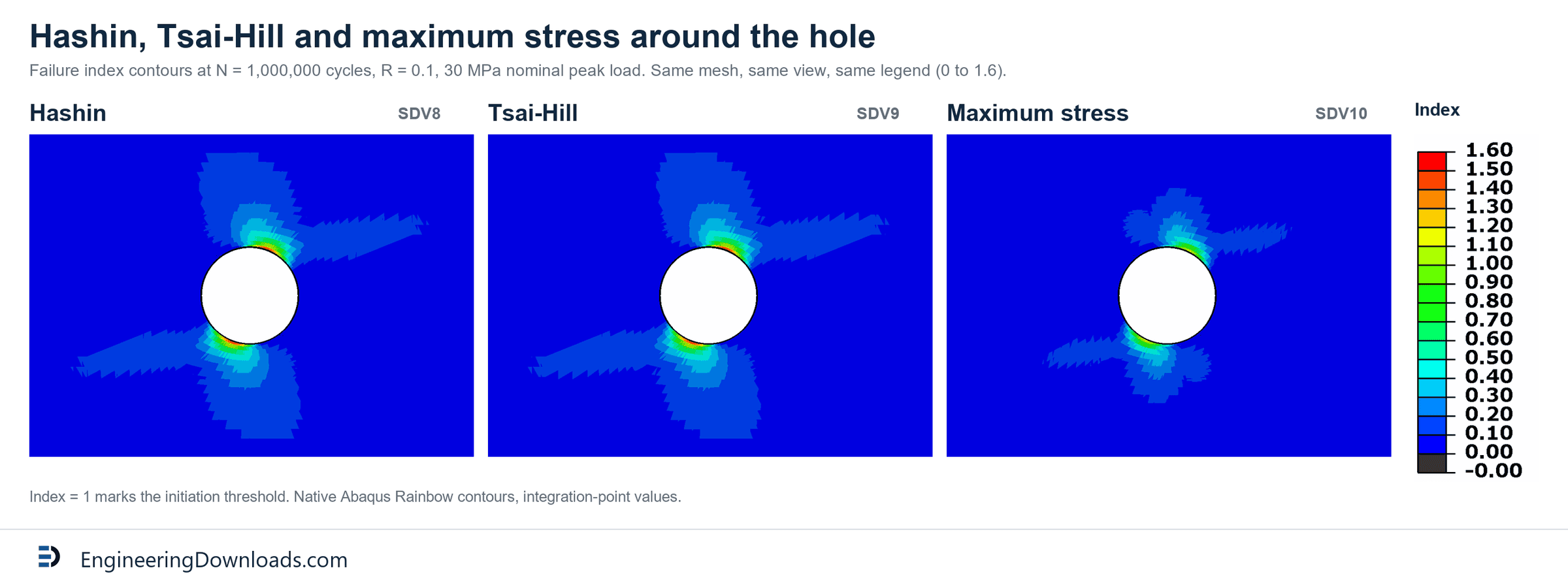 Composite Fatigue UMAT for Abaqus: Hashin, Tsai-Hill and Maximum-Stress Criteria€159,00
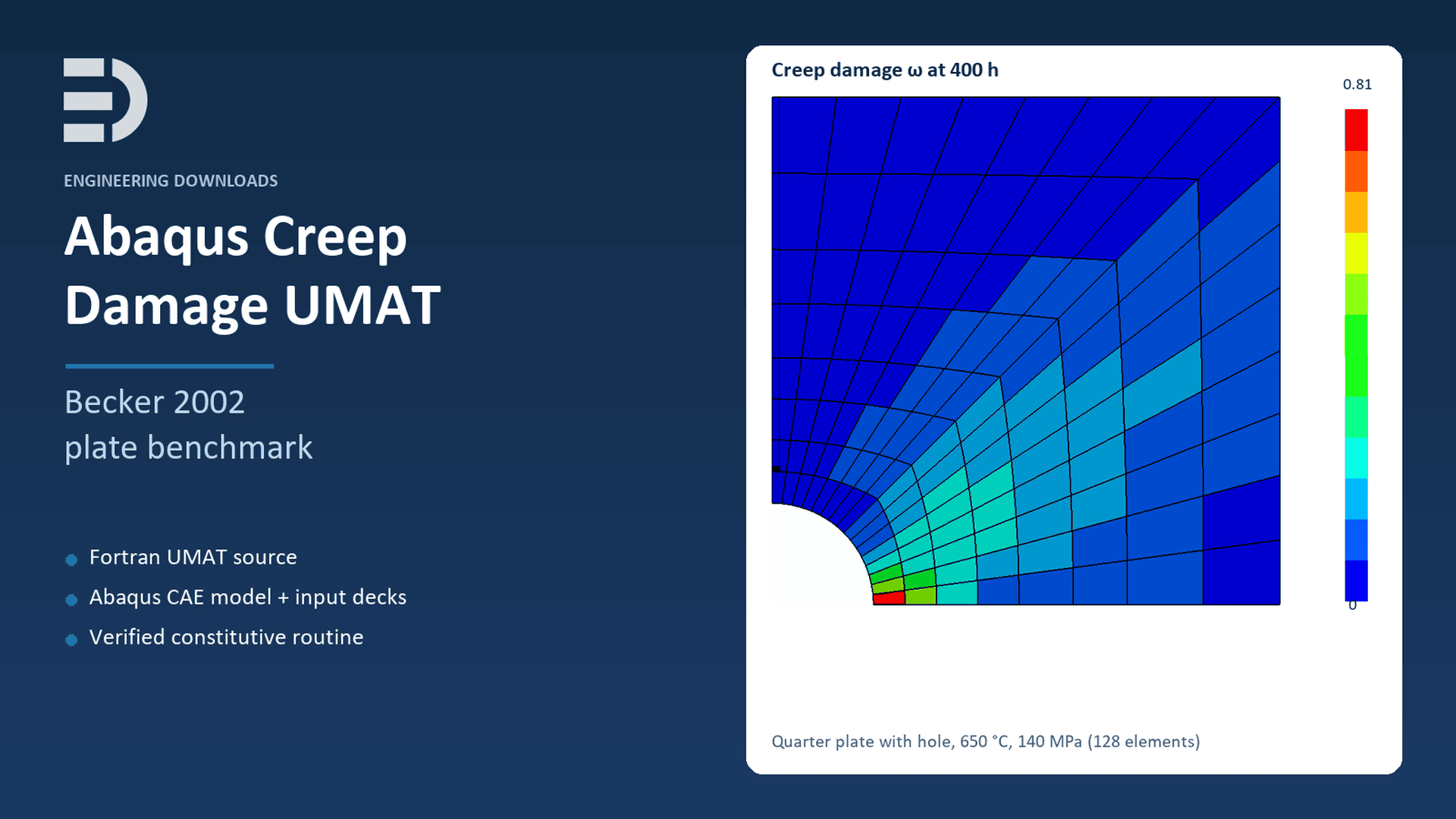 Creep Continuum Damage UMAT in Abaqus: Becker 2002 Perforated Plate Benchmark€49,00
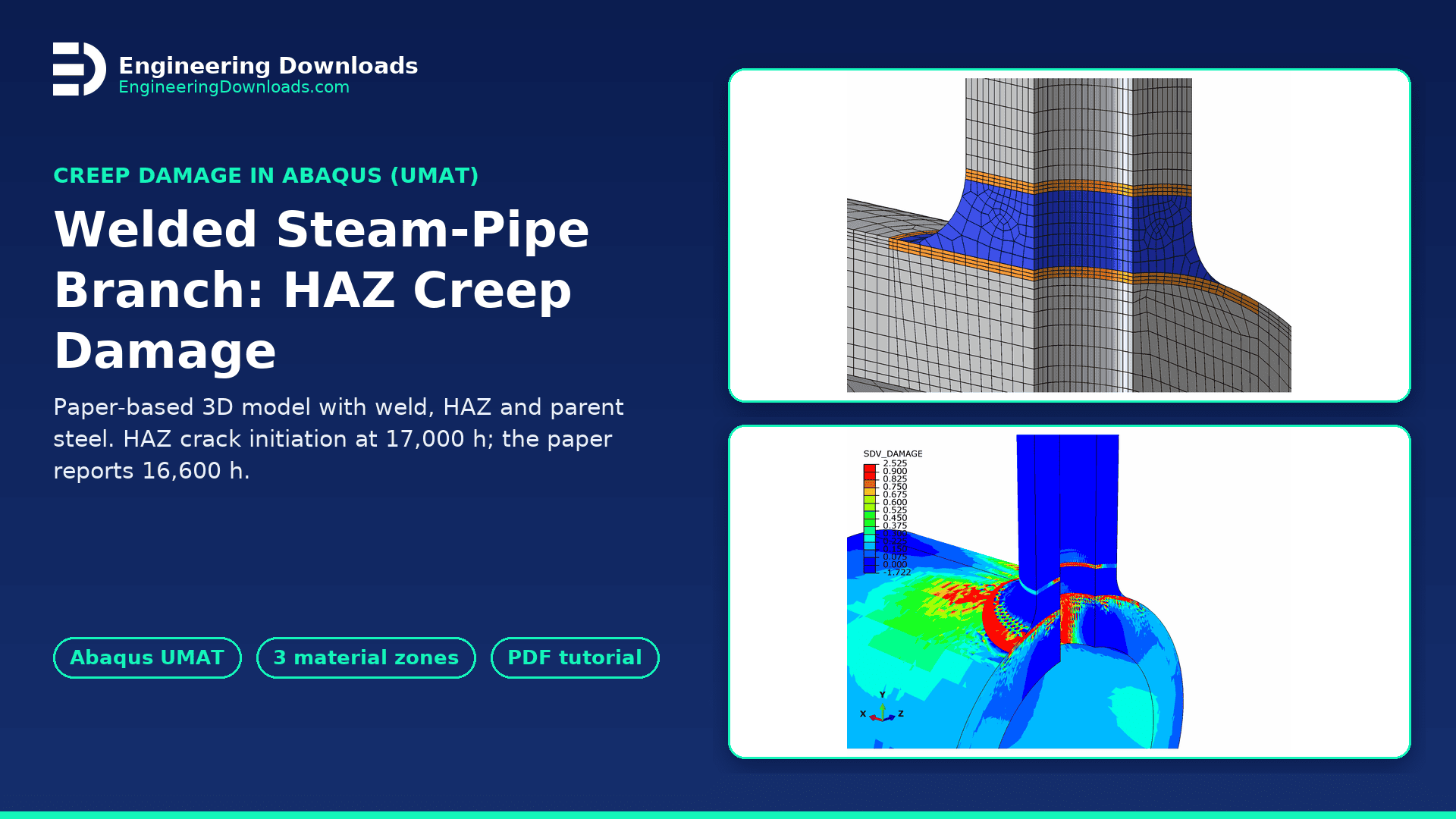 Creep Damage Analysis of a Welded Steam Pipe Branch in Abaqus: UMAT, HAZ Hex Mesh and Paper Comparison€149,00
 A simple example for UMAT subroutine in Abaqus
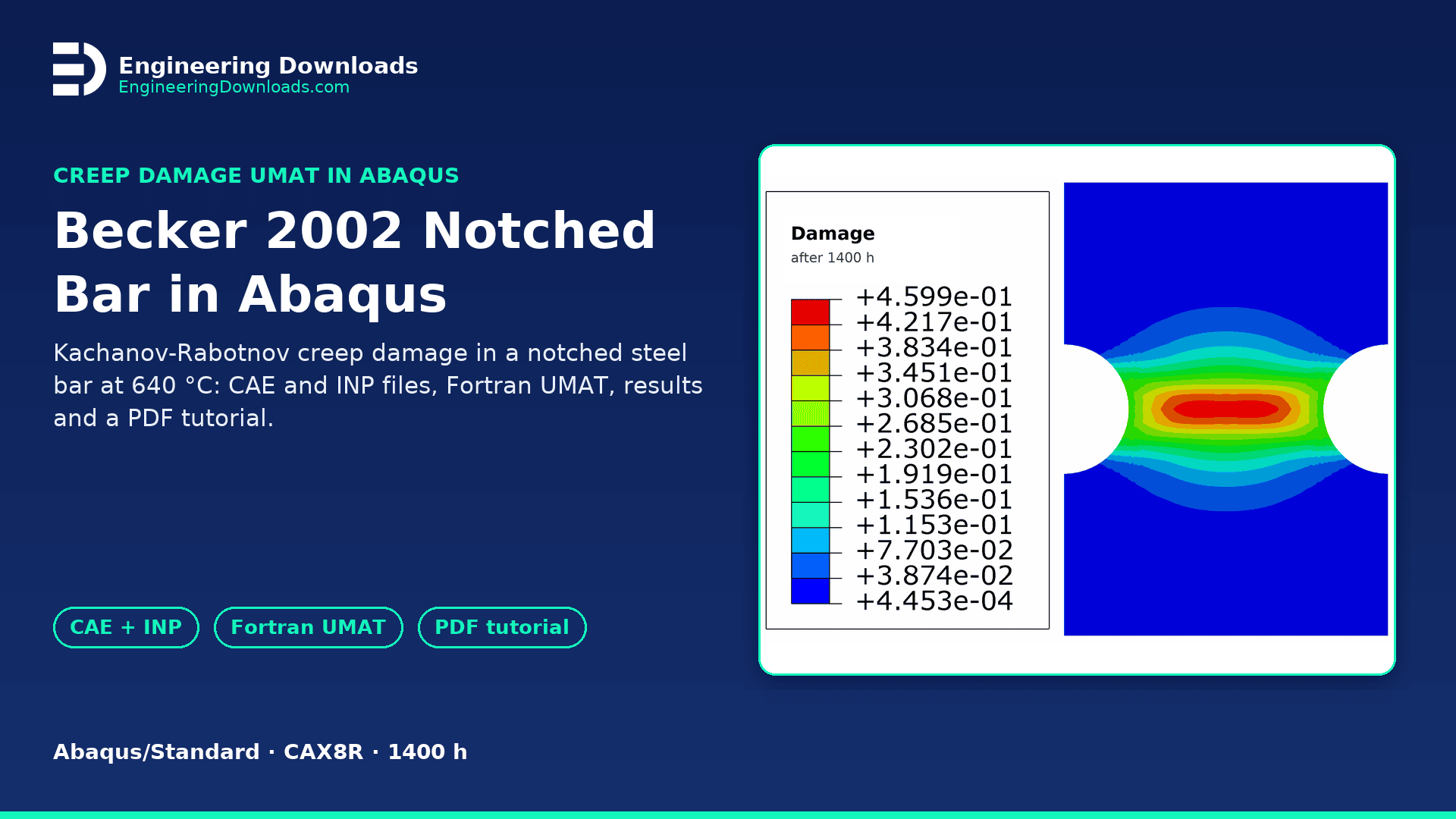 Creep Damage Notched Bar in Abaqus: Becker 2002 Benchmark with UMAT, CAE and INP Files and Paper Comparison€49,00
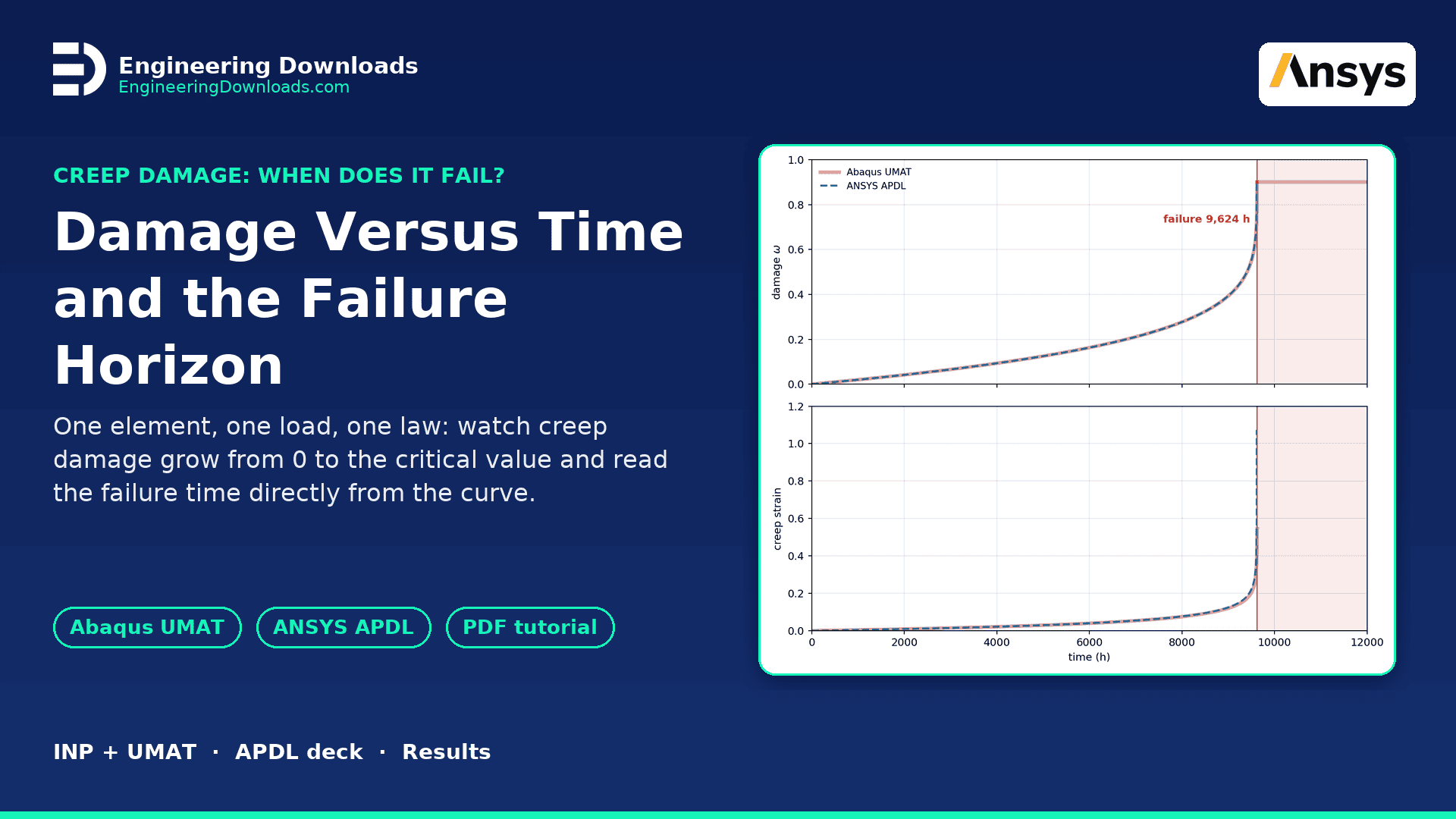 Creep Damage Versus Time in Abaqus: Failure Horizon of a Single Element with a Kachanov-Rabotnov UMAT€49,00
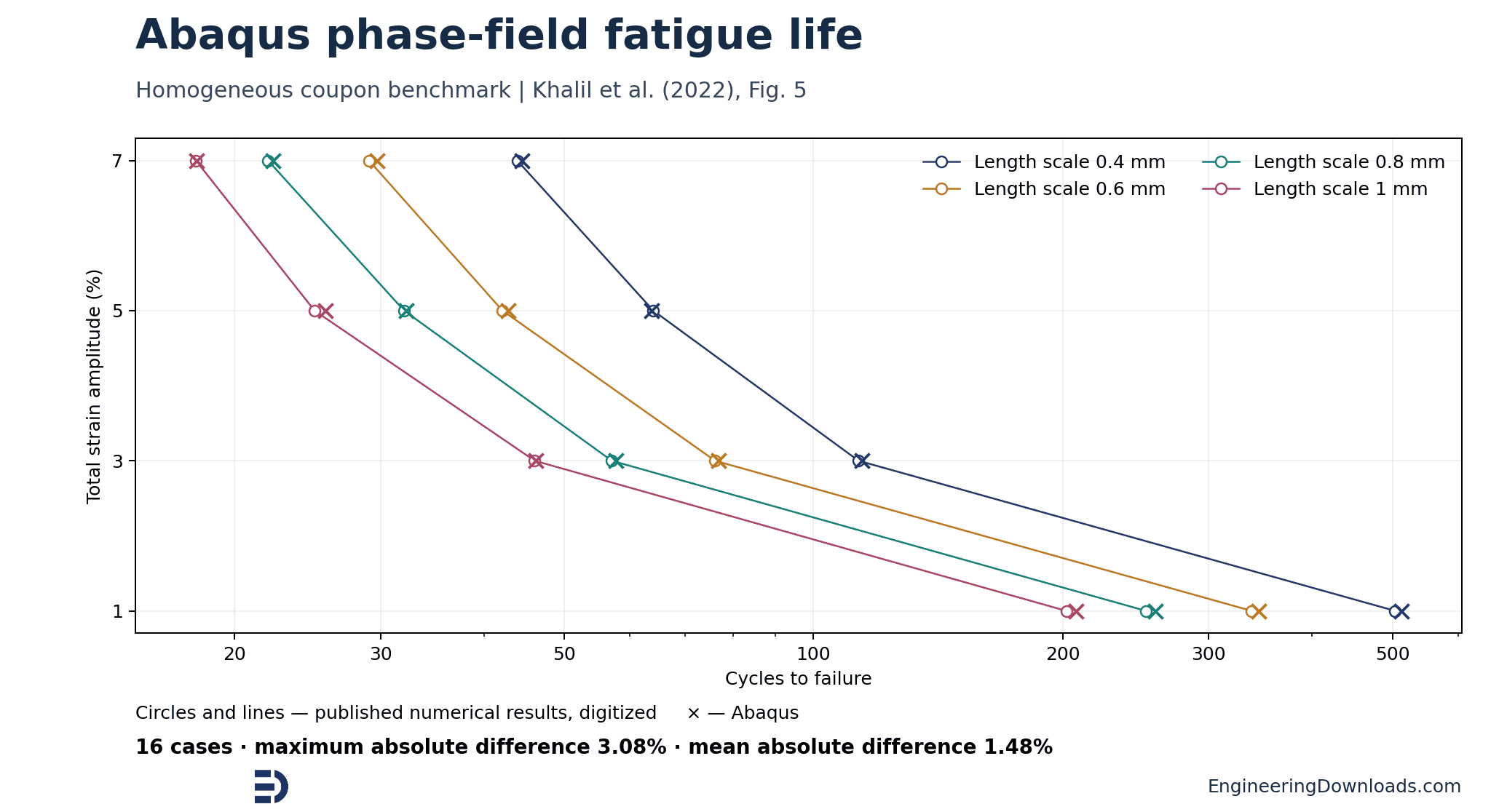 Abaqus Phase-Field Fatigue Life: Validated Coupon Benchmark€169,00
 Boot Seal Hyperelastic Material Model with UMAT Subroutine for Abaqus

Need a full custom project? See the options below.
€129,00
€179,00
€149,00
€119,00
€129,00
€149,00
See more
Want to receive push notifications for all major on-site activities?