Need a full custom project? See the options below.
Need a full custom project? See the options below.
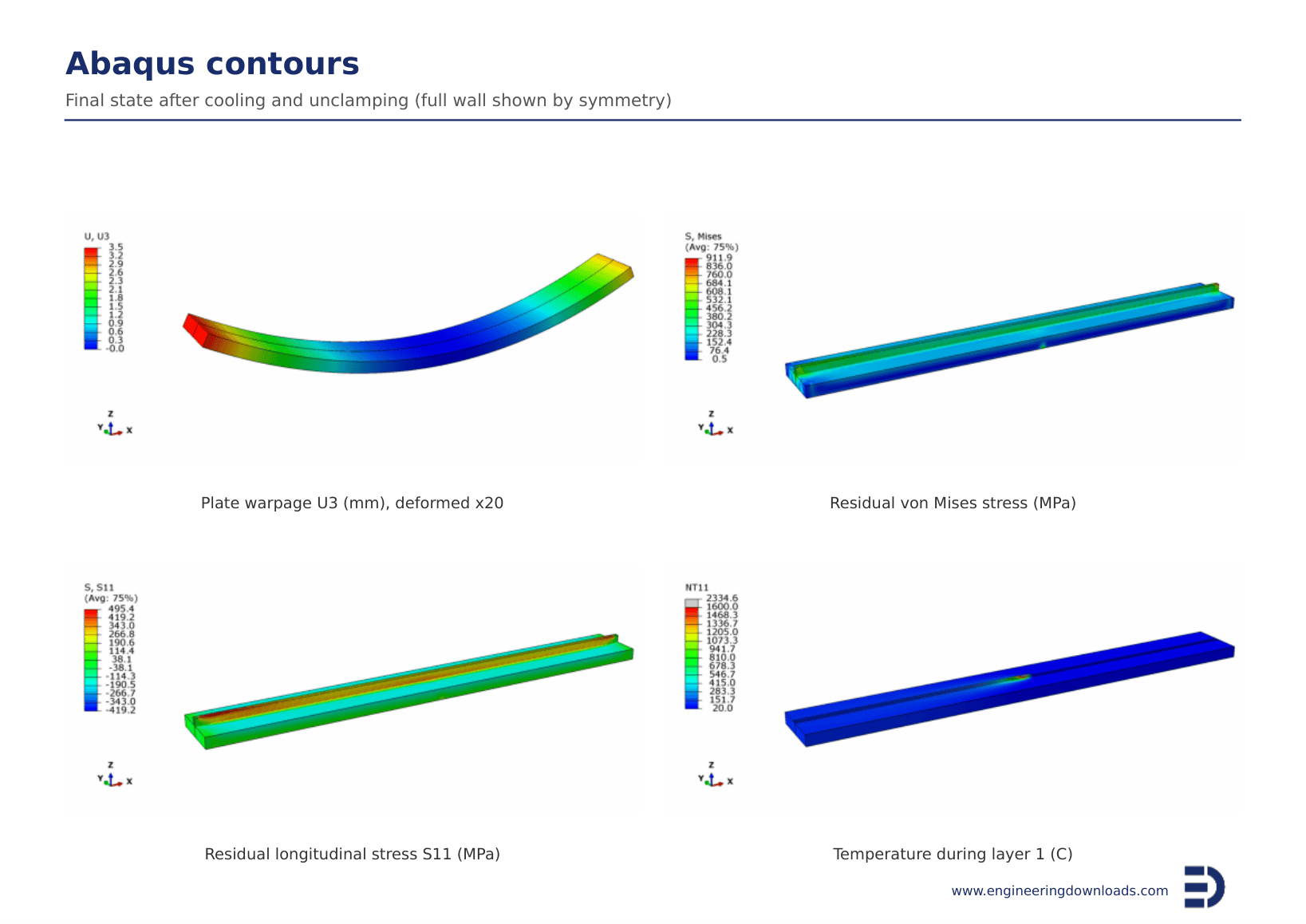
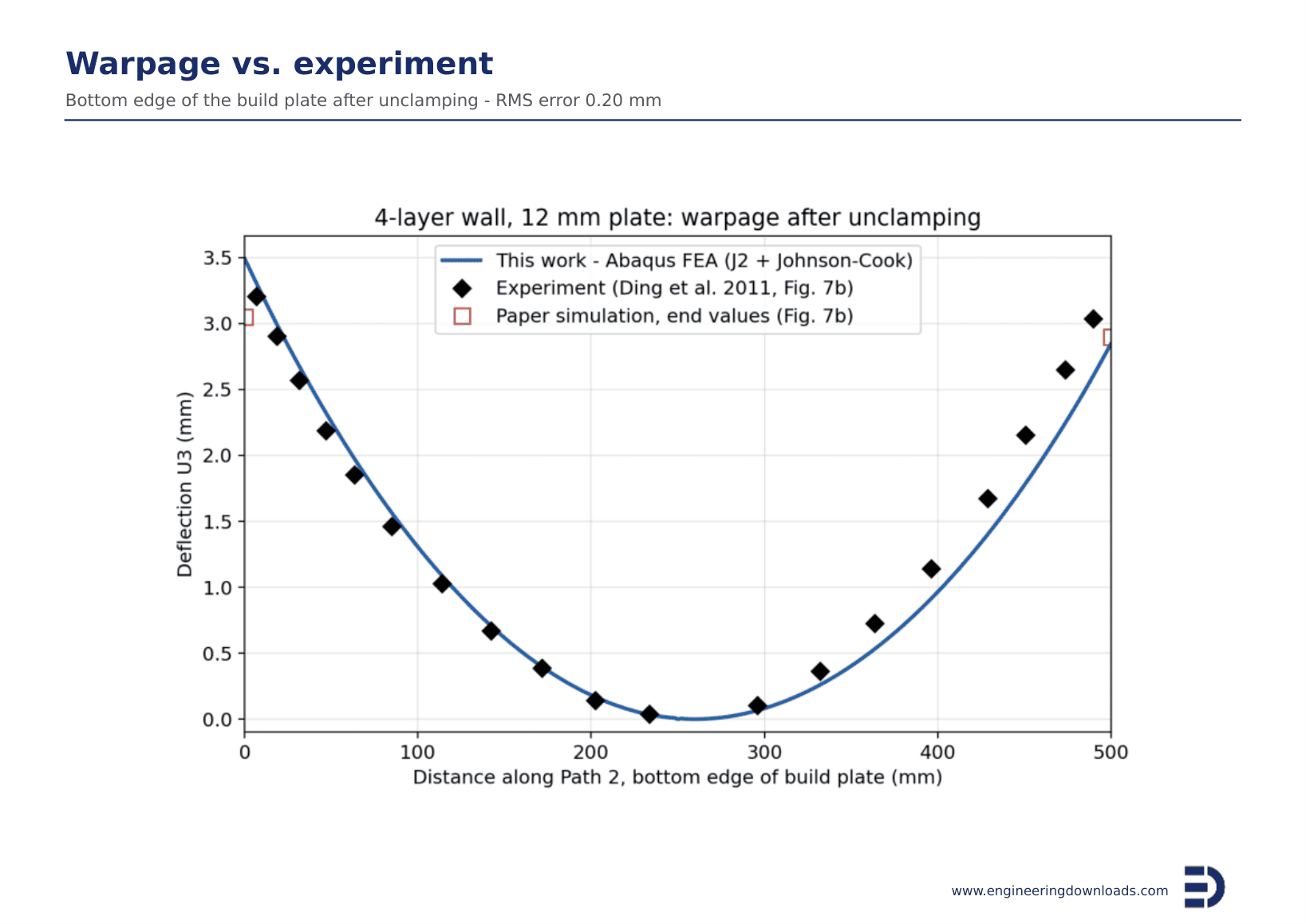
How much does a wire arc additive manufactured (WAAM) wall warp its build plate, and what residual stress does it leave behind? This Abaqus package replicates the journal paper Behseresht and Park, Metals 2025, 15, 665 on J2 plasticity with Johnson-Cook hardening for WAAM. It builds a 4-layer mild-steel wall on a 500 x 60 x 12 mm plate with a moving Goldak heat source and progressive bead activation, then a sequentially coupled stress analysis with clamping and release. The plate warpage matches the experiment with an RMS error of 0.20 mm, and the peak residual stress is within 2 % of the paper.
The paper develops a thermo-mechanical WAAM model with J2 plasticity and temperature- and rate-dependent Johnson-Cook hardening, and validates it against the distortion measured by Ding et al. (2011) on a mild-steel wall. It reports the warpage along the plate bottom (Fig. 7), the longitudinal residual stress through the mid-section (Fig. 8), the von Mises field (Fig. 6) and the longitudinal contraction of the wall (Fig. 12). This package rebuilds the 4-layer wall on the 12 mm plate.
| Item | This package |
|---|---|
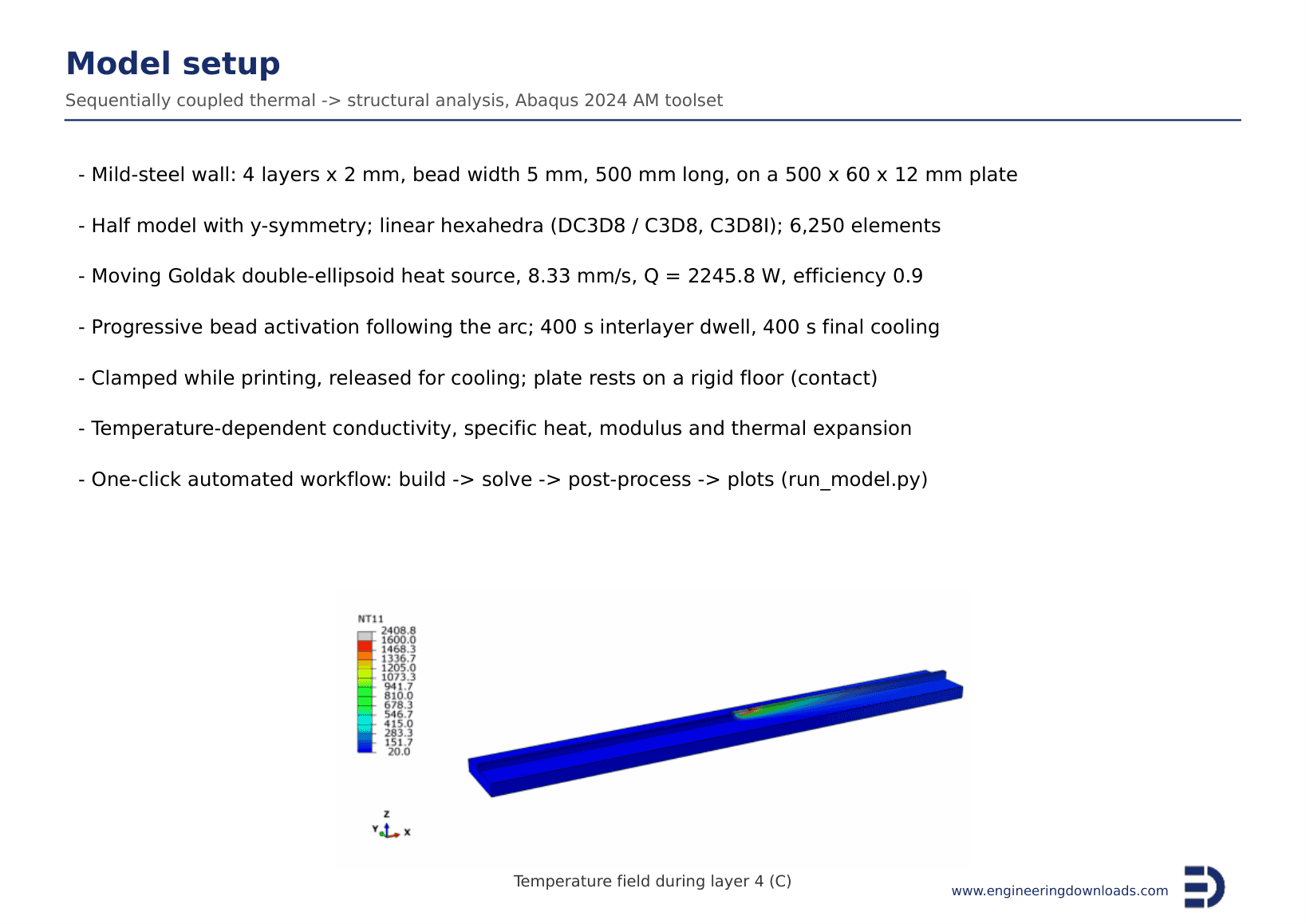
| Geometry | 4 layers x 2 mm, bead 5 mm, 500 mm long, on a 500 x 60 x 12 mm plate; half model (symmetry) |
| Elements | Linear hexahedra: DC3D8 thermal, C3D8 wall + C3D8I plate structural; 6,250 elements |
| Heat source | Goldak double ellipsoid, Q = 2245.8 W, efficiency 0.9, 8.33 mm/s, Abaqus AM toolset event series |
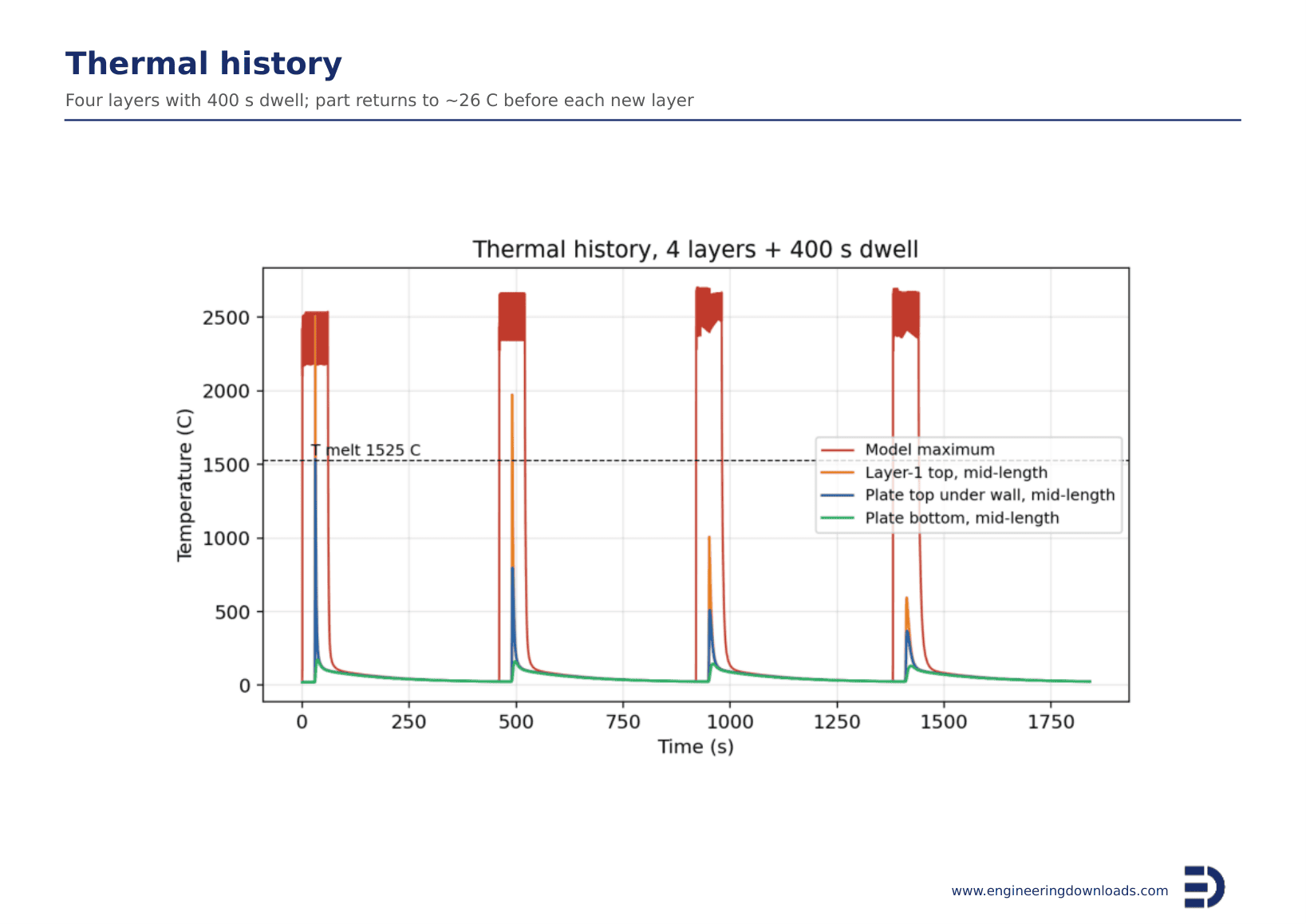
| Deposition | Progressive element activation with the arc, 400 s interlayer dwell, 400 s final cooling |
| Material | Mild steel, temperature-dependent k, cp, E, expansion; J2 + Johnson-Cook (A 363, B 792.7 MPa, n 0.5756, m 1.6456) |
| Boundary conditions | Clamped while printing, released for cooling; plate on a rigid floor with contact |
| Software | Abaqus/Standard 2024 or newer |
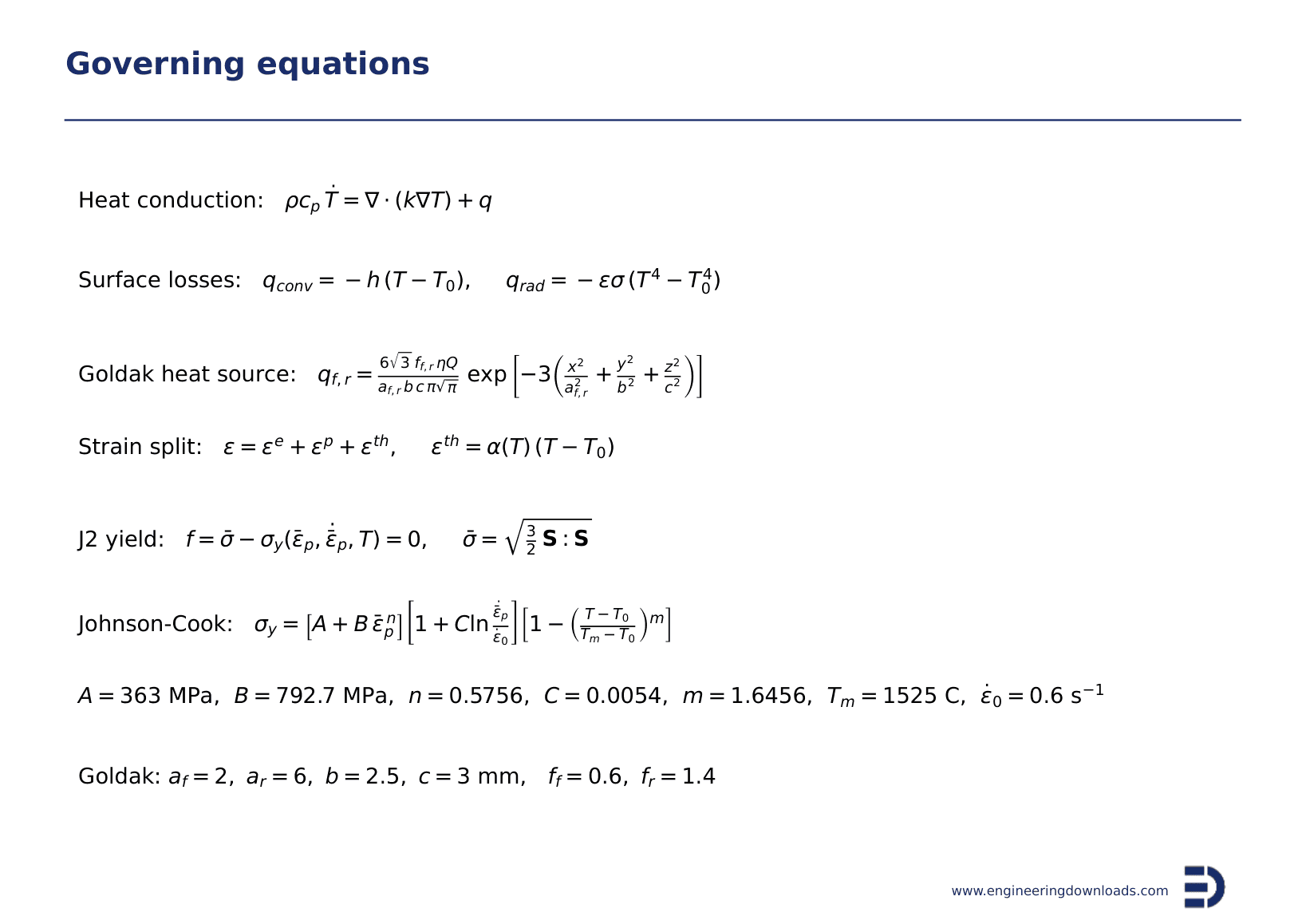
Transient heat conduction with convection and radiation, the Goldak double-ellipsoid source, the additive strain split with thermal strain, the J2 yield function and the Johnson-Cook flow stress are all listed with their constants in the package.
| Result | Paper / experiment | This work |
|---|---|---|
| Plate end lift, x = 0 (Fig. 7) | 3.21 mm (experiment) | 3.31 mm (+3.3 %) |
| Plate end lift, x = 500 (Fig. 7) | 2.90 mm (paper FE) | 2.85 mm (-1.9 %) |
| RMS warpage error, 19 points | – | 0.20 mm |
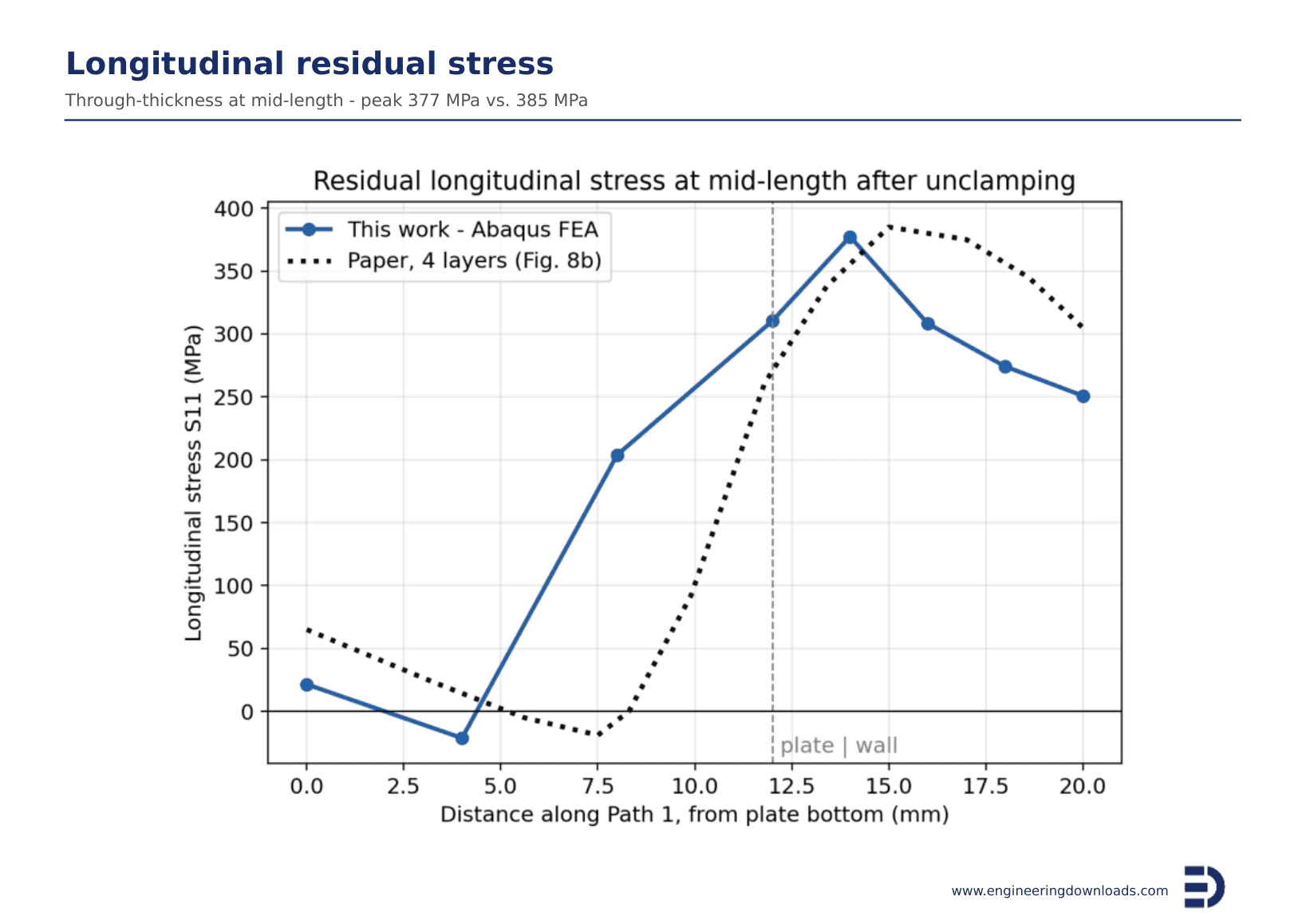
| Peak longitudinal stress, mid-section (Fig. 8) | 385 MPa | 377 MPa (-2.1 %) |
| Maximum von Mises stress (Fig. 6) | 981 MPa | 912 MPa (-7.0 %) |
| Wall-top contraction, x = 500 (Fig. 12) | -0.32 mm | -0.32 mm |
| Interpass temperature | < 50 °C | 26 °C |
Additive manufacturing and welding engineers who need to predict distortion and residual stress, FEA engineers learning the Abaqus AM toolset with Johnson-Cook plasticity, and students who want a validated WAAM model to start from.
Which paper does this package replicate? Behseresht and Park, Additive Manufacturing of Metal Parts: J2 plasticity with Johnson-Cook hardening for residual stress and distortion in WAAM, Metals 2025, 15, 665. The 4-layer mild-steel wall on a 12 mm plate is rebuilt; its distortion is checked against the experiment of Ding et al. (2011) shown in the paper. The paper is cited, not bundled.
How close are the results to the paper and the experiment? Plate end lift 3.31 mm against 3.21 mm measured at x = 6.6 mm (+3.3 %), 2.85 mm against 2.90 mm in the paper simulation at x = 500 mm, RMS error 0.20 mm over all 19 measured points. Peak longitudinal residual stress 377 MPa against 385 MPa (-2 %), maximum von Mises stress 912 MPa against 981 MPa (-7 %).
Is the Johnson-Cook law a user subroutine? No. The paper implements J2 plasticity with Johnson-Cook hardening in a UMAT. This package uses the same Johnson-Cook constants in Abaqus native *Plastic tables (strain x temperature), so it runs without a Fortran compiler. A 5 MPa floor near melting keeps the structural solve stable.
How is the deposition modelled? With the Abaqus additive manufacturing toolset: a moving Goldak double-ellipsoid heat source and progressive element activation driven by event series. The thermal and structural analyses are sequentially coupled.
What does run_model.py do? It is a one-click automated workflow: it writes both input files, runs the thermal and the structural job, extracts the result paths and produces the contour images and comparison plots. No editing is needed if Abaqus is installed in the default location.
Which Abaqus version do I need? Abaqus 2024 or newer with the AM toolset (event series and progressive activation). On 4 cores the thermal job takes about 75 minutes and the structural job about 45 minutes. ODB files are not included.
What if the package is not what I expected? Write to us. Engineering Downloads refunds clients who are not satisfied with a delivered product.
Need more than the files?
There are two ways we can help. Book a one hour online consultation if you want to talk a problem through with a CAE engineer, using the checkbox in the order box. Order a project if you need a full simulation built for you, delivered to an agreed scope, price and deadline under a written contract.
We work on FEA and CFD for engineers, researchers and companies. Order your project, or message us on WhatsApp for a quick reply.
Other packages engineers working on this topic also download.
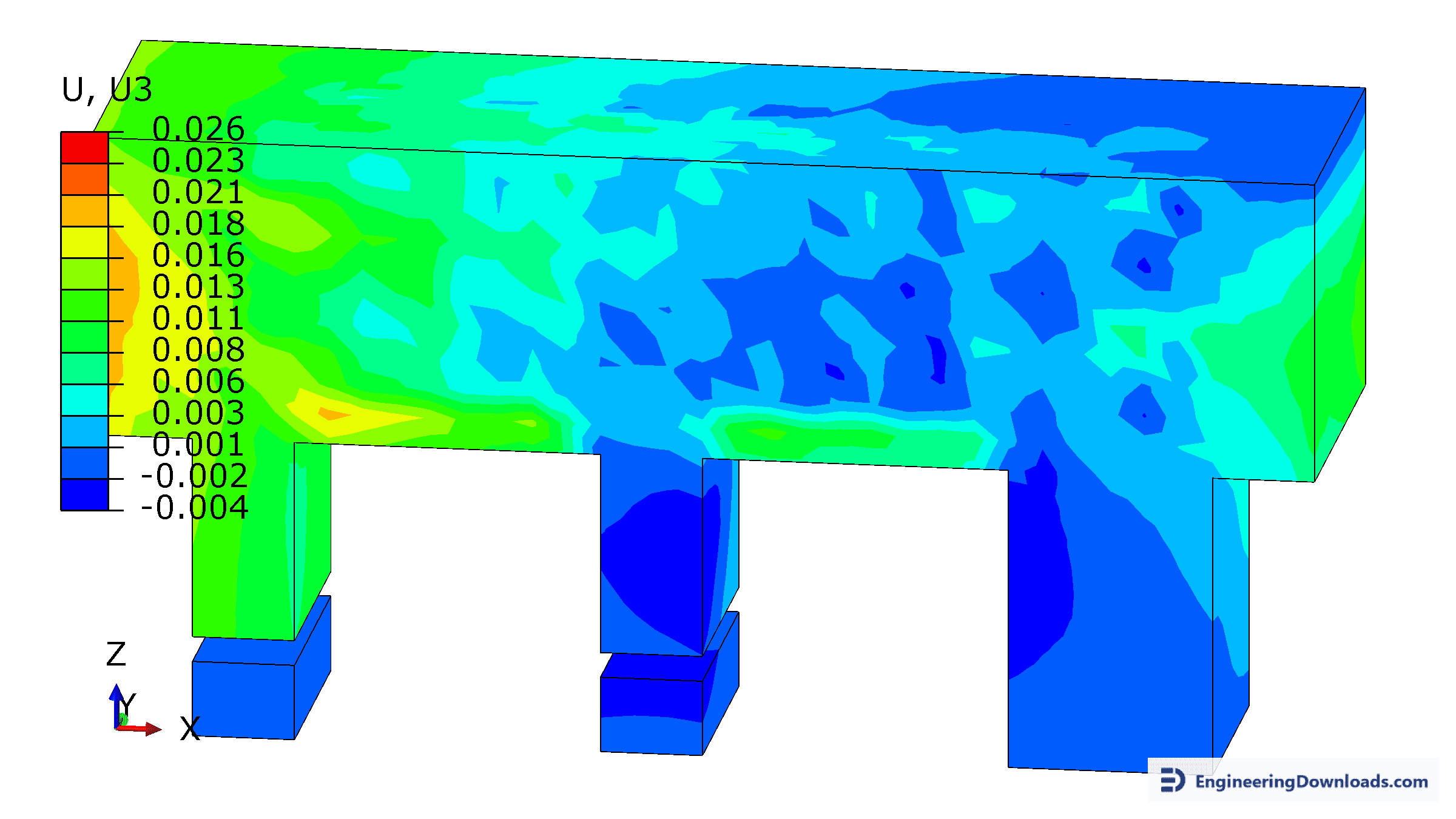 LPBF 316L Residual Stress and Cantilever Distortion in Abaqus: Sequentially Coupled Thermal-Stress Model with DFLUX and USDFLD Subroutines€159,00
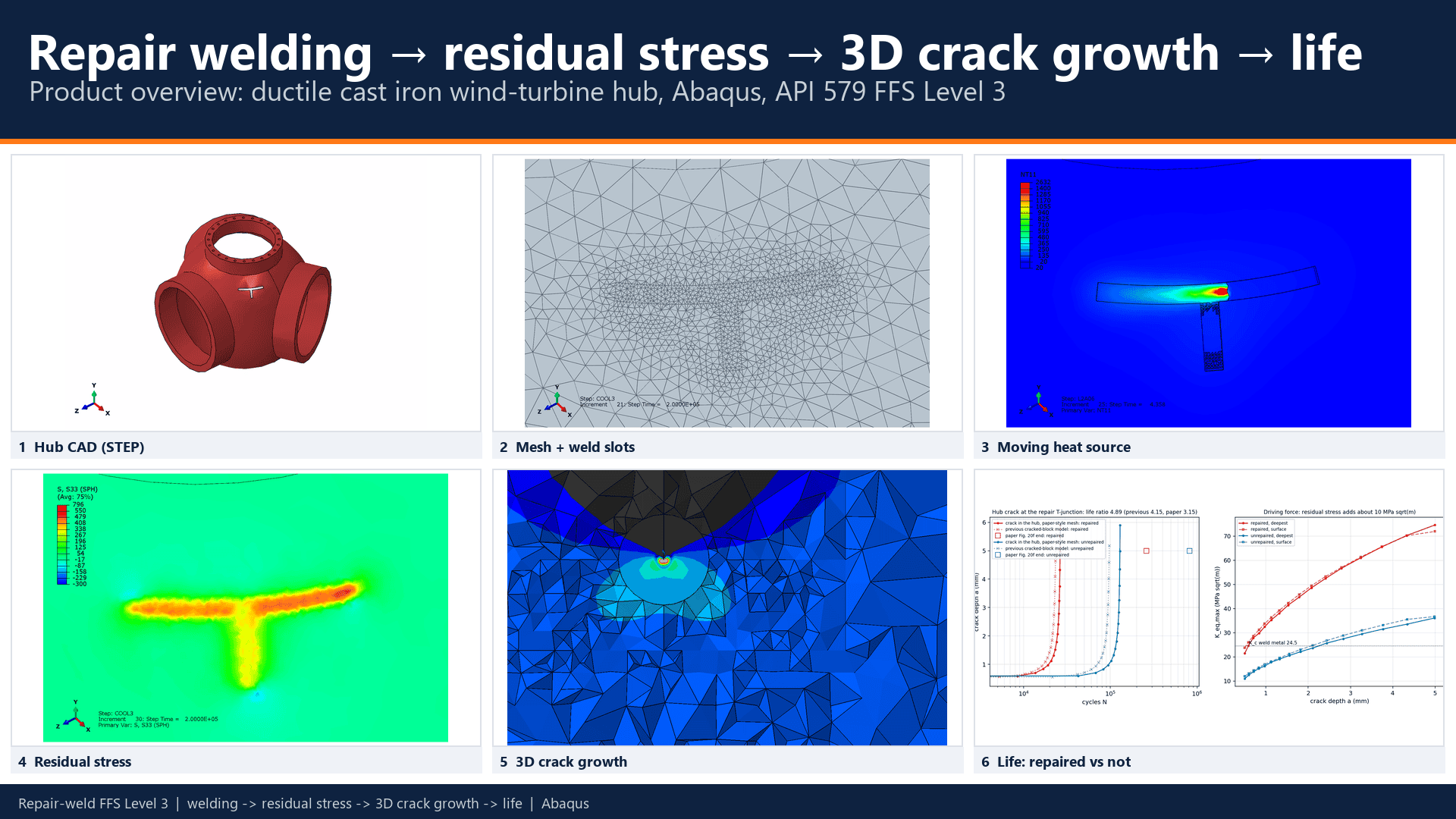 Repair Welding Residual Stress and 3D Fatigue Crack Growth in Abaqus: Ductile Cast Iron Wind-Turbine Hub (FFS Level 3)€299,00
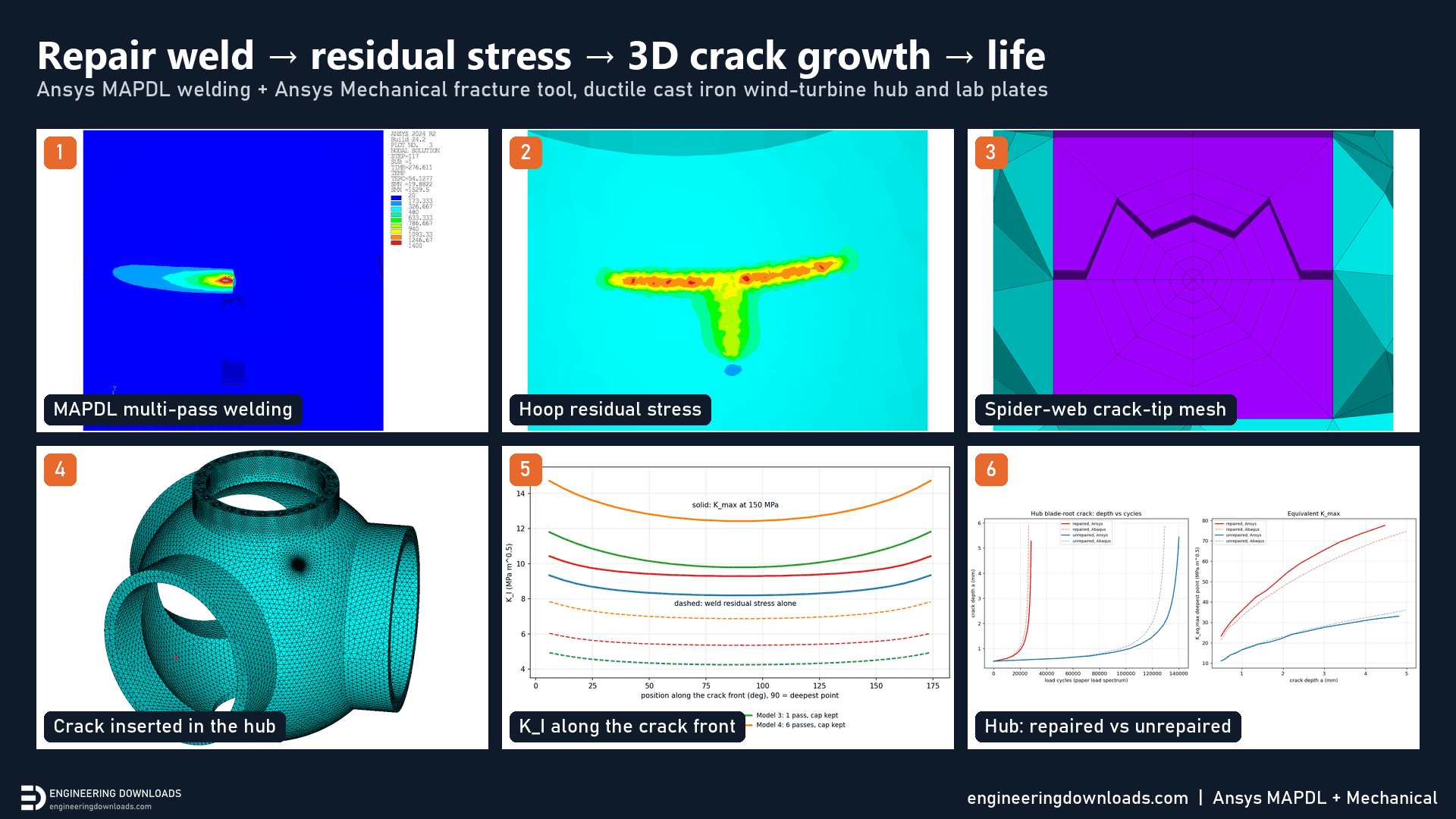 Repair Welding Residual Stress and 3D Fatigue Crack Growth in Ansys: Ductile Cast Iron Wind-Turbine Hub (FFS Level 3)€299,00
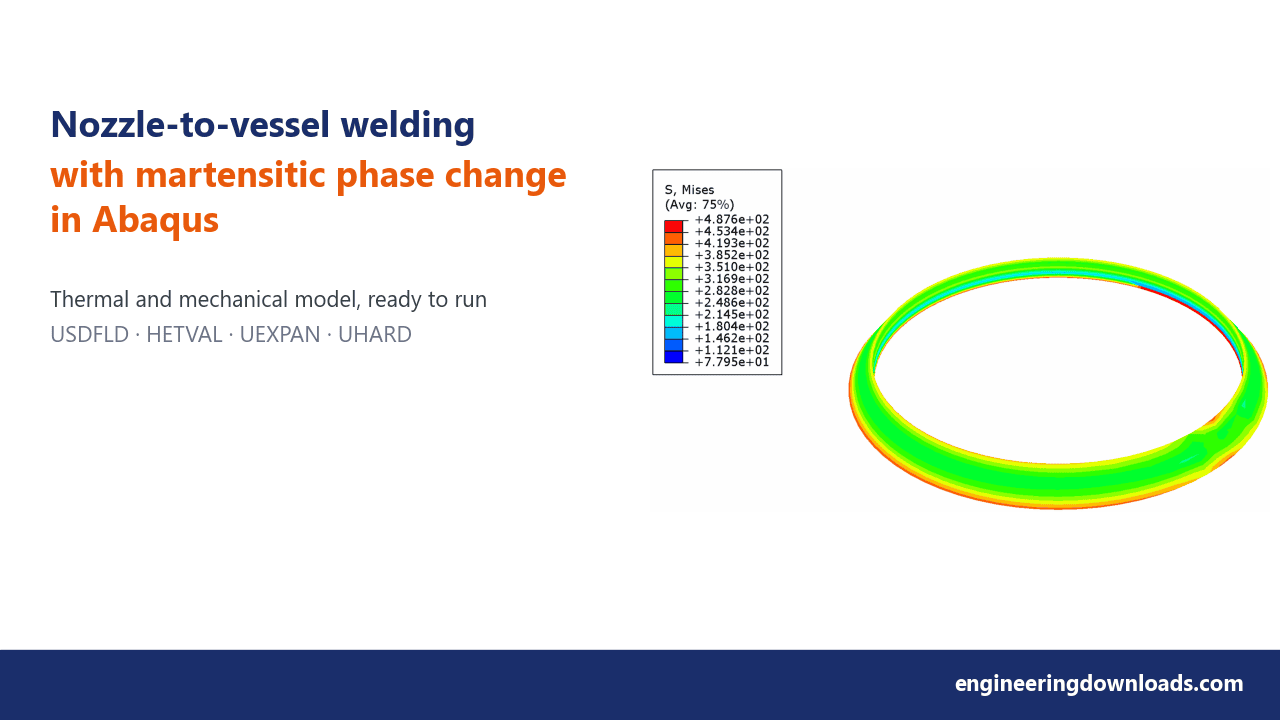 Nozzle-to-Vessel Weld in Abaqus: Martensitic Phase Change, Residual Stress and User Subroutines€209,00
 Welding Simulation Package in Abaqus (14 Models with DFLUX)
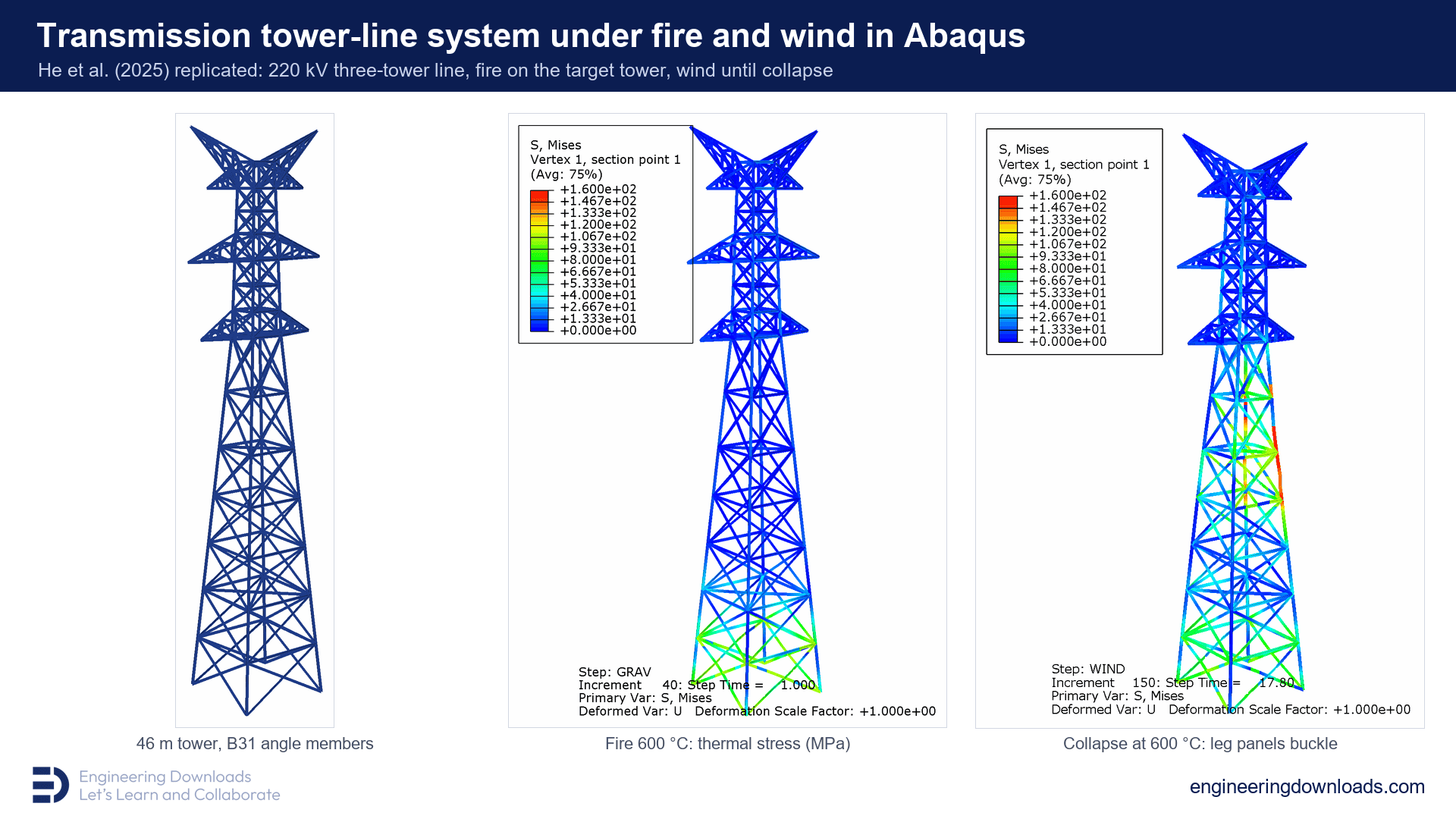 Transmission Tower-Line System under Fire and Wind in Abaqus: Modal and Collapse Analysis, after He et al. (2025)€169,00
 Cold spray analysis of an ABS particle with the CEL method
 SA508 Weld Phase Transformation in Abaqus: Bainite, Martensite and Residual Stress Model Checked Against a Published Paper€299,00

Need a full custom project? See the options below.
€129,00
€179,00
€149,00
€119,00
€129,00
See more
Want to receive push notifications for all major on-site activities?