Need a full custom project? See the options below.
Need a full custom project? See the options below.
Run a phase-field fatigue model in Abaqus with a Fortran UELMAT, reproduce a published fatigue-life benchmark, and inspect how damage develops around a notch. The package includes the input decks, matching subroutines, a Python runner for the coupon cases, and a PDF tutorial.
Validation result. Across 16 homogeneous steel coupon cases, Abaqus fatigue lives differ from the digitized Fig. 5 reference by at most 3.08%, with a mean absolute difference of 1.48%.
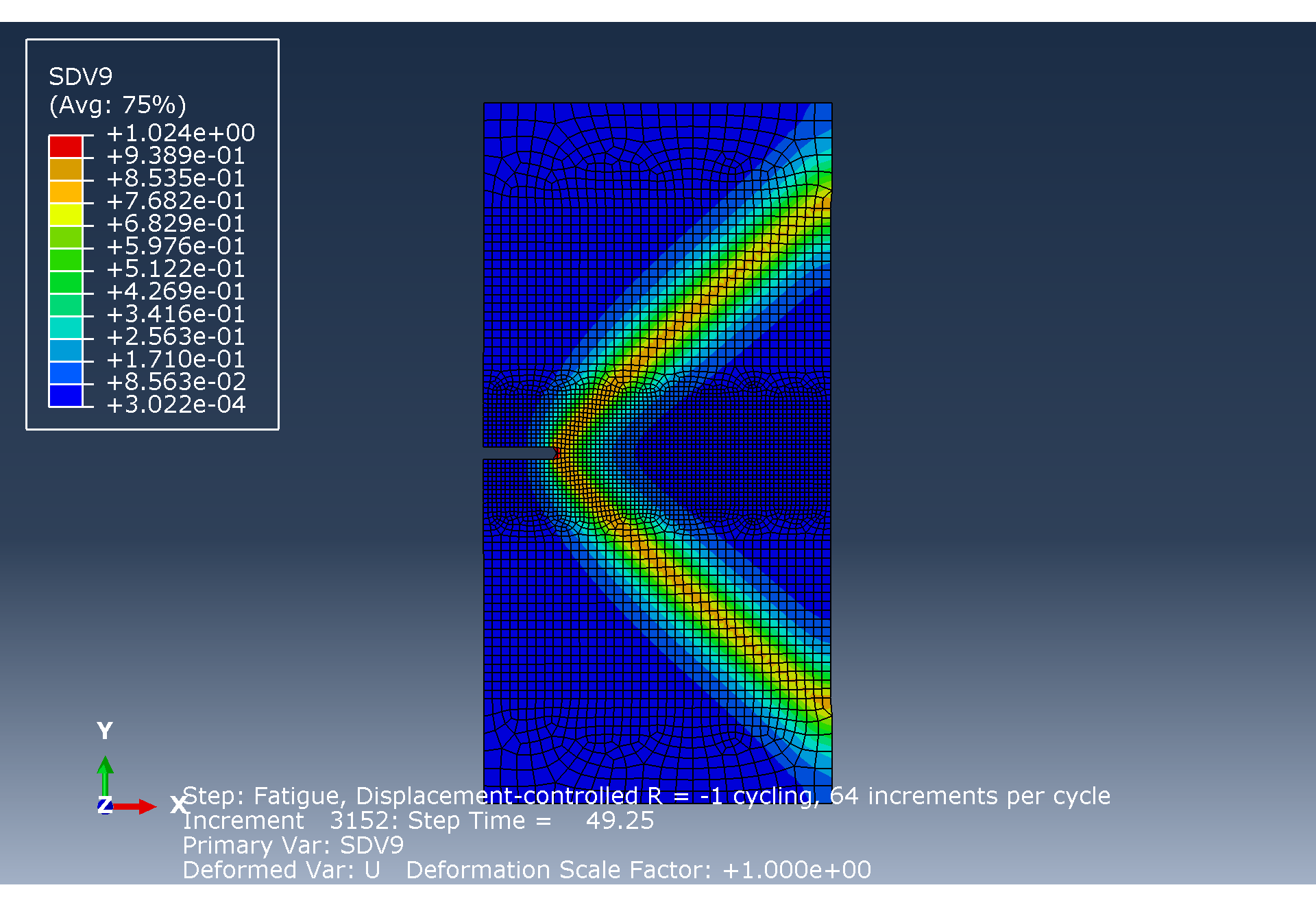
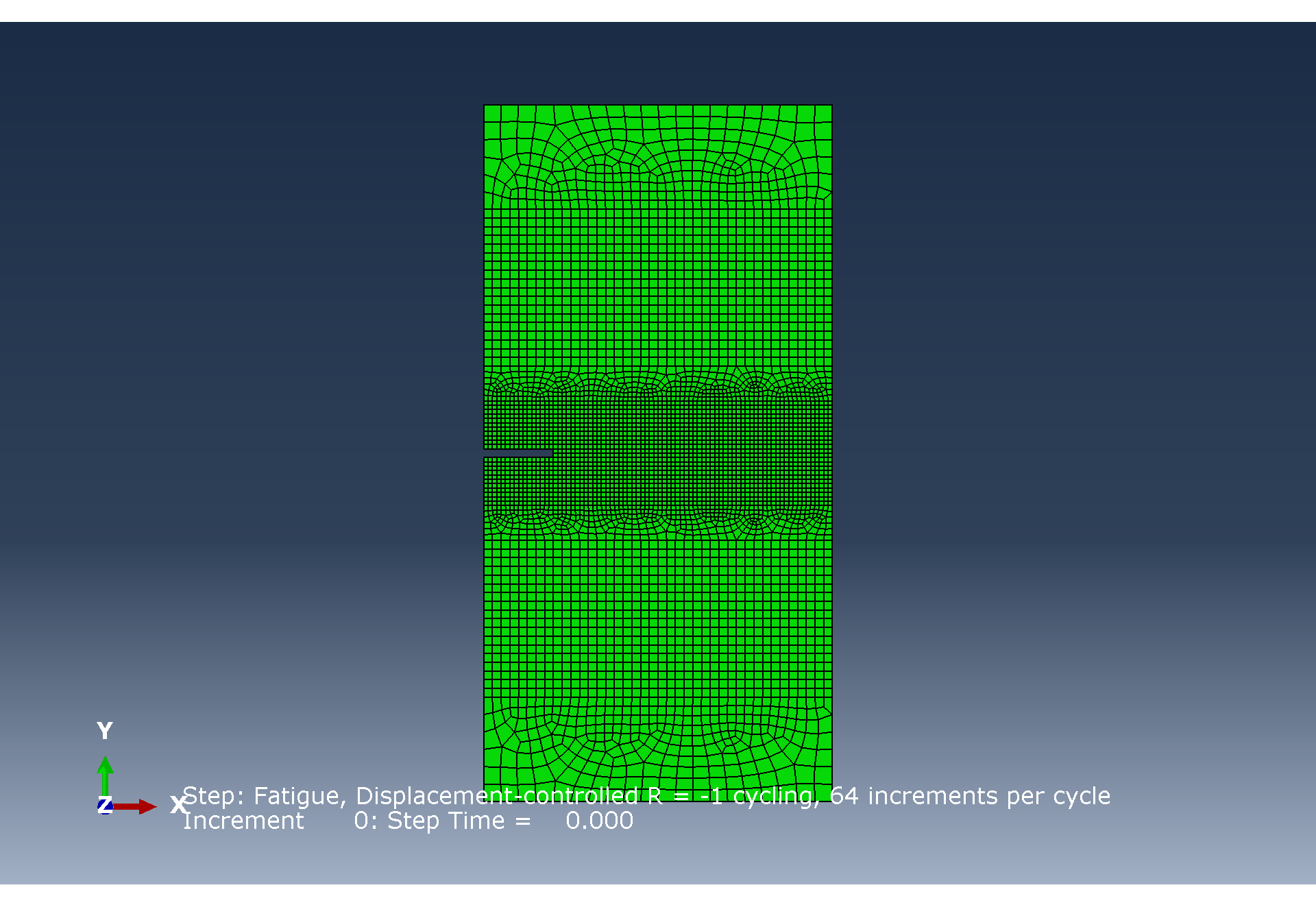
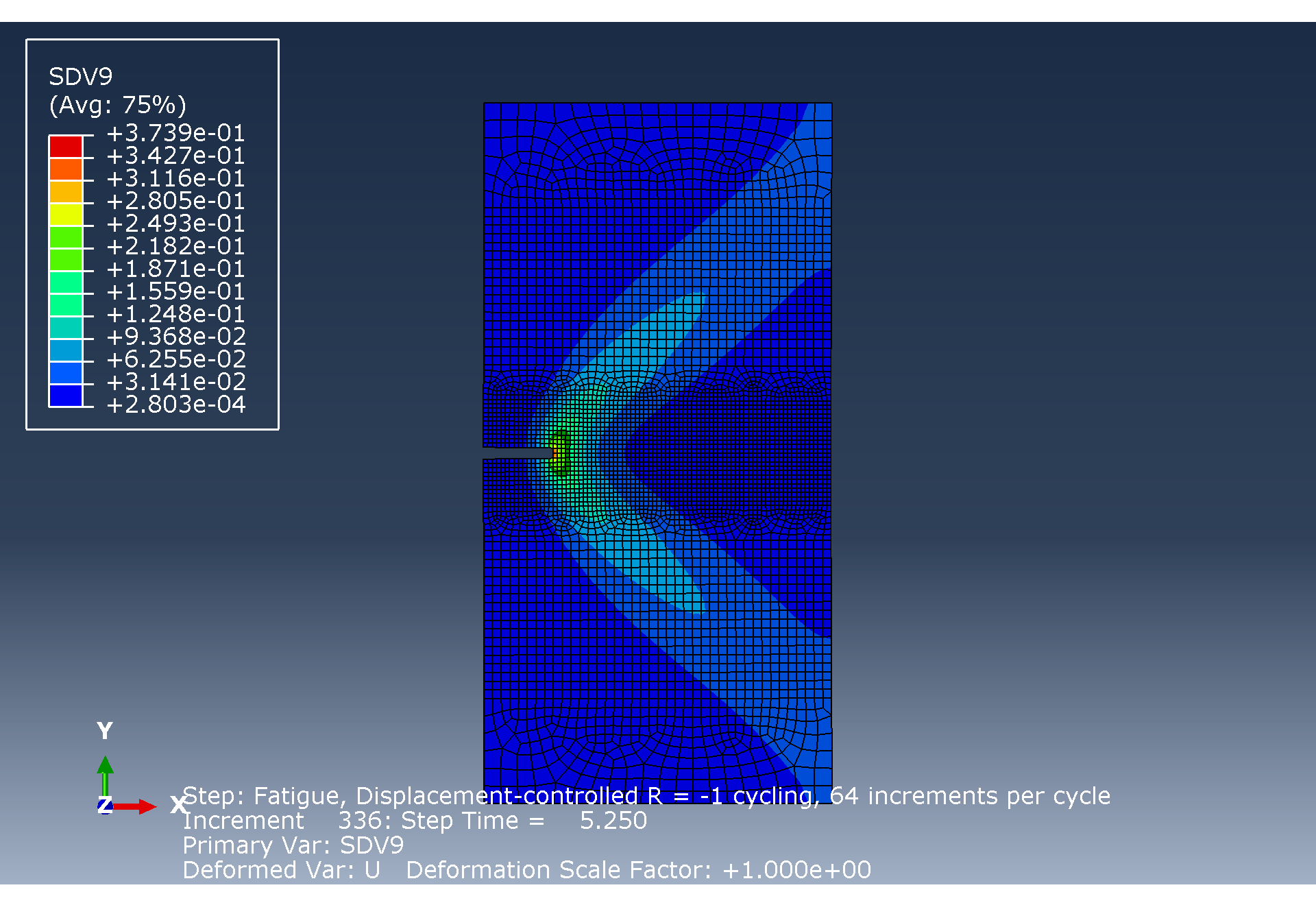
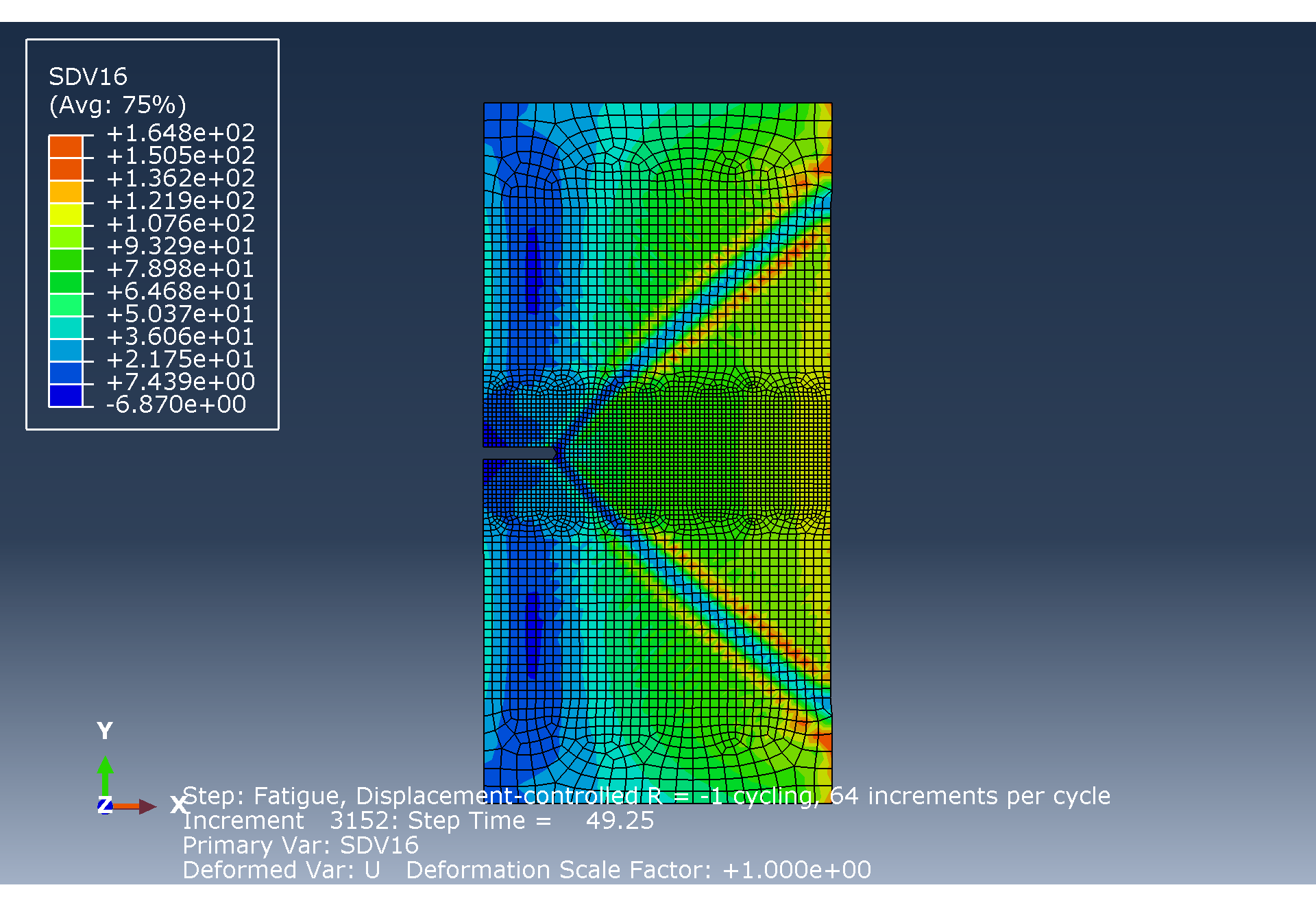
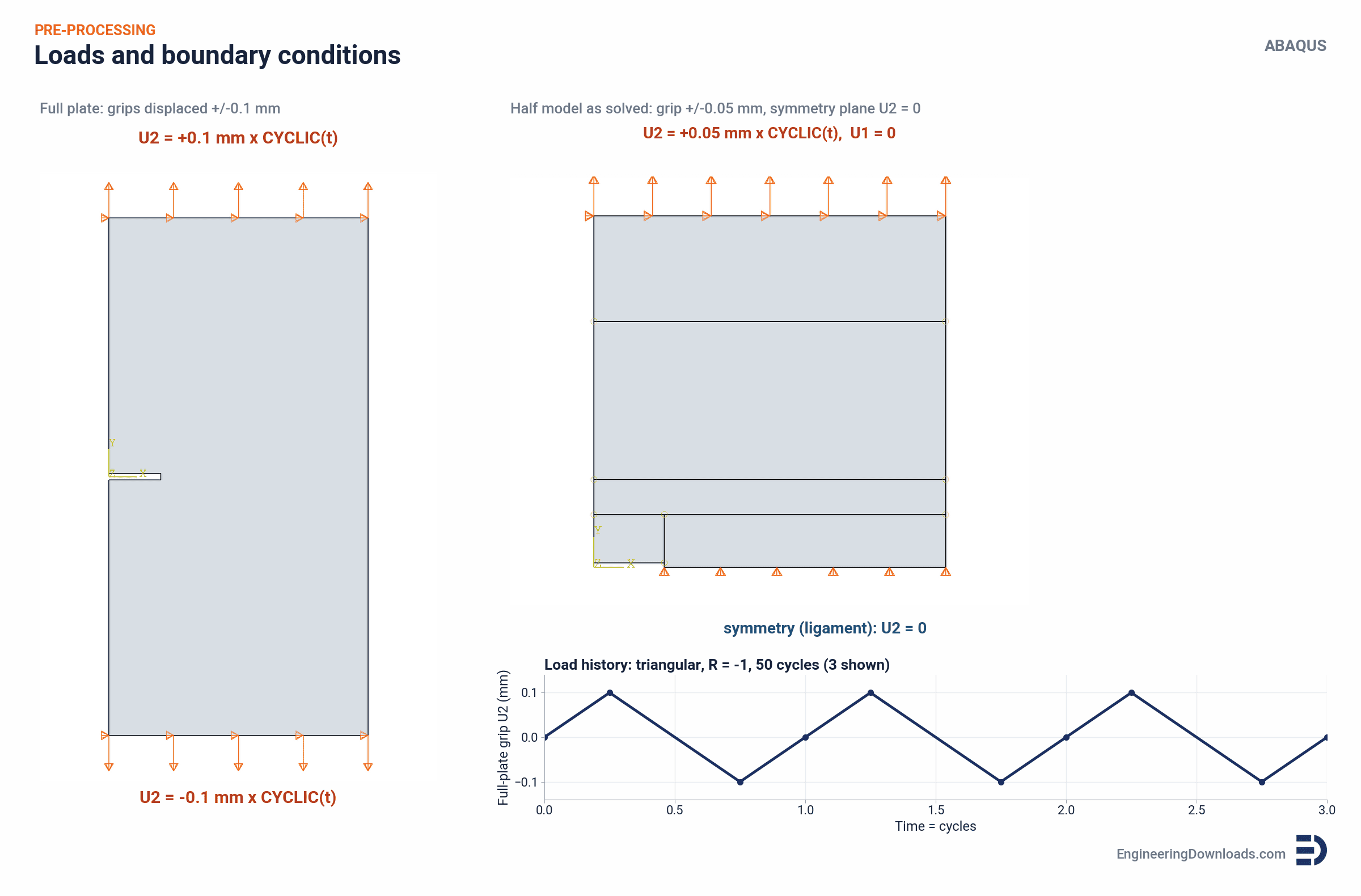
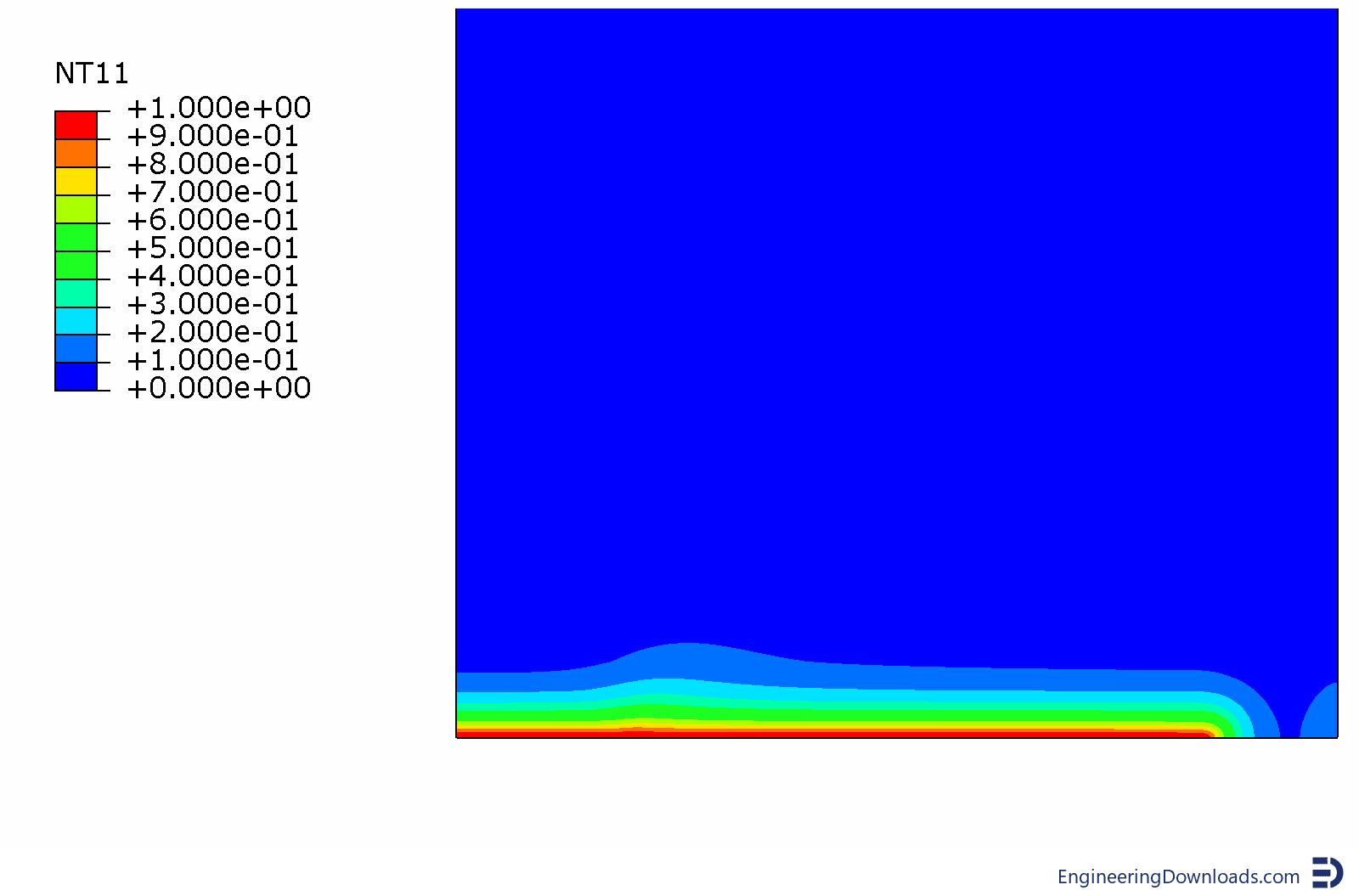
The notched plate workshop shows how the phase field evolves in space under fully reversed displacement. The 10 mm × 20 mm plate is modeled as a plane-strain half model and mirrored in Viewer. The half model uses 2,378 four-node user elements, with 0.125 mm spacing along the ligament and a phase-field length scale of 0.5 mm.
These images are direct exports from the completed Abaqus results database. They use the Viewer default Rainbow spectrum, automatic contour limits, and visible element edges. Read the scale printed beside each frame when comparing field values.
A generalised phase field model for fatigue crack growth in elastic–plastic solids with an efficient monolithic solver
Zeyad Khalil, Ahmed Y. Elghazouli and Emilio Martínez-Pañeda. Computer Methods in Applied Mechanics and Engineering, volume 388, 2022, article 114286. Read the paper and original abstract.
The authors develop a phase-field framework for predicting fatigue crack growth in metals with elastic–plastic behavior. They compare fatigue degradation functions against experimental results and formulate the model to support AT1, AT2 and phase-field cohesive-zone descriptions of fracture. The cyclic plasticity formulation accommodates nonlinear isotropic and kinematic hardening, individually or together.
The paper also proposes a monolithic quasi-Newton method for solving the displacement and phase-field equations together. The reported comparisons show gains over staggered solution strategies. Two- and three-dimensional examples examine how choices in the constitutive model and numerical solution affect fatigue predictions.
The validation reproduces the homogeneous response in Section 4.1, Fig. 5 using a 1 mm square plane-strain coupon. The four strain amplitudes are 1%, 3%, 5% and 7%, and the four length scales are 0.4, 0.6, 0.8 and 1.0 mm. The displacement cycle is fully reversed at R = −1. The reported life is the first quarter-cycle output at which the phase field reaches 0.9.
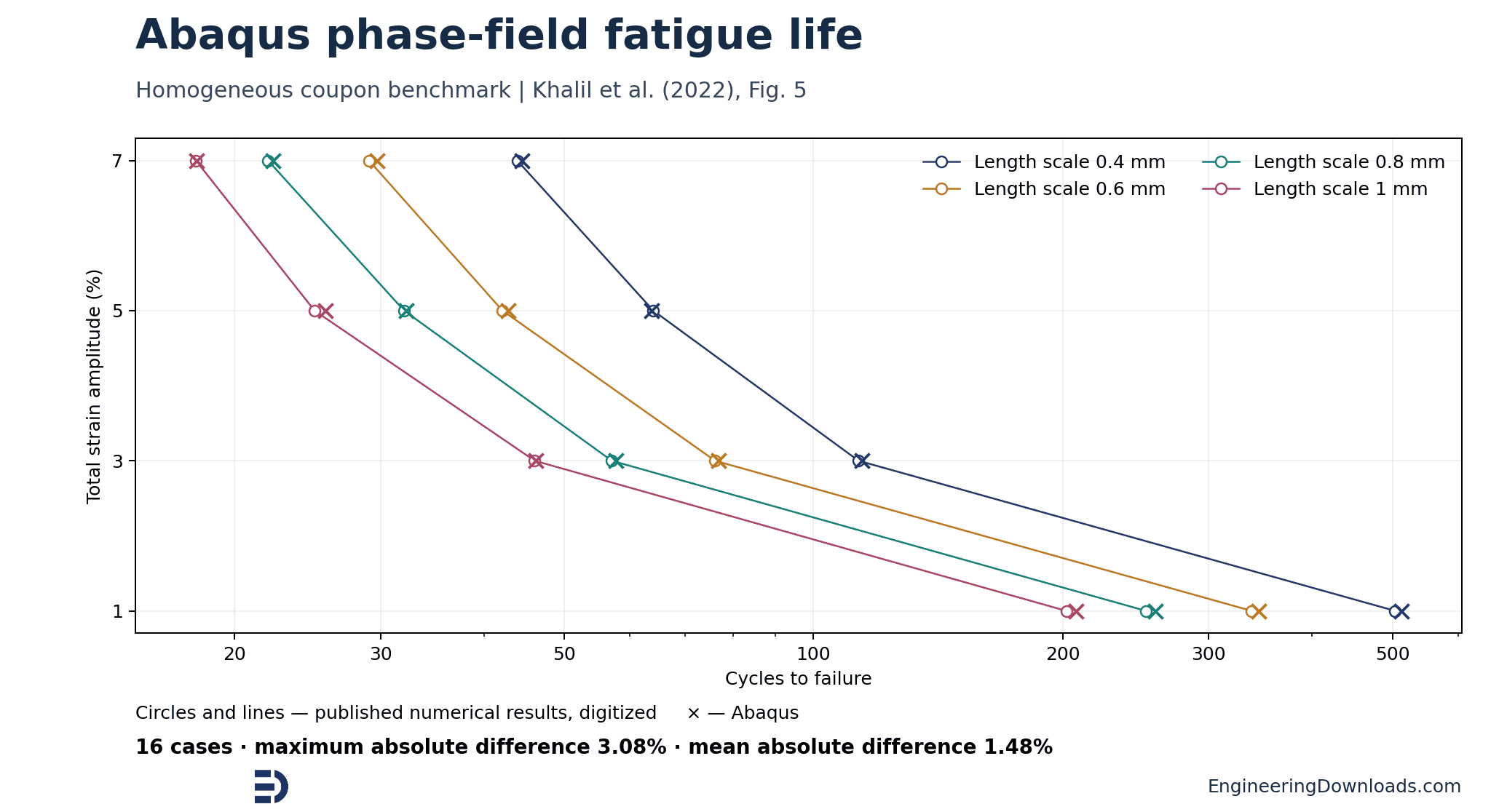
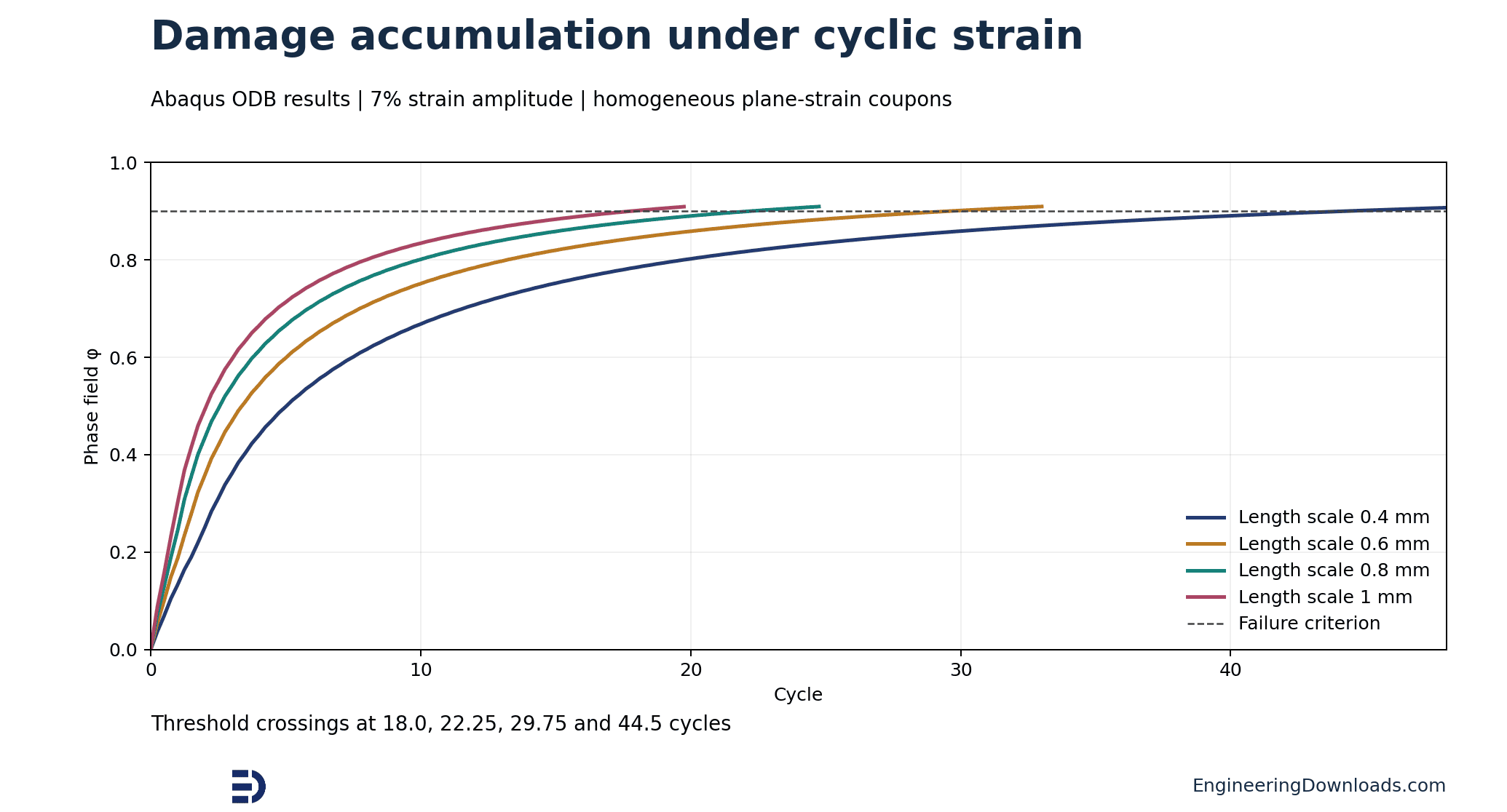
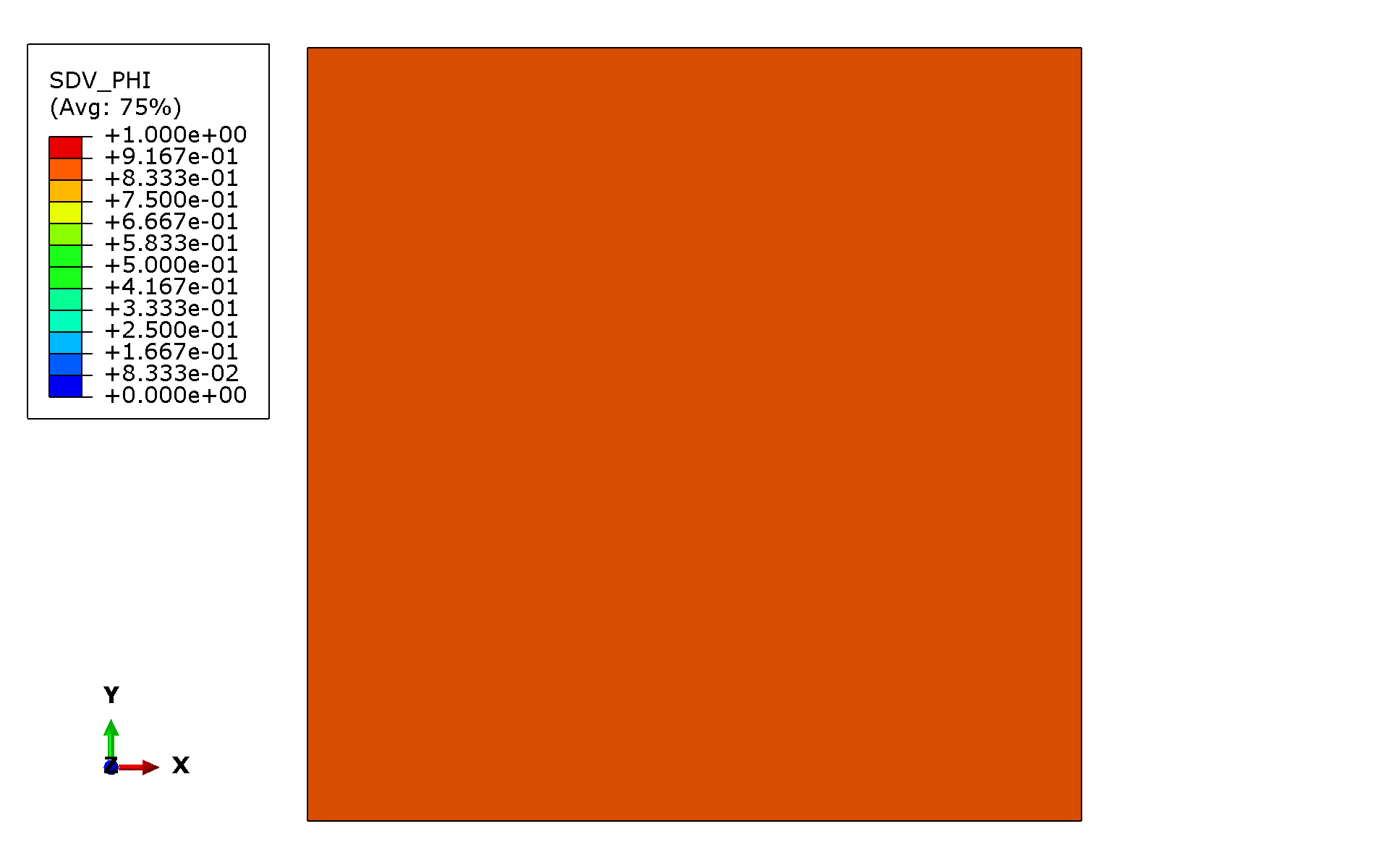
The coupon workflow couples AT2 phase-field fatigue with the combined nonlinear isotropic and kinematic hardening parameters in Table 1. The user element passes strains to the Abaqus material library and assembles the mechanical and phase-field residuals for the monolithic solution.
The stiffness degradation is g(φ) = (1 − φ)2. The fatigue threshold is αT = Gc/(12ℓ). Above that threshold, the fatigue reduction factor is [2αT/(ᾱ + αT)]2. In the homogeneous coupon, [Gcf/ℓ + 2D]φ = 2D, where D combines the tensile elastic history and accumulated plastic work.
Requires Abaqus/Standard, a compatible Fortran compiler configured for user subroutines, and Python 3 for the coupon runner.
Need more than the files?
There are two ways we can help. Book a one hour online consultation if you want to talk a problem through with a CAE engineer, using the checkbox in the order box. Order a project if you need a full simulation built for you, delivered to an agreed scope, price and deadline under a written contract.
We work on FEA and CFD for engineers, researchers and companies. Order your project, or message us on WhatsApp for a quick reply.
Other packages engineers working on this topic also download.
 Phase Field Fracture in Abaqus: AT1/AT2 UMAT, Crack Initiation and Edge-Cracked Tension Benchmark (Kristensen et al. 2021)€169,00
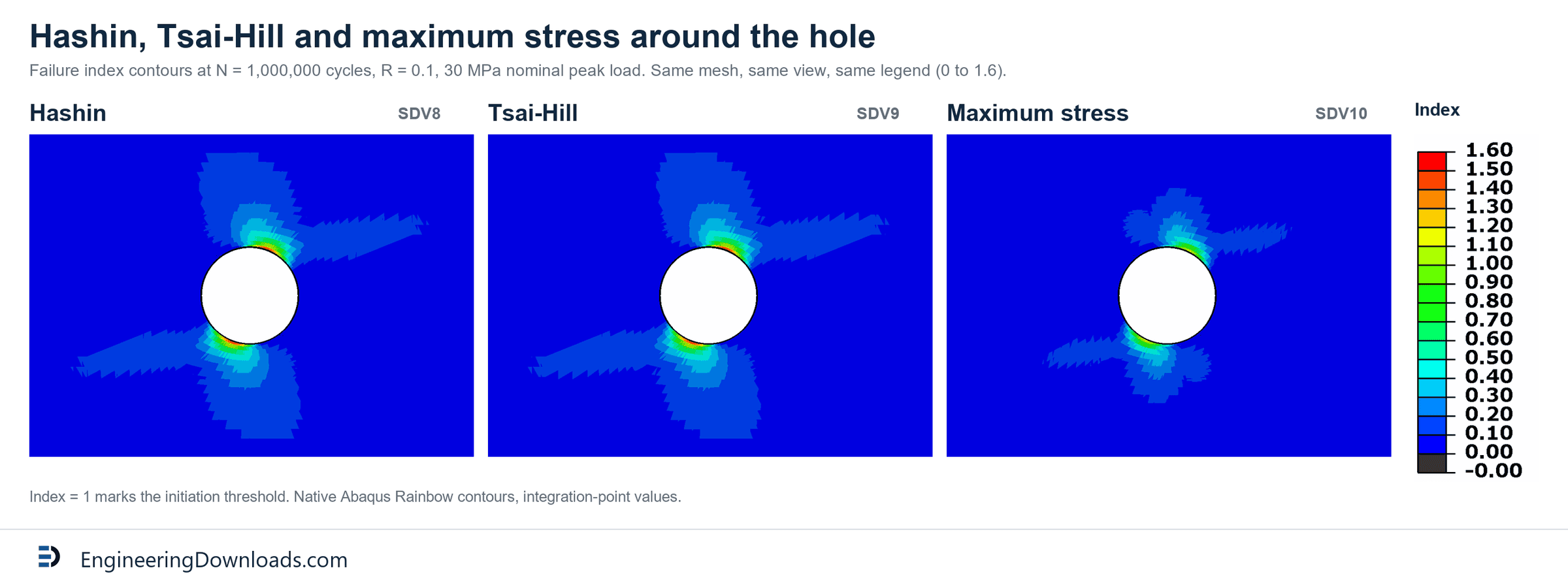 Composite Fatigue UMAT for Abaqus: Hashin, Tsai-Hill and Maximum-Stress Criteria€159,00
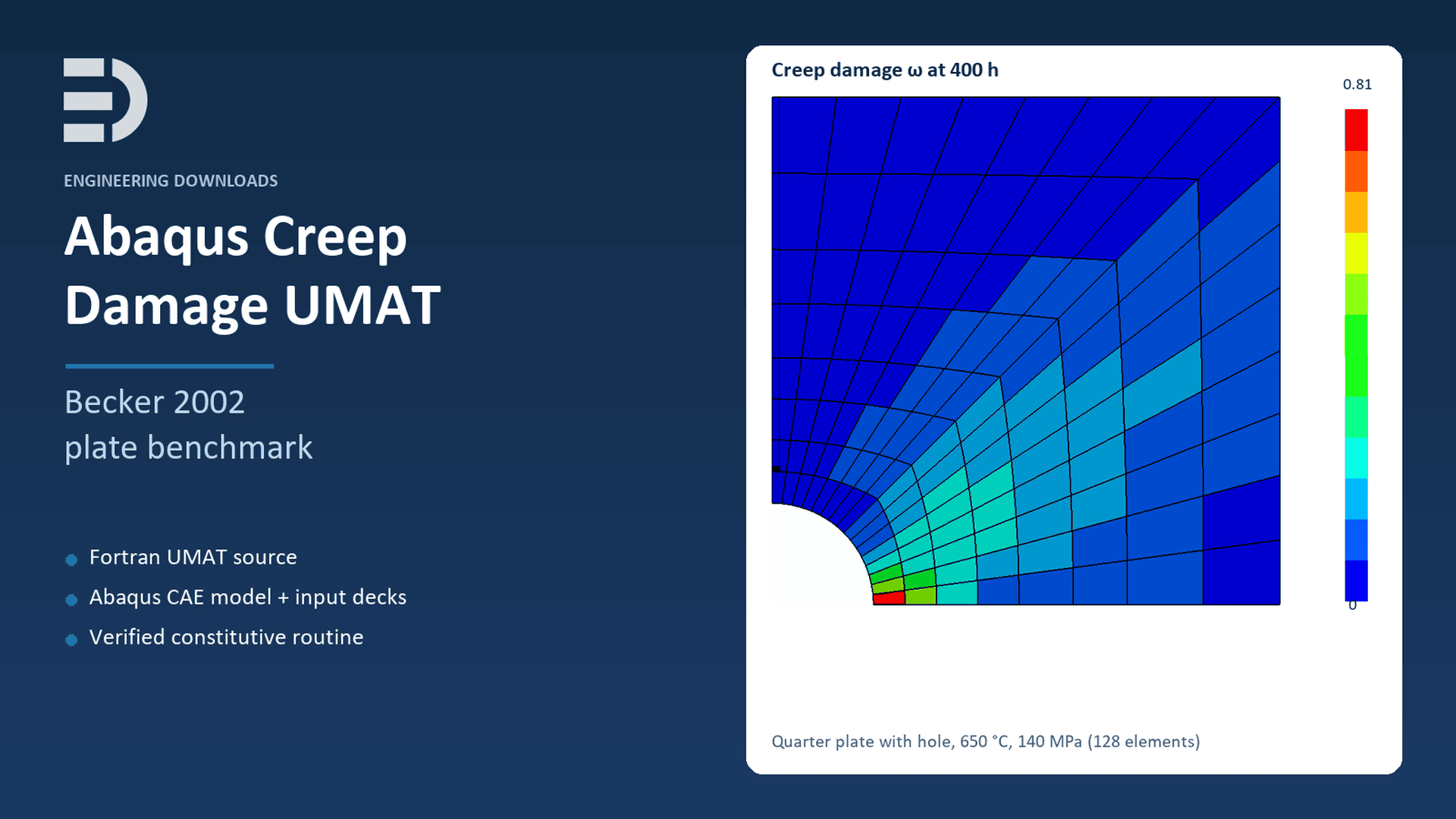 Creep Continuum Damage UMAT in Abaqus: Becker 2002 Perforated Plate Benchmark€49,00
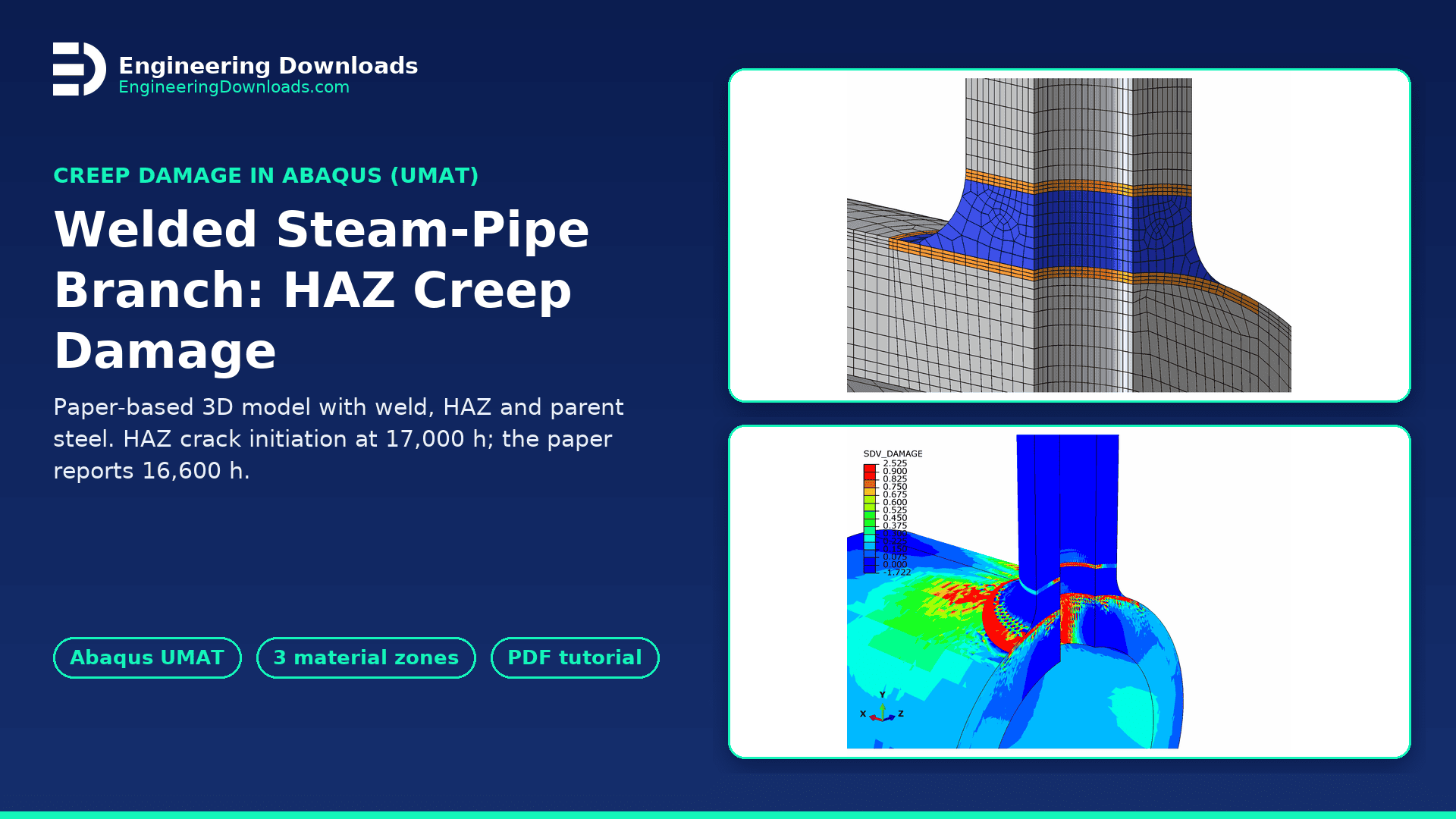 Creep Damage Analysis of a Welded Steam Pipe Branch in Abaqus: UMAT, HAZ Hex Mesh and Paper Comparison€149,00
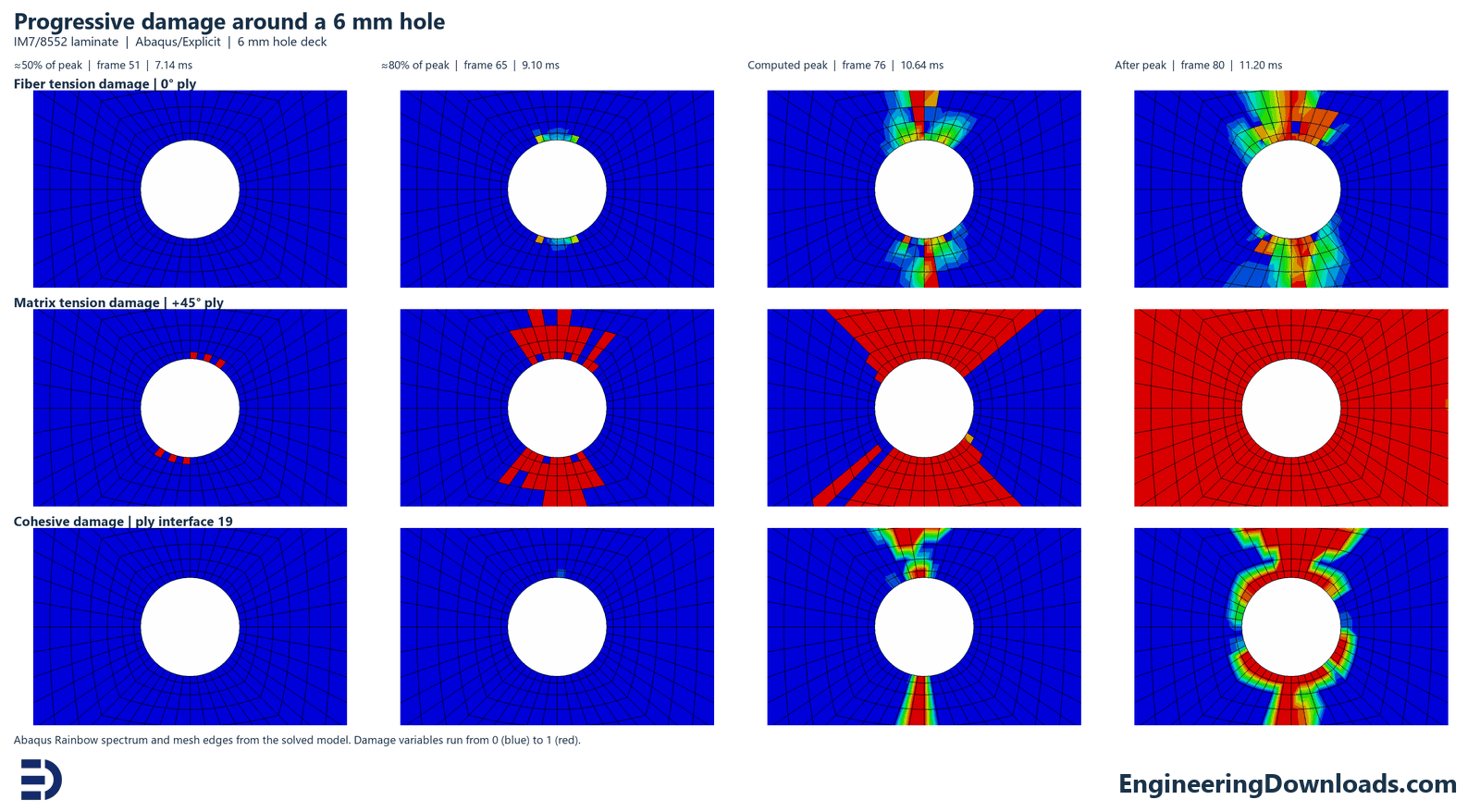 3D Hashin Progressive Damage VUMAT for Abaqus: Open-Hole Laminate with Cohesive Delamination€159,00
 LPBF 316L Residual Stress and Cantilever Distortion in Abaqus: Sequentially Coupled Thermal-Stress Model with DFLUX and USDFLD Subroutines€159,00
 Rib-to-Deck Weld Fatigue Hot-Spot Stress in Abaqus: Orthotropic Steel Bridge Deck, after Kc et al. (2024)€149,00
 Contact Fatigue Limit of a Hardness-Graded Gear Flank: Abaqus Brown-Miller-Morrow Workflow€129,00

Need a full custom project? See the options below.
€129,00
€179,00
€149,00
€119,00
€129,00
See more
Want to receive push notifications for all major on-site activities?