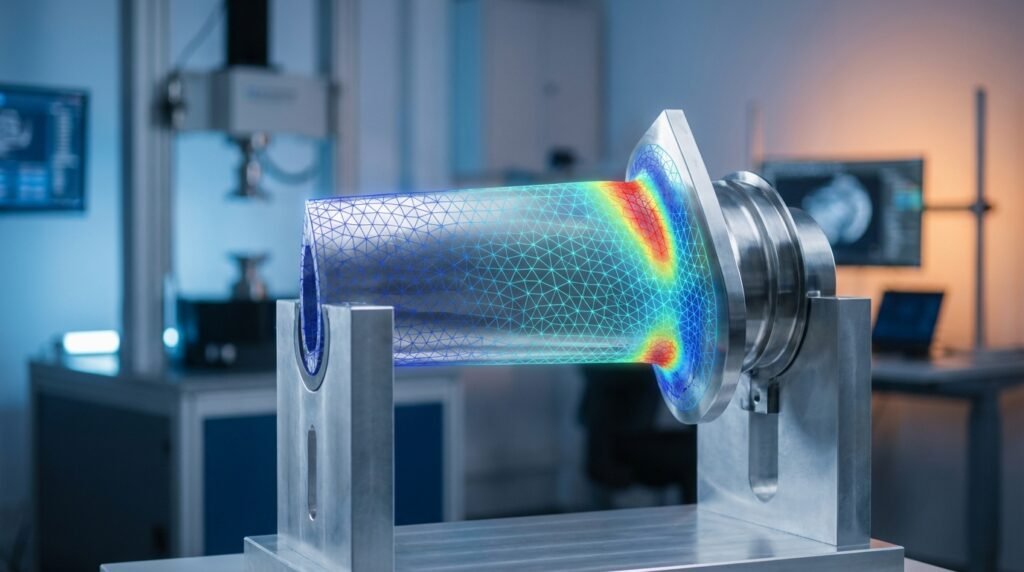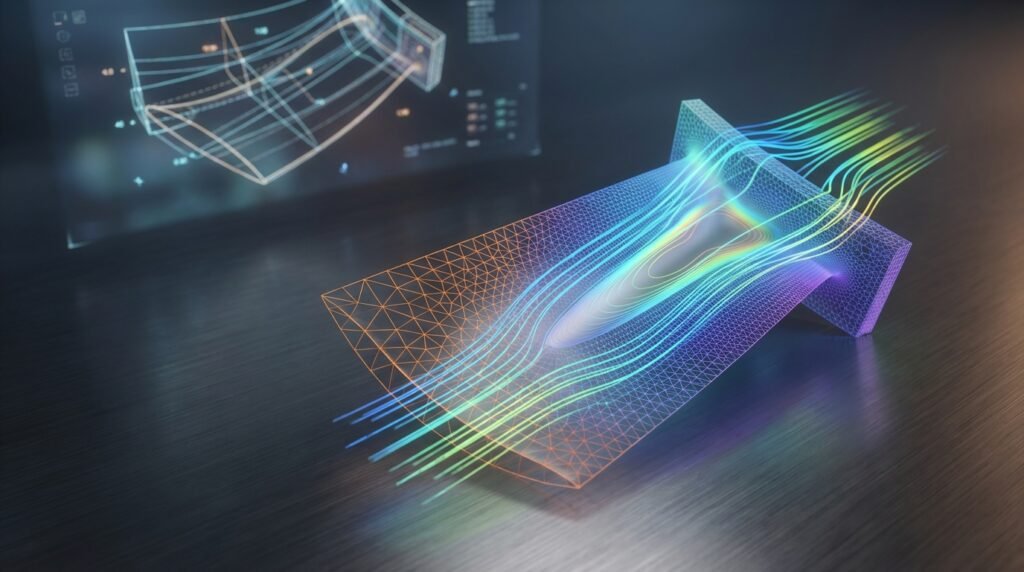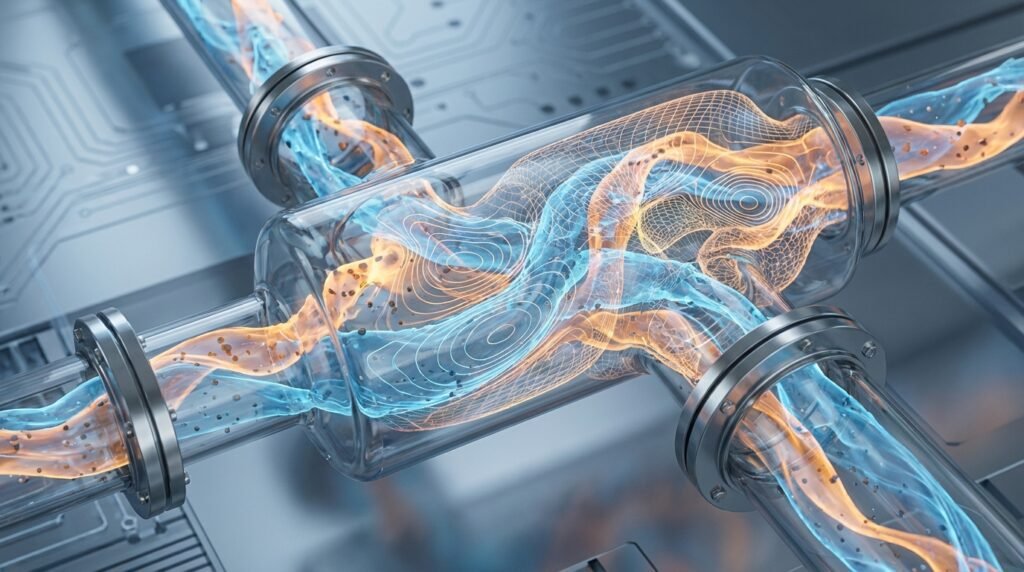
Understanding and predicting the behavior of multiphase flows is a cornerstone in many engineering disciplines. From the oil & gas pipelines transporting crude oil and gas to the intricate biological processes within the human body, wherever two or more phases (gas, liquid, solid) coexist and interact, you’re dealing with multiphase flow. This guide provides a practical, engineer-to-engineer perspective on analyzing these complex systems, with a strong focus on Computational Fluid Dynamics (CFD).
Simulation and analysis of multiphase flows are critical for optimizing designs, preventing failures, and ensuring operational safety and efficiency across various industries. Let’s dive into the fascinating world of how fluids and solids interact in dynamic systems.

Attribution: Wikimedia Commons, Public Domain
Understanding Multiphase Flow: The Engineering Context
Multiphase flow describes the simultaneous flow of two or more distinct phases. These phases can be any combination of gas, liquid, or solid. The interactions between these phases—think mass transfer, heat exchange, and momentum exchange—make these systems inherently challenging to analyze, yet crucial for accurate engineering design.
Why Multiphase Flow Matters Across Industries
The applications are vast and diverse, directly impacting design and operational decisions:
- Oil & Gas: Pipeline design, separator efficiency, wellbore dynamics, hydrate formation prediction. Understanding slug flow, for instance, is vital for preventing damage to downstream equipment.
- Chemical & Process Engineering: Reactor design, distillation columns, fluidized beds, atomization processes, mixing vessels.
- Power Generation: Boiler and condenser performance, nuclear reactor cooling, geothermal systems.
- Aerospace: Fuel injection systems, cryogenics, de-icing strategies, spray cooling in turbine blades.
- Biomechanics & Medical Devices: Blood flow with suspended cells, drug delivery systems, pulmonary airflow with aerosols.
- Environmental Engineering: Sediment transport in rivers, pollutant dispersion in air and water, wastewater treatment.
Common Multiphase Flow Regimes & Their Characteristics
The way phases distribute themselves in a flow is known as a flow regime. These regimes are often highly dependent on phase velocities, fluid properties, and pipe geometry. Recognizing the regime is fundamental for selecting the correct modeling approach and understanding system behavior.
Here’s an illustrative table of typical gas-liquid flow regimes in a horizontal pipe:
| Flow Regime | Description | Typical Characteristics |
|---|---|---|
| Stratified Flow | Phases flow separately, one above the other, due to gravity. | Low velocities, distinct interface, common in large pipes. |
| Wavy Flow | Similar to stratified, but the interface develops waves due to velocity differences. | Slightly higher velocities, increasing shear stress. |
| Slug Flow | Large Taylor bubbles (gas) separate liquid slugs that fill the pipe. | Intermittent, high pressure fluctuations, common in oil & gas. |
| Annular Flow | Liquid flows as a film around the pipe wall, with gas flowing in the core. | High gas velocities, liquid entrainment as droplets in the gas core. |
| Dispersed Bubble Flow | Small gas bubbles are dispersed almost uniformly in a continuous liquid phase. | High liquid velocities, low gas fraction. |
Challenges in Multiphase Flow Modeling
Analyzing multiphase flows isn’t straightforward. Several factors contribute to their complexity:
- Interfacial Phenomena: Tracking and modeling the interface between phases (e.g., surface tension, wetting, contact angle) is computationally intensive.
- Phase Coupling: Momentum, heat, and mass transfer occur between phases and are highly dependent on the flow regime and relative velocities.
- Turbulence: Multiphase flows often involve complex turbulence structures, which can be challenging to model accurately, especially with phase interactions.
- Numerical Stability: Strong coupling and rapid changes in phase distribution can lead to numerical instabilities if not handled carefully.
- Scale Differences: The relevant scales can range from micrometers (bubbles, droplets) to meters (pipeline lengths), requiring different modeling approaches.
CFD for Multiphase Flow: Unlocking Insights
Computational Fluid Dynamics (CFD) has become an indispensable tool for engineers tackling multiphase flow problems. It allows for detailed prediction of flow behavior, pressure drops, heat transfer, and species transport under various conditions, reducing the need for expensive physical prototypes and testing.
Key Modeling Approaches in CFD
Selecting the right model is critical for accuracy and computational efficiency. Here are the primary methods:
- Eulerian-Eulerian Approach:
- Treats all phases as interpenetrating continua. Each phase has its own set of momentum and continuity equations.
- Best for flows where phases are well-mixed or where the interface is not explicitly tracked (e.g., dispersed bubble flow, fluidized beds).
- Examples: Mixture Model, Eulerian Multiphase Model (available in ANSYS Fluent, OpenFOAM).
- Eulerian-Lagrangian Approach:
- One phase (typically continuous) is treated as a continuum (Eulerian), while the dispersed phase (particles, droplets, bubbles) is tracked individually (Lagrangian).
- Ideal for dilute flows where particle-particle interactions are less dominant, such as spray dryers or particle laden flows.
- Examples: Discrete Phase Model (DPM) in ANSYS Fluent.
- Interface-Tracking/Capturing Methods:
- Explicitly tracks or captures the interface between immiscible fluids.
- Volume of Fluid (VOF): Tracks the volume fraction of each fluid in computational cells. The interface is located where the volume fraction changes sharply. Excellent for stratified, slug, or free-surface flows.
- Level Set Method: Defines the interface as the zero level set of a signed distance function. Good for complex interface deformations.
- These methods are computationally more expensive but provide high fidelity interface details. Tools like ANSYS Fluent/CFX and OpenFOAM offer robust VOF capabilities.
Essential CFD Tools for Multiphase Flow
Several commercial and open-source software packages excel in multiphase flow simulation:
- ANSYS Fluent & CFX: Industry-standard tools offering a comprehensive suite of multiphase models (VOF, Eulerian, DPM, Mixture) with robust solvers and extensive post-processing capabilities. Highly versatile for a wide range of applications.
- OpenFOAM: An open-source CFD toolbox known for its flexibility and customization. It provides various multiphase solvers (e.g.,
interFoamfor VOF,twoPhaseEulerFoamfor Eulerian-Eulerian) and is favored by researchers and engineers who need deep control over their simulations. - Simcenter STAR-CCM+: Another powerful commercial tool with strong multiphase capabilities, particularly in transient and complex geometries.
Practical Workflow for Multiphase Flow Simulation
A structured approach ensures reliable and accurate results in multiphase CFD. Here’s a practical workflow:
Phase 1: Problem Definition & Data Gathering
- Objective: Clearly define what you want to achieve (e.g., pressure drop, void fraction distribution, mixing efficiency).
- System Boundaries: Identify the computational domain and relevant physical phenomena (e.g., heat transfer, mass transfer, chemical reactions).
- Material Properties: Gather accurate fluid properties (density, viscosity, surface tension) and solid properties, including temperature dependencies if applicable.
- Operating Conditions: Document inlet velocities/mass flow rates, pressures, temperatures, and initial conditions.
Phase 2: Geometry & Meshing Strategies
- CAD Preparation: Simplify your CAD model. Remove irrelevant features that won’t significantly impact flow but will complicate meshing.
- Mesh Generation:
- Choose appropriate mesh type (structured, unstructured, polyhedral). Polyhedral meshes are often efficient for complex geometries.
- Pay close attention to mesh refinement at interfaces, near walls, and in regions of high gradients (e.g., inlets, outlets, areas of phase change).
- For VOF models, a finer mesh near the interface can improve accuracy. Consider adaptive mesh refinement (AMR) if available.
- Ensure good mesh quality (orthogonality, aspect ratio, skewness) to avoid numerical issues.
Phase 3: Physics Setup & Boundary Conditions
- Multiphase Model Selection: Based on your problem (e.g., VOF for free surfaces, Eulerian for dispersed flows, DPM for dilute sprays).
- Turbulence Model: Select a suitable turbulence model (e.g., k-epsilon, k-omega SST). For multiphase flows, consider turbulence models specifically adapted for inter-phase interactions (e.g., dispersed turbulence models).
- Interfacial Phenomena: Configure surface tension, wall adhesion (contact angle), and possibly cavitation or boiling models if relevant.
- Boundary Conditions: Apply realistic inlets (velocity inlet, mass flow inlet), outlets (pressure outlet, outflow), walls (no-slip, free-slip), and symmetry conditions. Define phase fractions at inlets.
- Gravitational Effects: Crucial for many multiphase flows; ensure gravity is correctly defined.
Phase 4: Solver Settings & Convergence
- Solution Methods: Select appropriate discretization schemes (e.g., first-order for initial stability, then higher-order for accuracy).
- Time Stepping: For transient multiphase flows (which most are), choose a small enough time step to capture the dynamics and maintain stability. Courant number (CFL) should be monitored and kept within reasonable limits (e.g., <0.5-1 for VOF).
- Under-Relaxation Factors: Adjust these to improve stability, especially for highly coupled equations.
- Convergence Criteria: Define strict criteria for residuals (e.g., 1e-4 to 1e-6), and monitor key engineering quantities (e.g., pressure drop, mass flow rates at outlet, void fraction profiles) for stability.
Phase 5: Post-processing & Interpretation
- Visualizations: Create compelling visuals of phase distribution (volume fraction contours), velocity vectors, streamlines, and pressure plots. Animations are often essential for transient multiphase flows.
- Quantitative Analysis: Extract numerical data: average void fraction, pressure drop, heat transfer coefficients, mass flow rates.
- Regime Identification: Use your simulation results to confirm or identify the flow regime.
- Comparison: Compare your results against analytical solutions, empirical correlations, or experimental data (if available).
Verification & Sanity Checks: Building Confidence in Your Results
Never take simulation results at face value. A rigorous verification and validation process is essential for trustworthy multiphase flow analysis.
Mesh Sensitivity Analysis
Perform simulations on at least three different mesh resolutions (coarse, medium, fine). Observe how your key output parameters change. Once the results become relatively independent of further mesh refinement, you’ve achieved mesh independence (or near mesh independence) for that parameter. This step is non-negotiable.
Convergence Monitoring
Beyond residual plots, ensure that engineering quantities (e.g., total mass flow at outlet, force on a wall, average temperature) are stable over a significant number of iterations or time steps. Oscillating values indicate instability or insufficient simulation time.
Validation Against Empirical Data
Whenever possible, compare your simulation results with experimental data or well-established empirical correlations. This is the ultimate test of your model’s predictive capability. If direct experimental data isn’t available for your exact setup, look for similar benchmark cases in literature.
Sensitivity Analysis
Investigate the impact of input parameter variations (e.g., inlet velocity, fluid properties, surface tension coefficient, contact angle) on your results. This helps understand the robustness of your model and identify critical parameters. For example, how does a 5% change in surface tension affect slug length? This can also be automated using Python or MATLAB scripts.
Common Pitfalls & Troubleshooting Tips
- Incorrect Model Selection: Using VOF for a highly dispersed flow or Eulerian for explicit interface tracking will yield poor results. Review your problem type carefully.
- Poor Mesh Quality: Leads to divergence or inaccurate solutions. Always check mesh metrics.
- Unrealistic Boundary Conditions: Garbage in, garbage out. Ensure your BCs accurately represent the physical system.
- Too Large Time Step: Especially for transient VOF simulations, a large time step often causes divergence. Reduce the time step or adjust CFL settings.
- Lack of Convergence: If residuals stall or oscillate, check mesh quality, time step, under-relaxation factors, and boundary conditions. Sometimes, restarting with a smaller time step or different initialization can help.
- Ignoring Gravity: A common oversight, especially in horizontal flows where its effect might seem small but can dictate flow regimes.
- High Aspect Ratio Cells: Can cause issues, particularly near walls. Use inflation layers for boundary layer resolution.
Leveraging Scripting for Efficiency: Python & MATLAB
Automating tasks is a game-changer for multiphase flow analysis, especially for parametric studies or complex post-processing:
- Pre-processing: Generate complex geometries or mesh inputs programmatically (e.g., Python scripts for OpenFOAM mesh dictionaries).
- Solver Automation: Control CFD solvers (e.g., ANSYS Fluent’s journaling or OpenFOAM’s case setup) to run multiple simulations, adjust parameters, or perform restarts.
- Post-processing: Extract, analyze, and visualize data efficiently. Python libraries like NumPy, SciPy, Matplotlib, and Paraview (for visualization scripts) are invaluable. MATLAB also offers powerful tools for data manipulation and plotting.
- Optimization & Sensitivity Analysis: Combine scripting with optimization algorithms to explore design spaces and perform automated sensitivity studies.
Need to automate your multiphase flow post-processing or develop custom scripts for ANSYS, OpenFOAM, or general CFD data analysis? EngineeringDownloads.com offers specialized Python for Engineers tutorials and online consultancy services tailored for engineers looking to enhance their simulation workflows.
Best Practices for Robust Multiphase Flow Analysis
- Start Simple: Begin with a simplified 2D model or a steady-state assumption (if applicable) to establish a baseline before moving to complex 3D transient simulations.
- Understand Your Physics: Don’t just click buttons. A strong grasp of fluid dynamics, heat transfer, and phase interaction physics is paramount.
- Iterate and Refine: CFD is an iterative process. Expect to refine your mesh, adjust models, and tweak solver settings multiple times.
- Document Everything: Keep detailed records of your setup, assumptions, parameters, and results. This is invaluable for reproducibility and troubleshooting.
- Leverage Resources: Utilize software documentation, online forums, and academic papers to deepen your understanding and troubleshoot issues.
Further Reading
For a deeper dive into the theoretical foundations of multiphase flow modeling, consider resources from reputable universities and technical journals. A good starting point for CFD principles in general is the CFD-Online Wiki.