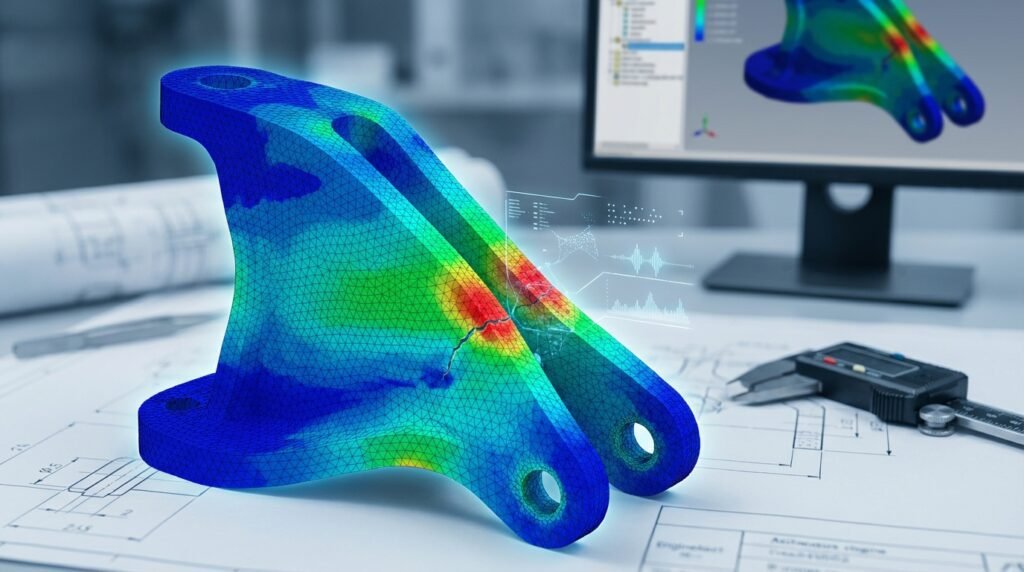
Understanding and predicting fatigue life is critical in the design and assessment of structural components across industries like aerospace, oil & gas, and automotive. Fatigue failure, often occurring under stresses well below a material’s ultimate tensile strength, can lead to catastrophic consequences if not properly addressed. Fortunately, Finite Element Analysis (FEA) provides a powerful toolkit for engineers to assess and predict fatigue behavior early in the design cycle.

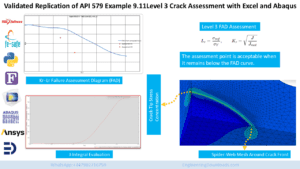
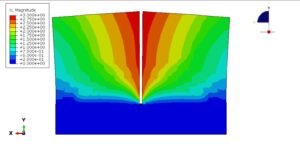
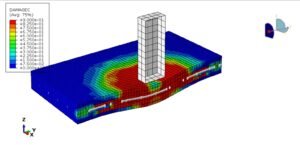
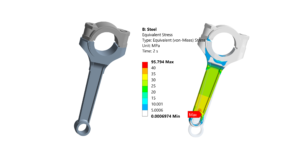
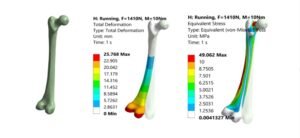
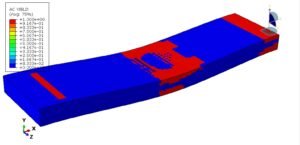
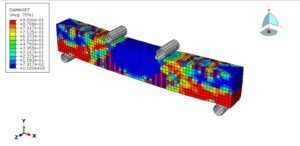
Image: Illustrative stress contour plot from a finite element analysis.
Understanding Fatigue Failure Mechanisms
Before diving into FEA, it’s essential to grasp the fundamental mechanisms of fatigue. Fatigue is a localized and progressive structural damage process that occurs when a material is subjected to cyclic loading.
High Cycle vs. Low Cycle Fatigue
- High Cycle Fatigue (HCF): Occurs under low stresses (often elastic) and a large number of cycles (typically > 10^5 cycles). The S-N (Stress-Life) approach is commonly used here.
- Low Cycle Fatigue (LCF): Occurs under high stresses (often plastic deformation) and a relatively small number of cycles (< 10^5 cycles). The ε-N (Strain-Life) approach is more appropriate for LCF.
Critical Factors Influencing Fatigue Life
Several factors dictate how a component will resist fatigue:
- Stress Amplitude & Mean Stress: The magnitude of cyclic stress and the average stress level are primary drivers.
- Material Properties: Yield strength, tensile strength, ductility, and especially the material’s S-N or ε-N curves are crucial.
- Surface Finish: Rough surfaces create stress raisers, reducing fatigue life.
- Residual Stresses: Compressive residual stresses can improve fatigue life, while tensile ones can reduce it.
- Environmental Factors: Corrosion, temperature, and fretting can significantly accelerate fatigue damage.
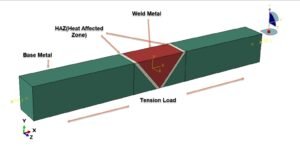
- Geometric Discontinuities: Notches, holes, fillets, and welds introduce stress concentrations, which are initiation sites for fatigue cracks.
The Role of FEA in Fatigue Life Prediction
FEA allows engineers to calculate detailed stress and strain distributions within complex geometries, making it an invaluable tool for identifying critical fatigue locations and predicting life.
Stress-Life (S-N) Approach
The S-N approach, based on Wöhler curves, is widely used for HCF. It relates stress amplitude to the number of cycles to failure. FEA provides the stress amplitudes at critical locations, which are then compared against the material’s S-N curve.
Strain-Life (ε-N) Approach
For LCF, where plastic deformation occurs, the ε-N approach is more accurate. It correlates total strain amplitude (elastic + plastic) with cycles to failure. FEA’s ability to capture non-linear material behavior is essential here.
Damage Accumulation Theories
For variable amplitude loading, damage accumulation theories like Miner’s Rule are employed. FEA helps by providing the stress/strain histories for each loading block, allowing for the calculation of cumulative damage.
Practical Workflow for FEA-Based Fatigue Analysis
A systematic approach is key to successful fatigue analysis using FEA.
Step 1: Material Characterization
- Obtain accurate material properties: Young’s Modulus, Poisson’s ratio, Yield Strength, Ultimate Tensile Strength.
- Acquire fatigue-specific data: S-N curves, ε-N curves, fatigue strength coefficient, fatigue ductility coefficient, etc.
- Consider environmental effects if applicable.
Step 2: Geometry & Meshing Considerations
- Simplify geometry appropriately, removing insignificant features while retaining critical stress concentration areas.
- Mesh Refinement: Crucial at stress concentration regions (notches, fillets, holes, welds). Use a finer mesh (e.g., quadratic elements like C3D8R in Abaqus or SOLID186 in ANSYS) to accurately capture stress gradients.
- Ensure mesh quality: Avoid highly distorted elements that can lead to inaccurate results.
Step 3: Loadings & Boundary Conditions
- Accurately represent operational loads: static, dynamic, cyclic.
- Define load history: Constant amplitude, variable amplitude (block loading, spectrum loading).
- Apply realistic boundary conditions that constrain the model correctly without over-constraining it.
- Consider pre-stress conditions or assembly stresses if relevant.
Step 4: Stress/Strain Calculation
Perform the FEA simulation (e.g., using Abaqus, ANSYS Mechanical, or MSC Nastran). The output will be detailed stress and strain fields. For fatigue, typically the maximum principal stress, von Mises stress, or critical plane stresses are extracted.
Step 5: Post-Processing & Fatigue Life Assessment
This is where the FEA results are translated into fatigue life. Most commercial FEA software (Abaqus/CAE, ANSYS Workbench) include fatigue modules or can export results to specialized fatigue analysis software.
Common Fatigue Theories for Post-Processing:
| Theory | Description | Applicability |
|---|---|---|
| Goodman | Accounts for mean stress effects (conservative). | Ductile materials, tensile mean stress. |
| Soderberg | Even more conservative than Goodman. | Brittle materials, highly critical applications. |
| Gerber | Parabolic relationship for mean stress correction. | Ductile materials, less conservative than Goodman. |
| Smith-Watson-Topper (SWT) | Considers mean stress in strain-life approach. | LCF & HCF, when mean stress is tensile. |
| Fatemi-Socie | Critical plane approach for multiaxial fatigue. | Multiaxial loading, shear-dominated fatigue. |
Tool Spotlight: Abaqus, ANSYS, Nastran
- Abaqus: Excellent for non-linear material behavior, explicit dynamics, and advanced fracture mechanics. Its scripting capabilities (Python) allow for complex fatigue post-processing automation.
- ANSYS Mechanical: User-friendly interface with integrated fatigue tools (e.g., ANSYS nCode DesignLife integration). Strong in contact analysis and complex assemblies.
- MSC Nastran/Patran: Widely used in aerospace for linear static and dynamic analysis. Fatigue capabilities are often integrated via external tools like MSC Fatigue.
Verification & Sanity Checks in Fatigue FEA
Don’t just trust the numbers; verify them!
Mesh Sensitivity Analysis
Run the analysis with progressively finer meshes in critical regions. Fatigue life should converge to a stable value. If it keeps changing significantly, your mesh isn’t fine enough.
Convergence Criteria
For non-linear analyses, ensure solution convergence. Divergence indicates issues with loads, BCs, or material models.
Hand Calculations & Analytical Solutions
For simplified geometries or load cases, perform basic stress calculations (e.g., stress concentration factors from engineering handbooks) to cross-check peak stresses from FEA.
Experimental Data Validation
Whenever possible, compare FEA predictions with experimental fatigue test data. This is the ultimate validation and helps refine your models.
Load Case Sensitivity
Slightly vary your input loads or boundary conditions to understand the sensitivity of your fatigue life prediction. This helps identify critical input parameters.
Common Pitfalls and Troubleshooting Tips
- Incorrect Material Properties: Double-check S-N/ε-N curves for the correct material condition (e.g., heat treatment, weld properties).
- Inadequate Mesh Refinement: Leads to underprediction of peak stresses at notches, significantly overestimating fatigue life. Always conduct a mesh convergence study.
- Overlooking Residual Stresses: Significant residual stresses (e.g., from welding, shot peening) must be accounted for as they affect the mean stress.
- Simplifying Load History: Variable amplitude loading needs careful representation. Using equivalent constant amplitude loads can be overly conservative or unconservative.
- Wrong Fatigue Theory: Using an S-N approach for LCF or a theory not suited for multiaxial loading can yield erroneous results.
Advanced Topics & Emerging Trends
Multiaxial Fatigue
When components experience complex, simultaneous loading in multiple directions, multiaxial fatigue criteria (e.g., critical plane methods) are required. These consider the interaction of normal and shear stresses.
Probabilistic Approaches
Materials, loads, and manufacturing processes all have inherent variability. Probabilistic fatigue analysis incorporates these uncertainties to provide a reliability-based fatigue life prediction.
Python & MATLAB for Automation
For repetitive tasks, post-processing large datasets, or integrating fatigue calculations with other tools, Python (for Abaqus, ANSYS APDL scripting) and MATLAB are invaluable. They enable custom fatigue life algorithms and automated reporting.
Want to streamline your FEA fatigue workflow? Explore our downloadable Python scripts and templates for Abaqus and ANSYS post-processing, designed to automate fatigue life calculations and reporting. Enhance your efficiency and accuracy!
Takeaways for Engineers
Mastering FEA for fatigue life prediction requires a blend of theoretical understanding and practical application. Here’s a quick checklist:
- ✓ Understand HCF vs. LCF and choose the appropriate fatigue model.
- ✓ Accurately define material properties and fatigue curves.
- ✓ Perform thorough mesh refinement, especially at stress concentration points.
- ✓ Apply realistic loads and boundary conditions.
- ✓ Validate FEA results with hand calculations or experimental data.
- ✓ Be aware of common pitfalls like mean stress effects and residual stresses.
- ✓ Consider advanced methods for complex loading scenarios (multiaxial) or automation.
By following these guidelines, you can significantly improve the accuracy and reliability of your fatigue life predictions, leading to safer and more durable designs.
FAQ Section
Further Reading
For more in-depth information on the fundamentals of fatigue and fracture, refer to resources from organizations like NAFEMS, a global association for engineering analysis and simulation.