As engineers, ensuring the long-term durability and reliability of components is paramount. One of the most critical failure modes in structural and mechanical design is fatigue, where repeated loading cycles lead to crack initiation and propagation, even at stress levels well below the material’s static yield strength. Predicting fatigue life accurately is a complex challenge, but with the advent of Finite Element Analysis (FEA), we now have powerful tools to tackle it.
This comprehensive guide dives into the world of fatigue life prediction using FEA. We’ll explore the underlying principles, walk through practical workflows, discuss common pitfalls, and equip you with the knowledge to conduct robust fatigue analyses.

The Stress-Life (S-N) curve, a fundamental concept in fatigue analysis. Image courtesy of Wikipedia Commons.
Understanding Fatigue: The Basics
Before diving into FEA, it’s essential to grasp the fundamentals of material fatigue. Fatigue is a localized and progressive structural damage process that occurs when a material is subjected to cyclic or fluctuating stresses and strains.
Key Concepts in Fatigue Analysis
- Cyclic Loading: Repeated application of forces or displacements, causing fluctuating stresses.
- Stress Concentration: Localized regions of high stress due to geometric discontinuities (holes, fillets, notches). These are often crack initiation sites.
- S-N Curve (Stress-Life Curve): Relates the applied stress amplitude (S) to the number of cycles to failure (N). High cycle fatigue (HCF) typically uses S-N curves.
- ε-N Curve (Strain-Life Curve): Relates the plastic and elastic strain amplitude to the number of cycles to failure. Low cycle fatigue (LCF) often requires ε-N curves.
- Fatigue Limit/Endurance Limit: For some materials (e.g., steels), a stress level below which fatigue failure will theoretically not occur, regardless of the number of cycles.
- Mean Stress Effects: The average stress in a cycle can significantly influence fatigue life. Tensile mean stresses are generally detrimental.
Why FEA for Fatigue?
Traditional hand calculations and empirical methods are valuable but often limited to simplified geometries and loading conditions. FEA allows engineers to:
- Accurately model complex geometries and material behaviors.
- Capture detailed stress and strain distributions, especially at critical stress concentration points.
- Simulate realistic loading sequences and boundary conditions.
- Integrate various fatigue theories to predict life under multiaxial stress states.
- Optimize designs for improved fatigue performance early in the design cycle.
Practical Workflow for FEA Fatigue Life Prediction
Conducting a robust FEA fatigue analysis involves a series of structured steps. While specific software interfaces might differ, the underlying methodology remains consistent.
Step 1: Define the Problem and Gather Data
This foundational step is crucial. Skipping it leads to GIGO (Garbage In, Garbage Out).
- Component Function: What does the part do? How is it loaded in service?
- Loading History: What are the types of loads (static, cyclic, random)? What are their magnitudes, frequencies, and durations? This often involves duty cycle data.
- Material Properties: Obtain accurate material data, including Young’s modulus, Poisson’s ratio, yield strength, ultimate tensile strength, and crucially, fatigue properties (S-N curves, ε-N curves, fatigue strength coefficient, fatigue ductility coefficient, etc.). Note that these properties are highly sensitive to processing, surface finish, and environment.
- Environmental Factors: Temperature, corrosive agents, and radiation can significantly affect fatigue life.
- Failure Criteria: What constitutes ‘failure’? (Crack initiation, crack propagation to a certain size, complete fracture?).
Step 2: Pre-Processing – CAD Model to FEA Model
This is where your CAD-CAE workflow skills come into play. Tools like SolidWorks, CATIA, or Creo for CAD, and Abaqus, ANSYS Mechanical, or MSC Nastran/Patran for FEA are commonly used.
2.1 Geometry Preparation
- Simplification: Remove small features (chamfers, small fillets, holes for fasteners not directly loaded) that do not significantly affect global stress distribution but can unnecessarily increase mesh density and computational cost.
- Defeaturing: For thin-walled structures, consider mid-surface extraction for shell element modeling to reduce 3D complexity.
2.2 Meshing Strategy
Mesh quality is paramount for accurate stress results, which directly feed into fatigue calculations.
- Element Type: Generally, 3D solid elements (tetrahedral or hexahedral) are preferred for stress analysis. For thin structures, shell elements can be used effectively but require careful consideration of through-thickness stresses.
- Mesh Density: Refine the mesh in areas of high-stress gradients and expected stress concentrations (e.g., fillets, holes, sharp corners). Use mesh controls like local sizing, edge sizing, or inflation layers.
- Element Quality: Ensure high-quality elements (low aspect ratio, Jacobian, skewness). Poor quality elements can lead to inaccurate and noisy stress results.
- Convergence: Perform a mesh convergence study to ensure that stress results are independent of mesh density. This involves running the analysis with progressively finer meshes and monitoring key stress values.
2.3 Material Assignment and Section Properties
- Assign the correct material model with accurate mechanical and fatigue properties.
- Define section properties for shell and beam elements.
2.4 Boundary Conditions and Loads
- Constraints: Apply appropriate fixed, simply supported, or symmetrical boundary conditions that accurately represent the component’s support in reality.
- Loading: Apply cyclic loads as defined in Step 1. This might involve defining load cases for minimum and maximum stress states, or using transient analysis for complex time-varying loads.
- Pre-stress/Pre-load: Account for any pre-existing stresses (e.g., from assembly, welding, or manufacturing processes).
Step 3: Solve the FEA Model
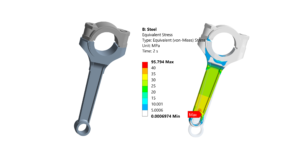
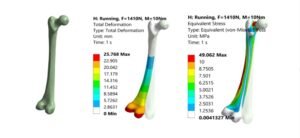
Run the structural analysis to obtain stress and strain results. For fatigue analysis, you typically need to solve for the linear elastic stress distribution under the peak and trough loads of a cycle.
Step 4: Post-Processing and Fatigue Life Calculation
This is where the magic happens. Specialized fatigue analysis modules (often integrated into Abaqus, ANSYS Mechanical, or dedicated tools like fe-safe, nCode DesignLife) take the FEA stress results and material fatigue properties to predict life.
4.1 Stress/Strain Transformation
- FEA often provides stress components (e.g., von Mises, principal stresses). Fatigue theories need to convert these into an equivalent uniaxial stress or strain amplitude.
4.2 Fatigue Theories and Criteria
Choosing the right fatigue theory is crucial and depends on the material, loading type, and desired accuracy.
| Theory Type | Description | Common Use Cases | Software Implementation |
|---|---|---|---|
| Stress-Life (S-N) | Based on nominal stress amplitude and cycles to failure. Good for high cycle fatigue (HCF) where plastic deformation is minimal. Often uses mean stress correction models (Goodman, Gerber, Soderberg). | Steel components, welded structures, long-life applications. | All major FEA fatigue modules. |
| Strain-Life (ε-N) | Based on local strain amplitude (elastic + plastic) and cycles to failure. Essential for low cycle fatigue (LCF) where plastic deformation is significant. Often uses Neuber’s rule for stress/strain correction. | Aluminum alloys, highly loaded components, thermal fatigue. | All major FEA fatigue modules. |
| Critical Plane Methods | Considers the plane on which fatigue damage is maximized, especially for multiaxial loading. Accounts for normal and shear stresses/strains on different planes. | Complex multiaxial loading, non-proportional loading. | Advanced fatigue modules (e.g., fe-safe, nCode DesignLife). |
| Dang Van Criterion | A multiaxial high cycle fatigue criterion based on microscopic considerations, checking against shear stress and hydrostatic stress on the critical plane. | High cycle fatigue under multiaxial loading, typically for steels. | Some advanced fatigue modules. |
4.3 Mean Stress Correction
If the stress cycle is not fully reversed (R = -1), mean stress correction models (e.g., Goodman, Gerber, Soderberg, ASME Elliptic) are applied to adjust the S-N curve based on the mean stress component. The choice of model depends on material ductility and conservativeness required.
4.4 Damage Accumulation
For variable amplitude loading, damage accumulation rules (e.g., Palmgren-Miner’s linear damage rule) are used to sum up the damage from different stress levels. Each stress block contributes a fraction of its fatigue life, and failure occurs when the sum of these fractions reaches unity.
4.5 Outputs: Life, Damage, Factor of Safety
- Fatigue Life (Cycles to Failure): The primary output, often displayed as a contour plot across the component.
- Damage Fraction: For a given design life, the ratio of actual cycles to predicted cycles to failure. Values > 1 indicate failure before design life.
- Factor of Safety (FoS): Often presented as a life factor of safety (predicted life / design life) or a stress factor of safety (stress to cause failure / applied stress).
Verification & Sanity Checks in FEA Fatigue Analysis
Never blindly trust FEA results. Rigorous verification is essential.
- Stress Hotspots: Do the predicted high-stress regions align with intuition or known failure points from similar designs?
- Material Properties: Double-check all fatigue data inputs. Are they from reliable sources (e.g., material suppliers, handbooks like MMPDS, ASM)? Are they adjusted for temperature, surface finish, or environment if necessary?
- Mesh Convergence: As mentioned, this is critical. Ensure your stresses (especially peak stresses) have converged.
- Boundary Conditions: Are the restraints and loads truly representative? Over-constraining or under-constraining can dramatically alter results.
- Fatigue Theory Choice: Is the chosen fatigue theory appropriate for the material and loading regime (HCF vs. LCF, uniaxial vs. multiaxial)?
- Results Comparison: If possible, compare with experimental data, field failures, or analytical solutions for simplified cases.
- Sensitivity Analysis: How sensitive are your results to small variations in input parameters (e.g., material properties, load magnitudes, geometric tolerances)? This helps identify critical parameters.
Common Mistakes and Troubleshooting
- Incorrect Material Data: Using static properties for fatigue analysis or incorrect S-N curve for the specific material/condition. Always seek appropriate fatigue data.
- Poor Mesh Quality: Leads to erroneous stress concentrations and inaccurate life predictions. Invest time in meshing critical areas.
- Ignoring Stress Concentrations: Simplified models might miss local stress risers that initiate fatigue cracks.
- Misapplication of Fatigue Theories: Using an S-N approach for highly plastic deformation (LCF) or ignoring mean stress effects when present.
- Static vs. Fatigue Strength: Designing only for static yield or ultimate strength often ignores fatigue failure modes entirely.
- Surface Finish & Residual Stresses: These have a significant impact on fatigue life but are often overlooked in standard FEA. Consider their effects through correction factors or more advanced models.
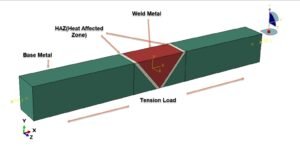
- Ignoring Welding Effects: Welds introduce complex residual stresses, geometric discontinuities, and heat-affected zones, all of which are major fatigue concerns. Specialized weld fatigue analyses are often required.
Optimizing Designs for Fatigue Resistance
FEA isn’t just for prediction; it’s a powerful optimization tool.
- Reduce Stress Concentrations: Optimize fillet radii, blend features smoothly, and avoid sharp corners.
- Material Selection: Choose materials with higher fatigue limits or better ε-N properties.
- Surface Treatment: Consider shot peening, case hardening, or surface coatings to introduce beneficial compressive residual stresses.
- Load Path Optimization: Reroute loads to reduce stresses in critical areas.
- Pre-Stressing: Introduce compressive pre-stress in critical regions.
- Topology Optimization: Use advanced optimization techniques to generate fatigue-resistant designs.
Leveraging EngineeringDownloads.com Resources
To deepen your understanding and streamline your workflow, consider exploring the resources available on EngineeringDownloads.com. We offer a range of downloadable templates for FEA pre-processing, Python scripts for post-processing fatigue data, and even online consultancy services to help you navigate complex fatigue analysis challenges. Our tutorials on Advanced Meshing Techniques for FEA can significantly improve your model quality, and our guidance on Material Models for Engineering Simulation can help you select the most appropriate properties for your fatigue analysis.
Conclusion
Fatigue life prediction using FEA is an indispensable capability for modern engineering design. By understanding the underlying principles, meticulously following a structured workflow, and diligently performing verification and sanity checks, engineers can develop robust, durable, and reliable components. Embrace FEA as your partner in designing against fatigue, and you’ll significantly enhance the longevity and safety of your products.
Further Reading
For a deeper dive into the fundamental concepts of material fatigue, refer to authoritative sources such as the article on fatigue from Britannica: Fatigue (material failure)