Pipeline integrity is the cornerstone of safe, reliable, and efficient operations in the oil and gas industry, as well as in water, chemical, and other critical infrastructure sectors. For engineers, it’s not just about keeping the fluids flowing; it’s about safeguarding assets, protecting the environment, and ensuring public safety. This comprehensive guide dives deep into the principles, practices, and advanced tools used to maintain pipeline integrity, offering actionable insights for every engineering professional.

Image: A Pipeline Inspection Gauge (PIG) being prepared for insertion, a critical tool in integrity management.
What is Pipeline Integrity? Why it Matters
Pipeline integrity refers to a pipeline’s ability to operate safely and reliably, resisting all anticipated stresses and preventing failures such as leaks or ruptures. It’s a multidisciplinary field encompassing design, construction, operation, maintenance, and comprehensive risk management. Neglecting pipeline integrity can lead to catastrophic consequences, including environmental disasters, significant financial losses, legal liabilities, and, most importantly, loss of human life.
The Core Principles of PIM (Pipeline Integrity Management)
- Prevention: Designing and constructing pipelines to high standards, using appropriate materials, and employing robust anti-corrosion measures.
- Detection: Regularly inspecting pipelines to identify defects, damage, or degradation early.
- Assessment: Analyzing detected anomalies to determine their severity and potential impact on pipeline safety and operational fitness.
- Mitigation: Repairing or replacing damaged sections, applying protective coatings, or reducing operational pressures.
- Response: Having robust emergency plans in place to manage any incidents swiftly and effectively.
Understanding the Risks: Threats to Pipeline Integrity
Pipelines face a multitude of threats throughout their lifecycle. Understanding these helps engineers develop targeted integrity management strategies.
Common Threat Categories
Identifying potential failure mechanisms is the first step in effective PIM.
- Corrosion:
- External Corrosion: Caused by environmental factors (soil chemistry, moisture, microbial activity) affecting the outer pipe surface. Often exacerbated by coating holidays or inadequate cathodic protection.
- Internal Corrosion: Occurs due to corrosive agents within the transported fluid (e.g., H2S, CO2, water, bacteria). Common in oil, gas, and water pipelines.
- Mechanical Damage:
- Third-Party Damage: Often caused by excavation activities (digging, trenching) near the pipeline, resulting in dents, gouges, or penetrations.
- Manufacturing Defects: Imperfections introduced during pipe fabrication, such as laminations, inclusions, or poor welds.
- Construction Defects: Damage occurring during installation, bending, or welding on site.
- Cracking:
- Stress Corrosion Cracking (SCC): Environmental cracking under tensile stress, often occurring on the external surface in specific soil conditions or internally in corrosive fluid environments.
- Fatigue Cracking: Initiated by cyclic stresses (e.g., pressure fluctuations, vibration), growing over time.
- Hydrogen Induced Cracking (HIC) / Sulfide Stress Cracking (SSC): Specific types of cracking in susceptible materials exposed to hydrogen or hydrogen sulfide environments.
- Material Defects: Imperfections inherent in the pipe material, such as poor toughness, lamellar tearing, or inadequate yield strength.
- Operational Overload/Exceeding Design Limits: Operating pipelines beyond their design pressure, temperature, or flow rates, leading to excessive stress or accelerated degradation.
Key Integrity Assessment Methods & Tools
Regular assessment is crucial for maintaining pipeline integrity. Various methods provide different insights into the pipeline’s condition.
Inspection & Monitoring Techniques
Choosing the right inspection method depends on the pipeline’s characteristics, potential threats, and regulatory requirements.
| Method | Description | Primary Use Cases | Relevant Tools/Tech |
|---|---|---|---|
| In-Line Inspection (ILI / Pigging) | Devices (PIGs) traverse the pipeline, collecting data on pipe wall thickness, corrosion, cracks, and geometry. | Comprehensive internal inspection for long distances, detecting internal/external corrosion, cracks, and dents. | Magnetic Flux Leakage (MFL), Ultrasonic Testing (UT), Eddy Current, Deformation (Caliper) PIGs. |
| Hydrostatic Testing | Pipeline is filled with water and pressurized beyond its maximum operating pressure to detect leaks or weak points. | Proof testing new pipelines, re-validating existing pipelines after repairs or significant changes. | Pressure transducers, flow meters, data loggers. |
| Direct Assessment (DA) | A structured process (e.g., ECDA for external corrosion, ICDA for internal) involving pre-assessment, indirect inspection, direct examination, and post-assessment. | Targeted assessment for unpiggable pipelines or specific threats. | CIS (Close Interval Survey), DCVG (Direct Current Voltage Gradient), ECDA/ICDA software. |
| External Corrosion Monitoring | Regular surveys to assess cathodic protection system effectiveness and identify areas of active external corrosion. | Preventing external corrosion, monitoring CP system performance. | CP rectifiers, test posts, multimeters, reference electrodes. |
| Stress Analysis & Fitness-for-Service (FFS) | Engineering assessments to determine if a component with a detected flaw can safely continue to operate. | Assessing remaining life, making run-or-repair decisions for identified defects. | FEA (Abaqus, ANSYS Mechanical), FFS software (e.g., based on API 579-1/ASME FFS-1 Level 3). |
Practical Workflow: Conducting an Integrity Assessment with CAE
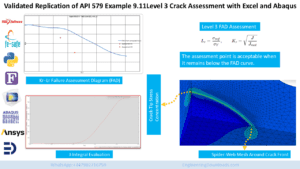
For complex defects or critical components, advanced simulation using Computational Aided Engineering (CAE) tools becomes indispensable. This is often part of a Level 3 Fitness-for-Service (FFS) assessment, as per API 579-1/ASME FFS-1.
Step-by-Step Simulation Guidance
- Problem Definition & Data Collection:
- Identify the Flaw: Precisely locate and characterize the defect (e.g., corrosion pit geometry, crack dimensions, dent depth) from NDT reports (ILI, UT scans).
- Operational Data: Gather design and operating pressures, temperatures, fluid properties, and historical data (pressure cycles, through-put).
- Material Properties: Obtain accurate material data (yield strength, ultimate tensile strength, Young’s modulus, Poisson’s ratio, fracture toughness, stress-strain curves).
- Environmental Factors: Note external soil conditions, internal fluid corrosivity.
- Material Model Selection:
- For most pipeline steels, an elastic-plastic material model is required to accurately capture behavior under extreme loads and around defects.
- Consider isotropic hardening for monotonic loading or kinematic hardening for cyclic loading (fatigue assessment).
- FEA Model Setup (Structural Integrity):
- Geometry: Create an accurate 3D model of the pipe section, precisely incorporating the defect geometry. CAD tools like CATIA or SolidWorks can be used, then imported into FEA pre-processors.
- Mesh Generation: Crucial for accuracy. Use a fine mesh in the vicinity of the defect (stress concentration areas) and a coarser mesh away from it. Hexahedral elements are preferred for accuracy where possible, but tetrahedral elements are common for complex geometries. Tools: Abaqus/CAE, ANSYS Mechanical, MSC Patran.
- Boundary Conditions (BCs): Apply appropriate constraints to represent the pipeline’s support and connection to adjacent sections. For example, fixed or symmetry conditions.
- Loads: Apply internal pressure, external soil pressure (if buried), thermal loads (due to temperature differences), and bending moments (if relevant). Consider both static and transient loading scenarios.
- CFD for Flow-Induced Corrosion/Erosion (if applicable):
- For internal corrosion/erosion, CFD analysis can model fluid flow characteristics (velocity profiles, turbulence) that influence material degradation rates.
- This can help predict localized thinning or identify high-risk areas. Tools: ANSYS Fluent/CFX, OpenFOAM.
- The results can then inform structural FEA, perhaps by defining material loss rates over time.
- Post-Processing & Interpretation:
- Stress & Strain Fields: Analyze maximum principal stress, Von Mises stress, and plastic strain. Compare with material yield and ultimate strengths.
- Fracture Mechanics: For cracks, calculate stress intensity factors (K), J-integral, or crack tip opening displacement (CTOD) to assess crack stability and predict propagation using tools like Abaqus’s XFEM or ANSYS’s fracture tools.
- Failure Modes: Determine if the defect leads to burst, collapse, or fracture.
Verification & Sanity Checks in Simulation
Simulation results are only as good as their input and methodology. Rigorous checks are essential.
- Mesh Sensitivity Study: Rerun the simulation with different mesh densities (finer and coarser) to ensure the results (e.g., maximum stress) converge to a stable value. If not, the mesh is inadequate.
- Boundary Condition & Load Sensitivity: Varying BCs or load magnitudes within reasonable limits to understand their impact. Small changes shouldn’t lead to wildly different results unless physically expected.
- Convergence Criteria: Ensure the solver has converged properly. Check residual norms and energy balances. Non-convergence often indicates issues with the model setup, material properties, or loads.
- Hand Calculations & Analytical Solutions: Where possible, compare simplified cases or sections of the model against known analytical solutions (e.g., Lame’s equations for thick cylinders, simple beam bending formulas). This provides a crucial sanity check.
- Material Property Variations: Consider the uncertainty in material properties by running analyses with upper and lower bounds to assess sensitivity.
- Validation against Experimental Data: If available, compare simulation results with physical tests or field observations.
Common Challenges & Troubleshooting
Pipeline integrity management presents several practical hurdles.
- Data Gaps & Inconsistencies: Missing or unreliable historical data (e.g., previous NDT reports, construction records) can severely hamper accurate assessments. Implement robust data management systems early.
- Complex Geometries/Defects: Accurately modeling intricate defects (e.g., interacting pits, complex crack networks) can be computationally intensive and require specialized expertise.
- Material Degradation Modeling: Predicting long-term degradation mechanisms like creep or fatigue crack growth under varying operational conditions is complex and often requires advanced material models and extensive testing.
- Regulatory Compliance: Navigating the ever-evolving landscape of local and international regulations (e.g., PHMSA in the US, EN standards in Europe) requires continuous monitoring and adaptation.
- Cost & Logistical Constraints: High costs associated with ILI, repairs, and advanced assessments can be a barrier, especially for older or smaller pipelines. Optimize inspection schedules based on risk.
Leveraging Data & Automation in PIM
The digital revolution offers powerful tools to enhance pipeline integrity management.
Smart PIM with Python & MATLAB
- Data Analysis & Visualization: Python libraries (Pandas, NumPy, Matplotlib, Seaborn) and MATLAB provide robust platforms for processing large datasets from ILI tools, SCADA systems, and sensor networks. This enables trend analysis, anomaly detection, and predictive modeling.
- Predictive Modeling: Develop machine learning models to forecast corrosion rates, predict potential failure locations, or optimize inspection schedules based on historical data and operational parameters.
- Automation of Simulation Workflows: Python scripts can automate tasks in FEA software (e.g., Abaqus, ANSYS) for parameterizing geometry, meshing, applying loads, and extracting results. This speeds up sensitivity studies and FFS assessments.
- Integration with GIS: Combining pipeline data with Geographical Information Systems (GIS) provides a visual and spatial understanding of integrity threats, environmental factors, and population density.
Looking for a head start on automating your engineering workflows or developing custom analysis scripts? EngineeringDownloads.com offers a range of downloadable templates, Python/MATLAB scripts, and expert consultancy to optimize your integrity assessment processes.
Regulatory Framework & Standards
Adherence to established codes and standards is paramount for legal compliance and best practices.
- API (American Petroleum Institute): Standards like API 1160 (Managing System Integrity for Hazardous Liquid Pipelines) and API 579-1/ASME FFS-1 (Fitness-For-Service).
- ASME (American Society of Mechanical Engineers): Standards for pressure vessels and piping, including B31.4 (Liquid Transportation Systems) and B31.8 (Gas Transmission and Distribution Systems).
- NACE International (National Association of Corrosion Engineers): Standards related to corrosion prevention and control (e.g., cathodic protection, coatings).
- ISO (International Organization for Standardization): ISO 20857 (Petroleum, petrochemical and natural gas industries – Pipeline integrity management system).
- Governmental Regulations: Agencies like PHMSA (Pipeline and Hazardous Materials Safety Administration) in the U.S. enforce stringent regulations for pipeline safety.
Further Reading
For more in-depth information on pipeline safety regulations and resources, visit the official PHMSA website: Pipeline and Hazardous Materials Safety Administration