Multiphase flow modeling is a critical tool in many engineering disciplines, from optimizing oil and gas pipelines to designing advanced aerospace components and biomedical devices. When two or more phases (gas, liquid, solid) coexist and interact within a system, their behavior can be complex and challenging to predict. This article dives into the practical aspects of multiphase flow modeling, offering engineers a clear, actionable guide to understanding, setting up, and troubleshooting these intricate simulations.
It’s an essential skill for anyone involved in process design, performance optimization, or safety analysis where fluid dynamics are at play. Let’s demystify the science behind it and explore how you can leverage computational fluid dynamics (CFD) for your multiphase challenges.

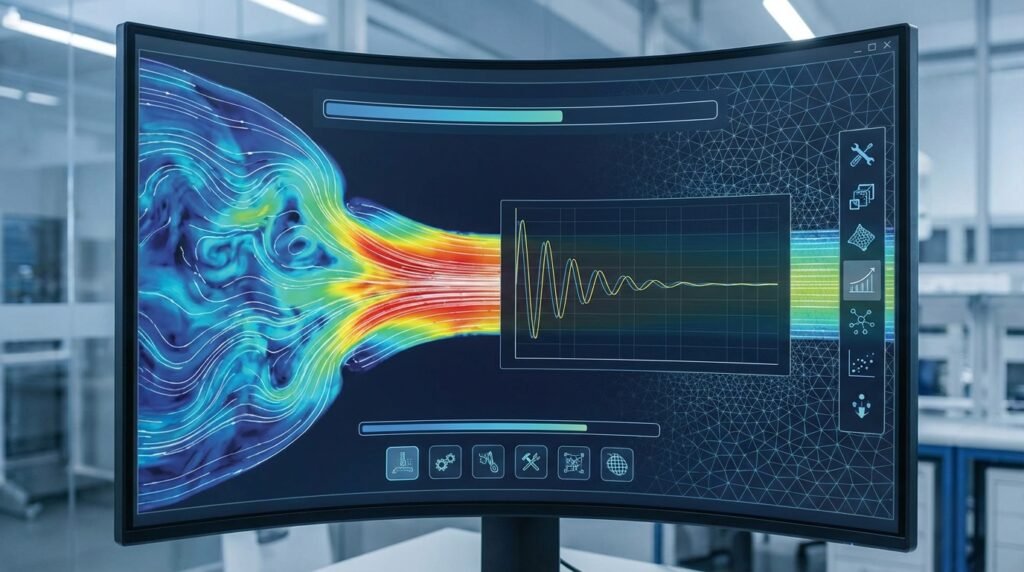
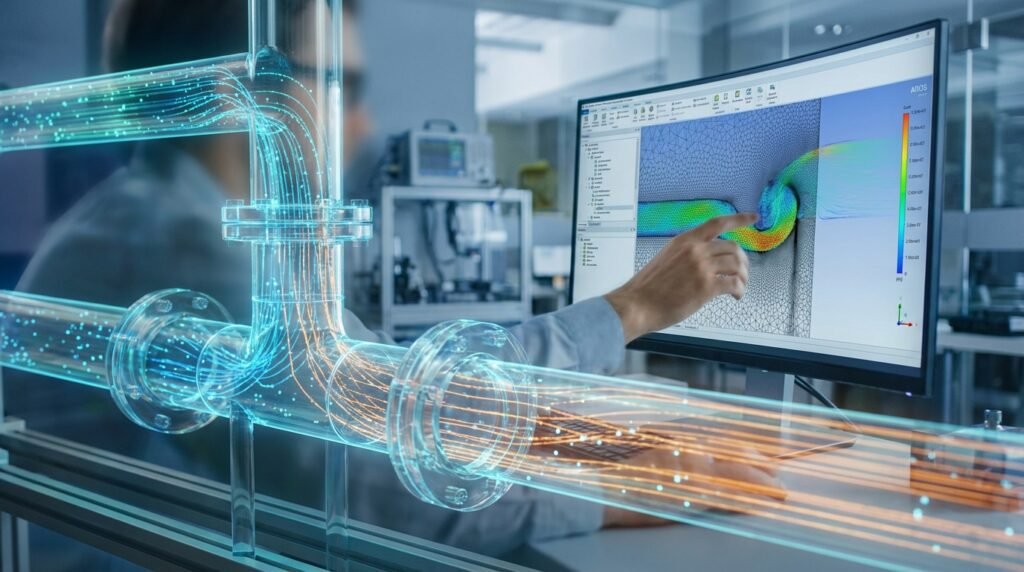
Simulation of two-phase fluid flow, illustrating complex interface dynamics.
What is Multiphase Flow?
Multiphase flow refers to the simultaneous flow of two or more distinct phases. These phases can be any combination of gas, liquid, or solid. The interaction between these phases, including their interfaces, momentum, and energy exchange, significantly impacts the overall system behavior. Understanding these interactions is key to effective design and operation.
Types of Multiphase Flows
- Gas-Liquid: Bubbles in a liquid, liquid droplets in a gas (sprays), or stratified flow (gas layer over liquid). Examples: boiling, condensation, bubbly flows in reactors.
- Liquid-Liquid: Immiscible liquids flowing together, like oil and water mixtures. Examples: emulsification, separation processes.
- Gas-Solid: Solid particles transported by gas. Examples: fluidized beds, pneumatic conveying.
- Liquid-Solid: Solid particles suspended or transported in a liquid. Examples: slurry transport, sediment transport.
- Three-Phase: More complex scenarios involving gas, liquid, and solid simultaneously, common in oil & gas production.
Why is Multiphase Flow Modeling Crucial?
Accurately predicting multiphase behavior can significantly impact efficiency, safety, and cost across numerous industries. Modeling allows engineers to virtually test designs, optimize parameters, and troubleshoot issues without costly physical prototypes or downtime.
Key Applications Across Industries
- Oil & Gas: Pipeline flow assurance (slugging, hydrate formation), separation processes, wellbore dynamics, sand transport.
- Aerospace: Fuel sloshing in tanks, liquid propellant rockets, aircraft icing, spray combustion in jet engines.
- Chemical & Process Engineering: Reactor design, mixers, distillation columns, fluidized catalytic cracking.
- Power Generation: Boiling water reactors, steam turbines, condensation in heat exchangers.
- Biomechanics: Blood flow with cells (treating blood as a two-phase fluid), drug delivery via aerosols or microfluidics.
Benefits of Multiphase Flow Modeling
- Design Optimization: Improve geometries for better mixing, separation, or heat transfer.
- Performance Prediction: Accurately forecast pressure drop, phase distribution, and erosion rates.
- Safety & Risk Assessment: Analyze scenarios like blowdowns, pipeline ruptures, or accidental spills.
- Cost Reduction: Minimize prototyping and experimental testing, reduce operational inefficiencies.
- Troubleshooting: Diagnose root causes of operational problems like fouling, erosion, or poor separation.
Common Types of Multiphase Flow Models
The choice of multiphase model is critical and depends heavily on the specific application, flow regime, and computational resources. Here’s a breakdown of the most common approaches:
Eulerian-Eulerian (Two-Fluid Model)
In this approach, each phase is treated as a continuous medium, interpenetrating and interacting within the computational domain. Separate momentum and continuity equations are solved for each phase, coupled by interphase exchange terms (drag, lift, virtual mass, turbulence dispersion).
Key Principles & Use Cases
- Ideal for dispersed flows (e.g., bubbly, droplet, fluidized beds) where the volume fraction of each phase is significant (typically > 10%).
- Provides detailed information on phase distribution and velocities.
- Requires closure models for interphase forces, which can be a source of uncertainty.
Eulerian-Lagrangian (Discrete Phase Model – DPM)
Here, a continuous phase is solved using an Eulerian framework (CFD), while the dispersed phase (particles, droplets, or bubbles) is tracked individually in a Lagrangian framework. The two phases are coupled through momentum and energy exchange terms.
Key Principles & Use Cases
- Best suited for dilute flows where the dispersed phase volume fraction is low (typically < 10-15%) and particle-particle interactions are negligible.
- Applications include spray drying, particle deposition, coal combustion, and cyclone separators.
- Computational cost increases with the number of particles tracked.
Volume of Fluid (VOF) Model
The VOF method is designed to track and locate the interface between two or more immiscible fluids. A single set of momentum equations is shared by the fluids, and the volume fraction of each fluid is tracked throughout the domain.
Key Principles & Use Cases
- Excellent for flows with a clearly defined interface, such as stratified flows, free surface flows (sloshing, waves), bubble column dynamics, and liquid film flows.
- Captures large interface deformations well but requires a very fine mesh near the interface for accuracy.
Mixture Model
A simplified multiphase model that treats the phases as a single mixture, solving a single momentum equation for the mixture. Relative velocities (slip velocities) between phases can be accounted for by algebraic expressions.
Key Principles & Use Cases
- Less computationally expensive than Eulerian-Eulerian.
- Suitable for flows where phases are well-mixed, strongly coupled, or dispersed with low slip velocities. Examples: hydrocyclones, separation processes where the primary interest is overall flow rather than detailed interphase dynamics.
Level Set Method
Similar to VOF, the Level Set method tracks the interface between immiscible fluids using a signed distance function. The interface is implicitly represented by the zero contour of this function.
Key Principles & Use Cases
- Offers good accuracy for interface tracking and robust handling of topological changes (merging/splitting).
- Can be more computationally intensive than VOF due to re-initialization of the distance function.
Here’s a comparison table to help guide your model selection:
| Model Type | Description | Key Application Areas | Pros | Cons |
|---|---|---|---|---|
| Eulerian-Eulerian | Each phase as an interpenetrating continuum. | Dispersed flows, high volume fractions, fluidized beds. | Detailed phase distribution, interphase exchange. | High computational cost, sensitive to closure models. |
| Eulerian-Lagrangian (DPM) | Continuous phase Eulerian, dispersed phase Lagrangian. | Dilute flows, sprays, particle deposition, combustion. | Tracks individual particle trajectories, efficient for low loading. | Not suitable for high volume fractions, complex particle-particle interaction difficult. |
| Volume of Fluid (VOF) | Tracks sharp interface between immiscible fluids. | Free surface flows, stratified flows, sloshing, bubble rise. | Accurate interface capture, good for large deformations. | Requires very fine mesh near interface, computationally intensive. |
| Mixture Model | Phases treated as a single mixture, optional slip. | Well-mixed flows, low slip velocity, hydrocyclones. | Less computationally intensive. | Less accurate for strong phase separation or high slip. |
Practical Workflow for Multiphase Flow Simulation
A structured approach is essential for successful multiphase flow modeling. This workflow outlines typical steps, setup logic, and common pitfalls.
Problem Definition & Objectives
Before touching any software, clearly define:
- What phases are involved (e.g., air and water, oil and gas, sand and water)?
- What are the operating conditions (temperatures, pressures, flow rates)?
- What specific phenomena need to be captured (e.g., interface tracking, mixing efficiency, pressure drop, heat transfer)?
- What are the desired outputs (e.g., phase distribution, velocity profiles, forces)?
- What assumptions are you making (e.g., isothermal, incompressible, steady-state)?
Pre-processing: Geometry & Meshing
- Geometry Creation: Use CAD software like CATIA or SolidWorks to create or import your geometry. Simplify intricate details that won’t significantly impact the flow physics.
- Meshing:
- Choose Mesh Type: Structured (hexahedral) meshes generally offer better accuracy and convergence but are harder for complex geometries. Unstructured (tetrahedral, polyhedral) meshes are more flexible.
- Refinement: Focus refinement in regions of high gradients, interfaces, or critical interest (e.g., near walls, inlets/outlets, phase boundaries).
- Boundary Layers: Use inflation layers (prism/wedge cells) near walls to accurately capture velocity and temperature gradients (e.g., using ANSYS Meshing or MSC Patran).
- Quality Checks: Ensure high mesh quality (low skewness, aspect ratio, orthogonal quality) to avoid numerical instabilities.
Physics Setup: Model Selection & Boundary Conditions
This is where your understanding of multiphase models becomes critical. Using software like ANSYS Fluent or OpenFOAM, you’ll configure your simulation:
- Model Selection: Based on your problem definition, choose the appropriate multiphase model (VOF, Eulerian-Eulerian, DPM, Mixture).
- Material Properties: Input accurate densities, viscosities, surface tension coefficients, and other relevant properties for each phase.
- Boundary Conditions (BCs):
- Inlets: Specify mass flow rate, velocity, or pressure, along with phase volume fractions.
- Outlets: Typically pressure outlet, sometimes outflow.
- Walls: No-slip condition is common. Specify wall roughness if relevant.
- Internal Zones: Define any internal heat sources, porous media, or rotating zones.
- Turbulence Model: Select an appropriate turbulence model (e.g., k-epsilon, k-omega, SST). Turbulence in multiphase flows adds another layer of complexity; specific multiphase turbulence models might be needed.
- Interphase Mass/Heat Transfer: If boiling, condensation, or chemical reactions are involved, enable and configure relevant models.
Solver Settings & Convergence
Careful solver setup is crucial for obtaining stable and accurate solutions:
- Discretization Schemes: Use appropriate spatial discretization schemes (e.g., higher-order schemes for advection where accuracy is paramount, but be mindful of stability).
- Time Stepping: For transient simulations, select a small enough time step to ensure stability and accuracy (CFL number considerations). Steady-state simulations use pseudo-transient approaches.
- Relaxation Factors: Adjust under-relaxation factors to aid convergence, especially for highly coupled equations.
- Convergence Criteria: Define strict convergence criteria for residuals (e.g., 1e-4 or 1e-5 for continuity, momentum). Monitor integral quantities (e.g., total mass flow rate at inlet/outlet) for stabilization.
- Initialization: Provide a reasonable initial guess for the flow field to speed up convergence.
Running complex multiphase simulations often requires significant computational power. For engineers seeking to accelerate their analysis, EngineeringDownloads offers affordable HPC rental services to run large-scale models, alongside online courses and project consultancy for advanced simulation needs.
Post-processing & Analysis
Extract meaningful insights from your simulation results:
- Visualizations: Generate contours of phase distribution, velocity, pressure, and temperature. Use vectors, streamlines, and particle tracks. Create animations for transient results.
- Quantitative Analysis: Calculate pressure drops, mass flow rates, heat transfer coefficients, mixing effectiveness, and forces on surfaces.
- Comparison: Compare simulation results with experimental data, analytical solutions, or simplified models where available.
Verification & Sanity Checks in Multiphase Flow Modeling
Never trust your simulation results blindly. Rigorous verification and validation are paramount for reliable predictions.
Mesh Independence Study
Run your simulation on at least three different mesh densities (coarse, medium, fine). Compare key output parameters (e.g., pressure drop, average velocity, interface position). Your solution is considered mesh-independent when further mesh refinement does not significantly change these outputs.
Boundary Condition Review
Double-check that your boundary conditions are physically realistic and correctly applied. Are flow directions consistent? Are temperature and pressure values reasonable for the operating environment? Incorrect BCs are a frequent source of error.
Convergence Criteria Monitoring
Beyond numerical residuals, monitor physical quantities for convergence. For instance, in a steady-state flow, the mass flow rate entering the domain should equal the mass flow rate leaving. For transient simulations, ensure quantities oscillate around a mean or reach a periodic steady state.
Validation with Experimental Data
Wherever possible, validate your model against experimental data. This is the ultimate test of your model’s predictive capability. If direct experimental data isn’t available for your exact setup, look for similar benchmark cases in literature.
Sensitivity Analysis
Investigate how sensitive your results are to changes in input parameters, especially those with inherent uncertainties (e.g., turbulence model constants, surface tension, drag coefficients). This helps quantify the robustness of your predictions and identify critical parameters.
Common Challenges and Troubleshooting Tips
Multiphase flow simulations are notoriously complex. Be prepared for hurdles.
Numerical Stability Issues
- Problem: Divergence, oscillating residuals, unphysical results.
- Tips:
- Start with simpler models or steady-state initialization before full transient runs.
- Reduce time step size (for transient) or use smaller relaxation factors.
- Ensure high mesh quality, especially near interfaces and complex regions.
- Use robust discretization schemes (e.g., first-order for initial convergence, then switch to higher-order).
Complex Interfacial Phenomena
- Problem: Poor interface resolution, spurious currents, unphysical interface breaking/merging.
- Tips:
- Refine mesh specifically at the interface region.
- Ensure accurate surface tension and contact angle definitions.
- Consider advanced interface capturing schemes or adaptive mesh refinement.
- Check solver settings for interface reconstruction and compression.
Computational Cost
- Problem: Simulations take too long to run, requiring immense CPU/GPU resources.
- Tips:
- Optimize mesh: refine only where needed, use polyhedral cells.
- Choose the simplest adequate multiphase model (e.g., Mixture instead of Eulerian-Eulerian if appropriate).
- Utilize parallel computing. Leverage HPC resources.
- Consider coarser initial meshes and then interpolate results to finer meshes for restart.
Tools of the Trade for Multiphase Flow Modeling
A range of software tools supports multiphase flow analysis, each with strengths and weaknesses.
Commercial Software
- ANSYS Fluent/CFX: Industry leaders with comprehensive multiphase models (VOF, Mixture, Eulerian, DPM), robust meshing tools, and advanced post-processing. Highly integrated for CAD-CAE workflows.
- COMSOL Multiphysics: Excels in tightly coupled multiphysics problems, including fluid-structure interaction (FSI) and heat transfer in multiphase systems.
- STAR-CCM+: Another powerful CFD software known for its polyhedral meshing and integrated workflow.
Open-Source Alternatives
- OpenFOAM: A free, open-source C++ toolbox for CFD. Highly customizable, allowing users to develop specific multiphase solvers. While it has a steep learning curve, its flexibility is unmatched for academic research and specialized industrial applications.
Scripting & Automation
- Python: Invaluable for pre-processing (geometry manipulation, mesh generation scripts), post-processing (data extraction, custom plots using Matplotlib/Seaborn), and automating simulation workflows. Libraries like NumPy and SciPy are essential for data analysis.
- MATLAB: Similar to Python, MATLAB is used for data analysis, algorithm development, and scripting simulation tasks, particularly useful for integrating custom models or control algorithms.
Multiphase Flow Modeling in Specific Industries
The application specifics vary widely, demanding tailored modeling approaches.
Oil & Gas
Modeling flow in pipelines, risers, and separators is critical for flow assurance. This often involves gas-liquid (e.g., slug flow) and three-phase (oil, water, gas) simulations, focusing on pressure drop, phase holdup, and erosion/corrosion predictions. Tools like ANSYS Fluent are widely used.
Aerospace
Applications range from fuel sloshing within aircraft tanks to cryogenic fluid behavior in rocket engines. Precise interface tracking (VOF) and understanding thermal stratification are key. Icing simulations on airfoils also fall under multiphase, involving air-water droplet interaction and phase change.
Chemical & Process
From fluidized beds in catalysis to agitated vessels for mixing, multiphase models help optimize reactor performance, mass transfer rates, and overall process efficiency. Eulerian-Eulerian models are often preferred for dense dispersed systems.
Biomechanics
The study of blood flow with suspended cells (often treated as a two-phase fluid), drug delivery via aerosols, or microfluidic devices involving immiscible liquids benefits greatly from multiphase modeling. Understanding rheology and interface dynamics is paramount.
Future Trends in Multiphase Flow Modeling
The field is continuously evolving. Expect to see:
- Increased integration of Machine Learning and Artificial Intelligence for model calibration, surrogate modeling, and accelerating simulations.
- Greater utilization of GPU computing for faster resolution of complex transient problems.
- Development of more sophisticated and robust interface tracking algorithms.
- Enhanced coupling with other physics (e.g., electrokinetics, complex chemical reactions) for truly multiphysics, multiphase simulations.
Further Reading
For more in-depth information on specific multiphase flow modeling techniques, consider exploring the official documentation and resources provided by major engineering software vendors:
Introduction to Multiphase Flow Modeling in CFD by ANSYS
Frequently Asked Questions (FAQ)
What is the primary difference between Eulerian-Eulerian and Eulerian-Lagrangian models?
The Eulerian-Eulerian model treats all phases as interpenetrating continua, solving averaged equations for each phase. The Eulerian-Lagrangian model treats the continuous phase as a continuum (Eulerian) and tracks individual dispersed phase elements (particles/droplets) using Lagrangian equations. Eulerian-Lagrangian is generally for dilute flows, while Eulerian-Eulerian is for denser dispersed flows.
When should I use the VOF model in CFD simulations?
You should use the Volume of Fluid (VOF) model when you need to accurately track a sharp interface between two or more immiscible fluids. This includes applications like free surface flows (waves, sloshing), stratified flows, liquid-gas interfaces, and bubble/droplet formation where the interface shape is critical.
What are common challenges in multiphase flow modeling?
Common challenges include achieving numerical stability, accurately capturing complex interfacial phenomena (e.g., surface tension, phase change), managing high computational costs, selecting appropriate interphase exchange models, and obtaining reliable experimental data for validation.
How important is mesh quality for multiphase flow simulations?
Mesh quality is extremely important for multiphase flow simulations, even more so than for single-phase flows. Poor mesh quality can lead to numerical instability, inaccurate interface tracking, and non-physical results. Fine, high-quality meshes are crucial, especially in regions with interfaces, high gradients, or strong phase interactions.
Can Python and MATLAB be used in multiphase flow modeling workflows?
Yes, Python and MATLAB are highly valuable for multiphase flow modeling workflows. They are extensively used for pre-processing tasks (e.g., automating geometry setup, mesh generation scripts), post-processing (e.g., extracting data, creating custom visualizations, performing statistical analysis), and for developing custom solvers or control algorithms that interact with commercial CFD packages.
Internal Linking Suggestions
- Computational Fluid Dynamics (CFD) Best Practices
- Advanced Meshing Techniques for Simulation
- Python and MATLAB for Engineering Automation
- Finite Element Analysis (FEA) for Engineers
- Mastering CAD-CAE Workflows
Conclusion
Multiphase flow modeling is a powerful, yet complex, domain of engineering simulation. By carefully selecting the right models, meticulously setting up your simulations, and rigorously performing verification and validation, you can unlock invaluable insights into your designs and processes. The ability to accurately predict multiphase behavior empowers engineers to innovate, optimize, and ensure safety across diverse industries. Embrace these advanced CFD techniques, and you’ll be well-equipped to tackle some of the most challenging problems in modern engineering.