Impact Engineering: Principles, Applications, and Future Trends
In a world where safety, durability, and performance under extreme conditions are paramount, Impact Engineering emerges as a critical discipline. This specialized field of engineering focuses on understanding, predicting, and mitigating the effects of high-speed collisions, sudden loads, and ballistic events on materials, components, and structures. From designing crashworthy vehicles to developing blast-resistant buildings and protective gear, Impact Engineering is at the forefront of safeguarding lives and ensuring the resilience of modern technology.
What is Impact Engineering?
Impact Engineering is a multidisciplinary field dedicated to analyzing the behavior of materials and structures when subjected to dynamic loads, typically involving high strain rates and significant energy transfer over very short durations. Unlike static or quasi-static analyses, impact events introduce complexities such as stress wave propagation, strain-rate-dependent material responses, and dynamic fracture phenomena. It integrates principles from mechanics of materials, solid mechanics, dynamics, numerical analysis, and materials science to address real-world challenges.
The core objective of Impact Engineering is two-fold: first, to enhance the energy absorption capabilities of structures to protect occupants or contents, and second, to design systems that can withstand impact events without catastrophic failure. This involves not only preventing structural collapse but also controlling deformation, dissipating kinetic energy, and maintaining the integrity of critical components. The evolution of Impact Engineering has been driven by the need for improved safety in transportation, defense, and industrial applications, pushing the boundaries of material science and computational modeling.
Fundamental Principles of Impact Engineering
Understanding the fundamental principles is crucial for effective design and analysis in Impact Engineering. These principles govern how materials react and how energy is managed during dynamic events.
Energy Transfer and Dissipation
When an object impacts another, kinetic energy is transferred. A primary goal in Impact Engineering is to manage this energy effectively. This can involve:
- Elastic Deformation: Energy is stored temporarily and then recovered as the material returns to its original shape. While useful for damping, excessive elastic deformation can lead to rebound.
- Plastic Deformation: Energy is absorbed irreversibly through permanent changes in the material’s shape. This is a highly effective mechanism for impact mitigation, as seen in crumple zones in vehicles. The material literally deforms, converting kinetic energy into heat and work of deformation.
- Fracture: Energy is dissipated through the creation of new surfaces, i.e., cracks. While sometimes unavoidable, engineers typically strive to control fracture in a ductile manner to maximize energy absorption before complete separation.
Material Response to High Strain Rates
Materials behave differently under high-speed loading compared to slow, static loads. This phenomenon is known as strain rate sensitivity:
- Metals: Many metals, such as steel and aluminum alloys, exhibit an increase in yield strength and ultimate tensile strength with increasing strain rates. This means they become stronger and stiffer under impact. However, their ductility can be affected.
- Polymers and Composites: These materials often show complex strain rate dependencies, which can vary significantly with temperature. Some polymers become brittle, while others maintain or even enhance energy absorption capabilities. Fiber-reinforced composites exhibit anisotropic behavior, meaning their response varies with the direction of impact relative to fiber orientation.
- Ceramics: Generally brittle, ceramics can offer exceptional hardness and stiffness but tend to fracture catastrophically under impact, making them suitable for specific applications like ballistic armor in conjunction with ductile backings.
Wave Propagation and Stress Waves
Impact events generate stress waves that propagate through the material. Understanding their behavior is vital:
- Compressional Waves: Travel fastest and carry stress information through the material.
- Shear Waves: Travel slower than compressional waves and induce shear deformation.
- Reflection and Refraction: When stress waves encounter interfaces (e.g., material changes, free surfaces), they can reflect and refract, leading to complex stress states, including tension waves that can cause spallation (fracture perpendicular to the wave direction).
- Attenuation: Waves lose energy as they propagate due to material damping and geometric spreading.
Dynamic Fracture Mechanics
Fracture under dynamic loading conditions is a critical aspect. Dynamic fracture mechanics studies how cracks initiate and propagate at high speeds. Factors include:
- Crack Initiation: The stress levels and energy required to initiate a crack in a material under dynamic loading.
- Crack Propagation Velocity: Cracks can propagate at speeds approaching the speed of sound in the material, which necessitates advanced modeling and experimental techniques to study.
- Dynamic Toughness: A material’s resistance to dynamic fracture, which can differ from its static fracture toughness. Engineers aim to design structures that fail in a ductile manner, allowing for more energy absorption before complete failure.
Key Methodologies and Tools
Modern Impact Engineering relies heavily on a combination of advanced computational and experimental techniques to simulate, test, and validate designs.
Computational Modeling and Simulation
Numerical methods have revolutionized Impact Engineering, allowing engineers to predict material and structural responses without extensive physical prototyping.
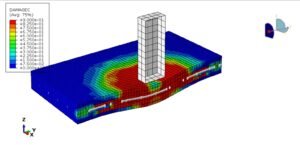
- Finite Element Analysis (FEA): Explicit dynamic FEA is the cornerstone of impact simulation. It discretizes a structure into a mesh of finite elements and solves the equations of motion explicitly over small time increments. This is ideal for highly nonlinear, short-duration events involving contact, large deformations, and material failure. Advanced material models are incorporated to capture strain rate dependency and damage evolution.
- Smoothed Particle Hydrodynamics (SPH): A mesh-free Lagrangian method particularly suited for problems involving extreme deformation, fragmentation, and fluid-structure interaction, such as hypervelocity impacts or explosive detonations, where traditional FEA meshes might distort excessively.
- Discrete Element Method (DEM): Primarily used for simulating granular materials (e.g., soils, rocks) or systems where the interaction of discrete particles is dominant. It can be coupled with FEA for problems involving both solid structures and granular media, such as vehicle interaction with terrain or projectile penetration into granular beds.
Experimental Techniques
Physical testing remains indispensable for validating computational models and characterizing material behavior under impact conditions.
- Drop Towers: Used for low to medium velocity impacts, typically to assess energy absorption and crashworthiness of components (e.g., helmet liners, vehicle subsystems). A mass is dropped from a controlled height onto a test specimen.
- Hopkinson Bar (Split Hopkinson Pressure Bar): A sophisticated apparatus for characterizing material properties at high strain rates (typically 102 to 104 s-1). It involves transmitting a stress wave through a specimen sandwiched between two long bars, measuring incident, reflected, and transmitted waves to determine dynamic stress-strain curves.
- Ballistic Testing: Involves firing projectiles at target materials or structures to assess resistance to penetration, perforation, and blast. This is crucial for armor design, aerospace components, and protective barriers.
- High-Speed Imaging: Ultra-high-speed cameras capture deformation and fracture mechanisms during impact events, providing invaluable visual data for understanding complex phenomena and validating simulations.
Material Characterization
Accurate material models are fundamental. This involves dynamic material testing, measuring properties like dynamic yield strength, ultimate tensile strength, elongation to failure, and fracture toughness at relevant strain rates and temperatures.
Diverse Applications of Impact Engineering
The reach of Impact Engineering extends across numerous industries, directly contributing to safety, performance, and resilience.
Automotive Industry
Impact Engineering is foundational to automotive safety. Engineers use it to design:
- Crashworthiness: Optimizing crumple zones, chassis structures, and occupant compartments to absorb kinetic energy and maintain survival space during collisions.
- Occupant Safety Systems: Designing airbags, seatbelts, and advanced restraint systems to mitigate injury severity.
- Pedestrian Protection: Developing front-end designs that reduce injury risk for pedestrians in the event of an impact.
- Battery Enclosures: Ensuring the integrity of electric vehicle battery packs during impacts to prevent thermal runaway.
Aerospace and Defense
The extreme conditions faced in aerospace and defense demand robust impact solutions:
- Bird Strike Resistance: Designing aircraft structures (wings, engines, fuselages) to withstand impacts from birds at high speeds.
- Foreign Object Damage (FOD): Protecting turbine blades and other critical components from damage due to ingestion of debris.
- Ballistic Protection: Developing lightweight, high-performance armor for military vehicles, aircraft, and personnel.
- Blast Resistance: Designing structures to withstand explosive forces, crucial for military installations, naval vessels, and civilian infrastructure near high-risk areas.
Sports Equipment
Enhancing athlete safety and performance:
- Helmet Design: Optimizing impact absorption in helmets for cycling, motorcycling, football, and other sports to reduce concussion risk.
- Protective Gear: Developing pads and body armor for various sports.
- Equipment Performance: Designing golf clubs, tennis rackets, and other equipment to efficiently transfer impact energy for optimal performance while minimizing structural failure.
Civil and Structural Engineering
Protecting critical infrastructure from unforeseen events:
- Vehicle Impact on Bridges/Barriers: Designing bridge piers and roadside barriers to safely absorb energy from vehicle collisions.
- Blast Mitigation: Reinforcing buildings and critical infrastructure against terrorist attacks or industrial accidents involving explosions.
- Seismic Design: While not a direct impact, the dynamic loads from earthquakes share similarities with impact events in terms of transient response and energy dissipation requirements.
Personal Protective Equipment (PPE)
Safeguarding individuals in hazardous environments:
- Industrial Helmets: Providing protection against falling objects and impacts in construction and manufacturing.
- Body Armor: Lightweight and effective solutions for law enforcement and military personnel.
- Safety Footwear: Protecting feet from impacts and punctures in industrial settings.
Manufacturing and Material Processing
Utilizing controlled impacts for material manipulation:
- High-Velocity Forming: Shaping metals using explosive forces or electromagnetic pulses.
- Impact Compaction: Consolidating powders or granular materials under high-speed impact.
- Cutting and Punching: Optimizing processes involving rapid material deformation and fracture.
Energy Sector
Ensuring the integrity and safety of energy infrastructure:
- Pipeline Integrity: Assessing resistance to external impacts from machinery or geological events.
- Offshore Structures: Designing platforms and wind turbine foundations to withstand wave impacts, boat collisions, and dropped objects.
Materials in Impact Engineering
The choice of material is paramount in Impact Engineering, as different materials exhibit distinct behaviors under dynamic loading.
Table: Common Materials and Their Impact Properties
| Material Class | Key Impact Properties | Typical Applications |
|---|---|---|
| High-Strength Steels | High strength, ductility, good energy absorption (plastic deformation), strain rate hardening. | Automotive chassis, ballistic plates, structural components. |
| Aluminum Alloys | High strength-to-weight ratio, good ductility, energy absorption through crushing. | Aerospace structures, automotive crash structures (lightweighting), lightweight armor. |
| Titanium Alloys | Excellent strength-to-weight, corrosion resistance, high temperature stability, moderate ductility. | Aerospace components (e.g., fan blades), blast shields. |
| Fiber-Reinforced Composites (e.g., Carbon Fiber, Kevlar) | High strength-to-weight, high stiffness, good energy absorption through delamination and fiber fracture (especially multi-layered). Anisotropic. | Aircraft structures, ballistic vests, sports equipment, race car chassis. |
| Ceramics (e.g., Alumina, Silicon Carbide) | Extreme hardness, high compressive strength, high stiffness. Very brittle. Used in combination with ductile backings for energy absorption. | Ballistic armor (strike face), wear plates. |
| Elastomers and Foams (e.g., Polyurethane, EPP) | Low stiffness, high compressibility, excellent energy absorption (deformation/crushing), good damping. | Helmet liners, crash pads, packaging, vibration isolation. |
| Smart Materials (e.g., Shear Thickening Fluids) | Viscosity increases dramatically under impact, stiffening up instantly to absorb energy. | Experimental body armor, protective gear. |
Engineers carefully select materials based on the specific impact scenario, considering factors like impact velocity, energy levels, structural constraints (weight, volume), and cost. Often, hybrid or multi-material solutions are employed, combining the best properties of different materials to achieve optimal impact performance.
Challenges and Future Trends in Impact Engineering
While Impact Engineering has made remarkable progress, it continues to evolve to address new challenges and leverage emerging technologies.
Current Challenges
- Multiscale Modeling: Accurately predicting impact behavior requires bridging phenomena from the microstructural level (e.g., grain boundaries, fiber-matrix interfaces) to the macroscopic structural response, which remains computationally intensive and complex.
- Material Property Uncertainty: Dynamic material properties, especially for novel materials or composites, can be difficult to characterize across all relevant strain rates and temperatures, leading to uncertainties in simulations.
- Validation of Simulations: Experimental validation of complex impact scenarios can be costly, time-consuming, and difficult to instrument precisely.
- Optimization for Multi-Objective Scenarios: Designing for impact often involves trade-offs between impact resistance, weight, cost, and manufacturability.
Future Trends
- Artificial Intelligence and Machine Learning (AI/ML): AI/ML algorithms are increasingly being used to optimize designs for impact performance, predict material behavior, and accelerate the design cycle by exploring vast design spaces more efficiently than traditional methods.
- Additive Manufacturing (3D Printing): This technology enables the creation of complex geometries and internal lattice structures that are highly effective at absorbing impact energy, allowing for customized and optimized impact-resistant components with reduced weight.
- Bio-Inspired Designs: Nature offers incredible examples of impact resistance (e.g., mollusk shells, woodpecker skulls). Biomimicry is inspiring new designs for lightweight, tough, and energy-absorbing structures.
- Smart Impact Systems: Integration of smart materials (e.g., shape memory alloys, piezoelectric materials, shear thickening fluids) to create structures that can adapt their properties in response to impact, offering enhanced protection or self-healing capabilities.
- Ultra-High Strain Rate Phenomena: Further research into hypervelocity impacts and extreme strain rate behavior, relevant for space debris protection, advanced defense systems, and material processing.
Conclusion
Impact Engineering is an indispensable field that continually pushes the boundaries of material science, mechanics, and computational power to make our world safer and more resilient. From the daily commute to the frontiers of space and defense, its principles are applied to protect, perform, and endure. As new materials emerge and computational tools become more sophisticated, the future of Impact Engineering promises even more innovative solutions to confront the challenges of dynamic loads, ensuring enhanced safety and reliability in an ever-evolving technological landscape.