Fatigue is often called the ‘silent killer’ in engineering. Unlike sudden overload failures, fatigue occurs due to repeated application of stress, even if those stresses are well below the material’s yield strength. Over time, microscopic cracks initiate and propagate, leading to catastrophic failure without warning. For structural engineers, understanding and accurately predicting fatigue life is paramount for ensuring the safety, reliability, and longevity of components and entire structures.
This article dives into the practical aspects of fatigue life prediction, especially within the context of structural engineering and advanced simulation techniques like Finite Element Analysis (FEA). We’ll explore various methodologies, walk through a typical analysis workflow, discuss crucial verification steps, and highlight common mistakes to avoid.

Image: A typical S-N (Stress-Life) curve, illustrating the relationship between stress amplitude and the number of cycles to failure for a material.
Understanding Fatigue: The Silent Killer of Structures
To effectively predict fatigue life, we first need to grasp the fundamental mechanisms at play. It’s not just about maximum stress, but about the cyclical nature of loading.
What is Metal Fatigue?
Metal fatigue is a progressive and localized structural damage process that occurs when a material is subjected to cyclic or fluctuating stresses and strains. It’s characterized by three stages:
- Crack Initiation: Microscopic cracks form, often at stress concentrators like surface imperfections, sharp corners, or material defects.
- Crack Propagation: These tiny cracks grow under continued cyclic loading. This stage can be slow or rapid, depending on stress levels and material properties.
- Final Fracture: The crack reaches a critical size, leading to sudden and often brittle failure of the component.
Why Fatigue Matters in Engineering Design
The implications of fatigue failure are severe, ranging from economic losses to catastrophic safety incidents. Industries such as Aerospace, Oil & Gas, Automotive, and Civil Engineering heavily rely on accurate fatigue assessment. Think of aircraft wings, offshore platforms, bridge structures, or even medical implants – all are subject to cyclic loading, and their integrity is directly linked to robust fatigue design.
Key Factors Influencing Fatigue Life
Several variables significantly impact a material’s resistance to fatigue:
- Stress Amplitude: The range of stress fluctuation is the primary driver of fatigue. Higher stress amplitudes generally lead to shorter fatigue lives.
- Mean Stress: The average stress level can influence fatigue. Tensile mean stress typically reduces fatigue life, while compressive mean stress can extend it.
- Material Properties: Ductility, ultimate tensile strength, yield strength, and specific fatigue properties (like endurance limit) are critical.
- Surface Finish: Surface roughness, machining marks, and surface treatments (e.g., shot peening) have a profound effect, as cracks often initiate at the surface.
- Environment: Corrosive environments (corrosion fatigue) or elevated temperatures (creep-fatigue) can drastically reduce fatigue life.
- Residual Stresses: Both tensile and compressive residual stresses, introduced by manufacturing processes, can alter fatigue performance.
Methodologies for Fatigue Life Prediction
Engineers employ various approaches, each suited to different loading regimes and material behaviors.
Stress-Life (S-N) Approach
The S-N approach, based on Wohler’s curve, is perhaps the most widely recognized method. It relates stress amplitude (S) to the number of cycles to failure (N). It’s primarily used for high-cycle fatigue (HCF), where stresses are elastic and below the yield strength.
Practical Application of S-N Curves
Typically, an S-N curve is generated from experimental data. For many ferrous metals, an ‘endurance limit’ exists, below which the material can theoretically withstand an infinite number of cycles. For non-ferrous metals like aluminum, no such limit exists; they will eventually fail if subjected to enough cycles.
Limitations
- It doesn’t directly account for local plastic deformation.
- Highly sensitive to mean stress effects, requiring correction factors.
- Assumes stress concentration factors are constant throughout life.
Strain-Life (ε-N) Approach
The ε-N approach is more suitable for low-cycle fatigue (LCF), where significant plastic deformation occurs at critical locations. It relates total strain amplitude to the number of cycles to failure, often using the Coffin-Manson relationship.
When to Use Strain-Life
This method is crucial when stress concentrations cause local yielding, such as in components with sharp notches or under severe thermal cycling. It captures the material’s ability to resist plastic deformation better than S-N curves.
Fracture Mechanics Approach
Unlike S-N and ε-N, which predict crack initiation and total life, fracture mechanics focuses on crack propagation. It’s used when a crack is already present or is assumed to exist. Paris’s Law, for example, relates the crack growth rate (da/dN) to the stress intensity factor range (ΔK).
Importance for Existing Cracks
This method is vital for damage tolerance assessments, fitness-for-service (FFS) evaluations (especially FFS Level 3), and determining inspection intervals in critical structures like those found in the Oil & Gas and Aerospace industries.
Advanced Approaches
Critical plane models, for instance, consider the plane on which maximum fatigue damage occurs, accounting for multiaxial stress states. These are particularly useful for complex loading scenarios and anisotropic materials.
Practical Workflow for Fatigue Analysis using FEA
Integrating fatigue analysis into a CAD-CAE workflow streamlines the design process and enhances reliability. Here’s a typical sequence for using FEA tools like Abaqus, ANSYS Mechanical, or MSC Nastran:
Step 1: Geometry Preparation and Material Definition
Start with a clean CAD model. Simplify features that won’t significantly impact stress distribution but could complicate meshing. Define material properties, including elastic modulus, Poisson’s ratio, yield strength, ultimate tensile strength, and crucially, fatigue-specific data (S-N curves, ε-N curves, or fracture toughness parameters). Ensure consistent units.
Step 2: Loading Conditions
Accurately represent the cyclic loads. This involves:
- Load History: Define the sequence and magnitude of applied forces, pressures, or displacements.
- Stress Ratio (R-ratio): This is the ratio of minimum to maximum stress (σmin / σmax) in a cycle. It’s crucial for mean stress corrections.
- Frequency: While not always directly used in fatigue life calculations (which are cycle-based), it can be important for dynamic effects or environmental considerations.
Step 3: FE Model Setup
Create a robust FE mesh. Pay particular attention to:
- Mesh Density: Use a finer mesh in regions of expected high stress gradients and stress concentrations (e.g., fillets, holes, weld toes).
- Element Type: Use appropriate elements (e.g., 3D solid elements for bulk material, shell elements for thin structures). For strain-life analysis, quadratic elements capable of capturing plastic deformation are preferred.
If you’re tackling complex models or require high-fidelity results quickly, consider leveraging external computational power. EngineeringDownloads.com offers affordable HPC rental to run your models, alongside online/live courses and internship-style training to enhance your simulation skills.
Step 4: Static or Transient Stress Analysis
Perform a preliminary static or transient structural analysis to determine the stress and strain distributions under the applied loads. This forms the basis for the fatigue calculation. Ensure the analysis captures the peak stresses and the stress range accurately.
Step 5: Fatigue Solver Integration
Most commercial FEA software packages have integrated fatigue modules or can export results to specialized fatigue analysis tools. You’ll input the stress/strain results, material fatigue data, and define the fatigue methodology (S-N, ε-N, etc.) and any necessary mean stress correction models (e.g., Goodman, Soderberg, Gerber, Smith-Watson-Topper).
Step 6: Post-processing and Life Prediction Results
The fatigue solver will output results such as:
- Fatigue Life (Nf): Predicted number of cycles to failure.
- Damage Factor: Ratio of applied cycles to fatigue life. A damage factor greater than 1 indicates failure.
- Safety Factor: The reciprocal of the damage factor.
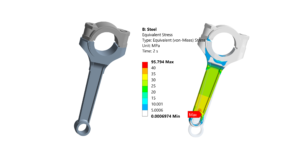
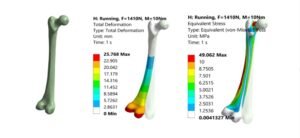
- Critical Locations: Visualizations highlighting areas with the lowest fatigue life.
Verification & Sanity Checks in Fatigue Analysis
Garbage in, garbage out. Rigorous verification is crucial for trustworthy fatigue predictions.
Mesh Sensitivity and Refinement
Continuously refine your mesh in critical areas until the stress results (especially peak stresses) converge. This ensures that stress concentrations are accurately captured and not simply artifacts of coarse meshing.
Boundary Condition Accuracy
Double-check that all loads, constraints, and supports precisely represent the real-world operating conditions. Incorrect boundary conditions are a common source of error in FEA.
Material Property Validation
Ensure that the material properties, especially the fatigue curves, are relevant to your specific material, manufacturing process, and operating temperature. Ideally, compare with experimental test data or industry standards.
Convergence Criteria
For the underlying static or transient analysis, confirm that solver convergence criteria (e.g., force, displacement, energy) have been met, indicating a stable solution.
Sensitivity Studies
Perform parametric studies by slightly varying critical input parameters (e.g., load magnitude, material properties, geometric dimensions) to understand their impact on fatigue life. This helps identify design robustness and critical parameters.
Hand Calculations & Benchmarking
For simple geometries or sub-components, try to perform a simplified hand calculation to get an order-of-magnitude estimate of fatigue life. Compare your FEA results against these simplified calculations or against published benchmark problems to build confidence.
Common Pitfalls and Troubleshooting
Even experienced engineers can fall into common traps when performing fatigue analysis.
Overlooking Mean Stress Effects
Neglecting to apply appropriate mean stress corrections can lead to overly optimistic or pessimistic fatigue life predictions. Always consider the R-ratio and choose a suitable correction model.
Incorrect Stress Concentration Factor Application
While theoretical stress concentration factors (Kt) are useful, FEA directly calculates actual stress distributions. Be careful not to double-count or misapply factors when comparing to nominal stresses.
Inadequate Mesh Refinement
The number one culprit for inaccurate stress results. A coarse mesh at a stress riser will severely underpredict the peak stress, leading to a dangerous overprediction of fatigue life.
Neglecting Surface Finish and Environmental Factors
These seemingly minor factors can have a massive impact. A rough surface or a corrosive environment can dramatically reduce fatigue strength. Ensure these are accounted for, either in material data or by applying appropriate knockdown factors.
Material Data Mismatch
Using generic fatigue data when your specific material has undergone a unique manufacturing process (e.g., welding, heat treatment) can be misleading. Always seek data representative of your final component state.
Optimizing Designs for Fatigue Resistance
Beyond prediction, the goal is to design structures that resist fatigue effectively.
Geometry Optimization
Eliminate or minimize stress concentrators. Use generous fillets and radii instead of sharp corners. Distribute loads more evenly by optimizing structural forms. Topology optimization can be a powerful tool here.
Material Selection
Choose materials with high fatigue limits, good ductility, and suitable fracture toughness for the expected loading conditions. Consider advanced alloys or composites where appropriate.
Surface Treatments
Processes like shot peening, nitriding, or case hardening induce compressive residual stresses at the surface, which can significantly improve fatigue performance by hindering crack initiation.
Manufacturing Processes
Be aware of how manufacturing affects fatigue. Welding can introduce tensile residual stresses and discontinuities, while machining marks can act as crack initiation sites. Proper process control and post-processing treatments are essential.
Comparison of Fatigue Life Prediction Approaches
Here’s a quick overview of when to use which method:
| Approach | Primary Application | Key Characteristic | Pros | Cons |
|---|---|---|---|---|
| Stress-Life (S-N) | High-Cycle Fatigue (Elastic stresses) | Relates stress amplitude to cycles to failure | Simple, widely used, good for infinite life prediction | Poor for plastic deformation, sensitive to mean stress, requires correction factors |
| Strain-Life (ε-N) | Low-Cycle Fatigue (Plastic deformation) | Relates strain amplitude to cycles to failure | Accounts for local yielding, better for notched components | More complex, requires local strain calculation, sensitive to surface finish |
| Fracture Mechanics | Crack Propagation (Existing cracks) | Predicts crack growth rate based on stress intensity factor | Essential for damage tolerance, FFS assessments | Requires initial crack size, complex stress intensity factor calculations |
Conclusion: Building Robust and Reliable Structures
Fatigue life prediction in structural engineering is a complex yet indispensable discipline. By combining a solid understanding of material behavior, robust FEA methodologies, and diligent verification, engineers can design structures that not only meet performance requirements but also withstand the relentless assault of cyclic loading throughout their operational lifespan. Investing in accurate fatigue analysis from the outset ensures safety, minimizes costly failures, and contributes to the overall structural integrity of engineering marvels.
Further Reading
For more in-depth information on fatigue and fracture standards, you can refer to the ASTM E08 Technical Committee on Fatigue and Fracture.