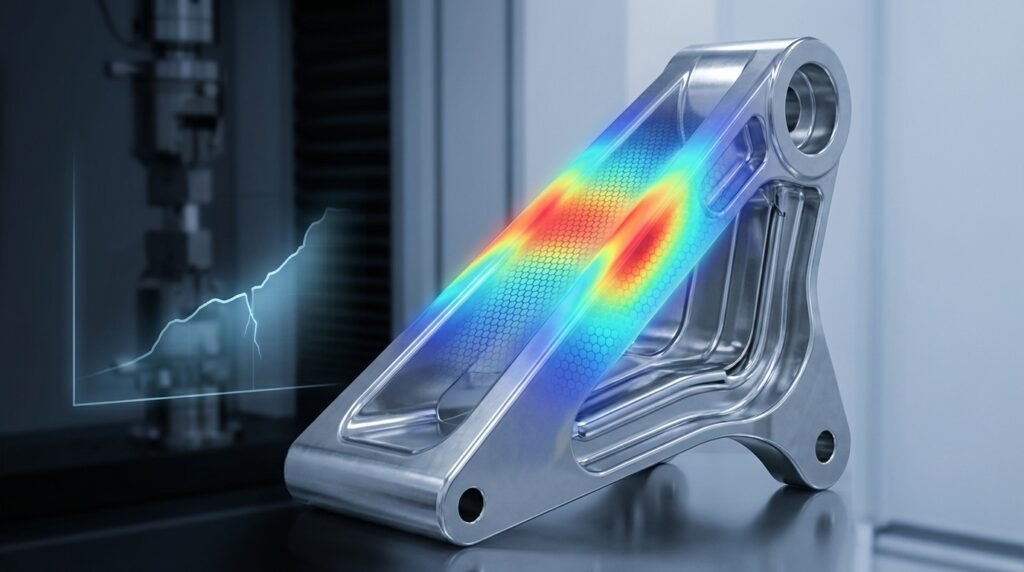
Fatigue, the progressive and localized structural damage that occurs when a material is subjected to cyclic loading, is a silent killer in engineering design. Unlike static failure, fatigue can occur at stresses well below a material’s yield strength, making its prediction and prevention crucial for structural integrity and safety across industries like aerospace, oil & gas, and biomechanics.

Image: Illustrative S-N curve showing stress amplitude versus cycles to failure. (Source: Wikimedia Commons)
Understanding Material Fatigue: The Silent Killer
Imagine a paperclip bent back and forth repeatedly. It doesn’t break on the first bend, but eventually, it snaps. This is a macroscopic example of fatigue failure. In engineering structures, this phenomenon is far more insidious, often occurring without visible warning until catastrophic failure.
What is Fatigue?
Fatigue is a process involving damage accumulation under cyclic or fluctuating stresses. It initiates as microscopic cracks, often at stress concentration points (like holes, fillets, or surface imperfections), and then propagates gradually with each loading cycle until the remaining cross-section can no longer sustain the applied load, leading to sudden fracture.
Why Fatigue Analysis Matters
For engineers, understanding and performing fatigue analysis is not merely an academic exercise; it’s a fundamental requirement for designing reliable and safe components. From aircraft wings experiencing millions of flight cycles to offshore platforms enduring constant wave loading, predicting fatigue life is paramount. Ignoring fatigue can lead to:
- Catastrophic Failures: Sudden and often unpredictable structural collapse, leading to loss of life and property.
- Costly Downtime: Unplanned maintenance and repairs due to fatigue damage.
- Reputational Damage: For manufacturers and engineering firms.
- Non-compliance: Failure to meet industry standards (e.g., FFS Level 3 assessments in oil & gas).
Key Concepts in Fatigue Analysis
To effectively analyze fatigue, several core concepts must be grasped. These form the bedrock of both theoretical and computational approaches.
Stress-Life (S-N) Approach
The Stress-Life (S-N) approach is the most common method for high cycle fatigue (HCF) applications where stresses are predominantly elastic. It relates the stress amplitude (S) to the number of cycles to failure (N).
The S-N Curve
An S-N curve is generated by testing multiple specimens under constant amplitude cyclic loading at various stress levels. The results are plotted on a log-log scale, showing a clear relationship: higher stress amplitudes lead to fewer cycles to failure. The typical shape includes:
- A high-stress region where life is short.
- A transition region.
- A low-stress region, often flattening out.
Endurance Limit & Fatigue Limit
Many ferrous metals exhibit an endurance limit (or fatigue limit), a stress level below which they can theoretically withstand an infinite number of load cycles without failing. For non-ferrous metals (like aluminum), a true endurance limit is rare; instead, a fatigue strength is often specified at a very large number of cycles (e.g., 107 or 108 cycles).
Strain-Life (E-N) Approach
The Strain-Life (E-N) approach is more suitable for low cycle fatigue (LCF), where plastic deformation occurs. It relates the total strain amplitude (elastic + plastic) to the number of cycles to failure. This method is particularly useful for components experiencing significant localized plastic yielding.
Low Cycle Fatigue (LCF) vs. High Cycle Fatigue (HCF)
The distinction between LCF and HCF is critical:
- Low Cycle Fatigue (LCF): Occurs at high stress levels, leading to plastic deformation and failure in a relatively small number of cycles (typically less than 104 to 105 cycles).
- High Cycle Fatigue (HCF): Occurs at lower stress levels, primarily elastic deformation, leading to failure after a large number of cycles (greater than 104 to 105 cycles).
Factors Influencing Fatigue Life
Fatigue life is not solely dependent on stress amplitude. Many other factors play a significant role:
Stress Concentration
Discontinuities in geometry (holes, notches, fillets) amplify local stresses, creating stress concentration factors (Kt). These localized high stresses are often the initiation points for fatigue cracks.
Surface Finish
Rougher surfaces have more microscopic stress risers, reducing fatigue life. Polished surfaces typically have higher fatigue strength.
Mean Stress Effects (Goodman, Gerber, Soderberg)
The average stress in a loading cycle (mean stress) influences fatigue. Tensile mean stress generally reduces fatigue life, while compressive mean stress can increase it. Various theories (e.g., Goodman, Gerber, Soderberg) are used to account for mean stress effects when converting constant amplitude S-N data to account for different mean stress states.
| Mean Stress Correction Theory | Application/Conservatism | Key Characteristics |
|---|---|---|
| Goodman | Commonly used for ductile materials, moderately conservative. | Linear relationship between stress amplitude and mean stress; safe for tensile mean stress. |
| Gerber | Often better fit for ductile materials when mean stress is high, less conservative than Goodman. | Parabolic relationship, generally better for compressive mean stresses. |
| Soderberg | Most conservative, suitable for brittle materials or when high reliability is critical. | Connects fatigue strength to yield strength. |
| ASME Elliptic | Widely adopted in design codes (e.g., pressure vessels), good for ductile materials. | Elliptical relationship, balances between Goodman and Gerber. |
Temperature & Environment
Elevated temperatures can reduce fatigue strength. Corrosive environments (corrosion fatigue) or the presence of hydrogen (hydrogen embrittlement) can drastically accelerate crack initiation and propagation.
Material Properties
Factors like ultimate tensile strength, yield strength, ductility, and microstructure all influence a material’s fatigue resistance.
Practical Workflow: Performing Fatigue Analysis with FEA
Finite Element Analysis (FEA) has become indispensable for fatigue analysis, especially for complex geometries and loading conditions. Here’s a typical workflow using commercial tools like Abaqus or ANSYS Mechanical:
Step 1: Define Loads & Boundary Conditions
Accurately identify all operational loads (cyclic, static, thermal) and boundary conditions. This is often the most critical step; garbage in, garbage out applies strongly here. Consider load sequencing if multiple load cases are involved.
Step 2: Material Characterization
Gather appropriate material properties. For HCF, this typically means S-N curves, often including mean stress correction parameters. For LCF, cyclic stress-strain curves and E-N curves are needed. Ensure these properties are for the relevant temperature and environment.
Step 3: Finite Element Model Setup (Meshing & Elements)
Build a detailed 3D model of the component. Pay close attention to mesh density, especially in areas prone to high stresses or stress concentrations (e.g., fillets, holes, sharp corners). Use appropriate element types (e.g., solid elements for 3D components, shell elements for thin-walled structures). For regions of interest, often a fine, well-structured mesh with at least 3-5 elements through the thickness is required to capture stress gradients accurately.
Step 4: Stress Analysis (Static or Dynamic)
Perform the underlying stress analysis using FEA. For HCF, a linear static analysis is often sufficient if loads are proportional. For dynamic loads or LCF, time-domain transient or frequency-domain random vibration analyses might be necessary to capture the full stress history.
Step 5: Fatigue Life Calculation
Once stresses are obtained, specific fatigue modules within software like Abaqus (using plugins like fe-safe) or ANSYS Mechanical (DesignLife) use the material fatigue data to calculate life. This involves:
Damage Accumulation (Miner’s Rule)
For variable amplitude loading, Miner’s rule (or Palmgren-Miner linear damage rule) is commonly employed. It assumes that each load cycle consumes a fraction of the total fatigue life, and failure occurs when the sum of these fractions reaches unity. While simple, it has limitations, especially in predicting crack initiation order.
Fatigue Software Integration (Abaqus, ANSYS)
Modern FEA packages have integrated fatigue modules or external interfaces. These tools take the calculated stress histories, apply appropriate mean stress corrections, and use material S-N or E-N curves to predict fatigue life (cycles to failure) or fatigue damage for a specified number of cycles.
Common Pitfalls in FEA Fatigue Analysis
- Inaccurate Load History: Assuming constant amplitude when loads are variable.
- Poor Mesh Quality: Especially at stress concentration points, leading to inaccurate stress predictions.
- Incorrect Material Data: Using generic data instead of specific, tested material properties, or not accounting for environmental factors.
- Ignoring Residual Stresses: Manufacturing processes often induce residual stresses that significantly impact fatigue life.
- Misinterpreting Results: Not understanding the limitations of the chosen fatigue theory or software.
For complex simulations or when you need to run many design iterations, considering EngineeringDownloads.com for affordable HPC rental can significantly speed up your analysis workflows and enhance productivity.
Verification & Sanity Checks for Robust Fatigue Analysis
FEA results are only as good as their inputs and the engineering judgment applied. Robust fatigue analysis demands thorough verification and sanity checks.
Mesh Sensitivity & Convergence
Always perform a mesh sensitivity study. Refine the mesh in critical areas and observe if the predicted stresses (especially peak stresses at hotspots) converge to a stable value. Non-converged stresses will lead to inaccurate fatigue life predictions.
Boundary Condition Realism
Double-check that boundary conditions accurately represent the physical constraints and support conditions. Incorrect supports can drastically alter stress distribution and magnitude.
Stress Hotspot Validation
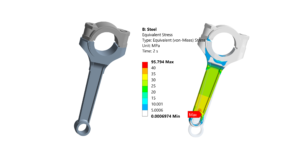
Visually inspect stress plots. Do high-stress areas make engineering sense? Are they located where you would intuitively expect failure? Compare with hand calculations for simple geometries if possible.
Convergence Criteria
For non-linear static or transient dynamic analyses, ensure that your numerical solver has converged within acceptable tolerances. Non-convergence often points to modeling issues (e.g., instability, material plasticity problems).
Comparison with Hand Calculations or Benchmarks
Wherever possible, compare your FEA results for simple sub-components or simplified load cases with analytical solutions or established benchmark problems. This builds confidence in your model setup and software usage.
Sensitivity Studies
Investigate how variations in key input parameters (e.g., material properties, load magnitudes, geometric tolerances) affect the predicted fatigue life. This helps identify critical parameters and potential design weaknesses.
Advanced Considerations & Specialized Applications
Fatigue analysis extends beyond basic S-N curves to address more complex scenarios.
Fracture Mechanics & Crack Propagation
Once a crack initiates, fracture mechanics principles are used to predict its propagation rate (e.g., Paris’ law) and critical crack size, leading to final fracture. This is fundamental in Fitness for Service (FFS) Level 3 assessments, particularly in the oil & gas industry, where the integrity of existing structures with known flaws needs to be evaluated.
Multi-Axial Fatigue
When components are subjected to complex, non-proportional multi-axial stress states, specialized multi-axial fatigue theories (e.g., critical plane methods) are required, as simple equivalent stress approaches may not be accurate.
Vibration Fatigue
In aerospace, automotive, or rotating machinery applications, components experience high-frequency, low-amplitude cyclic loading due to vibrations. Vibration fatigue analysis (often using spectral methods or time-domain approaches) becomes critical here.
Thermal Fatigue
Repeated thermal cycles, especially when coupled with mechanical loads, can induce thermal stresses leading to fatigue. This is common in power generation components or electronics.
Software Tools for Fatigue Analysis
- Abaqus & ANSYS Mechanical: Leading FEA platforms with extensive fatigue modules or integrations (e.g., fe-safe for Abaqus, DesignLife for ANSYS).
- nCode DesignLife: A specialized fatigue analysis software often used in conjunction with general-purpose FEA results.
- Python & MATLAB for Post-Processing: These scripting languages are invaluable for automating data extraction, performing custom fatigue calculations, visualizing results, and conducting parametric studies beyond standard software capabilities.
Troubleshooting Common Fatigue Analysis Issues
Even with careful execution, issues can arise. Here’s how to approach them:
Unexpectedly Low Fatigue Life
- Re-check Stress Concentrators: Ensure fine mesh and accurate geometry at critical locations.
- Material Data Accuracy: Verify the S-N/E-N curves and mean stress correction parameters.
- Boundary Conditions & Loads: Are loads realistic? Are all constraints correctly applied?
- Residual Stresses: Have you considered any manufacturing-induced residual stresses?
Convergence Problems
- Mesh Quality: Address highly distorted elements.
- Time Step Size (Transient): Reduce the time step for dynamic analyses.
- Non-Linearities: Check contact definitions, material plasticity settings, and large deformation options.
- Solver Settings: Adjust iteration limits or convergence tolerances.
Discrepancies with Test Data
- Assumptions Review: Revisit all modeling assumptions (material, loads, BCs, fatigue theory).
- Test Data Variability: Recognize that fatigue test data often has significant scatter.
- Manufacturing Variability: Real-world components have imperfections not captured in ideal FEA models.
- Environmental Factors: Were environmental effects (temperature, corrosion) accounted for in the FEA?
Checklist for a Successful Fatigue Analysis Project
- Clearly define project scope, target life, and safety factors.
- Accurately characterize material fatigue properties.
- Develop a robust FEA model with appropriate mesh density.
- Apply realistic loads and boundary conditions, including load sequencing.
- Perform thorough stress analysis and identify critical regions.
- Select the appropriate fatigue theory (S-N, E-N, multi-axial).
- Conduct mesh sensitivity and convergence studies.
- Perform verification and sanity checks on stress results.
- Interpret fatigue life results with an understanding of their probabilistic nature.
- Document all assumptions, inputs, results, and limitations.
- Consider EngineeringDownloads.com for specialized online courses or project consultancy to enhance your team’s fatigue analysis capabilities.
Further Reading
For more in-depth information on fatigue principles and testing, refer to authoritative academic sources, such as university course materials. For example, MIT’s Introduction to Fatigue provides an excellent foundational overview.