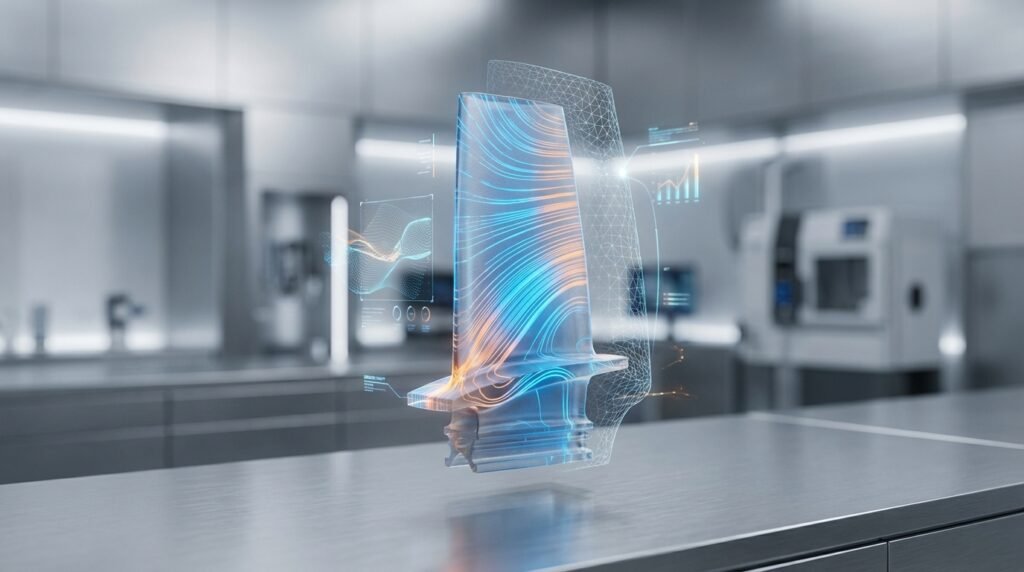
When designing components for high-temperature, sustained load applications, engineers face a silent, insidious threat: creep. Unlike typical yielding or fracture, creep is time-dependent deformation under constant stress, occurring at temperatures roughly above 30-40% of a material’s melting point. Ignoring it can lead to catastrophic failures, making a thorough understanding and robust creep analysis essential for structural integrity.
Whether you’re involved in power generation, oil & gas, aerospace, or advanced manufacturing, creep analysis is a critical tool in your engineering arsenal. This guide will walk you through the fundamentals, practical simulation workflows, and essential verification steps to ensure the longevity and safety of your designs.

Image courtesy of User:Cacycle on Wikimedia Commons, Public Domain.
Understanding Creep: The Phenomenon
Creep is a complex phenomenon influenced by temperature, stress, and time. It’s not about immediate failure but a gradual, permanent deformation that accrues over extended periods.
The Three Stages of Creep
Creep typically manifests in three distinct stages, clearly visible on a creep strain vs. time curve:
- Primary (Transient) Creep: An initial period where the creep rate decreases over time. This is often due to work hardening, where the material resists further deformation.
- Secondary (Steady-State) Creep: The most significant stage for design, characterized by a nearly constant creep rate. Here, the rate of work hardening and recovery processes (like dislocation climb) balance out. Most design life predictions are based on this stage.
- Tertiary Creep: A final stage where the creep rate accelerates rapidly, leading to rupture. This acceleration is often due to microstructural changes like void formation, necking, or grain boundary separation, reducing the material’s effective load-bearing area.
Factors Influencing Creep
- Temperature: The most dominant factor. Creep rate increases exponentially with temperature. Even a small temperature rise can drastically reduce component life.
- Stress: Higher applied stress leads to higher creep rates and shorter rupture times.
- Material Properties: Different materials exhibit vastly different creep resistance. Superalloys, ceramics, and refractory metals are designed for high-temperature creep resistance.
- Time: Creep is inherently time-dependent; deformation accumulates over hours, days, or years.
Why Creep Analysis Matters in Engineering
Creep analysis is not just an academic exercise; it’s a critical aspect of ensuring safety, reliability, and economic viability across various industries:
- Power Generation: Steam turbines, boiler tubes, heat exchangers, and nuclear reactor components operate at extremely high temperatures and pressures for decades. Creep dictates their design life and maintenance schedules.
- Oil & Gas: High-temperature pipelines, pressure vessels, and processing equipment in refineries and petrochemical plants are susceptible to creep, impacting structural integrity and Fitness-for-Service (FFS Level 3) assessments.
- Aerospace: Jet engine turbine blades, combustors, and exhaust nozzles experience extreme temperatures and centrifugal forces, making creep a primary failure mode.
- Automotive: Turbocharger components, exhaust manifolds, and engine blocks in high-performance vehicles.
- Advanced Manufacturing: Tools and dies used in hot forming processes.
Accurate creep analysis helps engineers:
- Predict component life.
- Optimize material selection.
- Develop appropriate maintenance strategies.
- Prevent catastrophic failures.
Key Material Properties and Models for Creep Analysis
Successful creep analysis hinges on accurate material characterization and appropriate constitutive models.
Essential Material Data
- Creep Rupture Strength: Stress required to cause rupture in a specified time at a given temperature.
- Creep Strain Rate Data: Often presented as strain rate vs. stress at various temperatures.
- Temperature-Dependent Elastic Properties: Young’s modulus, Poisson’s ratio, and thermal expansion coefficient must be considered as functions of temperature.
Common Creep Material Models
FEA software like Abaqus, ANSYS Mechanical, and MSC Nastran offer various material models to capture creep behavior:
| Model Name | Description | Typical Application |
|---|---|---|
| Norton-Bailey (Power Law) | Simplest model: strain rate = A * stress^n. Good for secondary creep, often temperature-dependent. | Metals in steady-state creep, initial design estimates. |
| Time Hardening | Creep strain rate is a function of current stress, temperature, and total time. | Captures primary creep effect, simple for constant temperature. |
| Strain Hardening | Creep strain rate is a function of current stress, temperature, and accumulated creep strain. | More accurate for variable stress and temperature histories. |
| Theta Projection Model | Uses four temperature-dependent parameters (theta1-theta4) to describe the entire creep curve, including primary and tertiary. | Predicting long-term creep curves, capturing all stages. |
| Viscoplasticity Models | Combine plasticity and creep, suitable for higher stresses and complex loading. Examples: Chaboche, Anand, Bodner-Partom. | High-temperature fatigue-creep interaction, advanced analyses. |
Practical FEA Workflow for Creep Analysis
Finite Element Analysis (FEA) is the cornerstone of modern creep analysis, offering detailed insights into stress redistribution and deformation. Here’s a structured approach:
1. Pre-Analysis Considerations: Setting the Stage
- Define Design Intent & Failure Criteria: What constitutes failure? Excessive deformation, rupture, or interaction with fatigue?
- Gather Material Data: This is paramount. Source temperature-dependent properties and creep constitutive model parameters. If experimental data is scarce, consider standardized material databases or consultancy.
- Characterize Operating Environment: Accurately define temperature profiles, mechanical loads (constant, cyclic), and exposure time. Are there thermal gradients?
- Simplify Geometry (if necessary): For complex assemblies, identify critical regions where creep is expected to be dominant and simplify non-critical parts to manage computational cost.
2. Model Setup in FEA Software (e.g., Abaqus, ANSYS Mechanical)
The core of your creep simulation lies in precise model definition.
Geometry and Meshing
- Import/Create Geometry: Use CAD tools like CATIA or your FEA pre-processor.
- Mesh Generation: Use appropriate element types. For creep, typically use reduced integration elements (e.g., C3D8R in Abaqus, SOLID186 in ANSYS) to avoid locking. Refine the mesh significantly in regions of high stress concentration or expected high creep strain. Consider using an adaptive mesh for highly deforming structures.
Material Model Implementation
- Temperature-Dependent Properties: Input Young’s modulus, Poisson’s ratio, and thermal expansion coefficients as tables or functions of temperature.
- Creep Constitutive Model: Select the most appropriate creep model (e.g., Norton-Bailey, time hardening, strain hardening) and input its parameters. Ensure units consistency.
Loading and Boundary Conditions (BCs)
- Thermal Loads: Apply temperature fields (either uniform or from a preceding steady-state thermal analysis if there are gradients).
- Mechanical Loads: Define all mechanical loads (pressure, forces, moments) that remain constant over time. Creep is usually analyzed under sustained loading.
- Boundary Conditions: Properly constrain the model to prevent rigid body motion while allowing realistic deformation.
Analysis Steps
- Initial Static/Thermal Step: Apply all mechanical and thermal loads instantaneously to establish the initial stress and strain state.
- Creep Step: Define a time-dependent analysis. The FEA solver will incrementally advance time, calculating creep strain accumulation and stress redistribution. The total time duration should match the required design life or exposure period.
3. Solver Settings: Ensuring Robustness
- Time Stepping: This is crucial for creep. Use automatic time incrementation with appropriate minimum and maximum step sizes. Smaller initial steps are often needed to capture primary creep.
- Convergence Criteria: Define acceptable tolerances for force, displacement, and energy. Creep problems can be numerically challenging due to non-linearity.
- Non-linear Solution Control: Set appropriate non-linear solution parameters to handle the evolving material behavior.
4. Post-processing and Interpretation: Unlocking Insights
Once the analysis is complete, extract and interpret the results:
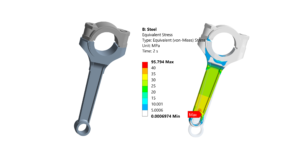
- Creep Strain Distribution: Identify areas with the highest accumulated creep strain.
- Stress Redistribution: Over time, stresses can redistribute from highly stressed regions (which creep faster) to less stressed areas. This is a key phenomenon to observe.
- Deformation & Displacement: Check total displacement against design limits.
- Creep Strain Rate: Monitor the rate of deformation over time.
- Creep Rupture Time: If a damage model is included (e.g., Kachanov-Rabotnov), predict time to rupture.
Common Challenges and Pitfalls
- Inaccurate Material Data: The single biggest source of error. Without reliable, temperature-dependent creep properties, your analysis is speculative.
- Temperature Gradients: Non-uniform temperatures can lead to complex stress states and localized creep, requiring coupled thermal-stress analysis.
- Interaction with Other Phenomena: Creep rarely acts alone. Its interaction with fatigue (creep-fatigue interaction), plasticity, and environmental degradation (oxidation, corrosion) makes analysis challenging.
- Computational Cost: Long-term creep simulations are computationally intensive, requiring significant solver time. Proper model simplification and efficient meshing are essential.
- Extrapolation of Data: Material data is often for shorter durations than the required design life. Extrapolating creep curves can introduce significant uncertainty.
Verification & Sanity Checks: Building Confidence
Trusting your creep analysis results requires rigorous verification:
- Mesh Sensitivity: Rerun the analysis with a finer mesh in critical areas. Results should not change significantly, indicating mesh independence.
- Convergence Checks: Ensure the solver converged at each time step. Review convergence plots. Divergence or large number of iterations indicates instability.
- Simplified Analytical Models: Compare FEA results (e.g., initial stresses, global deformation) with simplified analytical solutions (e.g., using hand calculations for a beam under creep) where possible. This provides a valuable sanity check.
- Literature Review & Historical Data: Compare your findings with published experimental data or historical performance of similar components. While you may not have access to internal company data, public literature can offer general trends.
- Boundary Condition Review: Carefully review all applied loads and constraints. Subtle errors here can invalidate an entire analysis.
- Energy Checks: In some FEA packages, you can monitor energy balance. Significant imbalances indicate problems.
- Material Model Sensitivity: Run the analysis with slightly different creep parameters (within their uncertainty bounds) to understand the sensitivity of your results.
Advanced Topics and Integration
- Creep-Fatigue Interaction: Many high-temperature components experience both sustained loads (creep) and cyclic loads (fatigue). Modeling their interaction is crucial for accurate life prediction, often involving sophisticated viscoplastic models.
- Multiaxial Creep: Creep behavior under combined normal and shear stresses, common in complex geometries.
- Automation with Python & MATLAB: For repetitive tasks, parametric studies, or post-processing large datasets, scripting FEA pre/post-processing (e.g., using Abaqus Python scripting, ANSYS APDL, or MATLAB interfaces) can drastically improve efficiency. This is particularly useful for optimizing designs or performing sensitivity analyses.
- Fitness-for-Service (FFS) Level 3 Assessments: Creep analysis is a fundamental part of advanced FFS assessments for existing components with damage or flaws, guiding repair-or-replace decisions.
Practical Tips for Success
A concise checklist to guide your creep analysis projects:
- Know Your Material: Invest in accurate, temperature-dependent creep data.
- Understand the Environment: Precisely define thermal and mechanical loading histories.
- Start Simple: Begin with a simplified model or analytical check to build confidence.
- Mesh Wisely: Use appropriate element types and refine in critical regions.
- Validate Your Model: Perform mesh sensitivity, convergence, and sanity checks.
- Monitor Results Closely: Pay attention to stress redistribution, strain accumulation, and total deformation over time.
- Document Assumptions: Clearly state all assumptions, especially regarding material behavior extrapolation.
Troubleshooting Common Creep Analysis Issues
- Convergence Problems: Reduce time step size, check element quality, review boundary conditions, or consider a less aggressive creep model. Ensure proper non-linear solution controls.
- Unrealistic Deformations: Double-check material properties (especially units!), applied loads, and constraints. Ensure the initial static step is stable.
- Long Run Times: Optimize mesh, use parallel processing if available, or consider simplifying the model (e.g., 2D axisymmetric if applicable). For extremely long durations, consider accelerated creep testing data.
Mastering creep analysis is a valuable skill for any engineer dealing with high-performance components. It’s a complex but rewarding field that directly impacts the safety and longevity of critical infrastructure.
Looking to deepen your understanding or need practical assistance with creep analysis FEA projects? EngineeringDownloads.com offers downloadable project files, advanced scripts for automation, and expert online consultancy to help you master these techniques.
Further Reading
Introduction to Creep in ANSYS Documentation
Conclusion
Creep analysis is indispensable for ensuring the long-term structural integrity of components operating at elevated temperatures. By following a structured FEA workflow, utilizing appropriate material models, and performing diligent verification, engineers can confidently design for creep and prevent costly failures. The insights gained from creep analysis are not just about predicting failure, but about optimizing performance and extending the life of critical engineering assets.