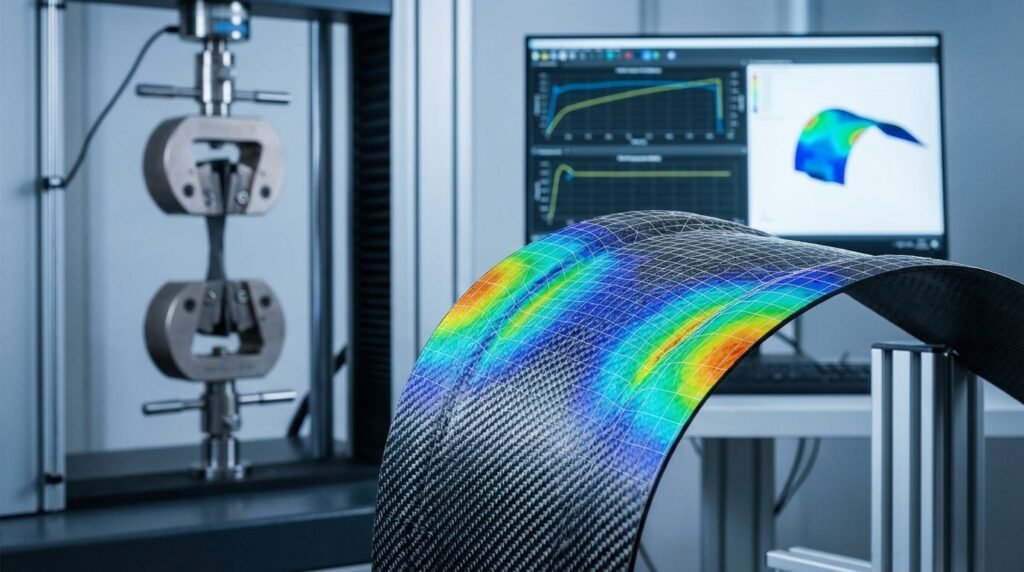
Composite materials have revolutionized engineering across industries, from aerospace and automotive to wind energy and biomechanics. Their impressive strength-to-weight ratio and tailored properties make them indispensable. However, designing with composites isn’t as straightforward as with isotropic metals. The anisotropic nature – where material properties vary with direction – introduces unique complexities, especially when it comes to predicting failure.
This is where Composite Failure Criteria come into play. These are mathematical models and theories developed to predict when and how a composite laminate or its individual plies will fail under various loading conditions. Understanding and correctly applying these criteria is crucial for ensuring structural integrity, optimizing designs, and preventing catastrophic failures in critical applications like aircraft structures, FFS Level 3 assessments in oil & gas, or high-performance sporting equipment.

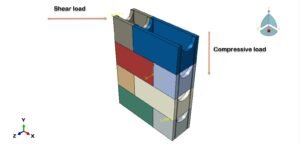
Attribution: Kmhkmh, CC BY-SA 4.0 <https://creativecommons.org/licenses/by-sa/4.0>, via Wikimedia Commons
What Makes Composites Different? The Anisotropic Challenge
Unlike metals that generally exhibit isotropic behavior (properties are the same in all directions), composites are built from distinct constituents – usually strong fibers embedded in a matrix material – arranged in specific orientations. This layered structure creates anisotropy, making their mechanical response highly directional.
Anisotropy and Its Implications
- Direction-Dependent Properties: A composite ply is much stronger and stiffer along the fiber direction than perpendicular to it.
- Complex Stress States: Applied loads can induce complex stress and strain states within individual plies, often leading to different failure modes.
- Interfacial Challenges: The interface between fibers and matrix, and between plies, is a critical region prone to failure (delamination).
Why Traditional Isotropic Theories Fall Short
Standard failure theories like Von Mises, which are excellent for ductile isotropic materials, are inadequate for composites. Von Mises criterion, based on distortional energy, doesn’t account for the differing strengths in tension and compression, or the distinct failure mechanisms (e.g., fiber breakage vs. matrix cracking) inherent in anisotropic materials. Composite failure criteria were developed to address these specific challenges, considering the material’s orthotropic or anisotropic nature.
The Core Purpose of Composite Failure Criteria
The primary goal of composite failure criteria is to provide engineers with a tool to predict failure in complex composite structures. This involves predicting both the initial and ultimate failure, as well as identifying the specific mode of failure.
Predicting Initial Failure (First Ply Failure – FPF)
FPF refers to the point where the first ply in a laminate reaches its strength limit and initiates failure. This doesn’t necessarily mean the entire structure fails; often, the load can be redistributed to other plies, allowing the laminate to carry more load. FPF is a conservative design limit and is often used for critical applications where any damage is unacceptable.
Predicting Ultimate Failure (Ultimate Ply Failure – UPF)
UPF is the point at which the entire laminate structure can no longer sustain additional load and undergoes catastrophic failure. This often involves progressive damage, where plies fail sequentially, and the load is redistributed until the ultimate load-carrying capacity is reached. Predicting UPF accurately usually requires more advanced progressive damage models.
The Importance of Mode Identification (Fiber vs. Matrix)
Unlike metals that typically fail by yielding or fracture, composites can fail in several distinct modes:
- Fiber Failure: Fibers can break under excessive tension or buckle under compression.
- Matrix Failure: The resin matrix can crack under tensile or compressive loads, or shear loads.
- Interfacial Failure: Debonding between fibers and matrix.
- Interlaminar Failure (Delamination): Separation between adjacent plies.
Many advanced failure criteria are ‘mode-dependent,’ meaning they distinguish between these different failure mechanisms, providing more insights into the physics of failure.
A Deep Dive into Key Composite Failure Criteria
Numerous composite failure criteria have been developed over the years, each with its strengths, limitations, and specific applications. They generally fall into categories like phenomenological (stress/strain-based), physically-based (mode-dependent), or damage mechanics models.
Phenomenological Criteria (Stress-Based / Strain-Based)
These criteria use a combination of stress or strain components relative to the material’s allowables to predict failure. They are relatively simple to implement but may not always distinguish specific failure modes.
Maximum Stress Criterion
The simplest failure theory. It states that a ply fails when any stress component (normal or shear) in the material principal direction exceeds its corresponding strength limit. Each stress component is checked independently.
- Pros: Easy to understand and implement.
- Cons: Does not account for interaction between stress components, often overly conservative.
- Use Case: Preliminary design checks, quick assessment where conservatism is acceptable.
Maximum Strain Criterion
Similar to the maximum stress criterion, but based on strain components. A ply fails when any strain component in the material principal direction exceeds its corresponding ultimate strain limit.
- Pros: Conceptually simple, useful when strain limits are readily available.
- Cons: Also ignores stress interaction, can be conservative.
- Use Case: Similar to maximum stress, often used in conjunction or as an alternative.
Tsai-Hill Criterion
An extension of the Von Mises criterion for anisotropic materials. It considers the interaction between normal and shear stresses, predicting failure when a combined stress state reaches a critical value. It does not distinguish between different failure modes.
The simplified 2D form for plane stress is often given as:
(σ1/X)2 - (σ1σ2/X2) + (σ2/Y)2 + (τ12/S)2 = 1
Where X, Y, S are longitudinal, transverse, and shear strengths, respectively. If the left side >= 1, failure is predicted.
- Pros: Accounts for stress interaction, computationally efficient.
- Cons: Does not distinguish between tensile and compressive strengths (uses maximum of tension/compression), doesn’t identify failure mode, isotropic in the transverse plane for unidirectional laminae.
- Use Case: General strength prediction, widely implemented in older FEA codes.
Tsai-Wu Criterion
A more generalized tensor polynomial criterion that addresses some limitations of Tsai-Hill. It accounts for differences in tensile and compressive strengths and includes interaction terms for all stress components, providing a more comprehensive failure envelope. It’s quadratic and can represent a non-symmetric envelope.
For plane stress, a simplified form:
F1σ1 + F2σ2 + F11σ12 + F22σ22 + F66τ122 + F12σ1σ2 = 1
Where F terms are strength parameters derived from unidirectional strengths.
- Pros: Accounts for differences in tensile and compressive strengths, considers all stress interactions, generally provides a better fit to experimental data than Tsai-Hill.
- Cons: Does not identify specific failure modes, requires more experimental constants, can sometimes predict an open failure surface if constants are not carefully chosen.
- Use Case: General strength prediction, widely used in commercial FEA software like Abaqus and ANSYS Mechanical for initial failure analysis.
Hashin’s Criterion
One of the first and most widely adopted physically-based failure criteria. Hashin’s criterion distinguishes between four different failure modes: fiber tension, fiber compression, matrix tension, and matrix compression. It provides separate failure indices for each mode, offering greater insight into the failure mechanism.
- Pros: Mode-dependent (identifies specific failure mechanisms), widely validated for fiber-reinforced composites.
- Cons: Can be overly conservative for fiber compression (doesn’t account for kink band formation), less suitable for woven or short-fiber composites.
- Use Case: Standard for unidirectional lamina failure prediction in aerospace and high-performance applications.
Puck Criterion
Developed to specifically address matrix failure (Inter-Fiber Failure – IFF) modes with a more physically meaningful approach. Puck’s criterion postulates that matrix failure is governed by stresses acting on an assumed fracture plane, providing more accurate predictions for transverse and shear loading, especially under compression.
- Pros: Excellent for predicting matrix failure, physically based on fracture mechanics principles, distinguishes between different IFF modes (A, B, C).
- Cons: More complex to implement than simpler criteria, requires material parameters that may not always be readily available.
- Use Case: Advanced analysis where accurate matrix failure prediction is critical, often used in conjunction with fiber failure criteria.
LaRC05 / LaRC04
These are more advanced, physically-based criteria developed at NASA Langley Research Center. They provide even more detailed distinctions between failure modes, including different matrix failure angles and considering factors like out-of-plane shear. They are often used in high-fidelity simulations.
Damage Mechanics and Progressive Failure
While the criteria above predict initial failure, progressive damage models go further. They couple a failure criterion with material degradation rules. Once a ply fails according to a criterion, its stiffness and strength properties are reduced (degraded), and the load is redistributed to the remaining material. This allows for the prediction of ultimate laminate failure and the simulation of post-initial failure behavior.
Comparison of Key Composite Failure Criteria
Here’s a quick overview of some common criteria:
| Criterion | Type | Key Strength | Key Limitation | Typical Use Case |
|---|---|---|---|---|
| Maximum Stress | Phenomenological | Simple, easy to implement | No stress interaction, very conservative | Preliminary design, quick checks |
| Maximum Strain | Phenomenological | Simple, strain-based | No strain interaction, very conservative | Preliminary design, strain-limited materials |
| Tsai-Hill | Phenomenological | Accounts for stress interaction | No tensile/compressive distinction, no mode ID | General strength prediction, older FEA codes |
| Tsai-Wu | Phenomenological | Tensile/compressive distinction, general interaction | No mode ID, requires more constants | General strength prediction, widely used in FEA |
| Hashin | Physically-based | Mode-dependent (fiber/matrix tension/compression) | Conservative for fiber compression, unidirectional only | Aerospace, detailed mode prediction |
| Puck | Physically-based | Excellent matrix failure prediction | More complex, specific material constants | Advanced matrix failure analysis |
Practical Workflow: Implementing Failure Criteria in FEA
Finite Element Analysis (FEA) is indispensable for analyzing complex composite structures. Implementing failure criteria correctly within FEA software (like Abaqus, ANSYS Mechanical, or MSC Nastran) is critical.
Pre-Processing: Setting Up Your Composite Model
- Define Material Properties: You’ll need elastic constants (E1, E2, G12, ν12) and strength allowables (Xt, Xc, Yt, Yc, S12, S13, S23) for each lamina or ply. These are orthotropic properties defined in the material’s principal direction.
- Create Plies: Define individual plies with their thickness, material, and orientation angle relative to a global coordinate system.
- Build the Laminate: Assemble the plies into a stacking sequence, defining the order and thickness of each layer. This is crucial as it dictates the overall laminate stiffness and stress distribution.
- Select Element Type: For thin laminates, shell elements (e.g., S4R in Abaqus, SHELL181 in ANSYS) are common. For thick sections or detailed through-thickness stress analysis, 3D solid elements with layers (e.g., SC8R in Abaqus, SOLID185 in ANSYS with layered section definition) might be necessary.
- Specify Failure Criteria: Within the FEA software, you’ll assign the desired failure criteria to your composite material definition. Most commercial codes offer a selection of criteria (e.g., Max Stress, Max Strain, Tsai-Hill, Tsai-Wu, Hashin). For advanced criteria like Puck or LaRC, you might need user-defined subroutines (e.g., USDFLD/UMAT in Abaqus) or specialized composite analysis modules.
Analysis Execution: Running Your Simulation
- Static vs. Dynamic: For most strength assessments, a static analysis is sufficient. Dynamic analyses are needed for impact, vibration, or blast scenarios.
- Linear vs. Non-linear: Initial failure can often be predicted with linear elastic analysis. However, if you’re interested in post-initial failure behavior, load redistribution, or ultimate failure, a non-linear analysis with progressive damage modeling is essential. This often involves iterative solutions and might require convergence controls.
Post-Processing: Interpreting Failure Indices
After running the FEA, the software will output ‘failure indices’ for each ply at each integration point. A failure index (FI) is typically a ratio where FI < 1 means safe, FI = 1 means failure initiation, and FI > 1 means failure has occurred (or is predicted to occur).
- Visualize Failure Envelopes: Plotting failure indices across the structure helps identify critical areas.
- Identify Critical Plies: Determine which plies are failing first and under what conditions.
- Understand Failure Modes: For criteria like Hashin or Puck, the software will often report separate indices for fiber tension, matrix compression, etc., providing valuable insights into the mechanism of failure.
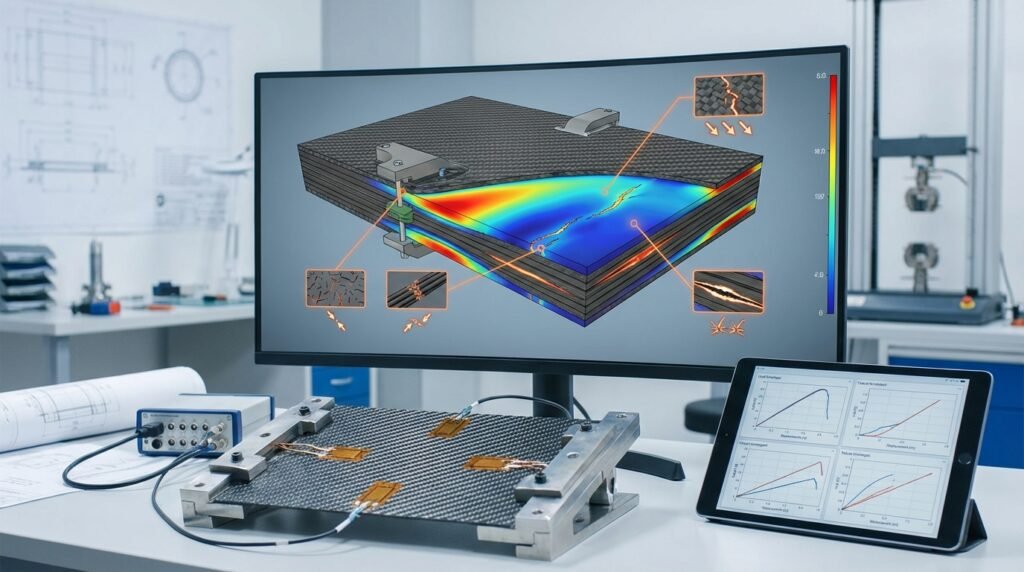
- Python/MATLAB for Custom Post-Processing: For advanced analysis or comparing multiple criteria, Python scripting (e.g., using libraries like NumPy, SciPy, Matplotlib) or MATLAB can be used to extract raw stress/strain data from FEA results and apply custom failure criteria or plot failure envelopes. This is especially useful in CAD-CAE workflows for automation and design optimization.
Common Pitfalls and How to Avoid Them
Even with powerful FEA tools, mistakes in composite analysis can lead to inaccurate predictions and unsafe designs. Be vigilant!
Material Property Mismatch
Using incorrect or generic material properties is a common error. Ensure your E, G, ν, and strength values correspond to the specific fiber/matrix system, fiber volume fraction, and curing conditions of your composite. Temperature and moisture effects also play a significant role.
Incorrect Ply Orientation/Stacking
A single typo in a ply angle or an incorrect stacking sequence can drastically alter the laminate’s stiffness and strength. Double-check your input against the design specification.
Meshing Challenges for Composites
Composites often exhibit high stress gradients near load introduction points or geometric discontinuities. Ensure your mesh is fine enough to capture these details, especially when using shell elements, where through-thickness stresses are derived from element formulations.
Ignoring Progressive Failure
Relying solely on FPF can be overly conservative, especially for non-critical structures or when seeking ultimate load capacity. Neglecting progressive damage can lead to underestimation of actual reserve strength, but using it requires careful validation.
Misinterpreting Failure Indices
A failure index of 0.95 means the ply is almost failing, not that it’s infinitely safe. Always consider safety factors based on industry standards (e.g., aerospace requires higher factors for FPF). Understand what each criterion’s index truly represents.
Verification & Sanity Checks for Robust Composite Analysis
Trust but verify. Robust engineering demands thorough checks to ensure the reliability of your FEA results.
Mesh Quality and Convergence
- Element Checks: Inspect aspect ratio, skewness, and Jacobian for distorted elements. Poor quality elements can lead to inaccurate stress predictions.
- Mesh Density Studies: Perform several analyses with increasingly finer meshes. Your results (e.g., max failure index, deflection) should converge to a stable value.
Boundary Conditions and Load Application
- Reaction Forces: Sum the reaction forces at constraints and compare them to the total applied load. They should balance.
- Displacement Checks: Visually inspect displacement plots for expected deformation patterns. Are displacements reasonable?
- Load Path: Does the stress distribution make physical sense given the applied loads and constraints?
Material Data Validation
- Literature Review: Compare your input properties with published data for similar composite systems.
- Manufacturer Data: Always use data from the material supplier when available.
Sensitivity Analysis
Vary key design parameters (e.g., ply angle by +/- 5 degrees, ply thickness, fiber volume fraction within expected variations) and observe the impact on failure indices. This helps understand design robustness and identify critical parameters.
Validation Against Hand Calculations or Experimental Data
- Laminate Theory Checks: For simple laminates, compare FEA results for stresses, strains, and initial failure with classical laminate theory (CLT) calculations.
- Benchmark Tests: If possible, compare predictions with experimental data from coupon tests or scaled prototypes. This is the ultimate validation.
Need to run complex composite simulations or want to deepen your understanding? EngineeringDownloads offers affordable HPC rental, online courses, and expert project consultancy to support your advanced engineering needs.
Advanced Considerations for Composite Failure
While basic failure criteria provide a good starting point, several advanced topics push the boundaries of composite failure prediction.
Progressive Damage Modeling
As mentioned, these models track damage growth beyond FPF by degrading material properties. This is vital for simulating post-buckling behavior, impact events, and predicting ultimate load capacity more accurately. Tools like Abaqus’s VUMAT or built-in progressive damage models in ANSYS offer this capability.
Delamination and Interfacial Failure
Delamination, the separation between plies, is a critical failure mode unique to laminates. Specialized techniques are used to predict and simulate it:
- Cohesive Zone Modeling (CZM): Introduces cohesive elements with traction-separation laws between plies to model crack initiation and propagation.
- Virtual Crack Closure Technique (VCCT): Used to calculate energy release rates for pre-existing cracks, helping predict delamination growth.
Environmental Effects
Composites are susceptible to environmental degradation. Factors like temperature, moisture absorption, UV radiation, and chemical exposure can significantly reduce mechanical properties and accelerate failure. These effects must be considered in critical designs, often by adjusting material properties based on environmental conditions.
Fatigue and Creep
Like metals, composites can experience fatigue (failure under cyclic loading) and creep (time-dependent deformation under sustained load). Predicting fatigue life in composites is complex due to multiple damage mechanisms. Dedicated fatigue models and extensive experimental data are required.
Future Trends in Composite Failure Prediction
The field of composite failure is continually evolving:
- Machine Learning (ML): AI/ML is being explored for accelerating material characterization, identifying complex failure patterns from experimental data, and even developing new, data-driven failure criteria.
- Multi-Scale Modeling: Integrating micro-scale (fiber/matrix level) simulations with macro-scale (laminate/structure level) FEA to capture finer details of damage initiation and progression.
- Improved Experimental Techniques: Advanced testing methods coupled with digital image correlation (DIC) provide richer data for validating and refining failure models.
Conclusion: Empowering Engineers with Robust Composite Design
Understanding and applying composite failure criteria is fundamental for any engineer working with these advanced materials. While the complexity can be daunting, a systematic approach, leveraging modern FEA tools, and rigorous verification processes can lead to safe, optimized, and innovative composite designs.
By moving beyond isotropic assumptions and embracing the specialized criteria designed for composites, engineers can confidently push the boundaries of what’s possible in structural integrity, performance, and efficiency across countless applications. Continuous learning and a practical, hands-on approach are key to mastering this vital domain.
Further Reading
For more detailed information on specific criteria and their theoretical background, refer to official software documentation or academic texts. For example, explore Abaqus Documentation on composite material models and failure theories.
Frequently Asked Questions (FAQ)
- Question: Why can’t I use the Von Mises criterion for composites?Answer: The Von Mises criterion is designed for ductile, isotropic materials and assumes material properties are uniform in all directions, and that tensile and compressive yield strengths are equal. Composites are anisotropic, meaning their properties vary significantly with direction, and they often have different strengths in tension and compression. They also fail by distinct mechanisms like fiber breakage or matrix cracking, which Von Mises doesn’t account for.
- Question: What’s the difference between First Ply Failure (FPF) and Ultimate Ply Failure (UPF)?Answer: FPF predicts when the first layer (ply) in a composite laminate starts to fail. This is often a conservative design point. UPF, or ultimate failure, refers to the point where the entire laminate can no longer carry additional load and catastrophically fails, often after multiple plies have failed progressively and redistributed load.
- Question: Which composite failure criterion is best?Answer: There isn’t a single ‘best’ criterion; the most appropriate one depends on the specific material, loading conditions, and required level of detail. For general interaction, Tsai-Wu is popular. For mode-dependent failure, Hashin or Puck are often preferred. More advanced criteria like LaRC offer greater physical insight, but require more input data.
- Question: How do I implement these criteria in FEA software like Abaqus or ANSYS?Answer: In most FEA software, you define composite material properties (elastic constants and strengths) for individual plies. You then create a laminate stacking sequence and associate it with shell or solid elements. Within the material or section definition, you can typically select from a list of built-in failure criteria (e.g., Max Stress, Tsai-Wu, Hashin). For advanced criteria not built-in, user subroutines (like UMAT/USDFLD in Abaqus) may be needed.
- Question: What is progressive damage modeling, and when should I use it?Answer: Progressive damage modeling simulates how damage initiates and evolves in a composite structure beyond initial failure. When a ply fails according to a criterion, its stiffness and strength are degraded, and the load is redistributed. You should use it when you need to predict the ultimate load-carrying capacity of a structure, simulate post-initial failure behavior (e.g., in impact analysis), or gain a more realistic understanding of damage propagation.
- Question: Are environmental factors important for composite failure?Answer: Absolutely. Environmental factors like temperature, moisture absorption, and UV exposure can significantly degrade composite material properties over time, reducing their strength and stiffness. It’s crucial to account for these effects in design, especially for long-term applications or structures exposed to harsh environments, as they can lead to premature failure.