Mastering ANSYS Fluent for Practical CFD Simulations
ANSYS Fluent is a cornerstone in the world of Computational Fluid Dynamics (CFD), empowering engineers to simulate fluid flow, heat transfer, and related phenomena with incredible precision. Whether you’re designing next-generation aircraft, optimizing oil & gas pipelines, or analyzing blood flow in arteries, Fluent provides the tools to gain deep insights without costly physical experiments.

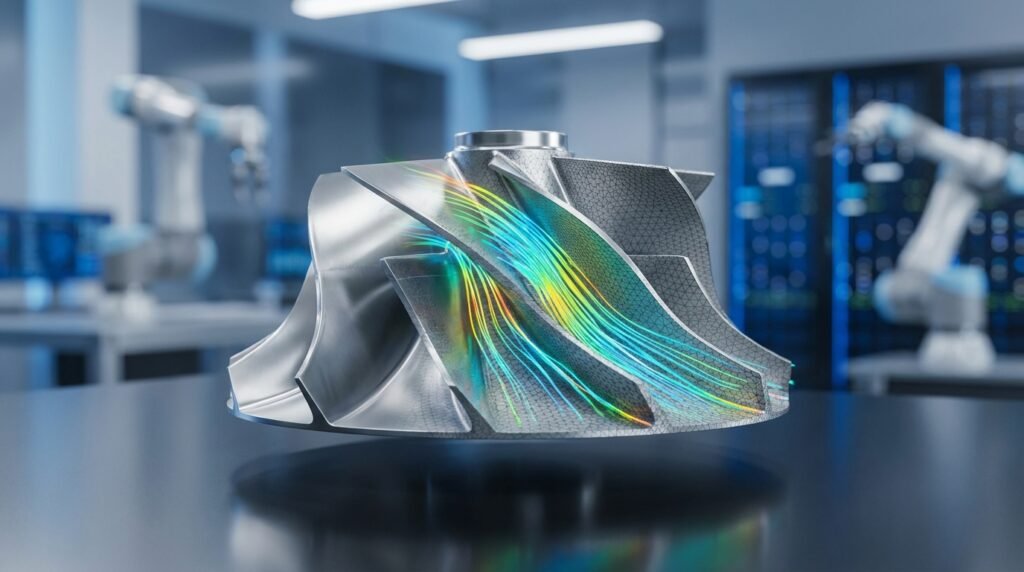
Image Credit: Ansys, Inc. via Wikimedia Commons
This article dives into the practical aspects of using ANSYS Fluent, focusing on workflows, best practices, and crucial verification steps for reliable simulation results. We’ll cut through the academic jargon and deliver actionable advice for your engineering projects.
Understanding ANSYS Fluent’s Core Capabilities
At its heart, ANSYS Fluent is a finite volume-based solver for the Navier-Stokes equations, but its power extends far beyond that. It’s a versatile tool capable of handling a vast array of fluid dynamics problems.
- Fluid Flow: Simulating laminar and turbulent flows (incompressible/compressible, steady/unsteady) across various scales.
- Heat Transfer: Conduction, convection, radiation, and conjugate heat transfer problems, critical for thermal management in electronics, engines, and architectural designs.
- Turbulence Modeling: A comprehensive suite of models including RANS (e.g., k-epsilon, k-omega, SST), LES, and hybrid RANS-LES approaches for accurate turbulence prediction.
- Multiphase Flows: Simulating interactions between different fluid phases (liquid-gas, liquid-liquid, gas-solid), essential for processes in chemical engineering and oil & gas.
- Reacting Flows & Combustion: Modeling chemical reactions, flame propagation, and pollutant formation, crucial for engine design and industrial furnaces.
- Dynamic Meshes & FSI: Handling moving geometries and performing Fluid-Structure Interaction (FSI) analyses, often coupled with tools like ANSYS Mechanical.
A Practical Workflow for ANSYS Fluent Simulations
Executing a successful CFD simulation in Fluent involves a structured approach. Here’s a step-by-step guide to get you started:
1. Geometry Preparation & Meshing
The foundation of any good simulation is a clean geometry and a high-quality mesh.
- Import/Create Geometry: Start with your CAD model. Fluent can directly import files from popular CAD software like CATIA, SolidWorks, and Autodesk Inventor. Ensure your geometry is clean, with no small edges, faces, or overlapping bodies that could cause meshing issues.
- Mesh Generation: This is arguably the most critical step. Fluent’s meshing tools (or ANSYS Meshing) allow you to create various mesh types:
- Structured Meshes: Ideal for simple geometries, offering high control and accuracy.
- Unstructured Meshes: More flexible for complex geometries, typically tetrahedral, hexahedral, or polyhedral elements. Polyhedral meshes often offer a good balance of accuracy and computational cost.
- Mesh Quality Check: Always prioritize mesh quality. Look for high skewness, aspect ratio, and orthogonal quality. A poor mesh will lead to inaccurate or divergent solutions. Pay special attention to boundary layers by using inflation layers near walls for accurate flow and heat transfer predictions.
2. Physics Setup & Boundary Conditions
This stage defines the ‘what’ and ‘how’ of your simulation.
- Solver Selection: Choose between pressure-based or density-based solvers. Most incompressible flows use pressure-based.
- Materials: Define fluid properties (density, viscosity) and solid properties (thermal conductivity, specific heat) if doing conjugate heat transfer.
- Cell Zone Conditions: Assign appropriate conditions to fluid and solid regions.
- Boundary Conditions (BCs): Crucial for defining how the fluid interacts with the boundaries of your domain. Common BCs include:
- Inlet: Velocity inlet, mass flow inlet, pressure inlet.
- Outlet: Pressure outlet, outflow.
- Walls: No-slip, slip, moving walls, heat flux, temperature.
- Symmetry: For reducing computational domain.
- Turbulence Model: Select an appropriate turbulence model (e.g., k-epsilon, k-omega SST) based on your flow characteristics and computational resources. The k-omega SST model is often a good all-rounder for aerospace and external aerodynamic applications.
3. Solving & Convergence Monitoring
This is where the numerical magic happens.
- Solution Methods: Choose appropriate discretization schemes (e.g., PISO, SIMPLE) and spatial discretization (e.g., second-order upwind for better accuracy).
- Initialization: Provide initial values for flow variables to help the solver start. Hybrid initialization is often a good default.
- Run Calculation: Start the iterative process. Monitor residuals (continuity, momentum, energy, turbulence quantities).
- Convergence: A solution is considered converged when residuals drop to acceptable levels (e.g., 1e-4 or 1e-5 for continuity/momentum, 1e-6 or 1e-7 for energy), and key engineering quantities (lift, drag, pressure drop, heat flux) stabilize.
4. Post-Processing & Analysis
Extracting meaningful insights from your raw data.
- Visualizations: Create contours of pressure, velocity, temperature; vector plots; streamlines; isosurfaces.
- Quantitative Data: Extract numerical values for forces (lift, drag), average temperatures, mass flow rates, pressure drops, and efficiency metrics.
- Reporting: Present your findings clearly, highlighting key phenomena and engineering conclusions.
For complex setups or to accelerate your learning curve, EngineeringDownloads.com offers downloadable ANSYS Fluent project templates and custom scripting services. These resources can significantly streamline your CAD-CAE workflows.
Verification & Sanity Checks for CFD Results
Blindly trusting simulation results is a recipe for disaster. Robust verification and validation are non-negotiable.
1. Mesh Sensitivity Study (Grid Independence)
The most fundamental verification step. Perform the simulation on at least three different mesh resolutions (coarse, medium, fine). If your results (e.g., drag coefficient, pressure drop) change significantly between the medium and fine mesh, your solution is not grid-independent, and you need a finer mesh.
2. Boundary Condition Review
Double-check every single boundary condition. Are the values realistic? Is the direction correct for inlets/outlets? Is the thermal condition appropriate (e.g., adiabatic wall vs. fixed temperature)?
3. Convergence Criteria Check
Don’t just look at residuals. While low residuals are good, always check that the engineering quantities you’re interested in have also converged to a steady value. If they are still fluctuating, the solution is not truly converged, even if residuals look good.
4. Physical Plausibility & Hand Calculations
Does the result make physical sense? Are velocities too high/low? Are temperatures realistic? Can you perform a simplified hand calculation (e.g., Bernoulli’s equation, basic heat transfer calculations) to get a ballpark figure? This sanity check often catches gross errors early.
5. Validation & Benchmarking
Whenever possible, compare your simulation results against:
- Experimental Data: Wind tunnel tests, flow rig measurements.
- Analytical Solutions: For simplified cases (e.g., fully developed pipe flow, flat plate boundary layer).
- Published Data: Benchmark cases from literature or other validated simulations.
This step builds confidence in your model’s predictive capability.
Advanced Features & Integration
Fluent’s capabilities extend beyond basic fluid flow problems.
Coupling with Other Tools (FSI)
Fluent can be coupled with ANSYS Mechanical for Fluid-Structure Interaction (FSI) problems, allowing you to simulate how fluid forces deform structures and vice-versa. This is critical in aerospace (wing flutter), biomechanics (arterial wall deformation), and structural integrity assessments.
Automation with Python & MATLAB
For parametric studies, design optimization, or complex workflows, Fluent allows scripting using Scheme or its extensive API, which can be accessed via Python or MATLAB. This enables you to automate repetitive tasks, control simulations externally, and integrate Fluent into larger CAD-CAE workflows.
Oil & Gas and Aerospace Applications
Fluent is indispensable in industries like Oil & Gas for multiphase flow assurance, pipeline slugging analysis, and flare stack design. In Aerospace, it’s used for external aerodynamics, propulsion system design, thermal management, and turbomachinery analysis.
Common Mistakes and Troubleshooting Tips
Even experienced engineers encounter issues. Here’s a quick guide to common pitfalls:
| Common Mistake | Impact | Troubleshooting Tip |
|---|---|---|
| Poor Mesh Quality | Inaccurate results, divergence | Check skewness, aspect ratio, orthogonal quality. Refine critical areas, use inflation layers. |
| Incorrect Boundary Conditions | Physically unrealistic results, divergence | Review BC types, values, and directions. Use simple cases for initial testing. |
| Lack of Convergence | Unreliable, oscillating results | Monitor engineering quantities. Adjust under-relaxation factors. Check mesh. Reduce time step (for unsteady). |
| Wrong Turbulence Model | Inaccurate shear stress, velocity profiles | Understand your flow regime. Start with k-omega SST for general external/internal flows. |
| Incorrect Material Properties | Wrong flow behavior, heat transfer | Double-check all material properties against reliable sources. |
| Insufficient Initialization | Slow convergence, divergence | Use hybrid initialization. For complex cases, use a simpler steady-state solution to initialize a more complex one. |
Troubleshooting Divergence
- Check Mesh: High skewness can cause divergence.
- Adjust Under-Relaxation Factors: Reduce them, especially for pressure, momentum, and energy.
- Initialization: Ensure a reasonable initial guess.
- Time Step (Unsteady): Reduce the time step for transient simulations.
- Boundary Conditions: Verify they are physically consistent.
- Turbulence Model: Try a more robust model (e.g., k-epsilon) for initial stability, then switch.
Frequently Asked Questions (FAQ) about ANSYS Fluent
Further Reading
For in-depth technical documentation and tutorials, refer to the official ANSYS Fluent Product Page.