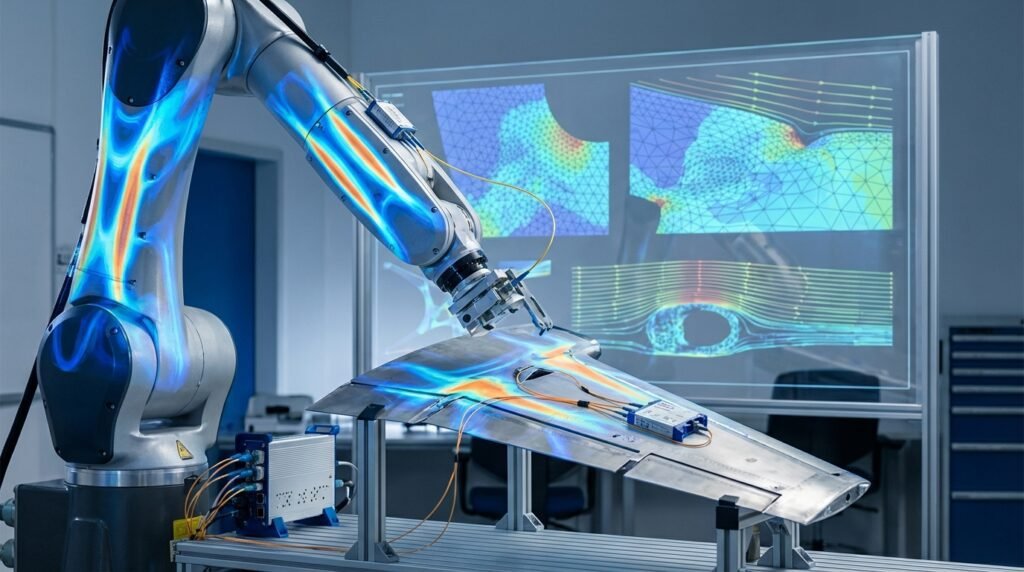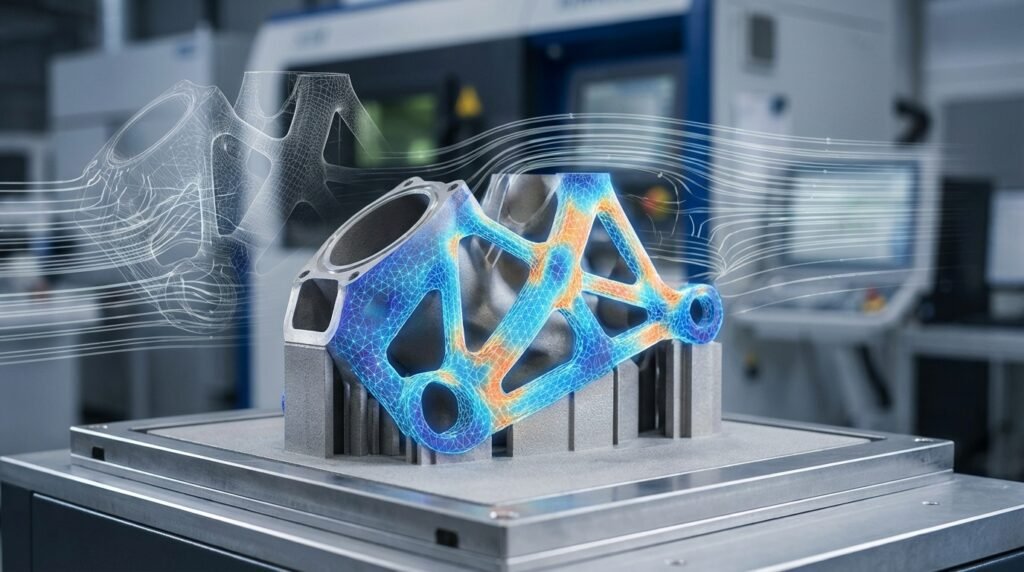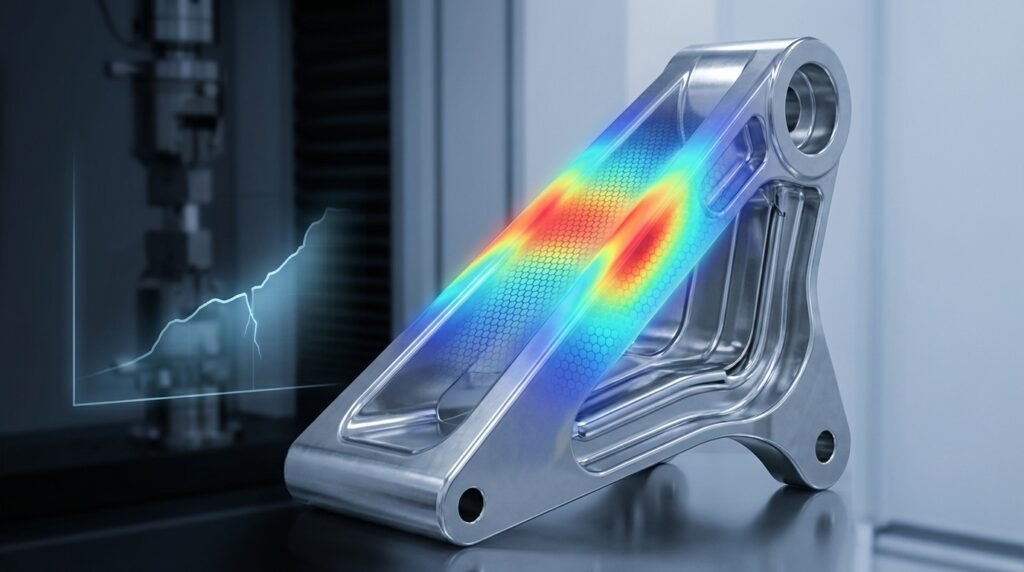
Computational Fluid Dynamics (CFD) has long been a cornerstone of engineering design and analysis, enabling engineers to predict fluid flow behavior in complex systems. From aerospace propulsion to biomechanical devices, CFD simulations provide invaluable insights. However, traditional CFD can be computationally expensive and time-consuming, especially for large-scale, transient, or optimization problems.
Enter Artificial Intelligence (AI) and Machine Learning (ML). These powerful technologies are rapidly transforming the landscape of CFD, offering innovative solutions to accelerate simulations, enhance accuracy, and unlock new possibilities for design and analysis.

Image: A simplified neural network diagram, illustrating the foundational AI concept driving many advancements in CFD.
The Convergence of AI and CFD: Why Now?
The synergy between AI and CFD isn’t new, but recent advancements in computational power, data availability, and sophisticated ML algorithms have truly ignited this field. Engineers can now leverage AI to tackle CFD challenges that were previously intractable.
Key Drivers for AI Integration in CFD:
- Data Proliferation: Modern CFD simulations generate vast amounts of data, which AI can effectively analyze and learn from.
- Algorithm Maturity: Deep Learning (DL) and Reinforcement Learning (RL) techniques have matured, offering robust tools for complex pattern recognition and decision-making.
- Hardware Advancements: GPUs and specialized AI accelerators significantly speed up ML model training and inference, making practical applications feasible.
- Demand for Speed & Efficiency: Industries require faster design cycles and real-time insights, pushing the need for accelerated CFD.
How AI Enhances the CFD Workflow
AI can be integrated at various stages of the CFD process, from pre-processing to post-processing and beyond, creating a more efficient and powerful workflow.
1. Pre-processing Acceleration: Smart Geometry & Meshing
The initial stages of CFD often involve labor-intensive tasks like geometry preparation and mesh generation. AI can automate and optimize these steps:
- Automated Mesh Generation: ML models can learn optimal meshing strategies based on geometric features and flow characteristics, generating high-quality meshes faster than manual approaches. Tools like OpenFOAM’s snappyHexMesh or commercial packages can be augmented with AI-driven pre-processing scripts (often in Python).
- Geometry Optimization: AI can intelligently modify CAD geometries (e.g., using parametric CAD tools like CATIA or design exploration platforms) to improve aerodynamic performance or reduce drag, even before a full CFD run.
- Boundary Condition Prediction: For similar cases, ML models can predict suitable boundary conditions, reducing setup time and errors.
2. Solver Enhancement & Acceleration
This is where AI can deliver significant computational savings.
Reduced Order Models (ROMs) & Surrogate Models:
AI can build highly accurate, fast-executing models that mimic the behavior of full CFD simulations. These ‘surrogate models’ are trained on a smaller set of high-fidelity CFD results and can then predict outcomes for new design parameters almost instantaneously.
- Applications: Rapid design space exploration, real-time control systems, and uncertainty quantification.
- Benefits: Drastically reduced computational cost, enabling thousands of design iterations in minutes instead of weeks.
- Tools: Python with libraries like scikit-learn or TensorFlow/PyTorch is crucial for developing and deploying these models, often working in conjunction with established CFD solvers like ANSYS Fluent/CFX or OpenFOAM.
Physics-Informed Neural Networks (PINNs):
PINNs integrate the governing physical equations (Navier-Stokes) directly into the neural network’s training process. This ensures that the AI model adheres to fundamental physical laws, even with sparse data.
- Benefits: Improved accuracy, better generalization, and reduced reliance on large datasets compared to purely data-driven models.
- Challenges: Implementing PINNs requires a solid understanding of both physics and deep learning.
3. Post-processing & Data Analysis
Extracting meaningful insights from massive CFD datasets is another bottleneck AI can address.
- Automated Feature Extraction: AI can identify critical flow features (e.g., vortices, separation points, shock waves) automatically, saving engineers hours of manual inspection.
- Anomaly Detection: ML can pinpoint unusual flow behaviors that might indicate design flaws or unexpected phenomena.
- Predictive Maintenance: For operational systems, AI models trained on CFD and sensor data can predict component degradation related to fluid flow.
4. Design Optimization & Digital Twins
AI unlocks new levels of optimization and operational efficiency.
- Generative Design: AI can propose novel geometries that satisfy performance constraints, going beyond human intuition.
- Real-time Digital Twins: Combining CFD-trained surrogate models with real-time sensor data creates ‘digital twins’ that can predict the performance of physical assets (e.g., oil & gas pipelines, aircraft engines) in real-time, enabling proactive maintenance and operational adjustments.
Practical Workflow for Integrating AI in CFD
Integrating AI into your CFD workflow requires a structured approach. Here’s a general outline:
Step-by-Step Guidance:
- Define the Problem: Clearly identify which part of your CFD workflow AI can most effectively enhance (e.g., reducing simulation time for parametric studies, optimizing a specific geometry feature).
- Data Collection & Preparation:
- Generate a diverse dataset of CFD simulations covering the relevant design space. Use established solvers like ANSYS Fluent, OpenFOAM, or specialized in-house codes.
- Ensure data quality: consistent formats, units, and reliable results.
- Pre-process the data (normalization, scaling) for optimal ML model training. Python scripts are invaluable here.
- Model Selection & Training:
- Choose an appropriate AI model (e.g., neural network, Gaussian Process, Random Forest) based on the problem type and data characteristics.
- Train the model using your prepared CFD dataset. Utilize libraries like TensorFlow, PyTorch, or Keras in Python.
- Hyperparameter tuning is crucial for model performance.
- Integration with CFD Solvers:
- Develop Python or MATLAB scripts to seamlessly link your trained AI model with your CFD setup.
- For surrogate models, the AI model takes design parameters as input and quickly outputs performance metrics (e.g., drag, lift, pressure drop), bypassing a full CFD run.
- For pre-processing, AI might generate mesh parameters or optimal geometries for the CFD solver.
- Deployment & Iteration:
- Deploy the AI-enhanced workflow.
- Continuously monitor performance and retrain models with new data as needed to maintain accuracy and adapt to evolving requirements.
Verification & Sanity Checks for AI-Enhanced CFD
Trusting AI-generated results in engineering is paramount. Rigorous verification and validation are non-negotiable.
Essential Checks:
- Validation Against High-Fidelity CFD: Always compare AI model predictions against a subset of high-fidelity CFD results (not used for training) and, ideally, experimental data.
- Physical Consistency: Ensure AI predictions adhere to fundamental physical laws (e.g., conservation of mass, momentum, energy). PINNs are excellent for this.
- Sensitivity Analysis: Understand how sensitive the AI model’s output is to changes in input parameters.
- Uncertainty Quantification (UQ): Quantify the confidence or uncertainty associated with AI predictions, especially in safety-critical applications like Aerospace or Oil & Gas.
- Extrapolation Behavior: Be cautious when using AI models to predict outside the range of their training data. AI models can ‘hallucinate’ unphysical results in these cases.
- Convergence Checks: If AI assists in solving (e.g., predicting initial guesses), ensure the CFD solver still reaches proper convergence.
Common Mistakes to Avoid
- Poor Data Quality: ‘Garbage in, garbage out’ applies strongly to AI. Unreliable or insufficient training data will lead to inaccurate models.
- Over-reliance on Black-Box Models: Don’t blindly trust AI. Understand its limitations and always validate its outputs.
- Ignoring Physics: Purely data-driven models might find correlations that violate physical laws. Incorporate physics knowledge where possible (e.g., PINNs).
- Lack of Domain Expertise: AI is a tool. It needs to be guided and interpreted by engineers with strong CFD domain knowledge.
- Overfitting: A model that performs perfectly on training data but poorly on new, unseen data is overfit. Regularization and cross-validation techniques help prevent this.
Impact Across Engineering Disciplines
The application of AI in CFD is not limited to a single field; it’s creating ripples across various sectors:
| Engineering Discipline | AI in CFD Application | Relevant Tools/Context |
|---|---|---|
| Aerospace Engineering | Aerodynamic shape optimization, rapid wing design, engine performance prediction, flutter analysis. | ANSYS Fluent, OpenFOAM, MATLAB for control systems. |
| Oil & Gas | Flow assurance in pipelines, reservoir simulation acceleration, equipment degradation prediction, FFS Level 3 assessments. | Abaqus for FFS, Python for data analysis. |
| Biomechanics | Blood flow analysis in arteries, prosthetic device design optimization, drug delivery modeling. | ANSYS Mechanical, Python for patient-specific modeling. |
| Automotive Engineering | Vehicle drag reduction, cooling system optimization, cabin comfort analysis. | ADAMS for multi-body dynamics, CATIA for CAD integration. |
| Chemical Processing | Reactor design, mixing optimization, multiphase flow predictions. | ANSYS CFX, Python for process optimization. |
Harnessing AI for Your CFD Projects
Ready to dive deeper? EngineeringDownloads.com offers a wealth of resources, including downloadable Python scripts for CFD post-processing, MATLAB templates for data analysis, and expert online consultancy to help you integrate AI into your specific simulation challenges. We can guide you through setting up AI-driven optimization loops or developing custom surrogate models for your projects.
The Future is Hybrid
The most promising direction for AI in CFD lies in hybrid approaches that combine the strengths of both physics-based models and data-driven AI. This ‘physics-informed AI’ ensures that models are not only efficient but also physically consistent and robust.
By embracing AI, engineers can unlock unprecedented efficiency, explore larger design spaces, and gain deeper insights into complex fluid phenomena. It’s an exciting time to be an engineer in the world of CFD!
Further Reading:
Physics-informed neural networks: A review of theoretical frameworks and applications