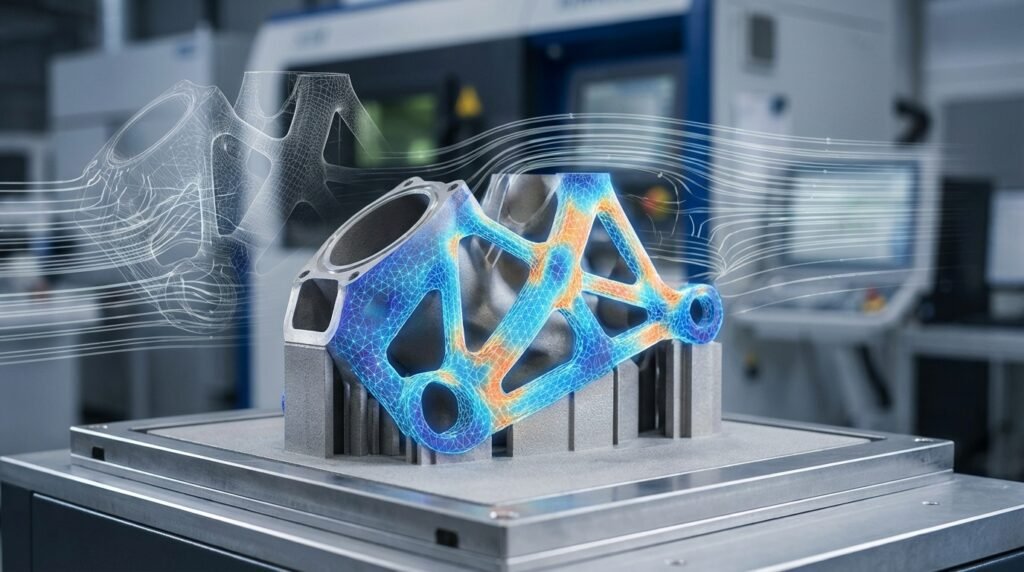
Selective Laser Melting (SLM) has revolutionized how engineers design and produce complex components, offering unparalleled design freedom and material efficiency. However, the intricate physics involved—rapid heating and cooling, phase changes, and solidification—can lead to common additive manufacturing challenges like residual stresses, warpage, and microstructure variations. This is where SLM simulation becomes an indispensable tool for modern engineering.
By leveraging advanced computational methods, engineers can virtually predict and mitigate these issues before a single part is printed. This guide dives deep into the practical aspects of SLM simulation, offering a clear, engineer-to-engineer perspective on how to master this powerful technology for optimized designs and robust manufacturing processes.

Courtesy of The MathWorks, Inc.
Understanding Selective Laser Melting (SLM) Fundamentals
The SLM Process Overview
Selective Laser Melting, a powder bed fusion technique, involves a high-power laser selectively melting layers of metallic powder based on a 3D CAD model. This layer-by-layer consolidation builds up the desired part. Key process parameters include laser power, scan speed, hatch spacing, layer thickness, and preheating temperature. Each of these parameters significantly influences the final part’s geometry, mechanical properties, and internal integrity.
Challenges in SLM and the Role of Simulation
While SLM offers incredible advantages, it also introduces several complexities:
- Residual Stresses: Caused by steep thermal gradients and non-uniform cooling, leading to potential cracking or delamination.
- Part Distortion/Warpage: Thermal stresses can deform the part, especially for geometries with thin walls or large overhangs.
- Microstructure Variations: Rapid solidification rates affect grain structure, influencing mechanical properties like strength and ductility.
- Defects: Porosity, lack of fusion, and keyhole effects can compromise structural integrity.
SLM simulation acts as a virtual prototyping lab, allowing engineers to:
- Predict and minimize distortion and residual stresses.
- Optimize process parameters for desired material properties.
- Reduce costly physical trial-and-error cycles.
- Enhance component performance and reliability.
Why Simulate SLM? Key Benefits for Engineers
Integrating SLM simulation into your workflow offers tangible benefits, transforming your additive manufacturing approach from guesswork to precision engineering.
Predicting Part Distortion and Residual Stresses
One of the primary drivers for SLM simulation is the ability to accurately predict and manage thermo-mechanical distortion and residual stresses. These are critical factors, particularly in applications where tight tolerances or high structural integrity are paramount, such as aerospace or biomedical implants.
- Distortion Prediction: Visualize how a part will deform post-build and during support removal, enabling pre-compensation of CAD models.
- Residual Stress Analysis: Identify high-stress regions that could lead to cracking during manufacturing or reduce fatigue life in service.
Optimizing Process Parameters
The SLM process involves numerous interdependent parameters. Simulation provides a systematic way to explore this complex parameter space without consuming expensive materials and machine time. You can virtually test different laser powers, scan speeds, and hatch spacings to find the optimal combination for specific geometries and material properties.
Material Microstructure and Property Prediction
Advanced SLM simulations can delve into the microstructural evolution during the melting and solidification process. While complex, these simulations can offer insights into grain growth, phase transformations, and how these impact bulk material properties. This is crucial for applications requiring specific mechanical performance, like FFS Level 3 assessments in oil & gas where material integrity is paramount.
Cost and Time Savings
Every physical prototype and failed build costs significant time and resources. Simulation drastically reduces the need for extensive build-test cycles, accelerating design iterations and time-to-market. For complex or critical components, this can translate into millions of dollars saved.
The Physics Behind SLM Simulation
Understanding the underlying physics is key to setting up accurate SLM simulations. It’s a multi-physics problem involving tightly coupled thermal and mechanical phenomena, often with metallurgical aspects.
Thermal Analysis: Melt Pool Dynamics and Temperature Gradients
The laser interacts with the powder bed, creating a highly localized and transient melt pool. Simulating this requires:
- Heat Source Modeling: Accurately representing the laser’s energy input (e.g., Gaussian distribution).
- Phase Change: Modeling melting and solidification, including latent heat effects.
- Heat Transfer Mechanisms: Conduction within the part, convection to the surrounding gas, and radiation from the hot surfaces.
- Temperature-Dependent Properties: Material properties (thermal conductivity, specific heat) change significantly with temperature, requiring robust material models.
Mechanical Analysis: Thermo-elastic-plastic Behavior
As material heats and cools, it undergoes expansion and contraction. When these thermal strains are constrained (e.g., by previously solidified layers or support structures), stresses develop. This necessitates:
- Thermo-elastic-plastic Material Models: Accounting for temperature-dependent yield strength, Young’s modulus, and Poisson’s ratio, along with plastic deformation.
- Large Deformation Analysis: Distortion can be significant, requiring non-linear geometric analysis.
Phase Transformations and Microstructure Evolution
For some advanced simulations, especially those focusing on material science aspects, phase transformations (e.g., austenite to martensite in steels) and their kinetics need to be considered. These influence the final mechanical properties and are often coupled with thermal and mechanical solvers.
Practical Workflow for SLM Simulation
A structured approach ensures reliable and accurate simulation results. Here’s a typical workflow, integrating common CAD-CAE practices.
Pre-processing: Geometry, Meshing, and Material Definition
- CAD Model Preparation:
- Start with your final part geometry in a CAD package like CATIA or SolidWorks.
- Simplify features not critical to the simulation (e.g., small fillets, chamfers) to reduce computational cost.
- Ensure a clean, watertight model.
- Meshing Strategy:
- Adaptive Meshing: The melt pool region experiences extreme gradients, requiring a very fine mesh. However, meshing the entire part finely is computationally prohibitive. Tools like Abaqus, ANSYS Mechanical, or dedicated AM software use adaptive meshing or element activation/deactivation techniques to refine the mesh only where needed (e.g., around the laser spot) and coarsen it away from the heated zone.
- Element Types: Use appropriate elements (e.g., 8-node brick elements for thermal-mechanical coupling).
- Support Structures: Model support structures as they significantly influence heat transfer and mechanical constraint.
- Material Definition:
- Accurate material properties are paramount. This includes temperature-dependent thermal conductivity, specific heat, density, Young’s modulus, yield strength, and coefficient of thermal expansion.
- Gather data from literature, material suppliers, or experimental characterization.
Setting Up the Simulation Model
- Thermal Boundary Conditions:
- Laser Heat Source: Apply as a moving heat flux or volumetric heat generation, typically with a Gaussian profile. Define laser power, scan speed, and path.
- Convection & Radiation: Apply convective heat transfer coefficients to ambient gas and radiative boundary conditions to all exposed surfaces.
- Build Plate Temperature: Define the preheating temperature of the build plate.
- Mechanical Boundary Conditions:
- Constraint: Fix the build plate at appropriate degrees of freedom to represent its rigid mounting.
- Support Structures: Model these using appropriate element types and material properties to capture their mechanical role in constraining deformation.
- Solver Settings:
- Transient Analysis: SLM is inherently time-dependent. Use a transient solver.
- Coupling: Choose between sequentially coupled (first thermal, then mechanical) or fully coupled thermo-mechanical analysis depending on the software and problem complexity.
Solving and Post-processing
- Solve: Run the simulation. This can be computationally intensive and may require high-performance computing (HPC) resources.
- Post-processing:
- Distortion Maps: Visualize total deformation and specific component displacements.
- Residual Stress Contours: Identify areas of high tensile or compressive stress.
- Temperature Histories: Track thermal cycles at specific points to understand melt pool behavior and cooling rates.
- Yielding & Plastic Strain: Assess the extent of plastic deformation.
Common Software Tools for SLM Simulation
Several powerful software packages cater to SLM simulation, ranging from general-purpose FEA to specialized additive manufacturing tools.
| Software Type | Examples | Typical Use Cases | Key Features |
|---|---|---|---|
| Dedicated AM Simulation | Ansys Additive, Simufact Additive, MSC Simufact, 3DEXPERIENCE (Additive Manufacturing role) | Process optimization, distortion compensation, build failure prediction, microstructure prediction. | Specialized algorithms for layer-by-layer build, inherent strain method, quick solve times for distortion. |
| General-Purpose FEA | Abaqus, ANSYS Mechanical, MSC Nastran/Patran | Detailed thermo-mechanical analysis, advanced material models, user-defined subroutines (UMAT/VUMAT), multi-physics coupling. | High fidelity, powerful for custom physics, but requires more expert setup for AM processes. |
| CFD Software | ANSYS Fluent/CFX, OpenFOAM | Melt pool fluid dynamics, gas flow around the melt pool, spatter prediction. | Simulating complex fluid flow and heat transfer within the melt pool. Often coupled with FEA. |
| Programming & Automation | Python, MATLAB | Pre-processing scripts, post-processing data analysis, optimization algorithms, parametric studies, custom UI development. | Automation of simulation workflows, integration with other tools, data visualization. |
Verification & Sanity Checks in SLM Simulation
Trusting your simulation results requires diligent verification. Skipping these steps can lead to misleading conclusions and failed builds.
Mesh Sensitivity Analysis
Always perform a mesh sensitivity study. Run the simulation with different mesh densities, especially in critical regions (e.g., around features where high stresses are expected or where the laser interacts). Your results (e.g., maximum stress, maximum distortion) should converge to a stable value as the mesh is refined. If they don’t, your mesh might be too coarse or incorrectly applied.
Boundary Condition Validation
Double-check all applied boundary conditions (BCs). Are the laser power, scan speed, and path correctly defined? Is the preheat temperature accurate? Are convective and radiative heat transfer coefficients reasonable for the environment? Incorrect BCs are a common source of error.
Convergence Criteria
Ensure your solver reaches convergence within acceptable tolerances for each time increment. Non-convergence often points to issues with mesh quality, highly non-linear material properties, or excessively large time steps. Review solver output messages carefully.
Validation with Experimental Data (Illustrative)
Whenever possible, compare your simulation predictions against experimental data. For example, if you predict a certain amount of warpage for a test coupon, compare it to the actual measured distortion. This helps calibrate your models and material parameters. While direct experimentation isn’t always feasible, looking at published literature for similar materials and geometries can provide valuable benchmarks.
Sensitivity to Material Parameters
Material properties, especially at elevated temperatures, can have uncertainties. Perform a sensitivity analysis by varying key material properties (e.g., thermal conductivity, yield strength) within their expected range. Observe how significantly your results change. This helps understand the robustness of your predictions and identify critical material data gaps.
Advanced Topics and Future Trends
Multi-scale Modeling
Bridging different length scales, from melt pool dynamics (micro-scale) to component-level distortion (macro-scale), is an active area of research. This allows for more accurate prediction of material properties based on process parameters.
In-situ Monitoring Integration
Real-time data from in-situ sensors (thermal cameras, melt pool monitoring) can be fed back into simulations for adaptive process control and more accurate predictions.
Machine Learning for Process Optimization
AI and machine learning are increasingly used to analyze simulation data, predict optimal process parameters, and accelerate design iteration cycles for new materials and geometries.
Troubleshooting Common SLM Simulation Issues
Even experienced engineers encounter challenges. Here’s how to tackle some common SLM simulation problems.
Convergence Failures
- Reduce Time Step: For transient analyses, smaller time steps can improve convergence for highly non-linear problems.
- Improve Mesh Quality: Poor element aspect ratios or highly distorted elements can cause issues.
- Review Material Properties: Ensure properties are smooth and well-defined across the entire temperature range, especially near phase change temperatures.
- Adjust Solver Tolerances: While not a fix for fundamental issues, slightly relaxed tolerances might help if the model is marginally struggling.
Inaccurate Distortion Predictions
- Material Properties: Re-verify temperature-dependent thermal expansion, Young’s modulus, and yield strength. These are critical for thermo-mechanical coupling.
- Boundary Conditions: Confirm support structure stiffness and attachment points are correctly modeled.
- Heat Source Calibration: Ensure laser power and interaction efficiency are accurately represented.
- Cumulative Error: For large parts, small errors accumulate. Consider using inherent strain methods for faster, but potentially less detailed, distortion predictions.
Computational Cost
- Sub-modeling/Superposition: For large parts, simulate a representative volume and then apply the predicted distortions to the full model using inherent strain approaches.
- Reduce Model Complexity: Simplify non-critical geometric features or use coarser meshes in non-critical areas.
- Leverage HPC: Utilize parallel processing and cloud computing resources.
- Sequentially Coupled Analysis: If fully coupled analysis is too expensive, a sequentially coupled thermal-mechanical approach can often provide good results at lower cost.
SLM Simulation in Engineering Disciplines
The impact of SLM simulation spans across numerous high-stakes engineering fields.
- Aerospace & Defense: Designing lightweight, high-performance components with complex internal geometries for engines, airframes, and rockets. Simulation ensures structural integrity and dimensional accuracy for critical parts.
- Biomedical Applications: Manufacturing custom implants (e.g., orthopedic, dental) with porous structures for osseointegration. Simulation helps predict scaffold performance and bio-compatibility.
- Automotive: Prototyping and producing specialized parts, tools, and molds, particularly for high-performance vehicles or customized components.
- Oil & Gas: Creating highly specialized components for harsh environments, such as FFS Level 3 repairs or novel sensor housings. Simulation is vital for ensuring performance under extreme pressure and temperature cycles.
Practical Tips for Success
Mastering SLM simulation takes practice. Here are some actionable tips to get you started and keep you on track.
- Start Simple: Begin with small, well-defined test geometries (e.g., cantilever beams, thin plates) before tackling complex parts. This helps build confidence and validate your setup.
- Understand Your Material: The accuracy of your simulation is only as good as your material data. Invest time in finding reliable, temperature-dependent properties.
- Leverage Computational Resources: SLM simulations can be demanding. Plan for adequate CPU/GPU power and memory.
- Collaborate & Learn: Engage with expert communities, attend webinars, and utilize software vendor support. Continuous learning is key in this rapidly evolving field.
- Document Everything: Keep detailed records of your assumptions, material data sources, boundary conditions, and key results. This aids in reproducibility and debugging.
Looking for advanced SLM simulation templates, custom Python/MATLAB scripts for pre/post-processing, or expert guidance on your additive manufacturing projects? EngineeringDownloads.com offers specialized resources and online consultancy to help you master complex additive manufacturing challenges.
Further Reading
Additive Manufacturing Simulation: An Overview