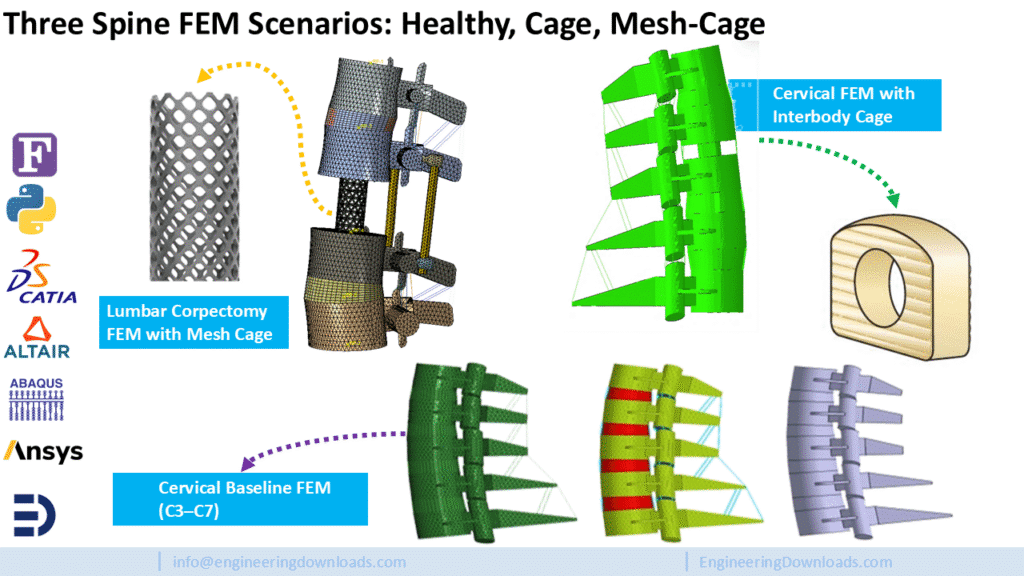
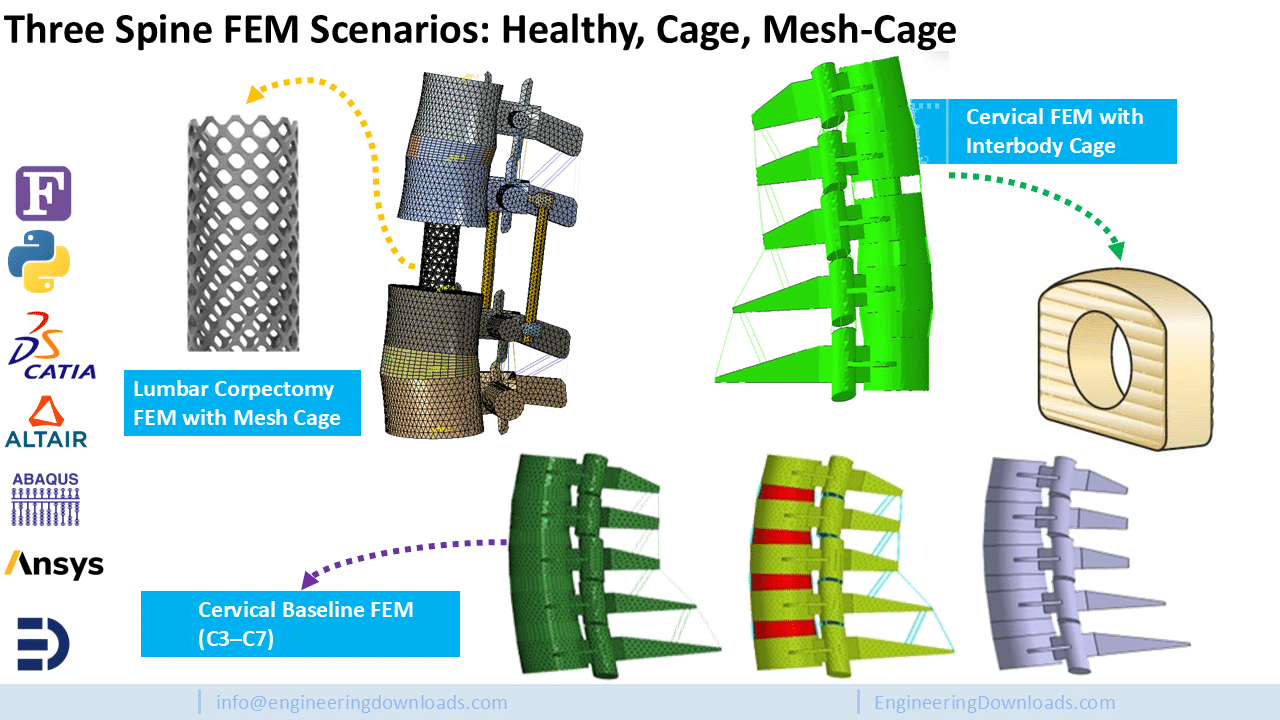
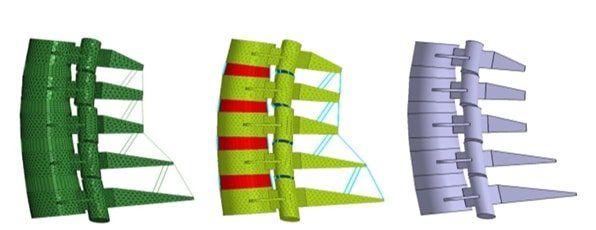
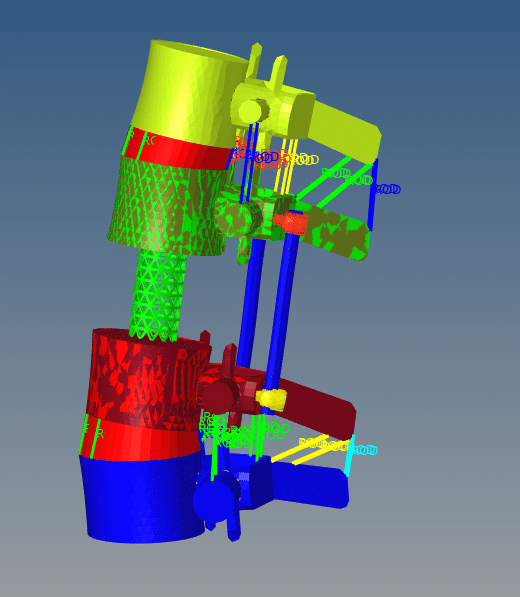



These three finite-element spine models—(1) healthy cervical C3–C7, (2) cervical with interbody cage, and (3) lumbar corpectomy with mesh cage—form a compact toolkit for understanding how implants change spinal mechanics. FEM lets us noninvasively predict segmental range of motion (ROM), intradiscal pressure (IDP), and stress/strain and contact forces in discs, facets, endplates, and the implant–bone interface under standardized pure-moment and compressive loads. With the paired cervical models you can make controlled, apples-to-apples comparisons—quantify motion restoration vs. restriction, assess load sharing through the cage, estimate subsidence risk, and explore adjacent-level effects or stiffness tuning. The lumbar mesh-cage case extends the analysis to reconstructive scenarios (e.g., tumor/trauma), helping evaluate construct stability and potential stress shielding. Shared file formats and organization (Abaqus .inp, CATIA/STEP, HyperMesh where provided) make the set ideal for R&D, education, and pre-op planning, reducing dependence on cadaver tests and enabling fast sensitivity studies and patient-specific personalization—all from a reproducible, validated baseline.


Engineering Downloads
Let’s Learn and Collaborate