Engineering Downloads

Let’s Learn and Collaborate
Engineering Downloads

Stress Analysis of Human Femur Bone Under Physiological Loading Conditions using ANSYS

50,00 60,00
50,00 60,00
29 people watching this product now!

Material Includes

  • Ansys Simulation File, CAD Model, Reference Paper

Audience

  • Mechanical Engineering students interested in Finite Element Analysis (FEA)
  • Biomedical Engineering students studying biomechanics
  • Researchers working in orthopedic biomechanics
  • Professionals involved in implant and prosthesis design
  • ANSYS beginners learning real-world structural analysis applications
  • Anyone interested in applying engineering principles to biological systems

What You Will Learn?

  • Understanding of biomechanical behavior of the human femur under different physiological activities.
  • Application of Finite Element Analysis (FEA) in ANSYS for static structural problems.
  • Implementation of realistic boundary conditions (forces, moments, fixed supports).
  • Mesh generation and element selection for accurate stress analysis.
  • Interpretation of stress distribution results and comparison between load cases.
  • Evaluation of structural safety based on stress limits.
  • Insight into applications of FEA in orthopedic implant design and biomedical engineering.

About Course

Femur FEA Simulation in ANSYS

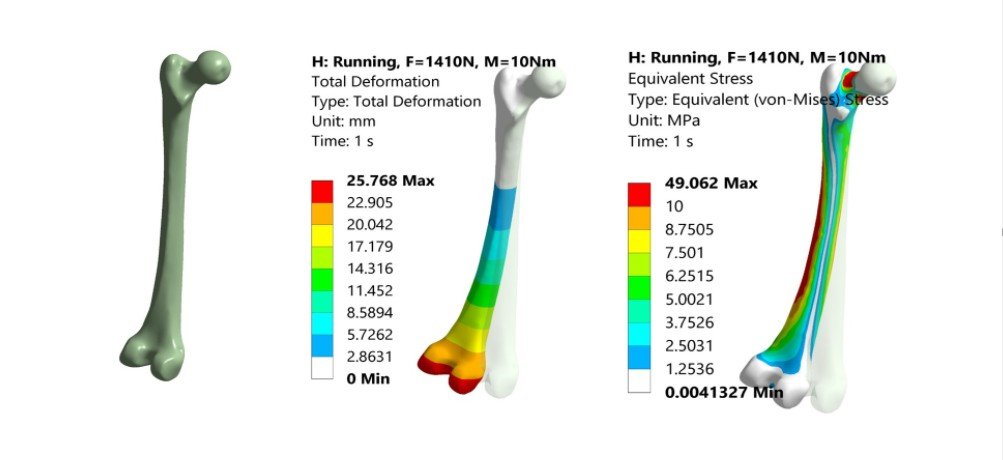
This project involves the biomechanical analysis of a human femur using Finite Element Analysis (FEA) in ANSYS under four physiological loading conditions: walking, standing, jumping, and running.

A 3D femur model was analyzed by applying loads at the knee joint while fixing the femoral head to simulate realistic boundary conditions. The following load cases were considered:

  • Walking: 750 N load with 10,000 N-mm bending moment

  • Standing: 705 N load with 0 N-mm moment

  • Jumping: 850 N load with 10,000 N-mm bending moment

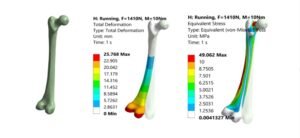
  • Running: 1410 N load with 10,000 N-mm bending moment

Static structural analysis was performed to evaluate the stress distribution developed in the femur under each condition. The material was assumed to be homogeneous and isotropic for simplification.

The results showed variation in stress levels depending on activity intensity, with running producing the highest stress and standing the lowest. All stress values remained within safe limits for a healthy femur.

This study helps in understanding femoral load-bearing behavior during daily activities and provides useful insights for orthopedic implant design and biomechanical research.

Software Used: ANSYS
Analysis Type: Static Structural
Application Domain: Biomechanics / Biomedical Engineering

Course Content

Finite Element Analysis of Human Femur Bone Under Physiological Loading Conditions
This project focuses on the finite element analysis of a human femur under four physiological loading conditions: walking (750 N), standing (705 N), jumping (850 N), and running (1410 N). The load was applied at the knee joint while the femoral head was fixed, with a bending moment of 10,000 N-mm considered for all cases except standing. Static structural analysis was performed in ANSYS to evaluate stress distribution. Results showed that running produced the highest stress, while standing produced the lowest, with all stresses remaining within safe limits.

  • Finite Element Analysis of Human Femur Under Physiological Loading Conditions

Reviews

No Review Yet
No Review Yet
50,00 60,00
29 people watching this product now!

Material Includes

  • Ansys Simulation File, CAD Model, Reference Paper

Audience

  • Mechanical Engineering students interested in Finite Element Analysis (FEA)
  • Biomedical Engineering students studying biomechanics
  • Researchers working in orthopedic biomechanics
  • Professionals involved in implant and prosthesis design
  • ANSYS beginners learning real-world structural analysis applications
  • Anyone interested in applying engineering principles to biological systems

Related  Products

See more

Want to receive push notifications for all major on-site activities?