Engineering Downloads

Let’s Learn and Collaborate
Engineering Downloads

Accurate simulation of delamination growth under mixed-mode loading using cohesive elements: Definition of interlaminar strengths and elastic stiffness

49,00 80,00
49,00 80,00
6 people watching this product now!

Material Includes

  • model.cae — Abaqus/CAE model (geometry, mesh, materials, steps, cohesive interface, outputs)
  • model.inp — Solver-ready Abaqus input file

Audience

  • FEA analysts & researchers working on composite delamination and interface fracture
  • Adhesive/laminate engineers
  • Students who want a validated example to understand traction–separation, damage evolution, and energy-based delamination growth

About Course

Paper title: Accurate simulation of delamination growth under mixed-mode loading using cohesive elements: Definition of interlaminar strengths and elastic stiffness

DOI: 10.1016/j.compstruct.2010.01.012


Paper abstract:

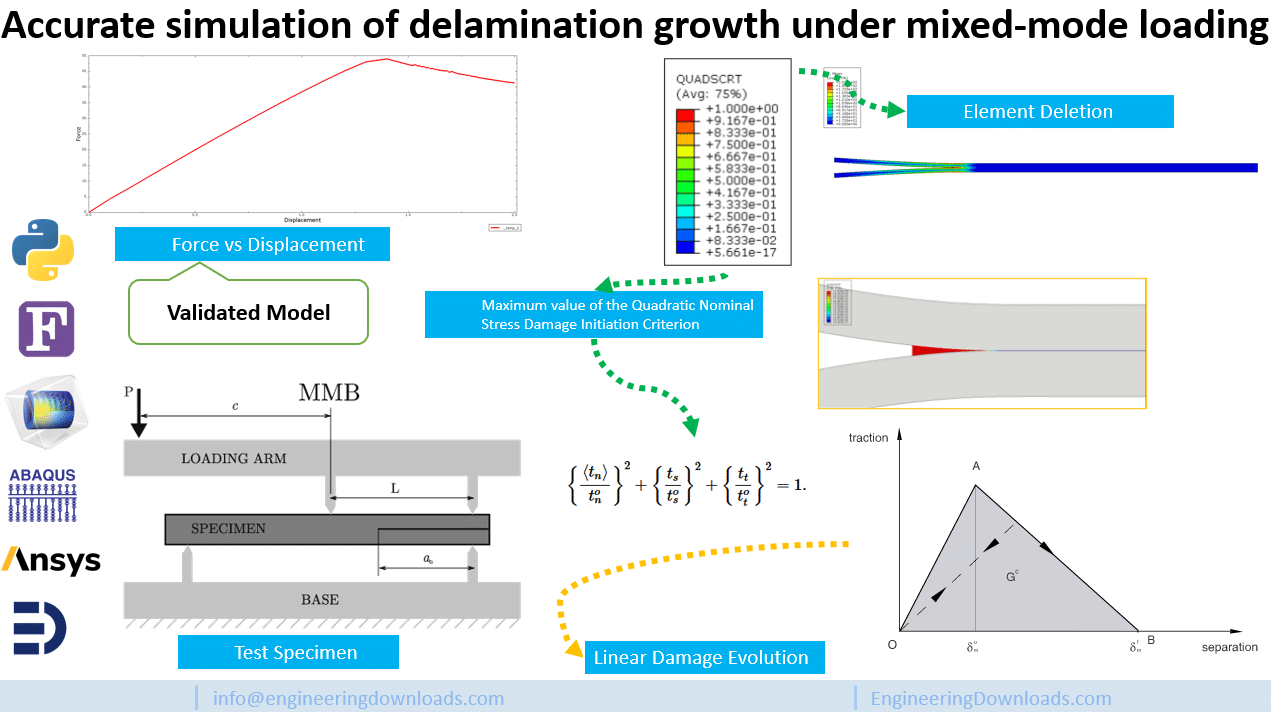
This paper proposes a cohesive-element methodology to predict delamination growth under mixed-mode loading with high accuracy. The authors show that as damage evolves, the local mode mix can shift, which—if not handled carefully—leads to wrong energy dissipation and incorrect load–displacement predictions, even when the global mode mix looks constant. To fix this, they establish consistent relations between interlaminar strengths and penalty stiffness so that the model dissipates the correct energy as the crack advances. The approach is verified across different mode ratios by comparison with LEFM-based analytical solutions.

Overview

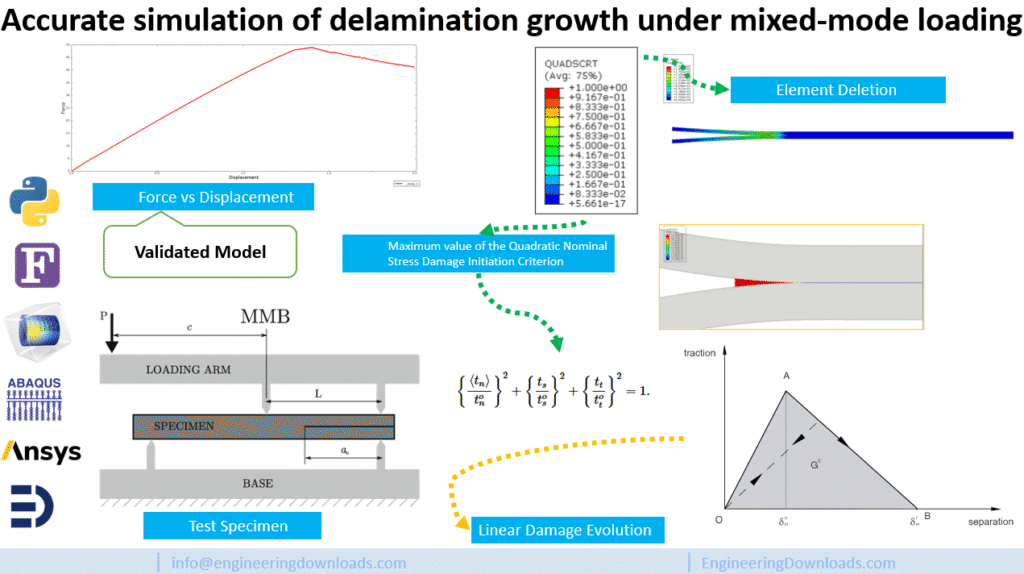
This product provides my Abaqus replication of one validated scenario from Turon et al. (2010). It’s a clean, ready-to-run example of cohesive-zone modeling (CZM) for delamination growth in composites under mixed-mode loading.

  • Cohesive theory & damage: Zero-thickness cohesive elements with a bilinear traction–separation law model the interface. As opening/sliding increases, a damage variable grows and reduces interface strength, allowing stable delamination propagation that matches the paper’s energy dissipation logic.
  • Mixed-mode consistency: The implementation follows the paper’s guidance on interlaminar strengths (normal vs. shear) and penalty stiffness, helping you avoid artificial toughness inflation when the local mode ratio changes during growth.
  • Scope: This package validates one scenario from the paper (mixed-mode delamination). It’s an ideal starting point if you want to learn, verify, or extend the method to your own laminates, joints, or adhesives.
  • Files are organized so you can open, submit, and plot load–displacement, SDEG (damage), and traction–separation results right away.

Who is this for?

  • FEA analysts & researchers working on composite delamination and interface fracture
  • Adhesive/laminate engineers needing a mixed-mode CZM reference in Abaqus
  • Students who want a validated example to understand traction–separation, damage evolution, and energy-based delamination growth

Why this model is useful

  • Demonstrates cohesive elements and damage evolution tuned for mixed-mode accuracy
  • Shows how to avoid mode-mix artifacts by relating interlaminar strengths and penalty stiffness (as discussed in the paper)
  • Gives you a solid baseline to run parametric studies (e.g., strength ratio, fracture energies, penalty stiffness) for your own structures

Course Content

Downloadable Files

  • Abaqus Files

Reviews

No Review Yet
No Review Yet
49,00 80,00
6 people watching this product now!

Material Includes

  • model.cae — Abaqus/CAE model (geometry, mesh, materials, steps, cohesive interface, outputs)
  • model.inp — Solver-ready Abaqus input file

Audience

  • FEA analysts & researchers working on composite delamination and interface fracture
  • Adhesive/laminate engineers
  • Students who want a validated example to understand traction–separation, damage evolution, and energy-based delamination growth

Related  Products

See more

Want to receive push notifications for all major on-site activities?