Demystifying Pressure Vessels: An Engineer’s Perspective
Pressure vessels are unsung heroes in countless industries, from the petrochemical giants to the pharmaceutical labs and even our everyday lives (think soda cans or scuba tanks!). These enclosed containers are designed to hold gases or liquids at a pressure substantially different from the ambient pressure. Their safe operation is paramount, as failure can lead to catastrophic consequences.
For engineers, understanding pressure vessels isn’t just about theory; it’s about practical design, rigorous analysis, and ensuring structural integrity under extreme conditions. This guide cuts through the academic jargon to give you a clear, actionable overview of what it takes to work with pressure vessels effectively.

Image: Basic illustration of a spherical pressure vessel.
What Exactly is a Pressure Vessel?
At its core, a pressure vessel is a containment unit engineered to withstand internal or external pressure differences. These pressures can be significant, ranging from a few atmospheres in simple storage tanks to hundreds of atmospheres in industrial reactors or aerospace components. Their design is a complex interplay of material science, mechanics, and stringent safety standards.
Common applications include:
- Oil & Gas: Separators, heat exchangers, storage tanks, reactors.
- Chemical Processing: Mixing tanks, distillation columns, reaction vessels.
- Power Generation: Boilers, accumulators, steam drums.
- Aerospace: Fuel tanks, oxygen tanks for spacecraft and aircraft.
- Medical: Sterilizers, hyperbaric chambers.
- Automotive: Airbag inflators, CNG/LPG tanks.
Types of Pressure Vessels by Shape
The geometry of a pressure vessel is critical to its ability to handle stress. Common shapes include:
- Spherical Vessels: Ideal for high pressures due to uniform stress distribution, minimizing localized stress concentrations.
- Cylindrical Vessels: Most common, often with hemispherical, ellipsoidal, or torispherical end caps. These are easier to fabricate than spheres.
- Rectangular Vessels: Less common for high pressures, as corners introduce significant stress concentrations, requiring substantial reinforcement.
- Multi-layered Vessels: Used for extremely high pressures, where multiple layers of material share the load.
Key Design Considerations for Pressure Vessels
Designing a pressure vessel is not just about making it strong enough; it’s about making it safe, efficient, and cost-effective throughout its lifecycle. Here are the core factors:
Material Selection
The choice of material is foundational. It must withstand the operating pressure and temperature, resist corrosion from the contained fluid, and offer good fatigue resistance.
- Carbon Steels: Common for moderate pressures and temperatures.
- Alloy Steels: Provide higher strength and better performance at elevated temperatures.
- Stainless Steels: Chosen for corrosion resistance, especially in chemical and food processing.
- Non-ferrous Alloys: Aluminum, nickel alloys (e.g., Inconel) for specialized applications like aerospace or highly corrosive environments.
- Composite Materials: Increasingly used in aerospace and automotive for lightweight, high-strength applications.
Factors influencing material choice:
- Tensile strength and yield strength
- Creep resistance (at high temperatures)
- Fatigue strength
- Corrosion resistance
- Impact toughness
- Weldability and fabricability
Operating Conditions
Understanding the exact conditions under which the vessel will operate is non-negotiable.
- Internal/External Pressure: The primary load.
- Temperature Range: Affects material properties, potential for creep, thermal expansion, and embrittlement.
- Fluid Properties: Corrosive nature, viscosity, density, phase changes.
- Cyclic Loading: Frequent pressure changes lead to fatigue.
- External Loads: Wind, seismic forces, support reactions, pipe loads, and vessel internals (agitators, trays).
Geometric Configuration
The overall shape and specific details like nozzle connections, supports, and internal components significantly impact stress distribution.
- Shell Thickness: Calculated based on pressure, diameter, material strength, and joint efficiency.
- Head Design: Hemispherical, ellipsoidal, torispherical, flat. Each has different stress characteristics.
- Nozzle Reinforcement: Openings are stress concentrators and require careful reinforcement.
- Support Structures: Legs, skirts, saddles, or lugs must transfer the vessel’s weight and operational loads safely to the foundation.
Design Codes and Standards: Your Safety Net
Pressure vessels are highly regulated due to their inherent risks. Adherence to established codes and standards is mandatory for design, fabrication, inspection, and repair.
ASME Boiler and Pressure Vessel Code (BPVC)
The ASME BPVC is the most widely adopted and comprehensive standard globally. It’s not a law, but it’s incorporated into the legal frameworks of many jurisdictions.
- Section VIII, Division 1: Rules for Construction of Pressure Vessels (most common).
- Section VIII, Division 2: Alternative Rules for Construction of Pressure Vessels (more rigorous design, often allows for thinner walls).
- Section VIII, Division 3: Alternative Rules for Construction of High Pressure Vessels.
- Section II: Materials.
- Section V: Nondestructive Examination.
- Section IX: Welding and Brazing Qualifications.
Familiarity with the applicable sections of the ASME BPVC is crucial for any engineer involved in pressure vessel work. It provides explicit rules, formulas, and material data.
Other Relevant Standards
- API (American Petroleum Institute): Standards like API 510 for Pressure Vessel Inspection, Repair, Alteration, and Rerating; API 620 for Design and Construction of Large, Welded, Low-Pressure Storage Tanks.
- EN 13445: European standard for unfired pressure vessels.
- PD 5500: British Standard for unfired fusion welded pressure vessels.
- ISO 16528: Boilers and pressure vessels.
Engineering Analysis for Pressure Vessels
Modern pressure vessel engineering relies heavily on advanced analytical and computational tools to ensure safety and optimize design.
Analytical Methods
For preliminary design and code compliance (especially under ASME Section VIII, Div. 1), analytical formulas are often sufficient. These are based on classical shell theory (e.g., thin-walled pressure vessel equations) and provide conservative estimates for stresses and minimum wall thicknesses.
Key formulas include:
- Hoop stress in a cylindrical shell: σ_h = PR/t
- Longitudinal stress in a cylindrical shell: σ_l = PR/(2t)
- Stress in a spherical shell: σ = PR/(2t)
Where P is pressure, R is radius, and t is thickness.
Finite Element Analysis (FEA)
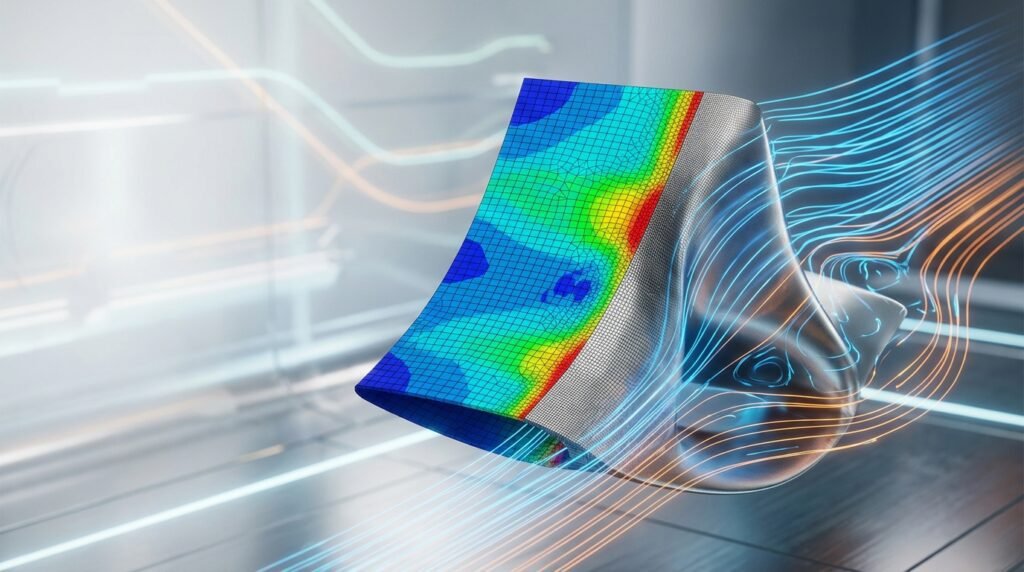
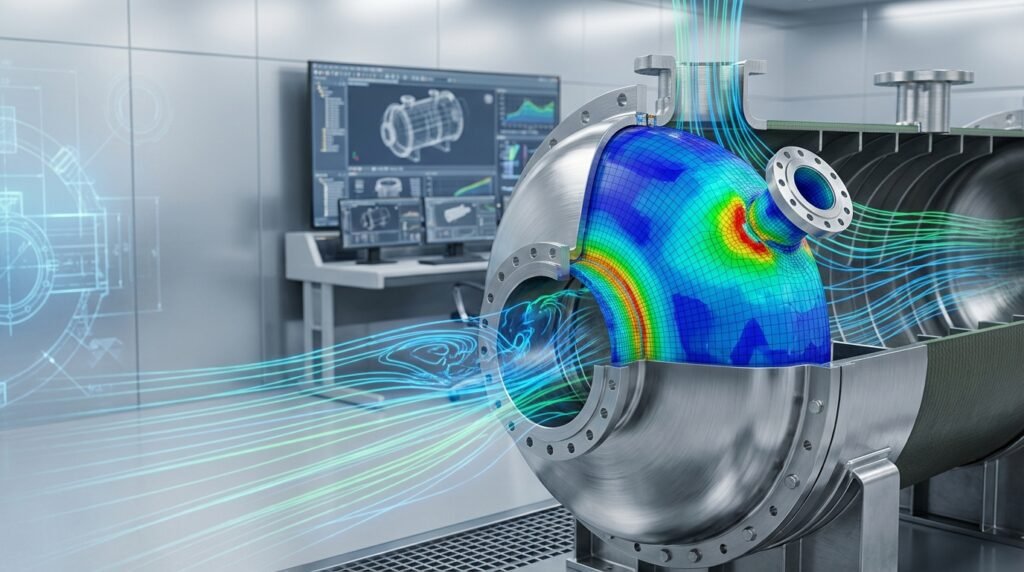
FEA is indispensable for complex geometries, non-uniform loads, detailed stress analyses, fatigue assessments, and Fitness-for-Service (FFS) evaluations that go beyond standard code formulas. Tools like Abaqus, ANSYS Mechanical, and MSC Nastran are industry standards.
Practical FEA Workflow for Pressure Vessels
Let’s outline a typical FEA process for a pressure vessel component:
Step 1: Geometry & Meshing
- Import/Create Geometry: Use CAD software (e.g., CATIA, SolidWorks) to create or import the vessel model. Simplify geometry by removing small features irrelevant to structural response (fillets, chamfers) unless they are critical stress concentrators.
- Meshing Strategy: Choose appropriate element types (shell elements for thin sections, solid elements for thick sections and nozzles). A finer mesh is required in high-stress gradient areas like nozzle-to-shell junctions or support interfaces. Aim for good element quality (aspect ratio, skewness).
Step 2: Material Properties
- Define Materials: Input accurate material properties (Young’s modulus, Poisson’s ratio, yield strength, ultimate tensile strength, thermal expansion coefficient if thermal loads are present). Consider temperature-dependent properties if applicable.
- Non-linearities: Decide if plasticity, creep, or large deformation effects need to be included. For FFS assessments, often non-linear material models are essential.
Step 3: Boundary Conditions & Loads
- Pressure Loading: Apply internal or external pressure as surface loads.
- Thermal Loads: If applicable, apply temperature distributions (either uniform or from a CFD analysis).
- Mechanical Loads: Include weight of vessel and contents, wind, seismic, pipe reactions, and support loads.
- Boundary Conditions (BCs): Apply appropriate restraints to simulate supports. Ensure that rigid body motion is prevented without over-constraining the model. For instance, pin supports at anchor bolts or fixed supports for skirt bases.
Step 4: Solution & Post-processing
- Run Analysis: Select the appropriate analysis type (static, transient, modal, fatigue).
- Interpret Results: Analyze stress contours (von Mises stress for yielding, principal stresses), displacement plots, and reaction forces. Compare stresses against allowable limits from ASME or other codes.
- Reporting: Document key results, assumptions, and conclusions clearly.
Verification & Sanity Checks in FEA
Trusting FEA results blindly is a common, and dangerous, mistake. Always perform rigorous checks:
Convergence Studies
Refine the mesh in critical areas and re-run the analysis. Stress and displacement results should converge (change minimally) as the mesh is refined. If not, the mesh is too coarse.
Hand Calculation Spot Checks
Perform simplified hand calculations (e.g., thin-walled pressure vessel formulas) for basic areas of the vessel and compare with FEA results. They won’t match perfectly in complex areas, but should be in the same ballpark for simple sections.
Visual Inspection & Deformed Shape
Review the deformed shape. Does it make physical sense? Are displacements realistic? Look for unexpected deformations or localized effects that might indicate incorrect boundary conditions or loads.
Sensitivity Analysis
Vary key input parameters (e.g., material properties within their tolerance, boundary conditions, load magnitudes) to understand the sensitivity of your results. This helps identify critical inputs and build confidence.
Common FEA Mistakes in Pressure Vessel Analysis
- Over-constraining: Applying too many or incorrect boundary conditions, leading to artificially low stresses.
- Under-constraining: Not preventing rigid body motion, leading to solver errors or incorrect results.
- Inadequate Meshing: Using too coarse a mesh in high-stress gradient regions, missing peak stresses.
- Incorrect Material Properties: Using room temperature properties for high-temperature applications.
- Ignoring Non-linearities: Assuming linear elastic behavior when plastic deformation or large displacements are expected.
- Incorrect Weld Modeling: Often, welds are simplified or ignored, but they are critical areas for stress and fatigue.
For deeper dives into FEA, consider exploring resources on EngineeringDownloads.com for downloadable project files, templates, or even online consultancy services that can guide you through complex simulations with tools like Abaqus or ANSYS Mechanical.
Fitness-for-Service (FFS) Assessments
When a pressure vessel develops flaws (corrosion, cracks, dents) or its operating conditions change, a Fitness-for-Service (FFS) assessment (e.g., API 579 / ASME FFS-1) determines if it can continue to operate safely without repair. This is a critical aspect of structural integrity and life extension.
FFS Level 3 & Advanced Techniques
FFS assessments typically range from Level 1 (simplified hand calculations) to Level 3 (advanced numerical analysis). Level 3 often involves detailed FEA to accurately characterize stress fields around flaws, predict crack growth, and assess remaining life. This can include fracture mechanics simulations and fatigue life predictions. Tools like Python or MATLAB can be used to automate post-processing of FEA results for FFS calculations.
Computational Fluid Dynamics (CFD)
While primarily a structural concern, pressure vessels often involve fluid flow and heat transfer. CFD tools (like ANSYS Fluent or OpenFOAM) are used to:
- Predict temperature distributions for thermal stress analysis.
- Analyze fluid mixing and flow patterns within reactors.
- Assess heat exchanger performance.
- Evaluate erosion or corrosion potential due to fluid flow.
The thermal maps derived from CFD can be imported into FEA software for coupled thermal-structural analysis.
Structural Integrity and Life Extension
Ensuring the long-term structural integrity of pressure vessels involves ongoing monitoring, inspection, and maintenance planning. Techniques include:
- Nondestructive Testing (NDT): Ultrasonic testing, radiographic testing, magnetic particle testing, liquid penetrant testing to detect flaws.
- Remaining Life Assessment: Predicting how much longer a vessel can safely operate, often based on fatigue analysis or creep damage assessment.
- Corrosion Management: Monitoring corrosion rates and implementing protective measures (coatings, cathodic protection).
- Repair and Alteration: Following strict procedures defined by codes (e.g., API 510) for any modifications.
Practical Tips for Pressure Vessel Engineers
Here are some actionable tips for navigating the world of pressure vessel engineering:
Checklist for Design Review
Before signing off on a design, run through this checklist:
- Code Compliance: Does the design meet ALL applicable code requirements (ASME, local regulations)?
- Material Compatibility: Is the material suitable for the fluid and operating conditions (temperature, pressure, corrosion)?
- Loading Conditions: Have ALL possible loads been considered (internal/external pressure, temperature, wind, seismic, pipe, support, fatigue)?
- Nozzle Reinforcement: Are all openings adequately reinforced?
- Welds & Fabrication: Are weld details specified correctly? Is the vessel fabricable?
- Access for Inspection: Can the vessel be easily inspected internally and externally?
- Safety Devices: Are pressure relief devices correctly sized and located?
- Support Design: Are supports adequately designed for all loads and stresses?
- Thermal Effects: Is differential thermal expansion considered for connected piping or internal components?
- Documentation: Is all design basis, calculation, and drawing documentation complete and traceable?
Troubleshooting Common Issues
Encountering problems is part of engineering. Here’s how to approach common pressure vessel issues:
- Unexpected High Stresses in FEA:
Check mesh quality in the area. Review boundary conditions and loads for over/under-constraining or incorrect application. Verify material properties. Compare with simplified hand calculations. - Fatigue Cracking:
Review cyclic loading history. Perform a detailed fatigue analysis (e.g., using S-N curves or fracture mechanics). Consider operational changes to reduce cycles or magnitude. - Corrosion/Erosion:
Identify the corrosive agent. Review material selection. Consider protective coatings, liners, or change of material. Analyze fluid velocity profiles (using CFD) if erosion is suspected. - Leakage at Flanges:
Check bolt tensioning procedures. Review gasket material compatibility and installation. Assess flange rotation and distortion (often with FEA).
| Pressure Vessel Design Parameter | Typical Range/Consideration | Impact on Design |
|---|---|---|
| Design Pressure | 0.1 MPa to >100 MPa (15 psi to >15,000 psi) | Directly dictates wall thickness and material strength requirements. |
| Design Temperature | Cryogenic to >1000 °C | Influences material selection (creep, embrittlement), thermal stresses, and code allowances. |
| Material Yield Strength | 150 MPa to >1000 MPa | Determines the allowable stress and thus minimum wall thickness. |
| Corrosion Allowance | 0 mm to 6 mm (0 to 0.25 inches) | Added thickness to account for material loss over design life; critical for longevity. |
| Weld Joint Efficiency | 0.7 to 1.0 (for ASME Div. 1) | Factor based on weld quality and NDT. Lower efficiency means thicker walls. |
EngineeringDownloads.com Resources
Mastering pressure vessel engineering requires continuous learning and access to the right tools. At EngineeringDownloads.com, we offer a growing library of practical resources:
- Downloadable FEA/CFD Project Templates: Accelerate your simulations with pre-built models and scripts.
- Python & MATLAB Automation Scripts: Streamline your design calculations, post-processing, and data analysis.
- Online Consultancy & Tutoring: Get personalized guidance for complex pressure vessel design and analysis challenges, including FEA verification and FFS assessments.
Frequently Asked Questions (FAQs)
Further Reading
For official rules and comprehensive details on pressure vessel design and construction, refer to the ASME Boiler and Pressure Vessel Code:
ASME BPVC – Boilers & Pressure Vessels
Conclusion
Pressure vessel engineering is a challenging yet rewarding field, requiring a blend of theoretical knowledge, practical application, and a strong commitment to safety. By understanding the core principles, leveraging advanced simulation tools like FEA and CFD, and meticulously adhering to codes and standards, engineers can design and maintain these critical components with confidence. Remember, continuous learning and diligent verification are your best allies in ensuring structural integrity and preventing catastrophic failures.