Understanding Imperfection Sensitivity in Engineering
As engineers, we strive for perfection in our designs and analyses. We meticulously calculate forces, optimize geometries, and specify materials. Yet, the real world is inherently imperfect. From manufacturing tolerances to material variances and unexpected loading conditions, structures rarely match their ideal blueprints exactly. This is where imperfection sensitivity comes into play – a critical concept that dictates how small deviations from an ideal state can dramatically influence a structure’s behavior, especially its stability and ultimate load-carrying capacity.
Ignoring imperfection sensitivity can lead to catastrophic failures, underestimated safety factors, and costly re-designs. In fields like aerospace, oil & gas, and structural engineering, where safety and reliability are paramount, understanding and accounting for these real-world imperfections is not just good practice, it’s non-negotiable.

Illustration of a column with an initial geometric imperfection, demonstrating how it influences buckling behavior. Image by Krishnavedala, CC BY-SA 3.0.
What Exactly is Imperfection Sensitivity?
Imperfection sensitivity refers to a structure’s propensity to exhibit a significant change in its load-carrying capacity or stiffness due to small deviations from its ideal geometry, material properties, loading, or boundary conditions. It’s particularly relevant for structures prone to buckling, such as thin shells, slender columns, and plates.
Why Imperfections Matter So Much
Imagine a perfectly straight column. Under axial compression, it will buckle elastically at a theoretical Euler buckling load. Now, introduce a tiny initial crookedness. This small imperfection immediately introduces bending moments, causing the column to deflect laterally even at very low loads. The non-linear behavior starts earlier, and the actual ultimate load the column can carry is significantly reduced compared to the ideal, perfect case.
This phenomenon isn’t limited to buckling. Imperfections can also:
- Accelerate fatigue crack initiation and propagation.
- Induce localized stress concentrations, leading to premature yielding.
- Alter dynamic response, shifting natural frequencies or amplifying vibrations.
- Reduce the collapse load of pressure vessels or pipelines.
Key Types of Imperfections
Imperfections can manifest in several ways:
Geometric Imperfections
These are deviations from the ideal shape or dimensions specified in the design. They are often the most critical type for stability problems.
- Initial Out-of-Roundness: Common in cylindrical shells and pipes, reducing buckling resistance under external pressure.
- Initial Crookedness/Straightness: Present in columns and beams, causing premature bending under axial loads.
- Local Dents or Waviness: Can occur during manufacturing or handling, creating stress concentrations.
- Misalignments: Imperfect joining of components, leading to eccentric loading.
Material Imperfections
Variations in material properties across a component or within a batch.
- Localized Yield Strength Variations: Can lead to early plasticity in specific regions.
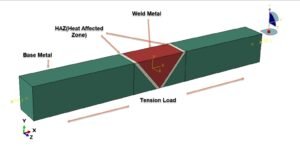
- Residual Stresses: Introduced during manufacturing (welding, forming, heat treatment), they can locally increase or decrease stress states.
- Anisotropic Properties: If a material is assumed isotropic but is actually anisotropic, it affects stiffness and strength predictions.
Loading and Boundary Condition Imperfections
Deviations from the idealized applied loads or support conditions.
- Eccentric Loading: Loads not applied precisely through the structure’s centroidal axis.
- Non-Uniform Pressure: Pressure loads that vary from the assumed uniform distribution.
- Non-Ideal Fixity: Supports that are not perfectly pinned or fixed, but rather semi-rigid.
- Dynamic Components: Unintended vibrations or impact loads.
To summarize these, consider the following table:
| Imperfection Type | Description | Common Examples | Impact on Structure |
|---|---|---|---|
| Geometric | Deviations from ideal shape/dimensions | Initial crookedness in columns, out-of-roundness in pipes, dents in shells | Premature buckling, localized stress, reduced collapse load |
| Material | Variations in material properties | Residual stresses from welding, localized strength differences, anisotropic effects | Early yielding, altered fatigue life, changed stiffness |
| Loading/BCs | Deviations in applied loads or support conditions | Eccentric loads, semi-rigid connections, unintended dynamic forces | Introduced bending moments, shifted resonance, changed load paths |
The Critical Role of Buckling Analysis
Buckling is a sudden loss of stability when compressive loads reach a critical level. It’s particularly sensitive to imperfections. In FEA, we typically distinguish between two main types of buckling analysis:
- Linear Buckling (Eigenvalue Analysis): This method predicts the theoretical critical buckling load for a perfectly elastic, geometrically perfect structure. It provides an upper bound and mode shapes that are excellent indicators of how a structure might buckle.
- Non-linear Buckling Analysis: This method accounts for large deformations, material non-linearity, and, crucially, imperfections. It provides a more realistic prediction of the actual collapse load, which is almost always lower than the linear buckling load.
For imperfection-sensitive structures, relying solely on linear buckling analysis is unsafe. The real-world behavior, influenced by even tiny imperfections, will deviate significantly from the linear prediction, potentially leading to failure at much lower loads.
Addressing Imperfection Sensitivity in Design & Analysis
Incorporating imperfection sensitivity into your design and analysis workflow is essential for robust and reliable engineering solutions.
Analytical Methods and Standards
For simpler structures or as a first pass, analytical methods and design codes provide guidelines:
- Design Codes and Standards: Organizations like ASME, API, Eurocode, and AISC provide specific clauses and reduction factors to account for imperfections. For example, pressure vessel codes often have rules for allowable out-of-roundness. FFS Level 3 assessments also often consider the impact of geometric deviations on remaining life.
- Simplified Analytical Models: For basic components like columns or plates, classical stability theory can be modified to include initial geometric imperfections (e.g., initially crooked column formulas).
Computational Methods: FEA/CAE
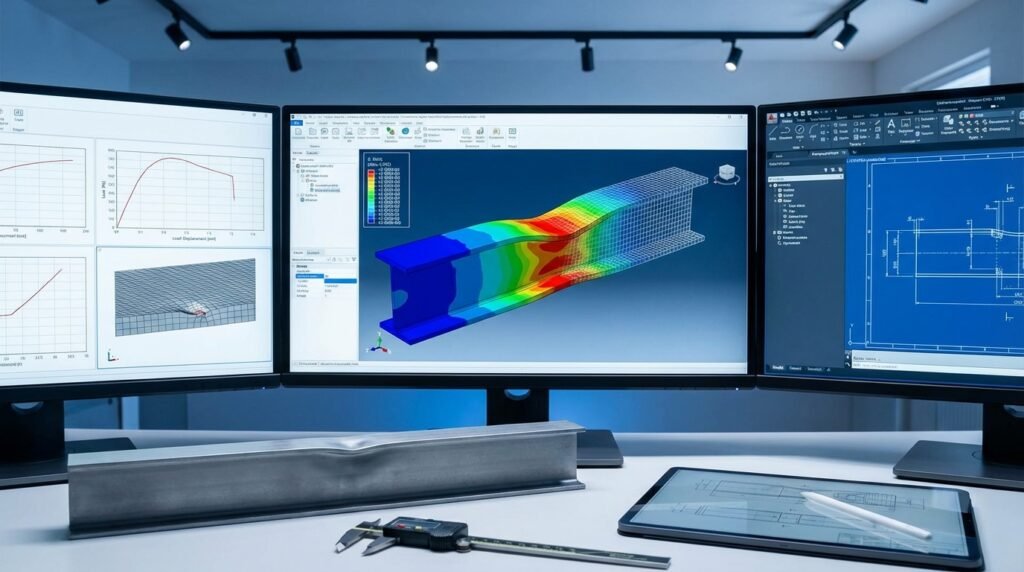
For complex geometries, loading conditions, or advanced material behaviors, Finite Element Analysis (FEA) is indispensable. Tools like Abaqus, ANSYS Mechanical, and MSC Nastran offer robust capabilities for non-linear analysis with imperfections.
Practical Workflow for Imperfection Analysis
Here’s a typical step-by-step workflow for performing an imperfection-sensitive buckling analysis:
- Perform a Baseline Linear Buckling Analysis:
- Run an eigenvalue buckling analysis (e.g.,
*BUCKLEin Abaqus, Eigenvalue Buckling in ANSYS Mechanical) on your perfect structure model. - Identify the critical buckling mode shapes and their corresponding eigenvalues (buckling load factors). These mode shapes are crucial as they represent the most likely initial deformation patterns.
- Run an eigenvalue buckling analysis (e.g.,
- Introduce Imperfections into the Model:
- Geometric Imperfections (Most Common):
- Scaling Eigenmodes: The most common approach. Perturb the perfect geometry by superimposing a scaled buckling mode shape from the linear analysis. For example, in Abaqus, you’d use the
*IMPERFECTIONoption referencing the mode shape and an amplitude. In ANSYS Mechanical, you can use the ‘Imported Imperfection’ feature. The amplitude of this imperfection is critical and typically derived from manufacturing tolerances or code requirements (e.g., L/1000, t/5). - Direct Geometric Modification: Manually model specific imperfections (e.g., a measured dent in a shell) by directly modifying the mesh or CAD geometry. This is suitable when specific defect data is available.
- Scaling Eigenmodes: The most common approach. Perturb the perfect geometry by superimposing a scaled buckling mode shape from the linear analysis. For example, in Abaqus, you’d use the
- Material Imperfections: Model residual stresses by applying initial stresses to specific elements or regions. This is more advanced and requires accurate input for stress distribution.
- Loading/BC Imperfections: Apply small eccentricities to load application points or modify boundary conditions to be semi-rigid rather than perfectly fixed.
- Geometric Imperfections (Most Common):
- Perform a Non-linear Static Analysis (with imperfections):
- Apply the service loads to the imperfect model. Use a non-linear solver with large displacement effects enabled.
- Arc-Length Method (e.g., Riks method in Abaqus, Arc-Length in ANSYS): This solver strategy is ideal for tracing the load-displacement path beyond the peak load, crucial for understanding post-buckling behavior and determining the ultimate collapse load.
- Carefully monitor the load-displacement curve. The peak load reached represents the actual collapse load of the imperfect structure.
- Parametric Studies:
- Investigate the sensitivity by varying the amplitude of the chosen imperfection mode(s). This helps determine how robust the design is to different levels of manufacturing tolerance.
- Consider Python or MATLAB scripting to automate these parametric runs and process results, especially when using tools like Abaqus or ANSYS.
Common Pitfalls in Imperfection Analysis
- Incorrect Imperfection Amplitude: Too small an amplitude might mask the sensitivity, while too large might be overly conservative and unrealistic. Refer to codes or manufacturing capabilities.
- Neglecting Material Non-linearity: For many structures, buckling occurs after some yielding. Using an elastic-perfectly plastic or hardening material model is often necessary.
- Applying Loads Incorrectly: Ensure the applied loads accurately reflect the real-world conditions on the imperfect geometry.
- Ignoring Multiple Imperfection Modes: Sometimes, the critical response comes from a combination of the first few buckling modes, not just the lowest.
For complex simulation challenges or when needing to run large models efficiently, EngineeringDownloads offers affordable HPC rental and specialized training to accelerate your project timelines.
Verification & Sanity Checks for Imperfection Analysis
Never trust a simulation blindly. Rigorous checks are vital:
- Mesh Convergence: Ensure your mesh is sufficiently refined, especially in areas where buckling or high deformation is expected. Run studies with finer meshes to confirm results are stable.
- Boundary Condition (BC) Review: Double-check that supports and constraints accurately represent real-world conditions. Small changes in BCs can drastically alter buckling behavior.
- Load Path Sanity Check: Visually inspect deformation plots at different load steps. Does the structure behave as you expect? Are loads transferring as intended?
- Solution Convergence: Monitor solver output for convergence issues. Non-linear analyses are complex; poor convergence might indicate model problems or numerical instability. Adjust increment sizes, stiffness stabilization, or non-linear solution controls.
- Sensitivity to Imperfection Amplitude: Plot the collapse load against different imperfection amplitudes. You should see a clear trend, often a rapid drop-off in load capacity with increasing imperfection size.
- Comparison with Simplified Models or Data: If possible, compare your FEA results (especially the collapse load) to analytical hand calculations, design code predictions, or experimental data (if available). This provides a crucial reality check.
Strategies for Mitigating Imperfection Sensitivity
Understanding imperfection sensitivity is the first step; mitigating its effects in design is the next:
- Design for Robustness: Increase stiffness, add stiffeners (e.g., rings or stringers in shells), or introduce redundancy to make the structure less sensitive to small deviations.
- Material Selection: Choose materials with higher yield strengths or improved ductility, which can tolerate some localized imperfections without immediate failure.
- Manufacturing Tolerances Control: Work closely with manufacturing to define realistic but tight tolerances for critical dimensions. Implement quality control measures to ensure these tolerances are met.
- Inspection and Quality Control: For existing structures or critical new builds, non-destructive testing (NDT) can identify actual imperfections, allowing for targeted repair or more accurate remaining life assessments.
- Post-Processing: For components with significant residual stresses, post-weld heat treatment (PWHT) can reduce these stresses, thereby increasing the overall load capacity and reducing imperfection sensitivity.
Practical Tips & Best Practices
Checklist for Imperfection Analysis
- Identify all potential sources and types of imperfections relevant to your structure (geometric, material, load, BCs).
- Define realistic imperfection levels, ideally derived from manufacturing data, standards, or worst-case scenarios.
- Perform linear buckling analysis to identify critical mode shapes.
- Introduce imperfections (typically scaled mode shapes) into a non-linear model.
- Use an appropriate non-linear solution method (e.g., Riks/Arc-Length) to trace the load-displacement curve to collapse.
- Conduct parametric studies by varying imperfection amplitudes and/or types.
- Perform thorough verification and sanity checks on your model and results.
- Document all assumptions, imperfection definitions, and analysis findings clearly.
Leveraging Automation
For extensive parametric studies or complex post-processing of results from tools like Abaqus, ANSYS, or OpenFOAM, scripting with Python or MATLAB is invaluable. You can automate:
- Generating multiple input files with varying imperfection amplitudes.
- Submitting multiple jobs to HPC clusters.
- Extracting and plotting critical load-displacement curves.
- Creating sensitivity plots (e.g., collapse load vs. imperfection amplitude).
Collaboration is Key
The best designs emerge from close collaboration between:
- Design Engineers: Who understand the functional requirements and initial geometry.
- Analysis Engineers: Who apply sophisticated tools like FEA to predict behavior.
- Manufacturing Engineers: Who know the limits of production processes and achievable tolerances.
- Materials Specialists: Who can advise on material behavior under various conditions.
Troubleshooting Common Imperfection Sensitivity Issues
- Model Not Converging in Non-linear Analysis:
- Check BCs: Ensure they are appropriate and not over-constraining or under-constraining.
- Load Step Size: Reduce increment size, especially around the peak load.
- Material Properties: Ensure they are realistic and defined over the full strain range. Look for numerical instabilities if using complex constitutive models.
- Mesh Quality: Refine critical regions. Distorted elements can cause convergence problems.
- Unexpected or Unrealistic Results (e.g., Collapse Load Too High/Low):
- Imperfection Amplitude: Re-evaluate if the chosen amplitude is representative. Could it be too large or too small?
- Mode Shape Direction: Ensure the imperfection is applied in the most detrimental direction.
- Material Model: Is the material model capturing plasticity or other non-linear effects correctly?
- Initial Stress State: If residual stresses are present, ensure they are correctly incorporated.
- Overly Conservative Design:
- If your analysis suggests a much lower capacity than expected, verify all inputs.
- Refine your imperfection definition. Perhaps a more detailed understanding of manufacturing processes allows for a more accurate (and less conservative) imperfection amplitude.
- Consider more advanced analysis techniques, such as probabilistic methods, if justified.
Frequently Asked Questions about Imperfection Sensitivity
Further Reading
For more in-depth information on non-linear buckling analysis and imperfection modeling in commercial FEA software, refer to the official documentation: