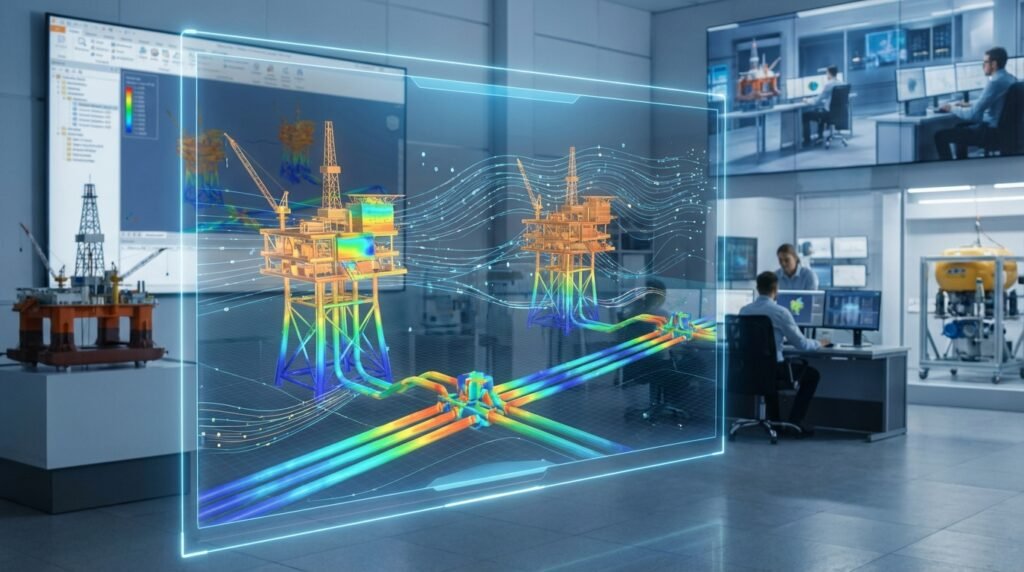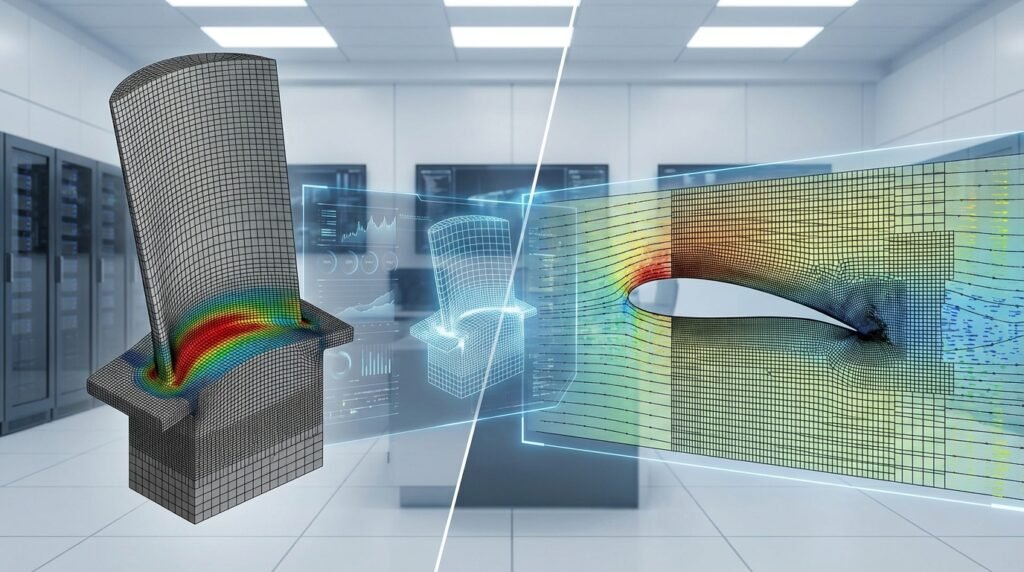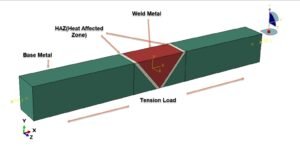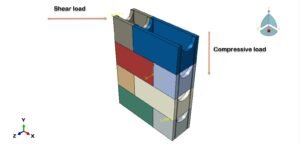
High-Performance Computing (HPC) is transforming how engineers and researchers tackle complex simulations and data-intensive tasks. Whether you’re running a finite element analysis (FEA) in Abaqus, a computational fluid dynamics (CFD) model in ANSYS Fluent, a Multiphysics simulation in COMSOL, structural analyses in OpenSees, or training a cutting-edge AI model, HPC can drastically speed up computation and handle problems that standard computers struggle with. In this blog, we’ll explore why HPC is crucial for engineering and AI, how HPC cloud services make this power accessible and affordable, and why our HPC cloud solution stands out as the cheapest, most convenient option for your simulation needs.
Why High-Performance Computing for Engineering Simulations?
Modern engineering simulations are incredibly demanding. A single simulation can involve millions of equations or elements, requiring immense CPU/GPU power and memory. On a normal workstation, such heavy workloads might run for days or simply not fit into memory. High-Performance Computing solves this by aggregating computing power – using many processors in parallel or whole clusters of machines – to tackle these tasks. The result is twofold:
- Dramatically Faster Computation: By leveraging multiple CPU cores and nodes simultaneously, HPC can perform far more operations per second than a single PC. This parallelism yields significant speedup – more CPUs means results come out faster. For example, Abaqus shows “large speed increases by allowing more cores to contribute” to a solve. A real-world case at PING (a golf equipment manufacturer) saw simulation time drop from 10 hours to just 20 minutes after switching from a desktop to an HPC cluster. That’s a 30× speed increase simply by using HPC resources. Adding specialized hardware like GPUs accelerates things further: one test showed adding an NVIDIA GPU cut an Abaqus solve time by 75% (turning a 4-hour run into 1 hour). For CFD, moving to HPC means you can run high-resolution fluid flow models that might be impractical otherwise – as one source put it, if your CFD runs are taking hours or days, HPC is the key to the next level of capability. In fact, cloud CFD platforms report up to 100× speedups on large simulations by scaling out in the cloud.
- Ability to Tackle Larger Models: HPC isn’t just about speed; it’s also about capacity. Complex simulations often need more memory or storage than a single workstation can provide. By distributing work across multiple nodes, an HPC cluster effectively pools memory and disk space, allowing much larger problems to be solved. This means you can simulate finer meshes, more detailed models, or longer time spans without running out of RAM. In COMSOL Multiphysics, for instance, running on a cluster enables you to solve big Multiphysics models that would overload a single machine. Likewise, structural engineers using OpenSees can analyze larger structures or many earthquake scenarios in parallel, thanks to HPC’s combined memory and compute. In short, HPC lets you push the limits of model size and complexity.
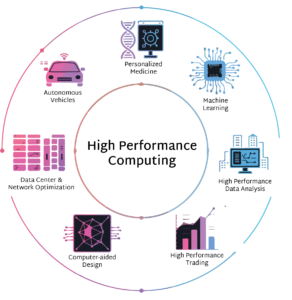
The bottom line: HPC empowers engineers to get results faster and explore more complex designs. Faster simulations translate to quicker design iterations and innovation. Instead of waiting a week for a result, you might get it overnight – or in an hour – and then improve your design accordingly. Studies show that faster simulation cycles accelerate product development and reduce time-to-market, giving companies a competitive edge. HPC allows more design variants to be tested in the same time, leading to better optimized, higher-quality products. It’s no surprise an article in Fortune dubbed HPC “the new secret weapon” for competitive engineering, as companies leveraging it (Boeing, Ford, etc.) dramatically improved their R&D efficiency.
From On-Premises to Cloud: The Advantages of HPC Cloud
Traditionally, only large organizations with big budgets could afford on-premises HPC clusters or supercomputers. These systems require hefty upfront investment, skilled IT staff to maintain, and they have fixed capacity. Today, HPC in the Cloud has emerged as a game-changer, offering the same (or greater) computing power as traditional clusters without the usual headaches. Here’s why moving your simulations to a cloud HPC platform makes sense:
- No Huge Hardware Costs: With cloud HPC, you don’t need to buy expensive servers or GPUs. Instead, you rent the resources as needed. This pay-as-you-go model turns what used to be a capital expense into an operating expense. You pay only for the compute hours you use, whether it’s for a one-off project or scaling up during a crunch. This eliminates cost constraints that used to put HPC out of reach for smaller firms or individual researchers. In fact, HPC cloud pricing has become very competitive – some providers offer 96-core high-end systems for only about €2–4 per hour (just a few euro-cents per core-hour). Our service goes even further in keeping prices as low as possible, giving you top-tier performance at the cheapest rates available.
- Scalability and Flexibility: An on-premises cluster has a fixed number of cores – if your job needs more, you’re out of luck. Cloud HPC has virtually unlimited capacity on demand. Need 32 cores for one simulation and 512 cores for the next? No problem – you can scale up or down instantly. If you have 10 simulations to run overnight, you can spawn 10 cloud instances in parallel instead of queuing them one after another. This elasticity means you’re never stuck waiting for resources. As one expert notes, cloud HPC lets engineers “easily allocate the precise number of resources needed, from a few cores to hundreds, without being constrained by local machine limits.” You can run many scenarios concurrently (say, a parametric sweep or an optimization study) to explore design alternatives faster than ever. And when you’re done, you spin down the resources and stop paying – no strings attached.
- No Maintenance, No Hassle: With our HPC cloud, you focus on your simulation, not the IT grunt work. We handle the hardware, networking, and updates behind the scenes. There’s no cluster setup, no drivers or libraries to install, no worrying about cooling a server room. As noted in a recent comparison, cloud HPC frees you from the “manual setup, license management, or hardware configuration” that on-prem HPC entails. Everything is ready to go in the cloud environment. This is a huge relief for users who don’t have dedicated IT support – essentially, HPC becomes as easy as launching an app in your web browser. Our service provides an intuitive dashboard and remote desktop access, so you can monitor runs in real time and visualize results without transferring giant files around.
- Access from Anywhere, Collaboration: Because it’s cloud-based, our HPC platform is available globally. No matter where your team is located, they can log in and harness the same powerful infrastructure. This global availability means if you’re a consulting firm or a university researcher, you can collaborate with colleagues around the world on the same large models. It also means you can tap into HPC even if you’re working from home or on the go – a simple internet connection is your gateway to a supercomputer. In today’s world of remote work and international projects, that accessibility is key.
- Flexible Pricing Plans (Daily, Weekly, Monthly): We understand that every project is different. That’s why we offer flexible rental plans – whether you need HPC for just a day, a week, or months at a time, we can accommodate. For example, if you have a thesis simulation that will take 48 hours, it might make sense to rent a beefy 64-core machine for a single day to finish it, rather than run for two weeks on a laptop. Our daily/weekly plans make such short-term usage extremely cost-effective. If you have continuous needs, monthly subscriptions are available at discounted rates. No long-term commitments are required – you use our HPC resources for exactly as long as you need, with full transparency in pricing. (And if you’re new and want to try it out, we even provide free trial credits to demonstrate the speedup you’ll gain.)
In summary, HPC cloud combines the power of supercomputing with the convenience of cloud computing. It’s no wonder the demand for “user-friendly HPC cloud solutions with preinstalled FEA/CFD software is rapidly growing” in the engineering community. Engineers get the best of both worlds: extreme performance when needed, and affordability/efficiency always.
HPC for Every Major Engineering Software (Abaqus, Ansys, COMSOL, and More)
One concern many people have is software compatibility: Will my specific simulation software run on the HPC cloud? The answer is yes – our HPC environment supports essentially any application that can run on a Linux or Windows machine, with full GPU and MPI support where applicable. In fact, leading HPC cloud providers integrate with all major commercial and open-source simulation tools, from Abaqus, Ansys, COMSOL, and Star-CCM+ to OpenFOAM, Code_Aster, and beyond. We ensure our platform is ready for the software engineers use daily:
- Abaqus (SIMULIA): Known for its strong nonlinear FEA capabilities, Abaqus can be extremely compute-intensive. Fortunately, it has built-in support for parallel processing and even GPU acceleration. On our HPC cloud, you can leverage dozens of CPU cores for Abaqus/Standard or Abaqus/Explicit jobs, slashing solve times. Remember, Abaqus on one core is slow, but “you will immediately see large speed increases by allowing more cores to contribute.” Many Abaqus users scale up to 8, 16, or more cores and see near-linear speedup for large models. If your workstation has, say, 8 cores but your model could really use 32 or 64 cores, you can get those on-demand in the cloud. This means even extremely fine-mesh simulations (think engine block analysis, complex composites, etc.) can be turned around quickly. And for supported analysis types, you can attach one or multiple GPUs to further accelerate solving – reducing wall-clock time dramatically. The end result: faster simulation, more design iterations, and hitting project deadlines with ease.
- ANSYS Fluent / CFX and Mechanical: ANSYS simulation software benefits hugely from HPC. CFD solvers like Fluent or CFX are designed to distribute meshes across multiple processors. With our HPC, you’re not limited to the few cores on your PC – you can run CFD on 32, 64, or 128 cores in parallel, enabling you to tackle high cell-count models (tens or hundreds of millions of cells) or run transient simulations that would otherwise be painfully slow. Complex flows (aeroacoustics, turbomachinery, multiphase flows) that used to require a cluster are now within reach of any engineer via our cloud. Likewise, ANSYS Mechanical (for FEA) can utilize HPC for large assemblies or detailed simulations (e.g. a full aircraft finite element model, or a high-fidelity electronics thermal analysis). If you’ve been running Fluent on a workstation and waiting days for results, moving to HPC can cut those runtimes to hours – or even minutes, depending on the scale. HPC ensures you never have to simplify your physics due to compute limits; you can use high-fidelity models to get more accurate results fast.
- COMSOL Multiphysics: COMSOL is a versatile tool coupling physics (structural, thermal, fluid, electromagnetic, etc.), and such multiphysics models can be extremely heavy to solve. Our HPC cloud is ideal for COMSOL users because it provides both the parallelism and memory needed. Large COMSOL models (fine meshes or 3D fully-coupled physics) often demand more RAM than a typical PC has – but by running on a cluster node with, say, 256 GB or 512 GB of RAM (available in our cloud), you can solve those models without running out of memory. COMSOL supports shared-memory parallelism and can also utilize distributed (cluster) parallelism for parametric sweeps or batch runs. The benefit is that what might take days on your own machine could run much faster on an 8-core or 16-core cloud instance. COMSOL’s own documentation on HPC notes that HPC is used to handle models too large or slow for a normal workstation – exactly the capability we provide. So go ahead and set up that fully coupled 3D simulation; our HPC will crunch through it.
- OpenFOAM and Open-Source CFD: Many researchers and startups use open-source solvers like OpenFOAM for CFD, or Code_Aster/Elmer for FEA. We’ve got you covered. Our platform supports these tools, and we even offer ready-to-use templates (pre-installed OpenFOAM versions, etc.) so you can get running quickly. With OpenFOAM on HPC, you can deploy “unlimited scalability” – run on as many cores as needed for your case. This is perfect for transient simulations or design of experiments where you might want to run multiple cases at once. Additionally, post-processing large CFD results is easier in the cloud where the data is local to a powerful machine – you can even use Preview in the cloud to visualize results without downloading huge files. We make open-source CAE tools first-class citizens on our cloud.
- Specialized Software (OpenSees, Simufact, etc.): We haven’t forgotten the niche and industry-specific tools. OpenSees, widely used for seismic and structural analysis, can benefit from HPC by running parameter studies (e.g., varying ground motion inputs or structural parameters) on multiple cloud cores in parallel, or by leveraging any parallel solver capabilities it has. Simufact (now part of Hexagon MSC Software) for manufacturing process simulation can also use HPC – in fact, recent versions introduced improved parallelization achieving up to 4× speedup in certain forming simulations. Our HPC instances can run Simufact Forming or Welding with ample CPU and GPU resources, enabling faster simulation of processes like forging, stamping, or welding sequences. This means manufacturing engineers can iterate on tool designs or process parameters much quicker than before. Essentially, any engineering or scientific software that runs on Windows or Linux can run on our HPC cloud – if you don’t see your tool pre-listed, just ask and we’ll help get it running.
The key takeaway is that HPC unlocks the full potential of these software packages. Most FEA/CFD/Multiphysics tools have HPC capabilities built-in, but many users haven’t been able to utilize them due to hardware limits. By using our HPC service, you can turn on all those high-performance options (multi-core solvers, distributed computing, GPU acceleration) and see your analysis fly. Complex simulations that once were impractical become routine. Engineers who adopt HPC often wonder how they ever managed without it – it’s that transformative. And with cloud, this power is no longer confined to big corporations; it’s available to anyone with a credit card and a need for speed. As an engineering blog recently noted, user-friendly cloud HPC with pre-installed simulation software is rapidly growing in demand because it lets engineers “efficiently run resource-intensive simulations” without traditional barriers.
HPC for AI and Machine Learning Workloads
It’s not just physics simulations – AI, machine learning, and data science projects also require massive computational muscle, especially as model sizes and datasets explode. Training modern AI models (like deep neural networks for image recognition, NLP, or scientific data analysis) can involve billions of computations and terabytes of data. This is another arena where our HPC cloud shines, by providing GPU-equipped instances and high-performance clusters to drastically shorten AI development cycles.
Why use HPC for AI? Because AI training demands extreme computing power. Large neural networks (think of big language models or complex vision models) can take weeks or months to train on a single normal computer. HPC changes that by spreading the workload across many GPUs and nodes in parallel. In effect, HPC lets you train in hours instead of days or days instead of weeks. For example, rather than one GPU chugging along alone, you could utilize 4 or 8 GPUs at once on our cloud, each handling a portion of the data – an approach that scales nearly linearly in many cases. An expert from the field explained that AI in HPC improves training speed by distributing work across many GPUs and nodes, so large models train in hours instead of days. We make that distribution easy: you can spin up multi-GPU virtual machines or even multi-node GPU clusters through our interface.

Benefits of using our HPC cloud for AI/ML tasks include:
- Powerful GPU Instances: We offer the latest NVIDIA GPUs (with high CUDA core counts and Tensor cores for AI) as part of our configurations. These GPUs are significantly faster than CPUs for deep learning due to their parallel architecture. You can select instances with 1, 2, 4, or more GPUs depending on your needs. All the popular AI frameworks (TensorFlow, PyTorch, etc.) run optimally on our systems, and you can leverage GPU acceleration out of the box.
- High Memory and Fast I/O: Large AI training jobs don’t just need compute; they need fast data throughput. Our HPC setups come with high-memory options (to fit large datasets or big models into RAM) and fast SSD storage. We also provide high-bandwidth networking when scaling across multiple nodes, so that communication (for distributed training) is efficient. This addresses common bottlenecks like feeding data to GPUs quickly enough. The bottom line is keeping the GPUs busy with data, which our HPC architecture is designed to do.
- Scalability for Big Experiments: Maybe you want to run a hyperparameter sweep – training dozens of model variations to find the best one. Instead of running those sequentially for months, you can launch dozens of small parallel jobs on the cloud and get results in a fraction of the time. Our platform can handle scheduling many AI jobs concurrently, and you only pay for the compute time you actually use. This means faster research iterations and more comprehensive experiments. The agility can be a competitive advantage for startups and research labs trying to innovate in AI.
- Pay-per-Use Cost Efficiency: AI hardware (like high-end GPUs) is expensive to buy and can sit idle between projects. With our cloud, you only pay when you’re actively training or testing models. For sporadic AI projects, this is far cheaper than owning hardware. Even for continuous workloads, the ability to automatically scale down during off-peak times saves money. We also don’t force you into any specific AI platform – you have full control (root access) to install your environment or use our ready-made AI images with common libraries preloaded.
In summary, HPC cloud gives AI practitioners supercomputer-level performance with the convenience of the cloud. It’s no wonder experts say “HPC infrastructure accelerates AI development – scalable, high-performance computing reduces training times and optimizes resource use.” By training models faster and handling huge datasets gracefully, our HPC service allows AI developers to iterate quickly and deploy solutions faster, which is critical in the fast-moving AI field. If you’re doing machine learning or deep learning that is pushing your single GPU to the limit, it’s time to try scaling out with our HPC cloud. Many of our clients in finance, healthcare, and academia are already using it to run things like complex simulations with machine learning, large-scale data analytics, and neural network training, with excellent results.
Our HPC Cloud Services – Powerful, Ready-to-Use, and Affordable
After discussing the immense benefits of HPC and cloud delivery, let’s introduce what we offer and why it’s the best choice for engineers, researchers, and organizations looking for HPC power:
- Ready-to-Use Environments: We provide fully configured HPC virtual machines and clusters with your choice of operating system. Need a familiar Windows Server environment for an ANSYS Workbench or MATLAB job? We have it. Prefer Ubuntu or CentOS Linux for running open-source tools and custom code? It’s available. The systems come pre-loaded with essential libraries and can include preinstalled engineering software on request. Essentially, you get a turnkey HPC system – no setup required. Just log in (via remote desktop or SSH/web interface) and start running your simulation or training your model. This saves you days of setup time compared to raw cloud VMs. We also ensure that the environment is optimized (e.g., MPI is configured, GPU drivers are in place) so your applications run at peak performance.
- High Performance Configurations: Our hardware is top-notch. We offer the latest multi-core CPUs (high-frequency Intel Xeon and AMD EPYC processors) and NVIDIA Tesla A100/RTX series GPUs for compute-heavy tasks. Ample memory (up to hundreds of GB per node) is available for memory-intensive jobs. For distributed computing, our cluster nodes are interconnected with high-speed networks. All this means your jobs run fast. We benchmark and tailor our offerings specifically for FEA, CFD, and AI workloads – for example, we know how important memory bandwidth is for CFD, or how certain simulations benefit from more cores vs. higher clock speed, and we advise you on the best instance type. Because of this specialization, you’ll get better performance per dollar with us than with generic cloud instances. We essentially give you a bespoke supercomputing service at cloud prices.
- Cheapest Pricing in the Market: We pride ourselves on offering HPC power at a cost that beats our competitors. Traditional cloud providers often charge a premium for compute-optimized instances or GPUs, and some HPC specialists require costly subscriptions. In contrast, our pricing is straightforward and genuinely budget-friendly – we want HPC to be accessible to even small engineering firms or individual PhD students. Our rates start as low as a few cents per core-hour, and our GPU hour rates are similarly affordable. We regularly monitor industry pricing (for example, we know Qarnot lists 96 cores at €2.26/hour and Rescale’s historical pricing of ~$0.10/core-hour) to ensure we are offering a better deal. Plus, with our flexible daily/weekly/monthly plans, you get discounts for longer use and don’t waste money on unused time. Simply put, when you choose us, you’re getting maximum compute for your money. Fast simulations, low bills – a combination that’s hard to find.
- Superior Customer Support: We differentiate ourselves with our client-centric service. When you rent our HPC, you’re not left on your own. Our support engineers are available around the clock to assist with any issues – be it software installation, job scheduling questions, or performance tuning. We have experience with all the software mentioned earlier (Abaqus, Ansys, COMSOL, etc., as well as machine learning frameworks), so we can help you get running and even offer tips to optimize your simulation setup for HPC. We’ll work closely with you to ensure your transition to cloud HPC is smooth. This level of support and expertise is something larger cloud platforms can’t match. We treat our clients’ success as our success, aiming to build long-term relationships. The feedback from our existing customers is that our hands-on support is a major reason they prefer us over bigger providers.
- Engineering Focus: Unlike generic cloud companies, we specialize in engineering and scientific computing. This means our entire infrastructure, tools, and team are geared toward HPC for simulation and data analysis. For example, we provide easy license server setup for commercial CAE software (so you can use your existing Abaqus/Ansys licenses in the cloud securely), and we have workflows for popular software ready to go (maybe you need to run LS-DYNA or Siemens STAR-CCM+ — we can spin up a configured node quickly). Our cloud interface might include features like remote visualization for 3D simulation results, batch script integration, and an API for automated submission of parametric studies. We continuously update software and support new versions so you can use the latest capabilities. By engineers, for engineers – that’s our philosophy.
- Global and Secure: Our HPC cloud is available globally, with data centers in multiple regions. You can choose a region near you for best performance. We also take data security seriously. All your simulation data is stored securely and can be encrypted. We can sign NDAs if needed for proprietary projects. We’ve served clients in industries from automotive to academia, and we understand concerns like ITAR, GDPR, etc. – we have solutions to meet those requirements (such as isolated environments). In short, you can trust our platform for your mission-critical simulation projects. And because it’s cloud, you and your team can collaborate and access the resources from anywhere in the world.
To sum up our offering: We deliver a powerful HPC cluster at your fingertips, with unrivaled cost-efficiency and support. With our service, an engineering student can afford a supercomputer for a weekend project, or a startup can run large simulations without capital expense, or a company can surge its computing during peak R&D periods without overbuying hardware. We believe HPC should be a tool anyone can use, not a luxury. By removing cost and complexity barriers, we help level the playing field – allowing your ingenuity to be the only limiting factor, not your computer.
Conclusion: Fast Simulations, Easy Access, Better Results
In today’s competitive environment, speed and efficiency in engineering and research are paramount. High-Performance Computing has proven to be a catalyst for innovation – enabling faster simulations, more iterations, and deeper insights. Now, with the advent of user-friendly HPC cloud services, this power is available to organizations and individuals of all sizes, globally. There’s no need to struggle with slow solve times or simplified models due to hardware constraints. By leveraging our HPC cloud, you can run state-of-the-art FEA, CFD, Multiphysics, or AI workloads with ease and at a fraction of the cost of traditional solutions.
We have built our HPC cloud platform to be the ultimate productivity boost for engineers and data scientists: it’s incredibly fast, ridiculously affordable, and simple to use. Whether you’re a seasoned analyst looking to cut a week-long simulation down to a day, or an AI developer needing dozens of GPUs for a training run, we invite you to try our services. The first time you see your job finish in minutes instead of days is a revelatory moment. It’s not just about speed – it’s about empowering you to do things that were impractical before, be it testing 50 design variants overnight or training a model on a billion data points.
In the end, adopting HPC is about achieving better outcomes. Faster computation means more optimization, which means better-performing products and research breakthroughs. As engineers, our creativity is often limited by the tools at hand – with HPC cloud, those limits are dramatically expanded. And with our customer-focused approach, you’ll have a guiding hand every step of the way. We handle the computing heavy lifting, you focus on engineering excellence.
Don’t let computing constraints hold you back. Embrace the future with HPC in the cloud – fast, flexible, and affordable. With our HPC cloud service, anyone, from an engineering student to a Fortune 500 company, can access world-class computing on demand. It’s time to run your simulations at the speed of thought and unlock new possibilities. If you’re ready to supercharge your simulations and workflows, we’re here to make it happen. Let’s launch your FEA, CFD, or AI project on our HPC cloud and experience the difference – faster results, bigger simulations, lower costs, and happy engineers!