Understanding Fracture Mechanics for Structural Integrity
Fracture mechanics is a critical discipline in engineering, providing the theoretical framework and practical tools to predict and prevent the failure of components and structures due to crack propagation. For structural engineers, material scientists, and design professionals, a deep understanding of fracture mechanics is paramount to ensuring safety, reliability, and economic viability. This guide delves into the core principles, analytical techniques, and computational approaches—including Finite Element Analysis (FEA)—essential for robust structural integrity assessments.
Why Fracture Mechanics is Indispensable
Catastrophic failures in engineering components, from aircraft fuselages to oil pipelines, often originate from pre-existing flaws or cracks. Traditional strength-of-materials approaches, which focus on yield and ultimate tensile strength, often fall short when dealing with the presence of defects. Fracture mechanics provides the necessary tools to:
- Quantify Crack Driving Force: Determine the stress state at a crack tip.
- Assess Material Resistance: Evaluate a material’s inherent ability to resist crack propagation.
- Predict Failure: Estimate the critical load or crack size that will lead to unstable fracture.
- Design for Durability: Incorporate defect tolerance into designs, especially for fatigue-critical applications.
- Perform Fitness-for-Service (FFS) Assessments: Evaluate the integrity of existing structures with detected flaws, allowing for continued operation under safe conditions, as seen in FFS Level 3 assessments in the Oil & Gas industry.
Fundamental Concepts in Fracture Mechanics
At its core, fracture mechanics revolves around understanding the local stress and strain fields around a crack tip and comparing them to a material’s intrinsic resistance to fracture.
Stress Intensity Factor (K)
For materials behaving predominantly linearly elastically, the stress field near a crack tip is characterized by the Stress Intensity Factor (K). It quantifies the ‘intensity’ of the stress singularity at the crack tip and depends on the applied load, crack size, and geometry. There are three primary modes of loading:
- Mode I (Opening Mode): Tensile stress perpendicular to the crack plane, causing crack opening. This is the most common and critical mode.
- Mode II (Sliding Mode): Shear stress acting parallel to the crack plane and perpendicular to the crack front.
- Mode III (Tearing Mode): Shear stress acting parallel to the crack plane and parallel to the crack front.
Failure occurs when the calculated stress intensity factor, K, reaches a critical value, KIC, known as the fracture toughness of the material. KIC is a material property that quantifies its resistance to brittle fracture under Mode I loading.
Energy Release Rate (G)
Introduced by Griffith, the Energy Release Rate (G) represents the rate at which elastic strain energy is released from a body as a crack extends by an incremental amount. Fracture occurs when G reaches a critical value, GC, which is also a material property. For linear elastic materials, K and G are directly related, providing alternative but equivalent criteria for fracture.
J-Integral
When significant plastic deformation occurs at the crack tip, Linear Elastic Fracture Mechanics (LEFM) becomes invalid. For such ductile materials, the J-Integral is used. It is a path-independent contour integral that characterizes the stress-strain field around a crack tip in elastic-plastic materials. J is a measure of the energy available for crack extension, and fracture occurs when J reaches a critical value, JIC (often correlated with KIC for situations where LEFM holds).
Crack Tip Opening Displacement (CTOD or δ)
Another parameter for Elastic-Plastic Fracture Mechanics (EPFM) is the Crack Tip Opening Displacement (CTOD). It represents the physical separation of the crack faces at the crack tip due to loading. CTOD is particularly useful for assessing the integrity of structures made from ductile materials and is commonly used in welding defect assessments. Fracture occurs when CTOD reaches a critical value, δC.
Linear Elastic Fracture Mechanics (LEFM) vs. Elastic-Plastic Fracture Mechanics (EPFM)
The choice between LEFM and EPFM is crucial and depends heavily on the material’s ductility and the extent of plastic deformation at the crack tip. The following table highlights their key differences:
| Feature | Linear Elastic Fracture Mechanics (LEFM) | Elastic-Plastic Fracture Mechanics (EPFM) |
|---|---|---|
| Material Behavior | Linear elastic, minimal plasticity at crack tip | Significant plasticity at crack tip, ductile materials |
| Applicability | Brittle materials, thick sections, low toughness (e.g., ceramics, high-strength steels at low temperatures) | Ductile materials, thin sections, high toughness (e.g., most structural steels, aluminum alloys) |
| Primary Parameters | Stress Intensity Factor (K), Energy Release Rate (G) | J-Integral, Crack Tip Opening Displacement (CTOD) |
| Plastic Zone Size | Negligible compared to crack length and other dimensions | Significant compared to crack length; dictates crack growth |
| Analysis Complexity | Relatively simpler, often analytical solutions for basic geometries | More complex, typically requires non-linear Finite Element Analysis (FEA) |
| Tools/Software | Analytical solutions, simple FEA | Advanced non-linear FEA (e.g., Abaqus, ANSYS Mechanical) |
Fatigue Crack Growth Analysis
Many structural failures are not due to a single overload event but rather to the progressive growth of cracks under cyclic loading, a phenomenon known as fatigue. Fatigue crack growth analysis is a vital part of fracture mechanics, especially in industries like Aerospace and Oil & Gas, where components experience millions of load cycles.
The Paris-Erdogan Law
The most widely used model for predicting stable fatigue crack growth is the Paris-Erdogan law:
da/dN = C * (ΔK)^m
Where:
da/dNis the crack growth rate per load cycle.ΔKis the range of the stress intensity factor during a load cycle.Candmare material constants determined experimentally.
Calculating the fatigue life of a component involves integrating this law from an initial crack size to a critical crack size. This requires accurate stress intensity factor solutions for changing crack geometries, often managed through computational methods.
Fracture Mechanics in Finite Element Analysis (FEA)
FEA has revolutionized fracture mechanics by enabling the analysis of complex geometries, loading conditions, and material behaviors that are intractable with analytical methods. Tools like Abaqus, ANSYS Mechanical, and MSC Patran/Nastran are indispensable for modern fracture assessments.
Practical Workflow for Fracture Mechanics FEA
Performing a fracture mechanics simulation requires careful planning and execution. Here’s a typical workflow:
1. Geometry and Crack Modeling
- CAD Integration: Start with accurate CAD models (e.g., from CATIA).
- Crack Introduction: Precisely define the crack geometry (e.g., surface crack, through-thickness crack, corner crack) and location. This is often done by creating a separate geometric feature for the crack or by partitioning the solid model.
2. Mesh Generation
- Local Refinement: Extremely fine mesh is critical in the vicinity of the crack tip to capture the high stress gradients.
- Singular Elements: Use specialized crack tip elements such as quarter-point singularity elements (for 2D and 3D) in traditional FEA. These elements are designed to replicate the square-root stress singularity at the crack tip.
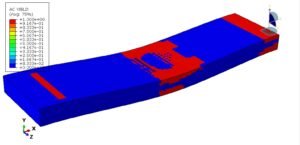
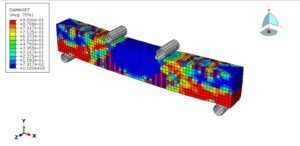
- Extended Finite Element Method (XFEM): For arbitrary crack paths or initiation, XFEM in Abaqus or ANSYS allows cracks to propagate independently of the mesh, simplifying pre-processing for complex crack growth scenarios.
- Meshing Tools: Utilize advanced meshing capabilities within Abaqus, ANSYS, or pre-processors like HyperMesh.
3. Material Modeling
- Linear Elastic: For LEFM, define Young’s Modulus and Poisson’s Ratio.
- Elastic-Plastic: For EPFM, use non-linear material models that accurately capture hardening behavior (e.g., isotropic hardening, kinematic hardening) from stress-strain curves.
4. Boundary Conditions and Loading
- Realistic Constraints: Apply appropriate boundary conditions that accurately represent the structural support.
- Applied Loads: Define external forces, pressures, or displacements that mimic operational conditions. For fatigue, ensure cyclic loading definition.
5. Analysis Setup and Execution
- LEFM Analysis: Often a static structural analysis to extract K values.
- EPFM Analysis: A non-linear static analysis is required to compute J-Integral or CTOD.
- Fatigue Crack Growth: Coupled with FEA to calculate ΔK at each step of crack propagation, often requiring iterative or automated crack extension features in the software.
- Software Choice: Abaqus and ANSYS Mechanical are leading tools offering robust fracture mechanics capabilities, including dedicated crack growth modules.
6. Post-Processing and Results Interpretation
- Extraction of Parameters: Most FEA software can directly compute and output K, J, and CTOD values.
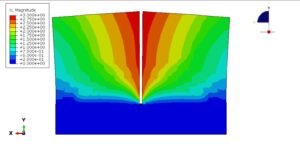
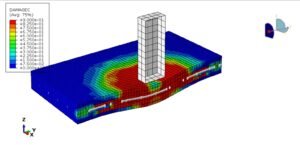
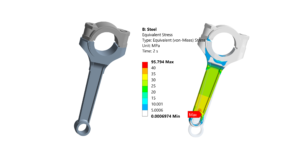
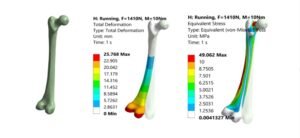
- Visualization: Plot stress contours, deformation, and crack opening profiles to qualitatively assess results.
- Post-Processing Automation: For parametric studies or extracting data from many load steps, scripting languages like Python (for Abaqus scripting) or MATLAB (for data analysis) are invaluable. You can find useful downloadable Python scripts for common fracture mechanics post-processing tasks on EngineeringDownloads.com.
Verification & Sanity Checks for Fracture Mechanics FEA
The accuracy of FEA results in fracture mechanics is highly dependent on the model setup. Rigorous verification is essential:
- Mesh Convergence Study: Systematically refine the mesh around the crack tip and observe the convergence of K, J, or CTOD. Ensure that further refinement does not significantly alter the key fracture parameters.
- Boundary Condition Sensitivity: Test the impact of minor variations in boundary conditions and loading application points. Sometimes, seemingly minor changes can significantly alter crack tip stress fields.
- Material Property Sensitivity: Conduct sensitivity analyses on critical material properties (e.g., Young’s Modulus, yield strength, fracture toughness values). This helps understand the robustness of the design against material variability. Use illustrative example values for these checks.
- Comparison with Analytical Solutions: For simplified geometries and loading (e.g., edge-cracked plate under tension), compare FEA results against well-established analytical solutions for K or J. This provides a baseline validation.
- Visual Inspection: Review the deformation and stress/strain contours. The stress singularity should be evident, and the deformation should be physically plausible. Look for any unusual distortions or unrealistic behavior.
- Energy Checks (if applicable): For non-linear analyses, check the energy balance reported by the solver to ensure numerical stability and convergence.
Advanced Applications and Automation
Structural Integrity and FFS Level 3
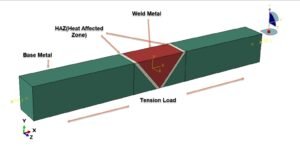
Fracture mechanics is foundational for Fitness-for-Service (FFS) assessments, especially in the Oil & Gas industry. API 579/ASME FFS-1 standards outline methodologies (e.g., Level 3 assessments) that heavily rely on advanced fracture mechanics calculations, often requiring detailed FEA to justify continued operation of pressure vessels, piping, and storage tanks with detected flaws.
Python & MATLAB for Automation and Post-Processing
Engineers are increasingly leveraging scripting languages to enhance their fracture mechanics workflows:
- Python: Essential for scripting FEA software like Abaqus (via its scripting interface) to automate model generation, submit analyses, and extract specific crack tip parameters from results files. It’s also excellent for general data manipulation and visualization.
- MATLAB: Ideal for complex post-processing of FEA results, developing custom fatigue crack growth algorithms, performing probabilistic fracture mechanics analyses, and creating interactive visualization tools for crack propagation data.
For engineers looking to accelerate their fracture mechanics simulations, EngineeringDownloads.com offers a range of downloadable FEA project templates and Python scripting examples for automated post-processing and parameter studies. Explore our resources to streamline your workflows and enhance your computational capabilities.
Conclusion
Fracture mechanics is an indispensable tool for engineers across various sectors, from Aerospace and Automotive to Biomechanics and Energy. By understanding the principles of LEFM, EPFM, and fatigue crack growth, and by effectively utilizing advanced FEA software and automation tools, engineers can ensure the structural integrity and longevity of critical components. The continuous evolution of computational methods and material characterization techniques further empowers professionals to tackle increasingly complex failure scenarios, making our engineered world safer and more reliable.