Fatigue is a phenomenon that leads to the progressive and localized structural damage when a material is subjected to cyclic or fluctuating stresses and strains. Unlike static failure, fatigue can occur at stresses significantly below the material’s yield strength, making its prediction crucial for the safety and reliability of countless engineering structures, from aircraft to bridges and oil & gas pipelines.
Understanding and accurately predicting fatigue life is paramount in modern structural engineering. This article will guide you through the fundamental concepts, practical methodologies, and advanced considerations for fatigue life prediction, especially within the context of finite element analysis (FEA).

Image: A generalized S-N (Wöhler) curve illustrating the relationship between stress amplitude and cycles to failure.
What is Fatigue?
Fatigue manifests as the initiation and propagation of cracks under repeated loading. This process is complex and influenced by various factors, including material properties, stress amplitude, mean stress, surface finish, and environmental conditions. It typically involves three stages:
- Crack Initiation: Microscopic cracks form at locations of stress concentration (e.g., notches, holes, surface imperfections, grain boundaries).
- Crack Propagation: These micro-cracks grow and coalesce into macro-cracks with continued cyclic loading.
- Final Fracture: When the crack reaches a critical size, the remaining cross-section can no longer sustain the applied load, leading to sudden, brittle fracture.
Why is Fatigue Life Prediction Crucial?
The consequences of fatigue failure can be catastrophic, leading to structural collapse, loss of life, significant economic costs, and reputational damage. Accurate fatigue life prediction allows engineers to:
- Ensure Safety: Design components that can safely withstand their intended service life.
- Optimize Designs: Avoid over-designing (which adds unnecessary weight and cost) and under-designing (which risks failure).
- Plan Maintenance: Establish inspection intervals and replacement schedules for critical components, especially in high-consequence industries like Aerospace and Oil & Gas.
- Perform Fitness-for-Service (FFS) Assessments: Evaluate the integrity of existing structures with known defects or damage, often aligning with FFS Level 3 assessments.
Key Approaches to Fatigue Life Prediction
Several methodologies exist for predicting fatigue life, each suited to different loading conditions and material behaviors.
Stress-Life (S-N) Approach
The S-N approach, also known as the Wöhler curve method, is primarily used for high-cycle fatigue (HCF) where stresses are predominantly elastic and the number of cycles to failure is high (> 104-105 cycles). It plots stress amplitude (S) against the number of cycles to failure (N) on a log-log scale.
- Input: Nominal stress amplitude, S-N curve for the material.
- Output: Number of cycles to failure.
- Considerations: Sensitive to mean stress effects (often corrected using Goodman, Gerber, or Soderberg diagrams) and surface finish. Many materials, especially ferrous metals, exhibit an “endurance limit” below which they can theoretically withstand infinite cycles.
Strain-Life (ε-N) Approach
The ε-N approach is suitable for low-cycle fatigue (LCF) where stresses are high enough to cause significant localized plastic deformation, and the number of cycles to failure is relatively low (< 104-105 cycles). It correlates plastic strain amplitude with cycles to failure using the Coffin-Manson relationship.
- Input: Local strain amplitude, ε-N curve for the material.
- Output: Number of cycles to failure.
- Considerations: Requires accurate local strain prediction, often obtained from elastoplastic FEA. More robust for predicting crack initiation in areas of high stress concentration.
Fracture Mechanics Approach (Crack Growth)
This approach is used when a pre-existing crack or defect is assumed or detected. It focuses on predicting the rate of crack propagation under cyclic loading until critical fracture occurs. Paris’s Law is a well-known model for stable crack growth.
- Input: Initial crack size, material crack growth parameters (e.g., Paris Law constants), stress intensity factor range (ΔK).
- Output: Number of cycles for the crack to grow from initial to critical size.
- Considerations: Critical for FFS assessments. Requires careful characterization of initial defects and understanding of fracture toughness. Often used in conjunction with FEA for calculating stress intensity factors (SIFs).
| Approach | Applicability | Primary Input | Key Advantage | Key Limitation |
|---|---|---|---|---|
| Stress-Life (S-N) | High-cycle fatigue (HCF), elastic stresses | Nominal Stress Amplitude | Simplicity, widely available data | Less accurate for LCF, insensitive to local plasticity |
| Strain-Life (ε-N) | Low-cycle fatigue (LCF), plastic deformation | Local Strain Amplitude | Accurate for crack initiation in local plasticity | Requires detailed local strain analysis (FEA) |
| Fracture Mechanics | Pre-existing cracks, crack propagation | Crack Size, Stress Intensity Factor | Predicts crack growth, critical for FFS | Assumes initial crack, requires specialized SIF calculation |
Practical Workflow for Fatigue Analysis in FEA
Integrating fatigue analysis into a Finite Element Analysis (FEA) workflow is a robust way to predict component life, especially for complex geometries and loading conditions common in Aerospace and Biomechanics.
Step 1: Material Characterization
Obtain comprehensive material data. This includes monotonic stress-strain curves (elastic modulus, yield strength, ultimate tensile strength), and critically, either S-N or ε-N curves. For the latter, cyclic stress-strain curves and fatigue ductility/strength coefficients are needed. Account for mean stress effects with correction models (Goodman, Gerber, Soderberg) and potentially scatter in material properties.
Step 2: Load Spectrum Definition
Accurately define the operating loads over the component’s life. This is often a complex history of varying amplitudes and frequencies. Techniques like rainflow counting are essential to condense complex load histories into an equivalent set of constant-amplitude cycles for cumulative damage calculations (e.g., Miner’s Rule). For rotating machinery, synchronous and asynchronous loads need careful consideration.
Step 3: Geometry & Mesh Generation
Create a detailed CAD model. Pay close attention to features that act as stress concentrators (fillets, holes, sharp corners). For FEA, generate an appropriate mesh. Critical areas requiring fatigue assessment demand local mesh refinement to accurately capture stress/strain gradients. Higher-order elements (e.g., quadratic) are generally preferred for stress accuracy.
Step 4: Static/Dynamic Stress Analysis (FEA)
Perform a linear static, non-linear static, or transient dynamic analysis using software like Abaqus, ANSYS Mechanical, or MSC Nastran. The type of analysis depends on the load characteristics (static, impact, vibration) and material behavior (elastic, plastic). For LCF, a non-linear analysis considering plasticity is mandatory to get accurate local strains.
Step 5: Fatigue Life Calculation
Once stresses or strains are obtained from FEA, dedicated fatigue post-processing software (often integrated into FEA suites or standalone like nCode DesignLife or fe-safe) is used. It applies the chosen fatigue theory (S-N, ε-N, fracture mechanics), material data, and load spectrum to calculate the fatigue damage and predicted life at each element or node.
Step 6: Post-Processing & Interpretation
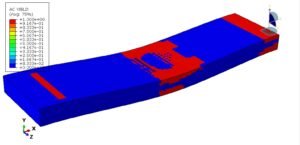
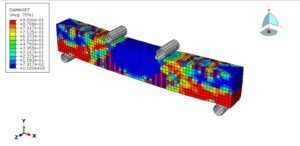
Visualize the results. Contour plots showing fatigue life, damage, or factor of safety are typical. Identify critical locations, often areas of low predicted life. Analyze the sensitivity of results to input parameters. Compare results against design targets and safety factors. Remember, fatigue predictions are inherently probabilistic; a single number should be interpreted with caution.
Common Pitfalls in Fatigue Analysis
- Inaccurate Material Data: Using generic data instead of actual test data for the specific material and condition.
- Incorrect Load Spectrum: Missing critical load events or oversimplifying real-world loading conditions.
- Insufficient Mesh Refinement: Failure to accurately capture stress concentrations, leading to underprediction of local stresses/strains.
- Neglecting Mean Stress Effects: Improperly accounting for non-zero mean stresses, which can significantly alter fatigue life.
- Ignoring Surface Effects: Surface finish, residual stresses, and environmental factors can profoundly impact fatigue life.
- Oversimplified Cumulative Damage Rule: Miner’s Rule is simple but can be non-conservative in certain loading sequences.
Verification & Sanity Checks for Fatigue Models
Robust verification and validation are critical for confidence in fatigue analysis results. Never rely solely on a single FEA output without thorough checks.
Mesh Sensitivity
Perform a mesh convergence study, especially in critical regions. Ensure that further mesh refinement in areas of high stress concentration does not significantly change the calculated local stresses or strains. A rule of thumb is to aim for at least 3-5 elements across critical radii or stress gradients.
Boundary Condition (BC) & Loading Checks
Verify that boundary conditions accurately represent real-world constraints. Check reaction forces and moments to ensure equilibrium. Visually inspect deformation plots to confirm the model behaves as expected under load. Any unexpected deformation patterns could indicate incorrect BCs or loads.
Material Property Validation
Double-check all material inputs (elastic modulus, yield strength, S-N/ε-N data). Ensure units are consistent throughout the model. If possible, compare against a second independent source or published literature values for similar materials.
Convergence Criteria
For non-linear FEA, ensure that solution convergence criteria (force, displacement, energy) are met. Diverging solutions indicate instability or errors in the model setup. For iterative fatigue calculations, ensure internal convergence of the fatigue solver.
Validation with Test Data
The most reliable check is to compare predictions against experimental fatigue test data from components or representative coupons. If direct component test data is unavailable, compare against similar industry case studies or published literature results. This is a crucial step in building confidence in the predictive capabilities of your model.
Sensitivity Analysis
Investigate how changes in key input parameters (e.g., material properties within their typical scatter, load magnitudes, manufacturing tolerances) affect the predicted fatigue life. This helps identify critical parameters and quantify the uncertainty in your predictions. Python and MATLAB can be invaluable for automating parametric studies and post-processing large datasets from sensitivity analyses.
Software Tools for Fatigue Analysis
The field benefits from a range of specialized tools:
FEA Software
Packages like Abaqus, ANSYS Mechanical, MSC Nastran, and OpenFOAM (for CFD-driven loads) provide the stress/strain results. They offer robust capabilities for linear and non-linear analysis, crucial for accurate local stress/strain calculations.
Specialized Fatigue Software
Dedicated fatigue analysis software such as nCode DesignLife, fe-safe, and FEMFAT integrate seamlessly with FEA results to perform life calculations based on various theories. These tools handle complex load histories, mean stress corrections, multi-axial fatigue, and probabilistic methods. For automating pre/post-processing tasks, scripting with Python or MATLAB can significantly enhance efficiency in CAD-CAE workflows.
Advanced Considerations & Best Practices
Surface Finish & Residual Stresses
Surface conditions significantly impact fatigue initiation. A rough surface, decarburization, or hydrogen embrittlement can reduce life. Conversely, beneficial compressive residual stresses (e.g., from shot peening or forging) can extend life by closing small cracks. FEA can sometimes model residual stresses, but their accurate representation is challenging.
Environmental Factors
Corrosive environments can drastically reduce fatigue life, leading to corrosion fatigue. High temperatures can also alter material properties and accelerate fatigue damage (creep-fatigue interaction). These factors must be considered, often requiring specialized material data and possibly coupled multi-physics simulations.
Probabilistic Fatigue
Fatigue is inherently statistical. Material properties, manufacturing tolerances, and loading conditions all have scatter. Probabilistic fatigue analysis (e.g., using Weibull distributions) helps quantify the probability of failure and design for a specified reliability target.
Welded Structures
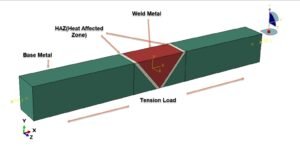
Welds are notorious for stress concentrations and material discontinuities, making fatigue prediction especially challenging. Specialized methods like the structural hot spot stress approach, effective notch stress method, or direct use of weld-specific S-N curves (often from standards like DNV or AWS) are employed.
Takeaways for Engineers
Fatigue life prediction is an essential skill in structural engineering that demands a thorough understanding of material behavior, loading conditions, and analytical methodologies. By adopting a systematic approach, leveraging advanced FEA tools, and performing rigorous verification, engineers can design durable and safe structures.
For those looking to deepen their expertise or needing computational power for complex fatigue models, EngineeringDownloads offers affordable HPC rental to run models, online/live courses, internship-style training, and project/contract consultancy for complex fatigue analysis challenges.
Further Reading
To delve deeper into fatigue testing standards, refer to ASTM E466 / E466M – 20 Standard Practice for Conducting Force Controlled Constant Amplitude Axial Fatigue Tests of Metallic Materials.
Frequently Asked Questions (FAQ)
What is the main difference between S-N and ε-N approaches?
The S-N (Stress-Life) approach is typically used for high-cycle fatigue where stresses are elastic and focuses on nominal stress amplitude. The ε-N (Strain-Life) approach is used for low-cycle fatigue, considering local plastic deformation and focusing on local strain amplitude for crack initiation.
When should I use the Fracture Mechanics approach for fatigue?
The Fracture Mechanics approach is used when a pre-existing crack or defect is present and the goal is to predict the crack’s growth rate and the remaining useful life of the component until critical fracture. It’s crucial for Fitness-for-Service assessments.
How important is mesh quality for fatigue analysis in FEA?
Mesh quality is extremely important, especially at stress concentration points. An insufficiently fine mesh can inaccurately predict local stresses and strains, leading to significant errors in fatigue life prediction. Mesh convergence studies are essential.
What are common pitfalls to avoid in fatigue life prediction?
Common pitfalls include using inaccurate material data, oversimplifying the load spectrum, neglecting mean stress effects, failing to use adequate mesh refinement, and ignoring environmental or surface finish factors that significantly influence fatigue behavior.
Can I use Python or MATLAB for fatigue analysis?
Yes, Python and MATLAB are excellent tools for automating pre-processing (e.g., parsing load histories, generating FEA inputs) and post-processing (e.g., extracting FEA results, performing custom fatigue calculations, sensitivity analysis, data visualization). While they don’t perform the core FEA or specialized fatigue calculations directly, they greatly enhance the workflow.
How does fatigue life prediction relate to FFS Level 3 assessments?
In Fitness-for-Service (FFS) Level 3 assessments, advanced analysis methods, often including detailed FEA and fracture mechanics, are used to evaluate structures with known flaws or damage. Fatigue life prediction is a core component, determining how quickly a crack might grow under operational loads and when the component would reach its critical size, ensuring continued safe operation.