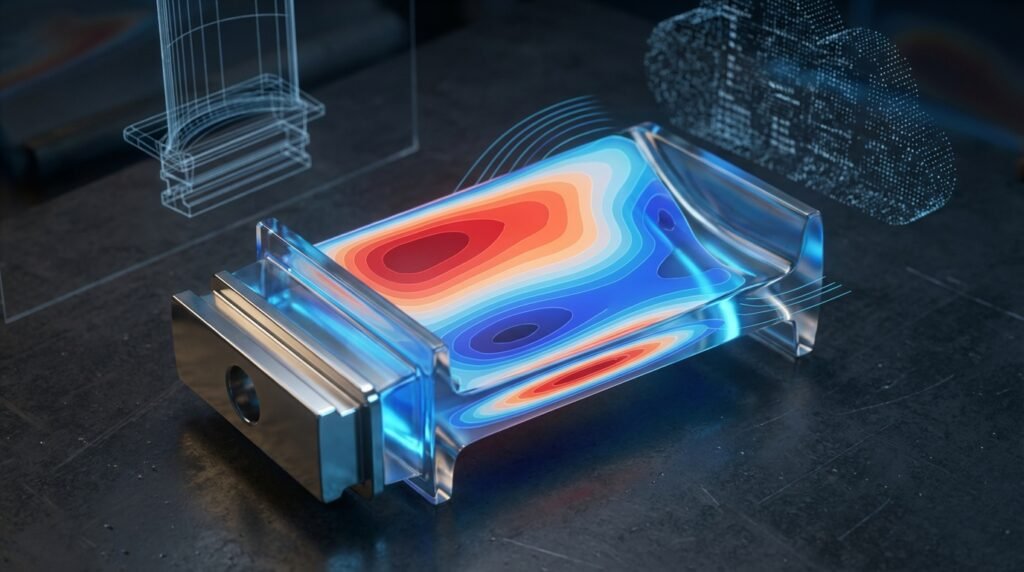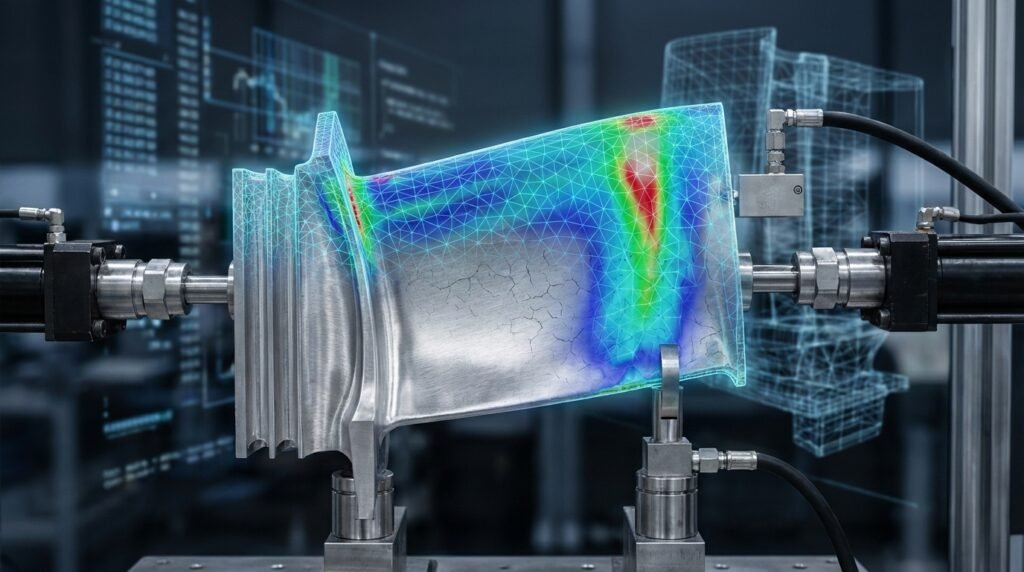
Fatigue failure is a silent killer in engineering. It affects everything from aircraft components and bridge structures to automotive parts and medical implants. Unlike sudden catastrophic failures, fatigue damage accumulates over time due to cyclic loading, often without obvious warning signs. For engineers, predicting and preventing fatigue is paramount to ensuring structural integrity and extending product lifespan.
This article dives into the practical application of Finite Element Analysis (FEA) for fatigue life prediction. We’ll explore the methodologies, walk through a typical workflow, discuss essential verification steps, and highlight common pitfalls to avoid. Our goal is to equip you with the knowledge to conduct more reliable fatigue analyses, leading to safer and more durable designs.

Image: Fatigue fracture surface of a crankshaft, revealing classic ‘beachmarks’ indicative of progressive failure under cyclic loading.
Understanding Fatigue Failure
The Basics of Fatigue
Fatigue is a localized progressive structural damage process that occurs when a material is subjected to cyclic or fluctuating stresses and strains. Even if these stresses are below the material’s yield strength, micro-cracks can initiate and propagate, eventually leading to macroscopic fracture. Key factors influencing fatigue include:
- Stress Amplitude: The range of stress experienced during each cycle.
- Mean Stress: The average stress level around which the cyclic stress fluctuates.
- Number of Cycles: The total count of load cycles applied.
- Material Properties: Strength, ductility, and inherent resistance to crack initiation and propagation.
- Geometry: Stress concentrators like notches, holes, or sharp corners significantly reduce fatigue life.
- Surface Finish: Rough surfaces provide initiation sites for cracks.
Why FEA for Fatigue?
Traditional analytical methods for fatigue prediction are often limited to simple geometries and loading conditions. Real-world engineering components, however, are complex, featuring intricate shapes, varying load paths, and localized stress concentrations. This is where FEA becomes indispensable. FEA allows engineers to:
- Accurately determine stress and strain distributions in complex geometries.
- Identify critical regions prone to crack initiation.
- Model various loading scenarios, including multi-axial and variable amplitude loads.
- Rapidly evaluate design modifications and material changes.
- Integrate with specialized fatigue analysis software to predict component life.
Key Methodologies for Fatigue Life Prediction
Several approaches exist for predicting fatigue life, each suited to different applications and stress regimes.
Stress-Life (S-N) Approach
The S-N approach, also known as the high-cycle fatigue (HCF) approach, is the most common. It relates the stress amplitude (S) to the number of cycles to failure (N) for a given material. S-N curves are typically generated from experimental data of smooth specimens subjected to constant amplitude loading.
- Application: Primarily for high-cycle fatigue (N > 10^4 cycles), where stresses are predominantly elastic.
- Advantages: Relatively simple to implement, requires less material data.
- Limitations: Does not account for plastic deformation well, sensitive to mean stress, and ignores local strain effects.
- FEA Use: FEA is used to calculate nominal stresses, which are then compared against the S-N curve, often with stress concentration factors applied.
Strain-Life (ε-N) Approach
The ε-N approach, or low-cycle fatigue (LCF) approach, focuses on local strain rather than stress. It is particularly effective when significant plastic deformation occurs at critical locations, which is common in low-cycle fatigue (N < 10^4 cycles).
- Application: Low-cycle fatigue where localized plastic deformation is present, or when analyzing notched components.
- Advantages: More accurate for situations involving plasticity, provides a better physical representation of local material response.
- Limitations: Requires more extensive material characterization (cyclic stress-strain curve, fatigue ductility coefficient), more complex to implement.
- FEA Use: FEA must perform a non-linear analysis to capture plastic strains at critical locations. These local strains are then used with the ε-N curve.
Linear Elastic Fracture Mechanics (LEFM)
While not strictly a fatigue *life prediction* from scratch, LEFM is crucial for predicting crack propagation life once a crack has initiated. It uses stress intensity factors (K) to characterize the stress field around a crack tip and relates them to crack growth rates (da/dN).
- Application: Damage tolerance analysis, life extension, predicting remaining life of components with existing flaws or cracks.
- Advantages: Provides insights into crack growth behavior and critical crack sizes.
- Limitations: Assumes an existing crack, requires knowledge of initial crack size and geometry.
- FEA Use: Specialized FEA techniques (e.g., J-integral, contour integral, XFEM) are used to calculate stress intensity factors for complex geometries.
To help visualize the differences, here’s a comparison table:
| Methodology | Primary Focus | Typical Cycles | FEA Requirement | Key Advantage |
|---|---|---|---|---|
| Stress-Life (S-N) | Nominal Stress | High-Cycle (>10^4) | Linear Elastic | Simplicity, common |
| Strain-Life (ε-N) | Local Strain | Low-Cycle (<10^4) | Non-linear Plastic | Accuracy with plasticity |
| LEFM | Crack Propagation | Variable | Specialized (K-factor) | Damage tolerance |
Practical Workflow for FEA-based Fatigue Analysis
A successful fatigue analysis integrates several steps within your CAD-CAE workflow. Here’s a structured approach:
Step 1: Material Characterization
Accurate material data is the bedrock of any reliable fatigue analysis. This includes:
- Static Properties: Young’s Modulus, Poisson’s Ratio, Yield Strength, Ultimate Tensile Strength.
- Fatigue Properties: S-N curve, ε-N curve, fatigue strength coefficient, fatigue ductility coefficient, cyclic strength coefficient, cyclic strain hardening exponent.
- Sources: Material handbooks, experimental testing (e.g., ASTM E466), or validated databases. Be cautious with generic data; seek specific grades and conditions.
Step 2: Geometry & Mesh Generation
The quality of your FEA model significantly impacts fatigue results, especially in areas of stress concentration.
- Geometry Simplification: Remove non-critical features (small fillets, holes) that don’t affect global stress but increase mesh complexity. Preserve critical features.
- Mesh Refinement: Crucial at expected stress concentration points (fillets, holes, notches, welds). Use finer elements (e.g., quadratic tetrahedral or hexahedral) in these regions to capture stress gradients accurately.
- Element Type: For S-N analysis, linear elements might suffice. For ε-N analysis, higher-order elements that can capture plastic deformation are usually required.
Step 3: Load Case Definition
Define the cyclic loading conditions the component will experience in service.
- Type of Loading: Constant amplitude, variable amplitude, random.
- Load Spectrum: For variable amplitude, a load history (time series of loads) or a load spectrum (block loading) is needed.
- Boundary Conditions (BCs): Accurately represent supports, constraints, and applied forces/pressures. Misapplied BCs are a common source of error.
Step 4: Static/Transient FEA Simulation
Perform the underlying stress/strain analysis using your chosen FEA software (e.g., Abaqus, ANSYS Mechanical, MSC Nastran).
- Linear Static: For S-N analysis, a linear elastic static solution is often sufficient to obtain stress components.
- Non-linear Static/Transient: For ε-N analysis, a non-linear analysis is necessary to capture local plasticity. This can be more computationally intensive.
- Result Extraction: Extract relevant stress (e.g., principal stresses, von Mises) or strain components from the converged FEA solution.
Step 5: Post-processing & Fatigue Calculation
This is where the FEA results are combined with material fatigue properties.
- Fatigue Software Integration: Specialized fatigue analysis software (often integrated with FEA tools like Abaqus/CAE, ANSYS nCode DesignLife, or standalone tools like fe-safe) takes the FEA stresses/strains and material data to calculate life.
- Mean Stress Correction: Apply appropriate mean stress correction theories (e.g., Goodman, Gerber, Soderberg, ASME-Elliptic, Morrow, Smith-Watson-Topper) to account for the effect of mean stress on fatigue life. This is critical.
- Damage Accumulation: For variable amplitude loading, use a damage accumulation rule (e.g., Miner’s Rule) to sum the damage from different load blocks.
Fatigue Software Integration
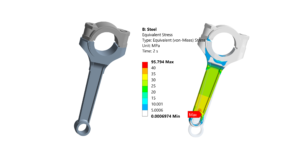
Most advanced FEA packages offer modules for fatigue analysis, or integrate seamlessly with dedicated fatigue codes. These tools automate the complex calculations involved in mean stress correction, damage accumulation, and life prediction, often presenting results graphically (e.g., contour plots of fatigue life).
Example: Stress Concentration
Consider a simple plate with a hole under tensile loading. FEA will reveal a stress concentration factor (SCF) of approximately 3.0 around the hole. This localized stress amplification is where fatigue cracks are most likely to initiate. The fatigue analysis software will then use this peak stress, coupled with the S-N curve and mean stress correction, to predict the fatigue life at that critical location.
Verification & Sanity Checks in Fatigue FEA
Never blindly trust FEA results. Thorough verification is paramount, especially for fatigue which is highly sensitive to input parameters.
Mesh Sensitivity
Perform a mesh convergence study. Ensure that further mesh refinement in critical areas does not significantly change the stress or strain results. For fatigue, local stresses can be extremely sensitive to mesh density.
Boundary Condition Review
Double-check that your boundary conditions accurately represent the real-world constraints and load application. Incorrect BCs are a frequent source of error.
Material Property Validation
Confirm that the material properties, especially fatigue-specific ones, are correct and applicable to your material and operating temperature. Slight variations can drastically alter predicted life.
Load Path Validation
Ensure that the load is transferred through the structure as expected. Visualizing stress contours and displacement plots helps confirm the structural response.
Convergence Criteria
For non-linear analyses (ε-N approach), ensure that the FEA solver has converged properly. Non-converged solutions yield meaningless results.
Hand Calculations & Benchmarking
Whenever possible, perform simplified hand calculations for a basic component or a sub-region. Compare your FEA results against these, or against published benchmark problems if available. This provides a crucial sanity check.
Common Pitfalls and How to Avoid Them
Neglecting Surface Finish
The surface condition (machined, polished, shot-peened) significantly impacts fatigue life. Ensure your material fatigue data or correction factors account for the actual surface finish of the manufactured part.
Incorrect Mean Stress Correction
Choosing the wrong mean stress correction theory can lead to substantial errors. Understand the applicability of Goodman, Gerber, Soderberg, Morrow, and Smith-Watson-Topper theories based on the material’s behavior (ductile vs. brittle) and the stress state (tensile vs. compressive mean stress).
Over-reliance on Default Material Data
Generic material properties from FEA software libraries or general handbooks may not be specific enough for your exact material grade, heat treatment, or manufacturing process. Always seek out specific data or conduct testing.
Meshing at Critical Locations
Under-meshing or using poor quality elements at stress concentration points will lead to inaccurate stress predictions, thus rendering your fatigue analysis unreliable. Always verify mesh quality metrics (aspect ratio, Jacobian) in these areas.
Ignoring Residual Stresses
Manufacturing processes like welding, shot peening, or heat treatment can induce residual stresses. These stresses act as a ‘mean stress’ on the component and can significantly affect fatigue life, often requiring advanced consideration in the analysis.
Advanced Considerations
Multiaxial Fatigue
Most real-world components experience stresses in multiple directions (multiaxial stress states). Basic S-N and ε-N curves are typically derived from uniaxial tests. Advanced multiaxial fatigue theories (e.g., critical plane methods, Dang Van criterion) are needed to accurately predict life under complex loading. Your FEA solver and fatigue software should support these.
Variable Amplitude Loading (VAL)
Components rarely experience constant amplitude cycles. Variable amplitude loading requires damage accumulation theories (like Miner’s Rule) to sum the damage caused by different stress blocks over the component’s lifetime. Understanding the load spectrum is key here.
Environmental Factors
Corrosive environments, elevated temperatures, and fretting can all significantly reduce fatigue life. These factors are challenging to model directly in FEA but must be accounted for through material property adjustments or reduction factors based on experimental data.
Takeaways for Robust Fatigue Design
- Early Integration: Incorporate fatigue analysis early in the design process to identify and mitigate risks.
- Data is King: Invest in accurate material characterization and realistic load definition.
- Mesh Wisely: Focus mesh refinement where it matters most – stress concentration zones.
- Verify, Verify, Verify: Perform diligent checks on mesh convergence, BCs, and results against hand calculations.
- Learn from Failures: Understand past failures to improve future designs and analysis methodologies.
For engineers seeking to master these techniques, EngineeringDownloads.com offers a wealth of resources, including downloadable FEA project templates for fatigue analysis and specialized scripts for post-processing. Consider our online consultancy services for expert guidance on your specific fatigue challenges.
Further Reading
For more in-depth information on fatigue analysis standards and practices, consult resources from organizations like NAFEMS or ASTM. A good starting point is the ASTM E1049 Standard Practice for Cycle Counting in Fatigue Analysis.