Fatigue failure is a silent killer in engineering, often occurring without warning after many cycles of loading, even at stress levels well below the material’s yield strength. For engineers designing critical components in aerospace, oil & gas, or automotive sectors, accurately predicting fatigue life is paramount for safety and reliability. This comprehensive guide will walk you through the practical aspects of fatigue life prediction using Finite Element Analysis (FEA), turning complex theories into actionable steps for your engineering projects.

S-N Curve for a metal under fatigue loading. Illustrative example.
Understanding Fatigue Failure and Why FEA is Key
Fatigue is a progressive, localized structural damage process that occurs when a material is subjected to cyclic loading. It typically initiates at microscopic cracks, often at stress concentrators, and propagates until the remaining cross-section can no longer withstand the applied load, leading to sudden fracture.
Why FEA for Fatigue Life Prediction?
Traditional analytical methods for fatigue analysis often rely on simplifying assumptions or require extensive experimental testing on prototypes. While experiments are crucial for validation, they can be costly and time-consuming. FEA offers a powerful, cost-effective alternative to:
- Identify stress concentration points and critical regions in complex geometries.
- Evaluate the effects of various loading scenarios, including multi-axial and variable amplitude loads.
- Optimize designs iteratively without physical prototyping.
- Assess the impact of material changes, surface finishes, and manufacturing processes on fatigue performance.
- Perform sensitivity studies to understand design robustness.
Practical Workflow for Fatigue Life Prediction using FEA
Implementing a robust fatigue analysis in FEA involves several critical steps, from model setup to post-processing. Missing any step can lead to inaccurate or misleading results.
Step 1: Geometry and Mesh Generation
The foundation of any FEA is a well-defined geometry and mesh. For fatigue analysis, mesh quality in critical regions is especially important.
- Geometry Preparation: Simplify non-critical features to reduce computational cost, but retain all details that influence stress concentrations (e.g., fillets, holes, weld toe details). Tools like CATIA, SolidWorks, or ANSYS SpaceClaim are excellent for this.
- Mesh Refinement: Employ fine mesh in areas of expected high stress (e.g., notches, corners, holes) where fatigue cracks are likely to initiate. Use structured hexahedral elements where possible for better accuracy, but tetrahedral elements are often necessary for complex geometries. Ensure good element aspect ratios and Jacobian values.
- Element Type: Use quadratic elements (e.g., C3D8R in Abaqus, SOLID186 in ANSYS Mechanical) for better stress approximation, especially for capturing stress gradients.
Step 2: Material Properties Definition
Accurate material data is non-negotiable for reliable fatigue predictions.
- Elastic Properties: Young’s Modulus, Poisson’s Ratio.
- Fatigue Properties: This is the core. For stress-life (S-N) approach, you’ll need S-N curves, which relate stress amplitude to the number of cycles to failure. For strain-life (ε-N) approach, you need cyclic stress-strain curves and Coffin-Manson parameters.
- Mean Stress Correction: Fatigue strength is sensitive to mean stress. Parameters for correction models like Goodman, Gerber, or Soderberg are often needed.
- Anisotropy: If the material exhibits anisotropic behavior (e.g., composites), these properties must be included.
Step 3: Loading and Boundary Conditions
Accurately representing the service loads and constraints is crucial.
- Load Application: Apply loads (forces, pressures, displacements, temperatures) as realistically as possible. Consider the worst-case scenario or a representative load spectrum.
- Boundary Conditions (BCs): Fix appropriate degrees of freedom to prevent rigid body motion and accurately represent supports or connections. Avoid over-constraining the model, which can lead to artificial stresses.
- Load History:
- Constant Amplitude Loading: Simplest case, where load magnitude is constant per cycle.
- Variable Amplitude Loading: More realistic. Requires a load spectrum (e.g., from service data). Rainflow counting algorithms are commonly used to convert complex load histories into an equivalent set of constant amplitude cycles. Many FEA tools like Abaqus, ANSYS Mechanical, and MSC Nastran offer integrated fatigue modules that handle these algorithms.
Step 4: Performing the FEA Simulation
Once the model is set up, the FEA solver takes over.
- Static or Transient Analysis: For stress-life, a single static analysis often suffices to get peak stresses, which are then used with fatigue theories. For strain-life or complex variable amplitude loading, multiple static steps or a full transient dynamic analysis might be needed to capture stress/strain histories.
- Nonlinearities: Consider geometric nonlinearities (large displacements, buckling) and material nonlinearities (plasticity) if they significantly influence the stress state. Fatigue often involves plastic deformation at notch roots, making nonlinear analysis important for strain-life approaches.
- Solver Settings: Ensure convergence criteria are met. For dynamic analyses, choose appropriate time steps and integration methods.
Step 5: Post-processing and Interpretation
The final step is extracting meaningful results from the FEA output.
- Stress/Strain Hotspots: Identify regions of highest stress or strain amplitude. These are your primary candidates for fatigue initiation.
- Fatigue Life Calculation: Using a dedicated fatigue module within your FEA software (e.g., Abaqus/Fatigue, ANSYS nCode DesignLife integration, Nastran Fatigue), apply the chosen fatigue theory (stress-life, strain-life) and mean stress correction model to calculate fatigue life or factor of safety at each element.
- Damage Summation: For variable amplitude loading, Miner’s rule or similar damage summation theories are used to accumulate damage from different load cycles.
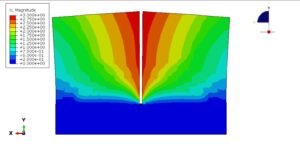
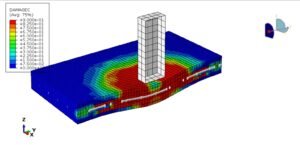
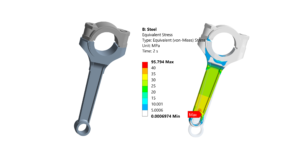
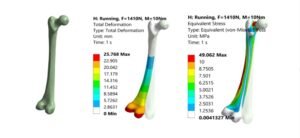
- Visualization: Generate contour plots of fatigue life, damage factor, or factor of safety to clearly identify critical areas and their predicted performance.
Common Fatigue Theories and Criteria
Selecting the right fatigue theory is crucial and depends on the material behavior, loading conditions, and desired accuracy.
| Approach | Description | Key Characteristics | Typical Application |
|---|---|---|---|
| Stress-Life (S-N) | Relates stress amplitude to cycles to failure. Focuses on total life. | Elastic behavior assumed; good for high-cycle fatigue (>10^4 cycles); relies on S-N curves. | High-cycle components (e.g., shafts, bolts, welds). |
| Strain-Life (ε-N) | Relates strain amplitude (elastic and plastic) to cycles to failure. | Accounts for local plastic deformation; good for low-cycle fatigue (<10^4 cycles); requires cyclic stress-strain data and ε-N curves. | Components with local yielding (e.g., notches, thermal cycling). |
| Multi-axial Fatigue | Analyzes fatigue under complex, multi-directional stress/strain states. | More complex, often uses critical plane approaches; required when principal stress directions rotate. | Complex geometries, rotating shafts, general components under combined loading. |
| Crack Propagation | Predicts growth of existing cracks using Fracture Mechanics principles (e.g., Paris Law). | Requires initial crack size and geometry; suitable for damage tolerance design. | Structures where cracks are unavoidable or expected (e.g., aerospace structures). |
Verification and Sanity Checks in Fatigue FEA
Trusting your FEA results blindly is a common mistake. Verification and validation are essential.
- Mesh Sensitivity: Perform a mesh convergence study to ensure your results are independent of mesh density. Refine the mesh in critical areas until the stresses or fatigue lives stabilize.
- Boundary Condition Sensitivity: Vary boundary conditions slightly to understand their impact. Are the supports over-constrained or under-constrained?
- Material Property Sensitivity: How do variations in Young’s modulus, yield strength, or S-N curve parameters affect the results?
- Analytical Checks: For simplified regions or specific load cases, compare FEA results with hand calculations or classical formulas (e.g., stress concentration factors for simple holes, beam bending stresses).
- Experimental Validation: If possible, compare FEA predictions with fatigue test data from similar components or materials. This is the ultimate validation.
- Common Sense: Do the predicted stress patterns make sense? Are the fatigue hot spots where you’d intuitively expect them to be?
Tools of the Trade for Fatigue Analysis
Several leading FEA software packages offer robust capabilities for fatigue life prediction:
- Abaqus: Strong in nonlinear analysis and offers Abaqus/Fatigue for comprehensive stress-life and strain-life analyses, including advanced mean stress corrections and multi-axial criteria.
- ANSYS Mechanical: Features powerful fatigue tools, often integrated with nCode DesignLife or FEMFAT, enabling detailed stress-life, strain-life, and weld fatigue analyses for both constant and variable amplitude loading.
- MSC Nastran/Patran: MSC Nastran with its fatigue modules provides extensive capabilities, particularly strong in aerospace and automotive applications, supporting various fatigue theories.
- HyperWorks (Altair OptiStruct/Radioss): Offers integrated fatigue tools through HyperLife, allowing for fast and accurate fatigue assessments within optimization workflows.
- OpenFOAM: While not having native fatigue modules, OpenFOAM’s extensibility with Python or MATLAB scripts allows users to implement fatigue post-processing routines based on calculated stress/strain fields.
Common Mistakes to Avoid in Fatigue FEA
Even experienced engineers can fall into these traps:
- Incorrect Material Data: Using static properties for fatigue analysis or incorrect S-N/ε-N curves for the specific material, surface finish, and environment.
- Insufficient Mesh Refinement: Overlooking mesh sensitivity in critical regions, leading to inaccurate stress peaks.
- Neglecting Mean Stress Effects: Failing to account for mean stress can significantly over- or under-predict fatigue life.
- Ignoring Manufacturing Effects: Residual stresses from welding, machining, or heat treatment can have a profound impact on fatigue life.
- Simplistic Load Representation: Assuming constant amplitude loading when the real-world load is highly variable.
- Misinterpreting Factor of Safety: A high static factor of safety does not guarantee adequate fatigue life.
Tips for Robust Fatigue Analysis
- Start Simple: Begin with a linear elastic analysis to identify potential hotspots, then move to more complex nonlinear or dynamic analyses if needed.
- Use Best Practices: Adhere to industry best practices and standards (e.g., NAFEMS guidelines) for FEA modeling and fatigue assessment.
- Understand Your Material: Invest time in gathering accurate and relevant fatigue properties for your specific material.
- Iterate and Optimize: Use FEA as an iterative design tool. Test design modifications quickly and efficiently.
- Consider Surface Finish: Surface conditions (roughness, coatings, shot peening) greatly affect fatigue resistance.
- Leverage Automation: For repetitive tasks, consider using Python or MATLAB scripts to automate pre-processing, post-processing, or parametric studies. This can significantly speed up your workflow.
Mastering fatigue life prediction using FEA is an invaluable skill for any design or structural engineer. By following a structured workflow, performing diligent verification, and avoiding common pitfalls, you can significantly enhance the reliability and safety of your designs. For engineers looking to deepen their understanding or tackle specific challenges, EngineeringDownloads.com offers downloadable templates, project files, and expert online consultancy to help you implement advanced fatigue analysis techniques effectively.