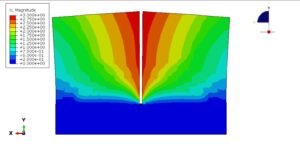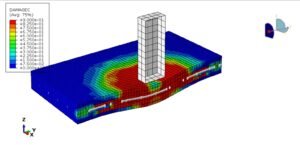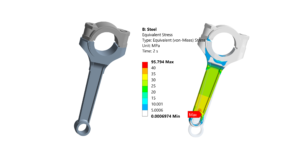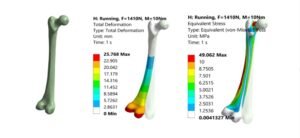
Fatigue crack growth is a critical phenomenon that can significantly compromise the structural integrity of components in various industries, from aerospace to oil & gas. For engineers working with demanding applications, understanding and accurately predicting crack propagation is not just good practice – it’s fundamental to ensuring safety, extending asset life, and complying with standards like FFS Level 3.
This guide provides a practical, engineer-to-engineer approach to fatigue crack growth analysis, focusing on methodologies, common tools, and essential verification steps to build confidence in your predictions.

Photo by Mti. Licensed under CC BY-SA 3.0.
Understanding Fatigue Crack Growth Mechanics
Before diving into the analysis, a solid grasp of the underlying mechanics is crucial. Fatigue crack growth occurs when a material is subjected to cyclic loading, even if the stresses are well below its yield strength. Microscopic cracks initiate and then grow incrementally with each load cycle.
The Basics: Stress Intensity Factor (K) and Paris Law
- Stress Intensity Factor (K): This parameter quantifies the stress state at the tip of a crack and is fundamental to fracture mechanics. It depends on the applied stress, crack size, and geometry. Higher K values indicate a more severe stress state at the crack tip.
- Paris-Erdogan Law (Paris Law): This empirical relationship is widely used to predict the rate of fatigue crack growth. It states that the crack growth rate (da/dN, where ‘a’ is crack length and ‘N’ is number of cycles) is proportional to the range of the stress intensity factor (ΔK) raised to some power:
da/dN = C (ΔK)^m. ‘C’ and ‘m’ are material constants determined experimentally.
Modes of Cracking
Cracks can propagate in three fundamental modes:
- Mode I (Opening Mode): Tensile stress perpendicular to the crack plane, pulling the crack open. This is the most common and often most critical mode for fatigue.
- Mode II (Sliding Mode): Shear stress acting parallel to the crack plane and perpendicular to the crack front.
- Mode III (Tearing Mode): Shear stress acting parallel to the crack plane and parallel to the crack front.
Factors Influencing Crack Growth
Several factors can accelerate or decelerate fatigue crack growth:
- Material Properties: Ductility, toughness, yield strength, and specific fatigue crack growth parameters (C, m).
- Stress Ratio (R): The ratio of minimum to maximum stress in a cycle (R = σ_min / σ_max). Higher R ratios generally lead to faster crack growth.
- Environment: Corrosive environments (corrosion fatigue) or high temperatures can significantly reduce fatigue life.
- Loading Spectrum: Variable amplitude loading, overloads, and underloads can introduce complex effects like crack retardation or acceleration.
- Residual Stresses: Compressive residual stresses can inhibit crack growth, while tensile residual stresses can accelerate it.
When and Why Fatigue Crack Growth Analysis is Essential
Fatigue crack growth analysis isn’t just a theoretical exercise; it’s a practical necessity in many engineering disciplines.
Failure Prevention and Fitness-for-Service (FFS)
For existing structures or components with detected flaws, FFS assessments (like those outlined in API 579-1/ASME FFS-1) often mandate Level 3 fatigue crack growth analysis. This helps determine if a component can safely remain in service for a specified period despite the presence of a flaw, guiding repair or replacement decisions.
Design Validation and Optimization
During the design phase, engineers use crack growth analysis to:
- Predict the remaining useful life of components.
- Optimize material selection and geometry to resist fatigue.
- Determine inspection intervals for critical components.
Life Extension and Maintenance Planning
For aging infrastructure or components with known service histories, crack growth analysis can support life extension programs by:
- Assessing the impact of historical loading events.
- Forecasting future crack propagation under anticipated operating conditions.
- Developing cost-effective maintenance and inspection schedules.
Practical Workflow for Fatigue Crack Growth Analysis (FEA-based)
While analytical methods provide quick estimates for simple geometries, complex structures and loading scenarios demand numerical techniques, primarily Finite Element Analysis (FEA). Here’s a typical FEA-based workflow:
Step 1: Problem Definition and Data Collection
- Component Geometry: Obtain accurate CAD models.
- Material Properties: Collect elastic modulus, Poisson’s ratio, and critical fatigue crack growth parameters (C, m for Paris Law), often from material handbooks or test data.
- Loading History: Define the cyclic stress spectrum (e.g., constant amplitude, variable amplitude, R-ratio).
- Initial Flaw Size and Location: Based on non-destructive testing (NDT) or assumed initial manufacturing defects. This is a critical input.
- Operating Environment: Temperature, corrosive agents.
Step 2: Finite Element Model Setup
- Geometry Modeling: Prepare the CAD model in your FEA software (e.g., Abaqus, ANSYS Mechanical).
- Mesh Generation: This is paramount for accuracy.
- Create a very fine mesh in the vicinity of the crack tip to capture the high stress gradients accurately.
- Use specialized crack tip elements (e.g., quarter-point singular elements) or mesh refinement techniques.
- Far from the crack, a coarser mesh is acceptable to manage computational cost.
- Crack Representation:
- eXtended Finite Element Method (XFEM): A powerful technique (available in Abaqus, ANSYS) that allows cracks to propagate through the mesh without explicit remeshing.
- Virtual Crack Closure Technique (VCCT): Calculates energy release rate for crack growth (Abaqus, ANSYS).
- Node Release/Remeshing: Explicitly remeshing the crack front at each growth increment (can be computationally intensive, often scripted with Python).
- Material Models: Typically linear elastic fracture mechanics (LEFM) is assumed, meaning plastic deformation is confined to a small region near the crack tip.
Step 3: Loading and Boundary Conditions
- Cyclic Loading: Apply the maximum and minimum loads of the cycle. For a crack growth simulation, you’re primarily interested in the difference (ΔK), but the absolute stress state is important for the R-ratio.
- Boundary Conditions: Apply appropriate constraints to prevent rigid body motion and accurately represent the structural supports.
Step 4: Stress Intensity Factor (SIF) Calculation
FEA tools offer various methods to compute SIFs:
- J-integral: A path-independent integral often used to calculate energy release rate, which can be related to SIF.
- Crack Opening Displacement (COD): Calculating the displacement of nodes near the crack tip and relating it to SIF.
- Contour Integral Method: Often employed by commercial software like Abaqus and ANSYS for accurate SIF extraction.
Step 5: Crack Growth Simulation
Once SIFs are known for a given crack length, the Paris Law is integrated over small crack length increments. The software automatically:
- Calculates ΔK for the current crack length.
- Uses Paris Law to determine the number of cycles (ΔN) required for a small crack length increment (Δa).
- Updates the crack length by Δa and repeats the process until a critical crack size is reached or the desired number of cycles is exceeded.
- Tools like Abaqus (using its direct cyclic fatigue feature or scripting its fracture capabilities with Python) and ANSYS Mechanical (using APDL commands or the Fracture module) are well-equipped for this. MSC Patran/Nastran also offers fracture mechanics capabilities.
Step 6: Post-processing and Life Prediction
- Crack Length vs. Cycles Curve (a-N curve): The primary output, showing how the crack grows over time.
- Critical Crack Size: The crack length at which the component is predicted to fail under static loading or becomes unstable.
- Remaining Useful Life: The number of cycles from the initial crack size to the critical crack size.
- Visualization: Plotting crack propagation paths and stress distributions. Python and MATLAB are excellent for scripting post-processing and creating custom plots.
Common Pitfalls in Fatigue Crack Growth Analysis
- Incorrect Material Data: Using generic C and m values instead of those specific to the material, environment, and temperature.
- Poor Mesh Quality: Insufficiently refined mesh around the crack tip can lead to highly inaccurate SIFs.
- Inadequate Load History: Simplifying complex variable amplitude loading to constant amplitude can be non-conservative.
- Choosing the Wrong SIF Calculation Method: Some methods are better suited for specific element types or crack representations.
- Ignoring Plasticity Effects: While LEFM is common, if plasticity is significant near the crack tip (large plastic zone), more advanced elastic-plastic fracture mechanics might be needed.
- Initial Flaw Assumption: If NDT data is unavailable, the assumed initial flaw size can heavily influence life prediction; always be conservative.
Verification & Sanity Checks in Fatigue Crack Growth Analysis
Confidence in your simulation results is paramount. Always perform thorough verification and sanity checks.
Mesh Sensitivity and Convergence
- Run your analysis with different mesh densities, especially around the crack tip. Ensure that your SIF results converge to a stable value as the mesh is refined. This demonstrates that your results are independent of mesh size.
Boundary Condition Review
- Visually inspect your model to confirm boundary conditions and loads are applied correctly.
- Check reaction forces to ensure they balance applied loads, indicating a properly constrained model.
SIF Validation Against Hand Calculations or Reference Solutions
- For simple geometries (e.g., edge crack in a plate, center crack), compare your FEA-derived SIFs with analytical solutions available in fracture mechanics handbooks or standards like API 579-1/ASME FFS-1. This is a powerful sanity check for your FEA setup.
Crack Path Sanity
- Does the predicted crack path make physical sense given the loading and geometry? Unrealistic paths may indicate issues with setup or material anisotropy.
Convergence Criteria for Crack Growth Increments
- Ensure that the crack growth simulation itself is stable. Check that the crack increment size (Δa) is appropriate and doesn’t lead to oscillations or non-physical jumps in the a-N curve.
Material Property Consistency
- Double-check all material inputs for consistency and correctness. Small errors in C or m values can lead to large differences in predicted life.
Sensitivity Analysis
- Perform analyses with slight variations in key input parameters (e.g., initial flaw size, material constant ‘C’ within its experimental scatter). This helps understand the robustness of your predictions and identify parameters that have the greatest impact on predicted life.
Illustrative Material Properties for Fatigue Crack Growth
The following table provides illustrative Paris Law parameters for common engineering materials. Note that actual values can vary significantly with heat treatment, manufacturing process, and environmental conditions. Always refer to specific material data for your application.
| Material (Illustrative) | Paris Law Constant C (mm/cycle / (MPa√m)^m) | Paris Law Exponent m | Application Example |
|---|---|---|---|
| Alloy Steel (e.g., AISI 4340) | 1.0 x 10⁻¹⁰ | 3.0 | Landing Gear, Drive Shafts |
| Aluminum Alloy (e.g., 7075-T6) | 2.0 x 10⁻¹¹ | 3.5 | Aircraft Fuselage, Wing Structures |
| Stainless Steel (e.g., 304L) | 5.0 x 10⁻¹¹ | 3.3 | Pressure Vessels, Piping in Oil & Gas |
| Titanium Alloy (e.g., Ti-6Al-4V) | 5.0 x 10⁻¹² | 2.8 | Turbine Blades, Medical Implants |
Advanced Considerations & Best Practices
Variable Amplitude Loading
Real-world components rarely experience constant amplitude loading. Advanced analysis methods consider load spectra, incorporating cycles counting algorithms (e.g., Rainflow counting) and accounting for load interaction effects like retardation from overloads.
Corrosion Fatigue
When cyclic loading occurs in a corrosive environment, both fatigue and corrosion mechanisms interact, often accelerating crack growth significantly. This requires specialized material data and possibly coupled electro-chemo-mechanical analysis.
Mixed-Mode Cracking
Cracks often propagate under a combination of Mode I, II, and III. Mixed-mode fracture criteria are used to predict the crack path and growth rate under such conditions.
Residual Stresses
Manufacturing processes (welding, shot peening, heat treatment) can introduce residual stresses. Incorporating these into the FEA model is crucial as they can significantly alter the effective stress range and thus the crack growth rate.
Practical Tips for Engineers
- Start Simple: If you’re new to crack growth analysis, begin with 2D models and constant amplitude loading to build foundational understanding before moving to complex 3D variable amplitude scenarios.
- Leverage Scripting: For repetitive tasks, parametric studies, or advanced post-processing, scripting with Python (e.g., Abaqus Python API, ANSYS ACT) or MATLAB can be a game-changer for efficiency and accuracy.
- Document Everything: Keep detailed records of assumptions, material properties, loading spectra, and verification steps. This is invaluable for review, reproducibility, and future projects.
- Seek Expert Guidance: Fatigue crack growth can be complex. Don’t hesitate to consult with experts or specialized resources. To tackle complex fatigue crack growth models or optimize your simulation workflow, explore EngineeringDownloads’ affordable HPC rental, specialized online courses, or project consultancy services.
Key Takeaways
- Fatigue crack growth analysis is indispensable for structural integrity, FFS assessments, and life prediction in critical industries.
- FEA is the primary tool for complex geometries and loading, requiring meticulous model setup, especially around the crack tip.
- Rigorous verification and sanity checks, including mesh sensitivity and SIF validation, are non-negotiable for trustworthy results.
- Understanding the underlying mechanics, material behavior, and potential pitfalls is key to successful and reliable analyses.
Further Reading
For a deeper dive into the theory and application of fracture mechanics and fitness-for-service assessments, consult authoritative resources such as the Iowa State University’s NDT Education Resource Center on Fracture Mechanics.