Understanding Fatigue Analysis: A Critical Discipline for Structural Integrity
In the realm of engineering design and structural integrity, understanding the long-term behavior of materials under cyclic loading is paramount. Fatigue analysis is the specialized discipline focused on predicting the life of components subjected to fluctuating stresses and strains, preventing catastrophic failures, and ensuring the reliability and safety of structures over their intended operational lifespan. This comprehensive guide from EngineeringDownloads.com delves into the principles, methodologies, and practical applications of fatigue analysis, offering actionable insights for practicing engineers.
The Imperative of Fatigue Analysis in Modern Engineering
Components in diverse industries—from aerospace and automotive to oil & gas and biomechanics—rarely experience only static loads. Turbines, aircraft wings, pressure vessels, vehicle axles, and even medical implants are routinely exposed to dynamic and repetitive stresses. Without rigorous fatigue assessment, these components are susceptible to sudden and unexpected failure, often without prior warning, leading to significant safety hazards, economic losses, and reputational damage.
Fatigue failure typically occurs at stress levels well below the material’s yield strength, making it a insidious threat. It initiates as microscopic cracks at stress concentrations (e.g., notches, holes, welds) which then propagate with each loading cycle until the remaining cross-section can no longer sustain the applied load, leading to brittle fracture. Effective fatigue analysis is thus not just good practice; it is an engineering mandate.
What is Fatigue? The Mechanism of Failure
Fatigue is a localized, progressive structural damage process that occurs when a material is subjected to repeated or fluctuating stresses and strains. The key characteristics include:
- Initiation: Microscopic cracks form, often at surface imperfections, inclusions, or stress risers.
- Propagation: These cracks grow incrementally with each load cycle. The rate of propagation is influenced by stress intensity, material properties, and environmental factors.
- Final Fracture: When the crack reaches a critical size, the remaining material can no longer support the load, resulting in sudden brittle fracture.
Unlike static failure, which is typically driven by plastic deformation or ultimate strength limits, fatigue is a cumulative damage process. The number of cycles to failure (fatigue life) is inversely related to the applied stress amplitude. Understanding this relationship is central to any fatigue assessment.
Fundamentals of Fatigue Analysis
A robust fatigue analysis hinges on several fundamental concepts and a thorough understanding of material behavior under cyclic loads.
Key Concepts and Terminology
Stress-Life (S-N) Approach
The S-N approach, also known as the high-cycle fatigue (HCF) approach, is widely used for components expected to undergo a large number of cycles (typically greater than 104-105 cycles) where stresses are predominantly elastic. It involves plotting the applied stress amplitude (S) against the number of cycles to failure (N) on a log-log scale. For some materials (e.g., steels), an ‘endurance limit’ or ‘fatigue limit’ exists, below which fatigue failure theoretically will not occur, regardless of the number of cycles.
Strain-Life (ε-N) Approach
The ε-N approach is particularly suited for low-cycle fatigue (LCF) applications, where stresses are high enough to cause significant plastic deformation (typically less than 104 cycles). This method considers the total strain amplitude (elastic + plastic) as the primary driving force for fatigue. It is often more accurate for predicting crack initiation in situations with high stress concentrations or thermal cycling.
Fracture Mechanics Approach
When an initial crack or flaw is known to exist, or when crack propagation dominates the fatigue life, the fracture mechanics approach is employed. This method uses concepts like the stress intensity factor (K) to characterize the stress field at the crack tip and predict crack growth rates (da/dN) based on parameters like ΔK (stress intensity factor range). This is crucial for Fitness-for-Service (FFS) Level 3 assessments, particularly in the oil & gas industry, where existing flaws need to be evaluated for continued safe operation.
Mean Stress Effects (Goodman, Gerber, Soderberg)
The mean stress (average stress over a cycle) significantly influences fatigue life. Tensile mean stresses generally reduce fatigue life, while compressive mean stresses can increase it. Various empirical models—such as Goodman, Gerber, and Soderberg—are used to account for mean stress effects when converting experimental constant amplitude fatigue data (typically obtained under fully reversed loading) to real-world loading conditions.
Loading Types (Constant Amplitude, Variable Amplitude)
- Constant Amplitude Loading (CAL): The stress amplitude remains constant throughout the loading history. This is often used for experimental characterization.
- Variable Amplitude Loading (VAL): The stress amplitude changes over time, mimicking real-world conditions. This requires more complex analysis, often involving cycle counting algorithms (e.g., Rainflow counting) and cumulative damage theories.
Cumulative Damage (Miner’s Rule)
For variable amplitude loading, Miner’s Rule (also known as the Palmgren-Miner linear damage rule) is widely used to estimate cumulative fatigue damage. It assumes that each stress cycle consumes a fraction of the total fatigue life, and failure occurs when the sum of these fractions reaches unity. While simple, it provides a reasonable engineering approximation for many applications.
Factors Influencing Fatigue Life
Several critical factors dictate the fatigue life of a component:
- Material Properties: Ultimate Tensile Strength (UTS), Yield Strength (YS), modulus of elasticity, and specific fatigue properties (e.g., fatigue limit, fatigue strength coefficients). Ductile materials generally exhibit better fatigue resistance.
- Geometry and Stress Concentrations: Sharp corners, holes, fillets, and sudden changes in cross-section create stress concentrations, which are prime sites for fatigue crack initiation. Effective design minimizes these.
- Surface Finish and Residual Stresses: A rough surface finish can introduce micro-notches, reducing fatigue life. Compressive residual stresses (e.g., from shot peening) can significantly improve fatigue life by inhibiting crack initiation.
- Environmental Factors: Corrosive environments can accelerate crack growth, leading to ‘corrosion fatigue.’ Elevated temperatures can also alter material properties and fatigue behavior.
- Loading Spectrum: The sequence, amplitude, frequency, and mean stress of applied loads are fundamental inputs.
Practical Workflow for Fatigue Analysis
Implementing fatigue analysis, especially with modern CAE tools, requires a systematic approach.
Data Acquisition and Characterization
Material Data Collection
Accurate material properties are the bedrock of reliable fatigue analysis. This includes:
- Static properties: UTS, YS, Young’s Modulus, Poisson’s Ratio.
- Fatigue properties: S-N curves, ε-N curves, fatigue crack growth rate curves (da/dN vs. ΔK).
- Environmental effects: Data for corrosion fatigue or elevated temperature fatigue, if applicable.
These data are typically obtained from standardized tests (e.g., ASTM E466, E606, E647) or from reliable material databases. It is critical to ensure that the material data corresponds to the actual manufacturing process and condition of the component.
Load Spectrum Definition
Defining the operational load spectrum is often the most challenging aspect. This involves understanding:
- Load History: What forces, moments, and pressures will the component experience?
- Frequency and Duration: How often do these loads occur, and for how long?
- Load Environment: Are there thermal cycles, vibrations, or impact events?
Data can come from field measurements, operational specifications, design standards, or statistical predictions. For variable amplitude loading, this data must be processed using techniques like Rainflow counting to extract equivalent constant amplitude cycles.
Structural Modeling and Stress Calculation
Leveraging CAD and FEA Tools
Modern fatigue analysis heavily relies on Finite Element Analysis (FEA) to accurately determine stress and strain distributions. Software packages such as Abaqus, ANSYS Mechanical, and MSC Nastran are indispensable. The general workflow includes:
- CAD Model Preparation: Start with a precise 3D CAD model (e.g., from CATIA or SolidWorks). Simplify non-critical features to reduce computational cost while retaining features relevant to stress concentrations.
- Material Assignment: Assign appropriate material properties (linear elastic, elastoplastic, depending on the chosen fatigue approach).
- Boundary Conditions and Load Application: Accurately replicate operational constraints and loads. This is crucial; errors here invalidate the entire analysis. For dynamic systems, tools like ADAMS can provide realistic load inputs for subsequent FEA.
- FEA Simulation: Perform static, transient, or modal analyses to obtain stress and strain results. For fatigue, the alternating stress/strain components and mean stress components are key.
Meshing Considerations for Fatigue
Mesh quality is paramount for accurate stress results, especially at stress concentration points where fatigue cracks initiate. Key considerations:
- Fine Mesh at Critical Areas: Ensure a very fine mesh in regions prone to high stress gradients (fillets, holes, welds) to capture peak stresses accurately.
- Element Type: Use higher-order elements (e.g., quadratic) where possible. Solid elements (hex or tet) are common for 3D components.
- Mesh Convergence: Perform a mesh sensitivity study to ensure that stress results are independent of mesh density.
Applying Fatigue Theories and Criteria
Choosing the Right Approach (S-N vs. ε-N vs. Fracture Mechanics)
The choice of fatigue theory depends on the expected loading regime and component characteristics:
- S-N: High-cycle, elastic stresses. Suitable for general design assessments where crack initiation dominates.
- ε-N: Low-cycle, plastic deformation. Better for highly localized plasticity, e.g., at sharp notches.
- Fracture Mechanics: Known cracks or situations where propagation is the primary concern (e.g., FFS assessments).
Many commercial FEA fatigue modules (e.g., within ANSYS, Abaqus, or specialized tools like fe-safe) integrate these theories, allowing engineers to select the appropriate method during post-processing.
Post-Processing and Life Prediction
Once stresses/strains are calculated via FEA, fatigue life is predicted by:
- Hot-Spot Identification: Locate areas of peak stress/strain.
- Mean Stress Correction: Apply Goodman, Gerber, or Soderberg corrections if needed.
- Life Calculation: Use the chosen fatigue criterion (S-N, ε-N) to determine the number of cycles to crack initiation or failure.
- Damage Summation: For variable amplitude loading, apply Miner’s Rule.
- Factor of Safety: Apply appropriate safety factors to the predicted life or stress, accounting for uncertainties.
Advanced Topics and Special Considerations
Multiaxial Fatigue
When components experience complex loading that results in stress and strain cycling in multiple directions simultaneously, multiaxial fatigue theories are necessary. These theories, such as critical plane approaches, aim to identify the plane on which fatigue damage is maximized.
Welded Structures Fatigue
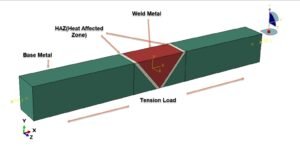
Welds are notorious for their complex geometries, residual stresses, and material microstructures, making fatigue analysis particularly challenging. Specialized approaches like the nominal stress method, structural stress method, or effective notch stress method are often employed, often with reference to codes like BS 7608 or DNVGL-RP-C203.
High-Cycle vs. Low-Cycle Fatigue
Distinguishing between HCF and LCF is crucial for selecting the appropriate analysis method. HCF (elastic stresses, >104-105 cycles) typically uses S-N curves, while LCF (plastic strains, <104 cycles) uses ε-N curves. The transition point varies by material.
Verification and Sanity Checks in Fatigue Simulation
FEA-based fatigue analysis is powerful but prone to errors if not carefully validated. Rigorous verification and sanity checks are non-negotiable.
Mesh Sensitivity and Convergence
Always perform a mesh convergence study. Ensure that refining the mesh further at critical locations does not significantly alter the predicted stresses or fatigue life. This validates that the numerical solution is stable and accurate.
Boundary Conditions and Load Application Accuracy
Review boundary conditions and load application meticulously. Even experienced engineers can misapply constraints or loads. Ask: “Does this realistically represent the component’s support and operational environment?” Simple beam bending or torsion examples can often expose fundamental errors.
Material Model Validation
Confirm that the material model used in FEA (e.g., linear elastic, elastoplastic) and the fatigue properties (S-N, ε-N curves) are appropriate for the material, temperature, and loading conditions. Discrepancies here can lead to grossly inaccurate predictions.
Comparison with Hand Calculations and Empirical Data
Whenever possible, compare FEA results for simplified cases with classical hand calculations (e.g., stress concentration factors for basic geometries). For complex scenarios, cross-referencing with published empirical data or similar past projects provides invaluable confidence. For illustrative purposes, if a component is subject to a fluctuating stress of 100 MPa and an S-N curve predicts a life of 106 cycles, ensure your simulation aligns within an acceptable tolerance, given the input parameters.
Sensitivity Studies
Perform sensitivity studies by varying key input parameters (e.g., load amplitude, material properties within their scatter bands, fillet radii). This helps understand the robustness of the design and identifies the most influential variables, guiding further design optimization or data collection efforts.
Industry-Specific Applications and Best Practices
Fatigue analysis is a cornerstone across numerous engineering domains.
Aerospace Engineering: Lightweight Structures and High Reliability
In aerospace, fatigue analysis is critical due to the high cycle counts, stringent safety requirements, and the need for lightweight materials. Components like wings, fuselage, landing gear, and engine parts are meticulously analyzed. Fracture mechanics (FFS Level 3 principles applied to crack growth) is extensively used for damage tolerance design, ensuring that even if a crack initiates, it will not grow to a critical size before inspection.
Oil & Gas: Offshore Platforms and Pipeline Integrity
Offshore structures, risers, and pipelines in the oil & gas industry are exposed to harsh environments, corrosive media, and continuous wave/current-induced fatigue loading. Here, fatigue analysis, often integrated with CFD tools (like ANSYS Fluent or OpenFOAM for flow-induced vibration), is essential. Fitness-for-Service (FFS) assessments, particularly API 579-1/ASME FFS-1 Level 3, frequently rely on detailed fracture mechanics-based fatigue crack growth predictions to determine the remaining life of components with known defects.
Automotive and Biomechanics: Dynamic Loading and Durability
Automotive components (engine blocks, suspension arms, chassis) endure complex, dynamic loads, requiring sophisticated fatigue analysis to ensure durability over millions of miles. In biomechanics, implants (e.g., hip replacements, dental implants) are subjected to repetitive physiological loading; fatigue analysis here is vital for predicting implant longevity and preventing premature failure within the human body.
Automation and Optimization in Fatigue Analysis
The efficiency and accuracy of fatigue analysis can be significantly enhanced through automation.
Scripting with Python and MATLAB for Pre/Post-Processing
Python and MATLAB are powerful tools for automating repetitive tasks in fatigue analysis workflows. Engineers can write scripts to:
- Pre-processing: Generate complex material models, define load spectra, or parameterize geometric variations for design optimization.
- Post-processing: Extract stresses/strains from FEA results files (e.g., .odb from Abaqus, .rst from ANSYS), apply fatigue theories, perform mean stress corrections, and automatically generate life contour plots or critical location reports. This reduces manual errors and accelerates design iterations.
For those looking to streamline their fatigue analysis, EngineeringDownloads.com offers a range of downloadable Python scripts and MATLAB templates designed for automating FEA post-processing and life prediction calculations.
Integrating Fatigue Analysis into CAD-CAE Workflows
Modern CAD-CAE platforms increasingly integrate fatigue analysis capabilities directly into the design environment. This allows for ‘design-for-fatigue’ iterations much earlier in the product development cycle. Parametric CAD models can be directly linked to FEA and fatigue software, enabling rapid evaluation of design changes on fatigue life and facilitating design optimization studies. This seamless integration enhances efficiency and fosters a more robust design process.
Concluding Thoughts: Ensuring Long-Term Structural Reliability
Fatigue analysis is a challenging yet indispensable aspect of engineering design, particularly for components operating under cyclic loads. By diligently applying fundamental principles, leveraging advanced simulation tools like Abaqus, ANSYS Mechanical, and MSC Nastran, and performing rigorous verification and validation, engineers can significantly enhance structural integrity and prevent costly, dangerous failures.
Mastering this discipline requires continuous learning and practical application. EngineeringDownloads.com is committed to supporting engineers with resources, including technical articles, downloadable project templates, and expert online consultancy, to deepen their understanding and practical skills in fatigue analysis and related fields.