Computational Fluid Dynamics (CFD) has long been an indispensable tool for engineers across diverse sectors, from aerospace to oil & gas and biomechanics. It allows us to simulate complex fluid behaviors, predict performance, and optimize designs before a single prototype is built. However, traditional CFD simulations can be computationally intensive, time-consuming, and require significant expertise to set up and interpret.
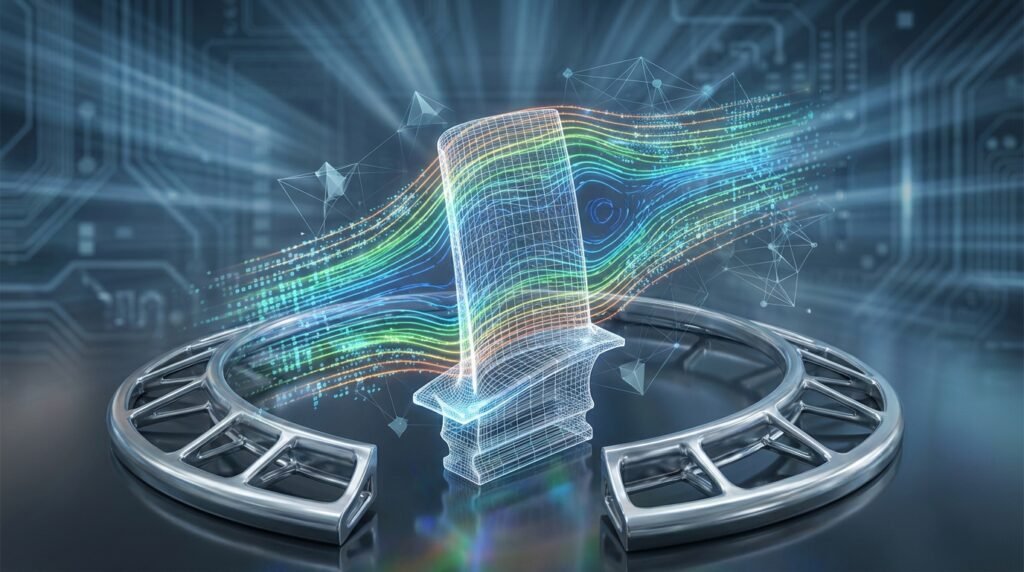
Enter Data-Driven CFD – a powerful paradigm shift that merges the rigor of classical fluid dynamics with the intelligence of machine learning (ML) and artificial intelligence (AI). This approach leverages vast datasets, whether from previous simulations, experimental measurements, or real-world sensor data, to accelerate analysis, improve accuracy, and unlock new predictive capabilities. For engineers, this means faster iterations, more informed design decisions, and the potential to tackle previously intractable problems.

Image courtesy of Glosser.ca, via Wikimedia Commons.
What is Data-Driven CFD?
Data-Driven CFD isn’t about replacing the fundamental physics; it’s about augmenting and enhancing it. At its core, it involves using machine learning algorithms to learn patterns, relationships, and surrogate models from fluid dynamics data. This data can come from various sources:
- High-fidelity CFD simulations: Results from detailed, expensive simulations.
- Experimental data: Measurements from wind tunnels, flow loops, or real-world operational sensors.
- Analytical solutions: Simplified theoretical models.
The goal is to build predictive models that can quickly approximate CFD results, optimize parameters, reduce dimensionality, or even correct errors in lower-fidelity simulations.
Why the Shift to Data-Driven Approaches?
The engineering landscape demands efficiency and accuracy. Data-Driven CFD addresses several pain points:
- Computational Cost: Traditional CFD, especially for transient, turbulent, or multiphase flows, can demand significant HPC resources. ML models can provide rapid approximations.
- Design Space Exploration: Optimizing a design often requires thousands of simulations. Surrogate models built with ML can drastically speed up this exploration.
- Uncertainty Quantification: ML can help quantify uncertainties in simulation inputs and outputs more efficiently.
- Real-time Applications: For digital twins or operational monitoring (e.g., in oil & gas pipelines or aerospace control surfaces), rapid predictions are crucial.
- Handling Complex Physics: ML can sometimes capture complex, non-linear relationships that are challenging to model explicitly.
Key Techniques and Methodologies
Several machine learning techniques form the backbone of Data-Driven CFD. Understanding these helps in selecting the right approach for your engineering problem.
1. Surrogate Modeling (Reduced Order Models – ROMs)
Surrogate models are simplified mathematical models that mimic the behavior of a more complex simulation or experiment. They are trained on a dataset of inputs and corresponding outputs and can then predict outputs for new inputs almost instantly.
- Polynomial Regression: Simple but effective for smooth, well-behaved response surfaces.
- Gaussian Process Regression (Kriging): Provides both mean prediction and uncertainty estimates, useful for design optimization and uncertainty quantification.
- Artificial Neural Networks (ANNs): Highly flexible, capable of learning complex non-linear relationships, suitable for high-dimensional problems.
- Support Vector Regression (SVR): Effective for non-linear regression problems, especially with limited data.
2. Physics-Informed Machine Learning (PIML)
PIML methods, particularly Physics-Informed Neural Networks (PINNs), integrate the governing physical equations (e.g., Navier-Stokes equations) directly into the neural network’s loss function. This means the model isn’t just learning from data but is also constrained by the underlying physics, leading to more robust and physically consistent predictions, even with sparse data.
3. Data Assimilation and Kalman Filters
These techniques combine real-time sensor data with numerical model predictions to improve the accuracy of a system’s state estimation. Critical in applications like weather forecasting, and increasingly relevant for real-time monitoring of complex industrial processes or structural integrity in harsh environments.
4. Reinforcement Learning for Flow Control
RL agents can learn optimal control strategies for fluid systems by interacting with the environment (simulation or physical). This has potential for active flow control, reducing drag, or enhancing mixing efficiency.
Practical Workflow for Data-Driven CFD
Implementing Data-Driven CFD in your engineering projects requires a structured approach. Here’s a practical workflow:
Step 1: Define the Problem and Objectives
- Clear Goals: Are you aiming for faster predictions, optimization, uncertainty quantification, or real-time monitoring?
- Scope: What fluid phenomena are you interested in? What range of parameters will your model cover?
- Data Availability: Do you have existing CFD results, experimental data, or will you need to generate it?
Step 2: Data Generation and Collection
This is often the most time-consuming step.
- High-Fidelity Simulations: If generating data, use robust CFD solvers like ANSYS Fluent/CFX or OpenFOAM. Systematically vary input parameters (e.g., inlet velocity, geometry, material properties) to cover your design space.
- Experimental Data: Ensure data quality, calibration, and appropriate instrumentation.
- Data Pre-processing: Clean, normalize, and scale your data. Handle outliers and missing values. Consider dimensionality reduction techniques if dealing with very large datasets (e.g., Proper Orthogonal Decomposition – POD).
Step 3: Model Selection and Training
- Choose an ML Algorithm: Based on your problem (regression, classification, time-series) and data characteristics. ANNs (e.g., using TensorFlow or PyTorch via Python) are versatile for complex relationships.
- Feature Engineering: Identify relevant input features that significantly influence the output. This is where engineering intuition is crucial.
- Train the Model: Split your data into training, validation, and test sets. Train the ML model to learn the underlying relationships.
- Hyperparameter Tuning: Optimize model parameters (e.g., learning rate, number of layers/neurons in an ANN) to improve performance.
Step 4: Verification & Sanity Checks
Crucial for building confidence in your data-driven model.
- Model Validation: Test the trained model on unseen data (the test set) to assess its generalization capability. Metrics like R-squared, Mean Absolute Error (MAE), or Root Mean Squared Error (RMSE) are essential.
- Physics Consistency: Does the model’s prediction make physical sense? Are there any violations of conservation laws or unphysical trends?
- Extrapolation Behavior: ML models can be poor at extrapolating outside their training data range. Test rigorously at the boundaries of your parameter space.
- Sensitivity Analysis: Understand how sensitive your model’s outputs are to changes in input parameters.
Step 5: Deployment and Integration
Once validated, integrate your data-driven model into your design or analysis workflow. This could involve using it for:
- Rapid Design Iteration: Quickly evaluate new designs.
- Optimization: Coupling with optimization algorithms to find optimal designs.
- Real-time Monitoring: Deploying the model for operational insights.
- Coupling with CAD/CAE: Automating parts of the simulation workflow, potentially via scripting in Python or MATLAB.
For more detailed scripts, templates, or expert guidance on setting up these workflows, explore the resources available on EngineeringDownloads.com, including our online consultancy services.
Tools and Technologies for Data-Driven CFD
Leveraging the right tools is essential for an effective Data-Driven CFD workflow:
| Category | Primary Tools | Typical Use Cases | Notes |
|---|---|---|---|
| CFD Solvers | ANSYS Fluent/CFX, OpenFOAM, STAR-CCM+, Abaqus (for FSI) | Generating high-fidelity data, traditional CFD validation. | Provide the ‘ground truth’ data for ML training. |
| Programming Languages | Python, MATLAB | Data processing, ML model development, scripting, automation. | Python with libraries like NumPy, SciPy, Pandas, Scikit-learn, TensorFlow, PyTorch is dominant. MATLAB is strong for engineering data analysis. |
| ML Frameworks | TensorFlow, PyTorch, Keras, Scikit-learn | Building and training neural networks and other ML models. | Offer extensive functionalities for various ML tasks. |
| Data Visualization | ParaView, Tecplot, Matplotlib, Plotly | Understanding CFD results and ML model predictions. | Crucial for insight generation and debugging. |
| Optimization & UQ | Dakota, PyMOO, OpenMDAO | Coupling ML models with optimization and uncertainty quantification algorithms. | Enhance design space exploration and robustness. |
Common Pitfalls and Troubleshooting Tips
- Insufficient or Poor Quality Data: Garbage in, garbage out. Ensure your training data is representative, accurate, and covers the relevant parameter space.
- Overfitting: Your model performs well on training data but poorly on unseen data. Use validation sets, cross-validation, regularization techniques, and simpler models when appropriate.
- Extrapolation Errors: ML models struggle outside their training domain. Always verify performance for new input ranges. If extrapolation is critical, consider PIML approaches.
- Ignoring Physics: While data-driven, a strong understanding of fluid mechanics remains vital. Use physical intuition to guide feature selection and sanity checks.
- Computational Expense of Data Generation: High-fidelity CFD runs for training data can still be costly. Consider active learning strategies to minimize the number of required simulations.
- Model Interpretability: ‘Black box’ models can be hard to trust. Techniques like SHAP or LIME can help explain model predictions.
Applications Across Engineering Disciplines
Data-Driven CFD is already making significant impacts:
- Aerospace Engineering: Rapid aerodynamic performance prediction, wing shape optimization, active flow control for drag reduction or lift enhancement. Digital twins of aircraft components for predictive maintenance.
- Oil & Gas: Real-time monitoring of pipeline flows, optimizing pump performance, predicting multiphase flow regimes, and assessing structural integrity (similar to FFS Level 3 assessments) in complex subsea environments.
- Biomechanics: Personalized medical device design (e.g., heart valves, stents), predicting blood flow patterns in aneurysms, understanding drug delivery mechanisms.
- Automotive: Aerodynamic design optimization, thermal management of battery packs, vehicle cabin climate control.
- Renewable Energy: Optimizing wind turbine blade designs, predicting wake effects in wind farms, hydrokinetic turbine efficiency.
- Manufacturing: Optimizing mixing processes in chemical reactors, cooling strategies for additive manufacturing.
These applications often benefit from integration with CAD-CAE workflows, allowing for seamless transition from design to analysis and optimization using data-driven insights.
Further Reading
For a deeper dive into the theoretical underpinnings of Physics-Informed Neural Networks, consider exploring foundational research papers.