

What is the Best FEA Software in 2025

What is the Best FEA Software in 2025 Finite Element Analysis (FEA) software has become a cornerstone of modern engineering, allowing designers to virtually test how products and structures behave under various forces and conditions. By breaking complex structures into smaller “finite” elements and simulating physical phenomena (like stress, heat, or fluid flow) on each […]
Abaqus vs ANSYS: Which Simulation Software Is Better in 2025?
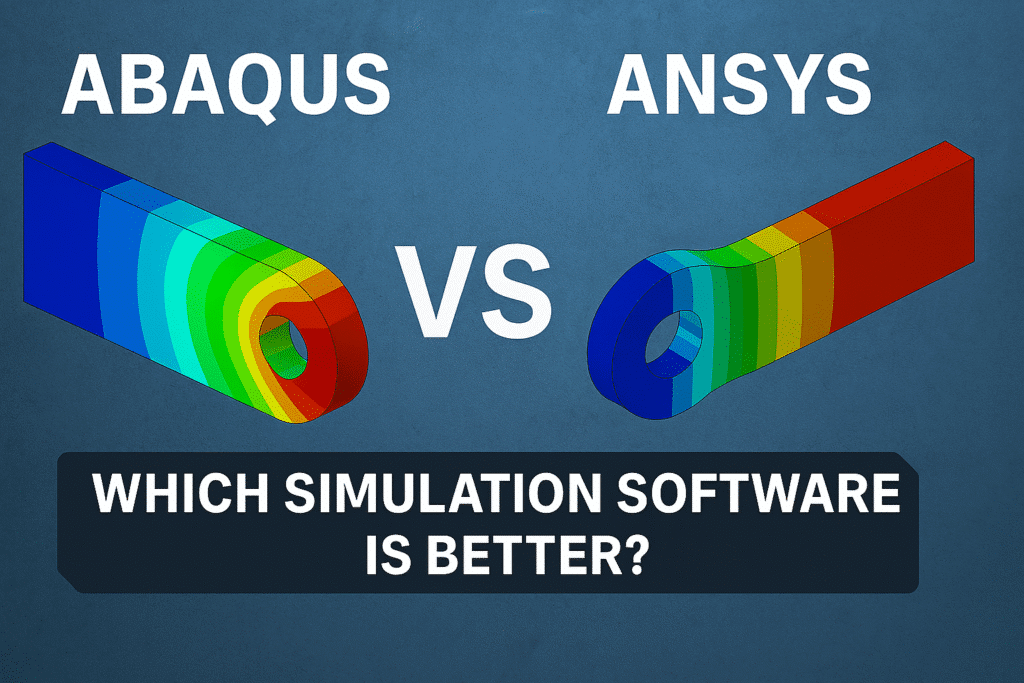
Introduction In modern engineering workflows, simulation tools are indispensable. They enable engineers to virtually test designs under various conditions, reducing the need for costly physical prototypes and accelerating innovation. Two of the leading finite element analysis (FEA) platforms are Abaqus and ANSYS, each with decades of development behind them. In 2025, these tools remain at […]
Cold Gas Spraying & Shot Peening: A clear, practical guide to simulating high-velocity impacts
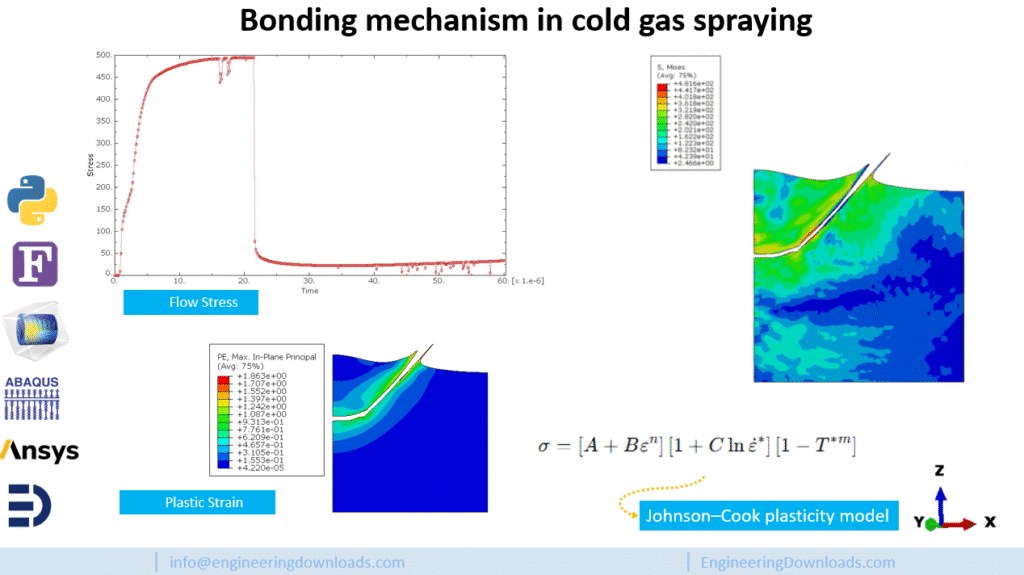
Cold gas spraying and shot peening may look different at first glance — one deposits material, the other changes the surface — but both are driven by the same physics: high-velocity impacts that create intense, highly localized plastic deformation. That makes them perfect candidates for finite-element simulation with tools like Abaqus, Ansys, COMSOL, or other […]
Large Deformation in ABAQUS via UMAT
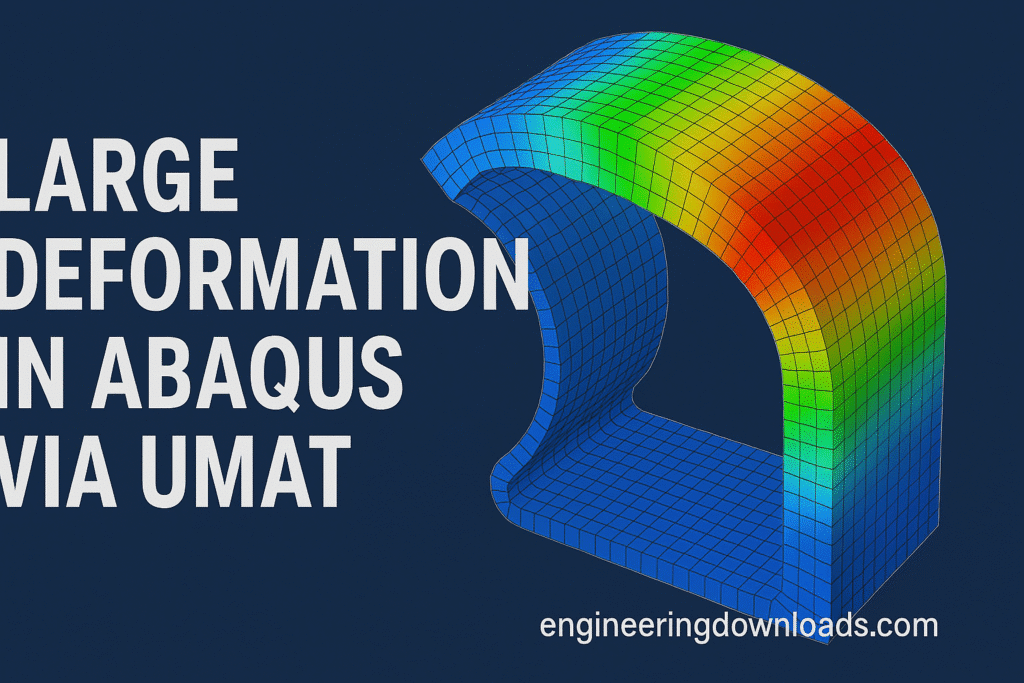
1. An Introduction to Non-Linear Continuum Mechanics Finite deformation (also called large deformation or finite strain theory) is a framework in continuum mechanics that describes the behavior of materials undergoing significant volume changes, where strains and rotations are not small. Contrary to small deformation theories, which assume infinitesimal changes, finite deformation accounts for geometric non-linearities […]
Thermal Expansion: Holding bad boys in their prison
Confession Time: I sometimes totally underestimate thermal expansion it looks so innocent on paper! 🤓 Let’s break it down: We’ve all seen that classic formula strain = ΔT × α, where α (alpha) is the material’s “how much do I expand when heated?” number. For aluminum, α is 23e-6 /°C which looks ridiculously tiny, like a […]
History of FEA Computation Time

In the past decade, processor performance has increased significantly, leading to a huge jump in computational speed. For example, the first computers, such as the ENIAC, could perform 385 multiplications per second, whereas modern processors can perform more than 11 trillion operations per second (more than 28 million times faster). In addition, computation methodologies have […]
Creep Strain vs Stress Relaxation, A practical guide for CAE users

Description Learn what creep is, how temperature and stress control creep life, and which creep models CAE tools (ANSYS, COMSOL, Abaqus and others) use. Simple equations, practical CAE workflows, ASME / code context, and industrial project examples (boilers, pressure vessels, turbines, heat exchangers). What is creep? Creep is permanent deformation that accumulates over time when […]
My FEM Software Journey: The Good, The Bad & The “Aha!” Moments

I’ve been quiet for a while, but for good reason—more on that later. Today, I’m sharing the messy, challenging, and surprisingly fulfilling path I took to learn commercial FEM software. If you’re navigating the same struggles in your FEM software journey—confusing GUIs, cryptic errors, trial-and-error modeling—you’re not alone. Phase 1: The “Click & Hope” Era […]
Which one is better? Abaqus or ANSYS?
As an engineer, we need to build a model to simulate a process so we can save many and reduce processing time. For this aim, we need to use conventional solvers such as Abaqus, ANSYS, Solidwork (I know, Solidwork solver is a joke), and etc. In this post, we are trying to explore the differences […]
